





After oscillating for over two months, Bitcoin is finally showing signs of a breakout.
Leading the charge for Bitcoin remains its old friend Michael Saylor, who has now deployed a new weapon: STRC.
Take a look at Saylor’s recent tweets, and you’ll find he’s posting content about STRC almost every day. AI-generated low-quality promotional videos featuring poolside tropical getaways and women holding cocktails send a clear message: the man who elevated MSTR to Nasdaq stardom is applying the same marketing firepower to STRC.

Why did he do this? Because STRC is currently the almost exclusive tool Strategy has to convert market funds into BTC buy orders. Over the past three months, every large BTC accumulation announced by Strategy has been funded through STRC.
What is STRC?
STRC stands for Variable Rate Series A Perpetual Stretch Preferred Stock, a perpetual preferred stock issued by Strategy and listed on Nasdaq in November last year.
Its mechanism works as follows:
You spend approximately $100 to buy one share of STRC. Strategy pays monthly cash dividends at an annualized rate of 11.5%, or about $0.96 per share per month. It has no maturity date, and Strategy is not required to repay the principal.
The share price is anchored near its $100 par value through monthly adjustments to the dividend rate: if the price falls below $100, the dividend rate is increased to attract buying pressure; if the price rises above $100, the dividend rate is decreased to bring the price back toward par. The maximum monthly adjustment to the dividend rate is 25 basis points.
Strategy can only issue new shares at par value to raise capital if the STRC stock price is above $100—this is the foundation of the entire flywheel. The proceeds from the issuance, after setting aside dividend reserves, are primarily used to purchase BTC.
Saylor named this product "Short-Duration High-Yield Credit" or "Bitcoin-Secured Money Market Fund." With U.S. Treasury yields around 3.5%, STRC offers a yield equivalent to three times that of U.S. Treasuries.
Flywheel
A common misconception about Saylor is that he is printing money indefinitely to buy BTC.
He can't do it. Saylor can't print money out of thin air—he must wait for the market to hand him the money. For each additional share of STRC issued, there must be a genuine marginal buyer willing to purchase it at $100.
Buyers of STRC are essentially entering into a credit "transaction," and the 8% higher yield offered by STRC compensates for the "Strategy Credit Risk."
However, many STRC buyers are unaware that the funds they use to purchase STRC are indirectly leveraged threefold and flow into BTC.
The strategy has a publicly stated financial target: a 33% leverage ratio.
In the company’s overall funding structure, perpetual preferred shares such as STRC, STRF, and STRK account for approximately one-third, while the remaining two-thirds come from MSTR common stock. Saylor refers to this principle as "intelligent leverage." This means that for every $1 raised by Strategy through STRC, they must issue approximately $2 in MSTR shares to maintain the 33% leverage threshold, collectively deploying $3 toward BTC purchases: $1 STRC + $2 MSTR = $3 BTC buy order.
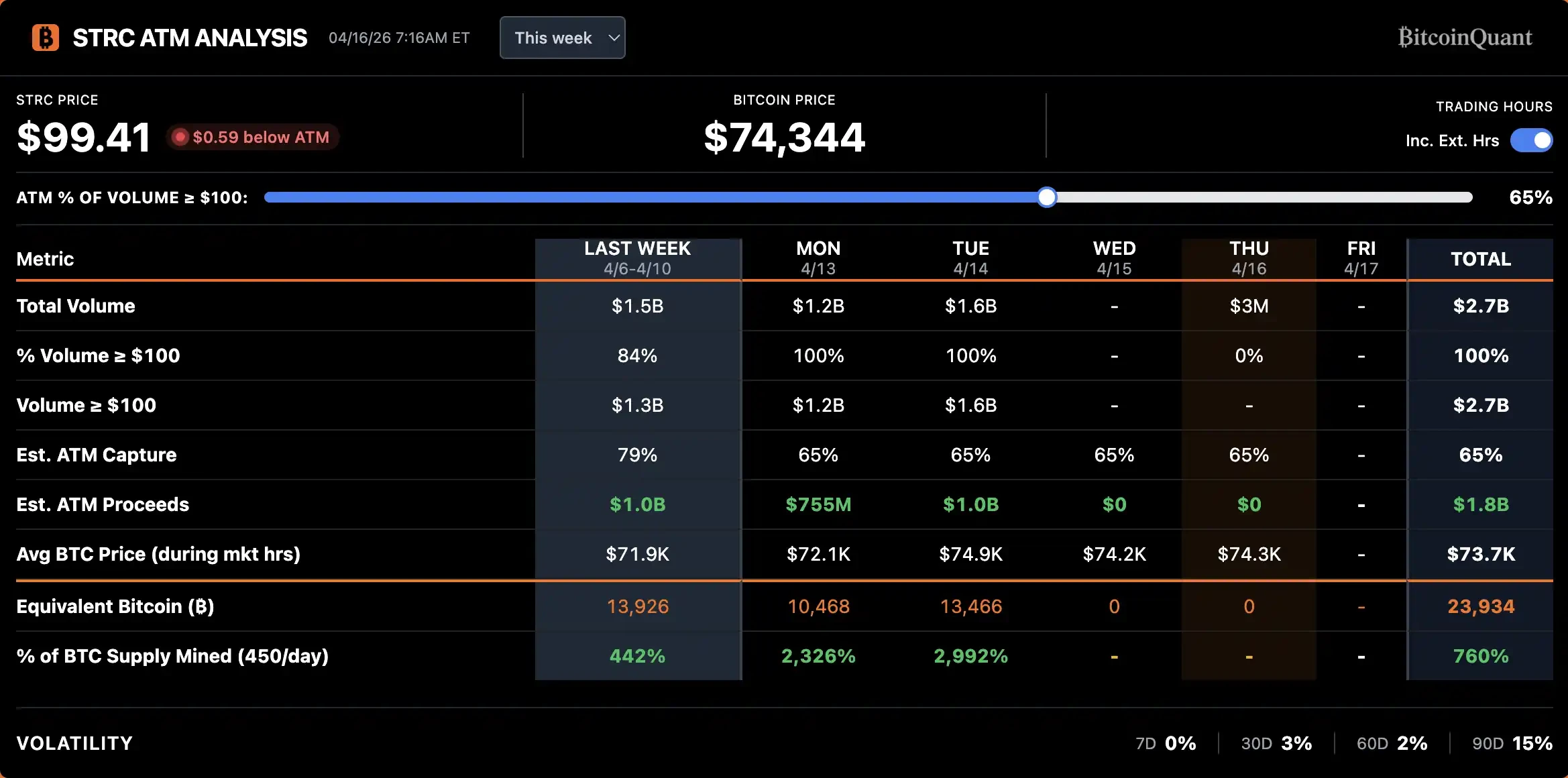
On April 14, Strategy raised approximately $1 billion in a single day through STRC. Leveraged 3x, this corresponds to about $3 billion in BTC buy pressure, precisely matching the total BTC accumulation over the two weeks prior to the dividend in April.
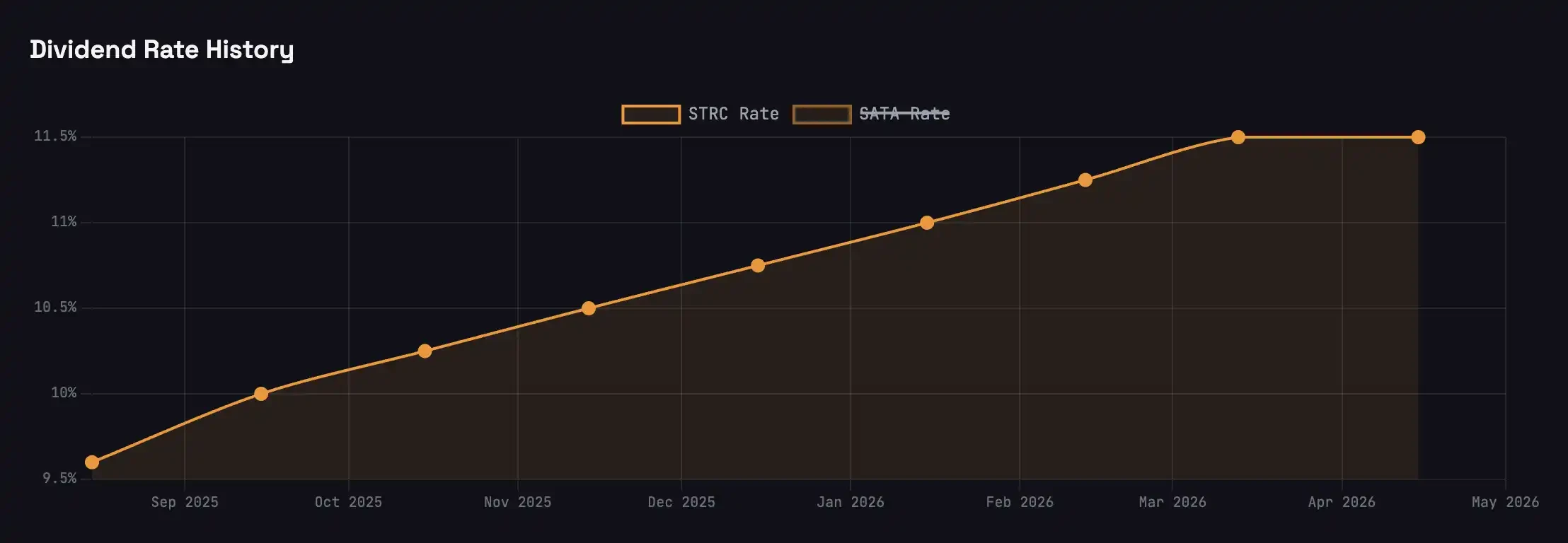
When BTC declines, collateral value shrinks, and STRC’s credit risk rises, the Strategy must increase the dividend rate to compensate for the new risk level. However, the higher the dividend rate, the greater the cash flow pressure and the higher the probability of default. This creates an unstable feedback loop. During the period last October when BTC plummeted from $120,000 to $60,000, STRC’s dividend rate had to be raised steadily from 7% to 11.5% just to barely restore buying demand.
Conversely, when BTC stabilizes and rises, collateral values increase and credit quality improves, making STRC more attractive at the same dividend rate, further amplifying demand. In April, BlackRock’s Preferred and Income Securities ETF ranked Strategy’s preferred shares as its second-largest holding, increasing its market value from approximately $200 million in March to $344 million, serving as direct institutional validation of Strategy’s current credit standing.
Strategy’s flywheel has turned positive: more capital buying STRC → Strategy buys BTC with 3x leverage → BTC price receives support → STRC’s collateral base becomes stronger and credit spreads narrow → STRC becomes more attractive at the same yield rate → more capital buys STRC.
Dividend Date Arbitrage
The dividend mechanism for preferred shares differs from that of bonds. Bonds accrue interest daily—you earn interest for each day you hold them—while preferred shares pay dividends in a single lump sum on a fixed date. For STRC, as long as you hold the shares at the close of business on the day before the ex-dividend date, you receive the full monthly dividend of 96 cents.
This creates a clear arbitrage opportunity: buy several days before the ex-dividend date, collect the dividend, and sell the next day. Data from the past few months show that STRC typically drops by an average of about 20 cents after the ex-dividend date—significantly less than the 96-cent dividend itself. The net profit per share from a single dividend arbitrage trade can reach approximately 40 to 50 cents.
Arbitrageurs won't miss this opportunity.
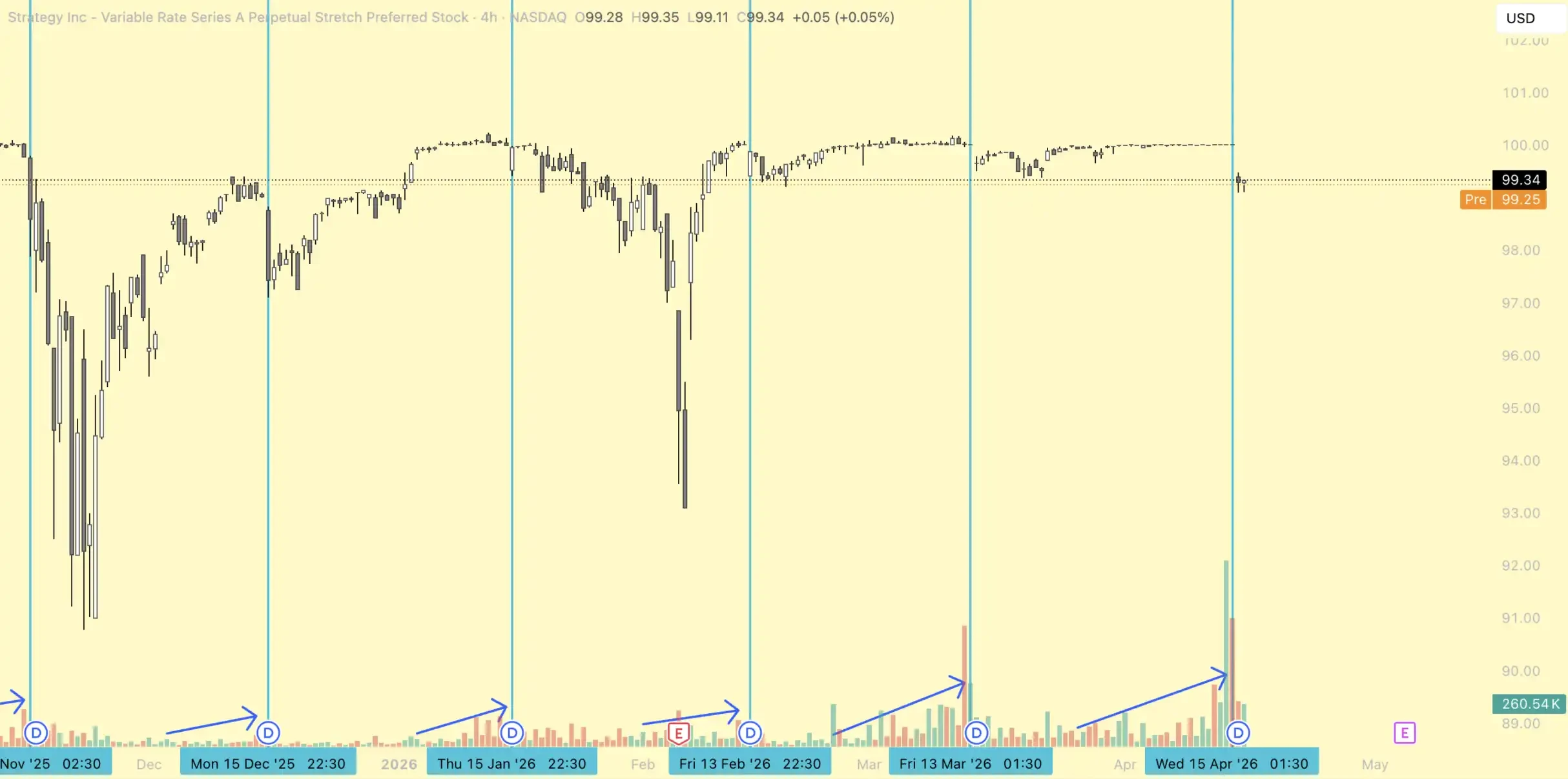
As shown, trading volume began to rise one week before the ex-dividend date, peaked on the ex-dividend date or the day before, and quickly subsided afterward. The volume surge in April was significantly steeper than in March, indicating that more capital is participating in STRC’s dividend arbitrage.
However, such arbitrage behavior may not necessarily be beneficial.
For the STRC product itself, the two to three weeks following the ex-dividend date enter a "dead zone"—characterized by reduced liquidity, widened bid-ask spreads, and prolonged trading below its $100 par value. This recurring misalignment erodes STRC’s positioning as a "money market product," pushing it toward a structure more akin to a monthly volatile bond.
For Saylor, his BTC purchases are easily front-run by arbitrage capital. The STRC token issuance is concentrated in the two weeks leading up to the ex-dividend date, meaning his BTC purchases are also concentrated during this period.
Arbitrageurs now flood in at the same time each month to buy STRC, knowing that Saylor will soon use that money to scoop up BTC on the spot market; they buy BTC in advance and sell it after Saylor drives up the price, thereby increasing Saylor’s cost of acquisition.
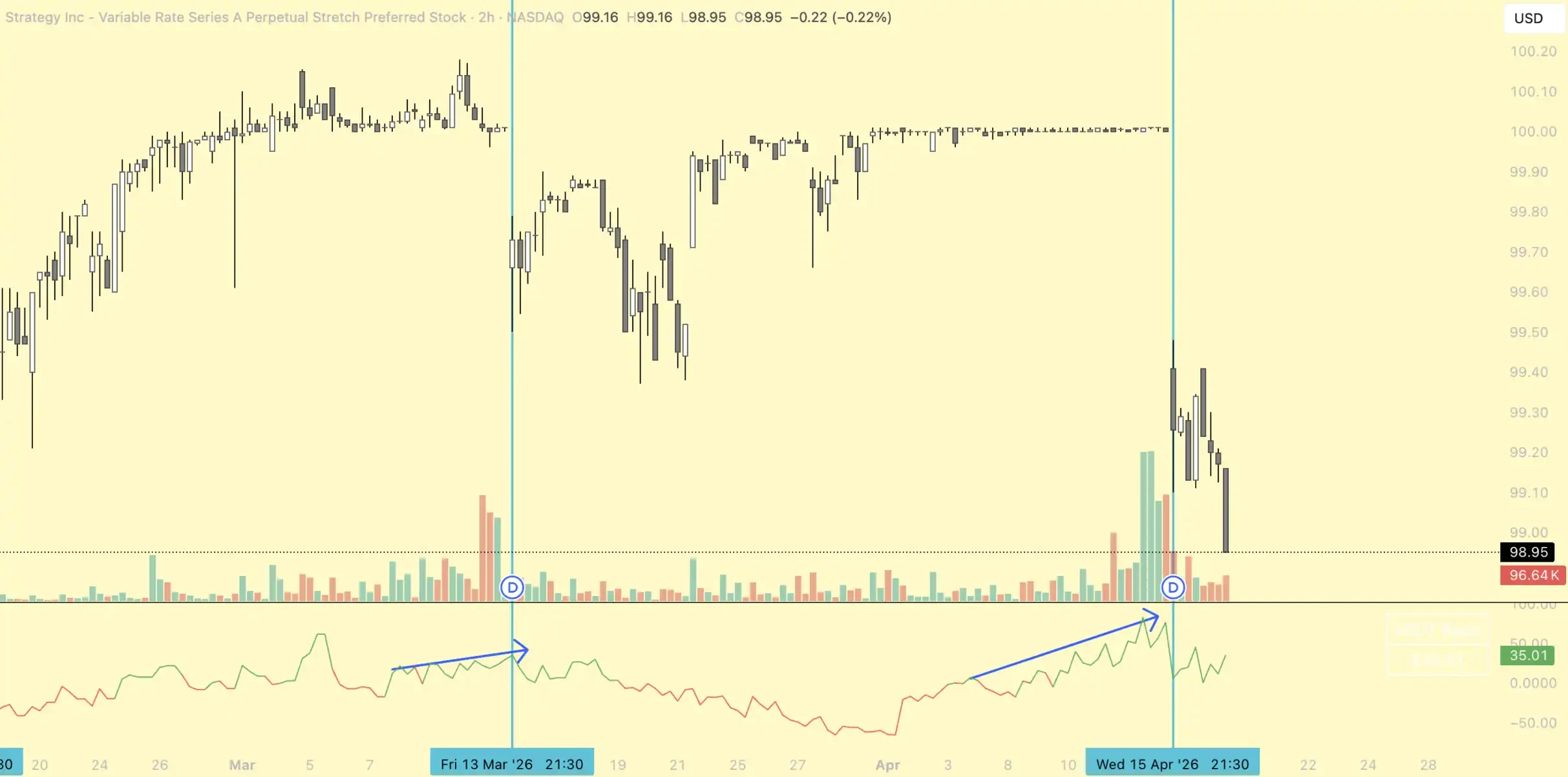
In the past two weeks, the Coinbase spot premium for STRC around the ex-dividend date has significantly increased.
There are two possible solutions: adjust the dividend frequency, such as changing from monthly to weekly, to distribute arbitrage profits; or launch a more basic derivative product with more frequent dividends to disperse concentrated arbitrage trading.
Indeed, Saylor acted swiftly, announcing on Saturday that Strategy filed a proxy statement proposing to change the dividend payment frequency for STRC from monthly to biweekly, while maintaining the annual dividend obligation and dividend rate.
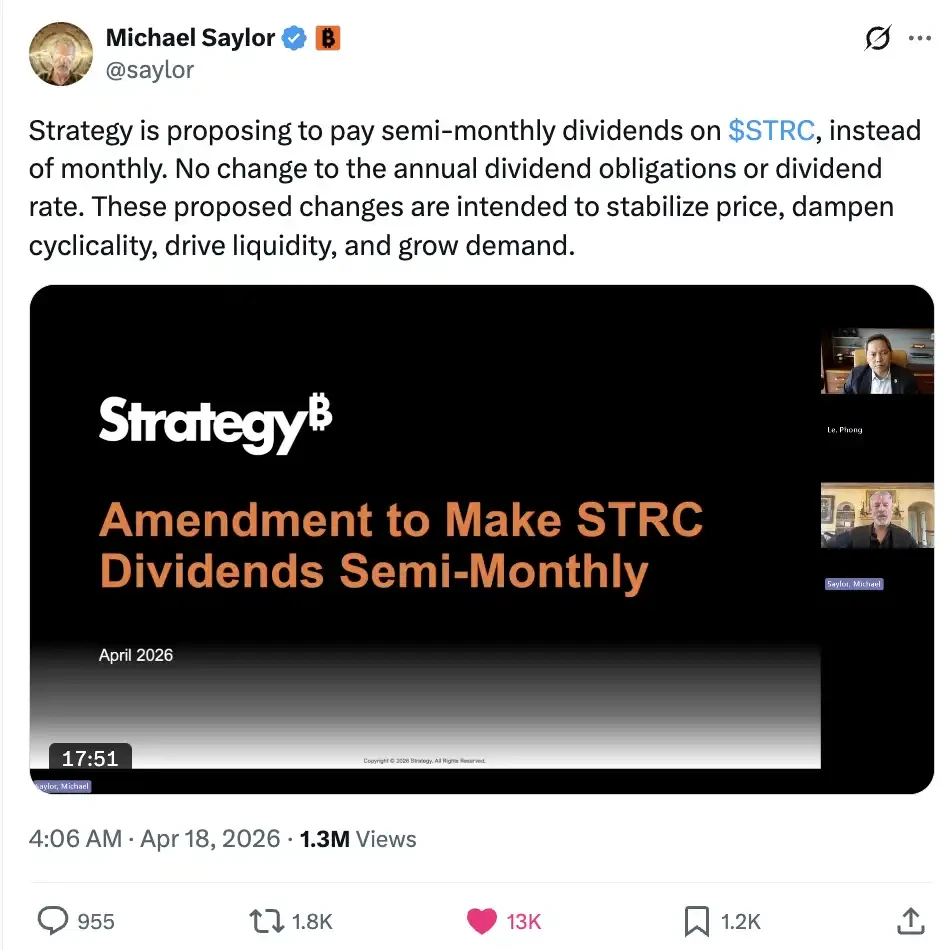
If this proposal is approved, the first biweekly dividend will be distributed on July 15.
Bitwise advisor Jeff Park noted that there are currently no corporate bonds that pay dividends biweekly, and retail investors' preference for more frequent payments has been validated by the success of products such as weekly dividend ETFs.
On a deeper level, Jeff Park views this as a landmark step in the crypto industry’s vision of “streaming payments” infiltrating traditional capital markets: the frequency of interest payments essentially reflects the efficiency with which monetary potential energy is converted into kinetic energy, and the era of digital currency should transcend artificially imposed time cycles.
He believes STRC has set a new benchmark for traditional enterprises and looks forward to its evolution toward biweekly, daily, and even instant payments.
The new narrative in DeFi
The emergence of STRC has brought fresh vitality to the stagnant DeFi market.
Over the past year, yield on DeFi stablecoins has been steadily declining. Stablecoin deposits on Aave yield around 2% annually, while USDe on Ethena and USDS on Sky both remain below 4%, and even the PTs of major stablecoins on Pendle struggle to exceed 6%. At this yield level, the risk exposure of smart contracts in the AI era has discouraged many seasoned DeFi participants.
DeFi needs a trustworthy, sufficiently large source of yield to bring TradFi capital back on-chain, and STRC provides exactly that opportunity.
Two projects are attempting to package STRC’s yields on-chain:
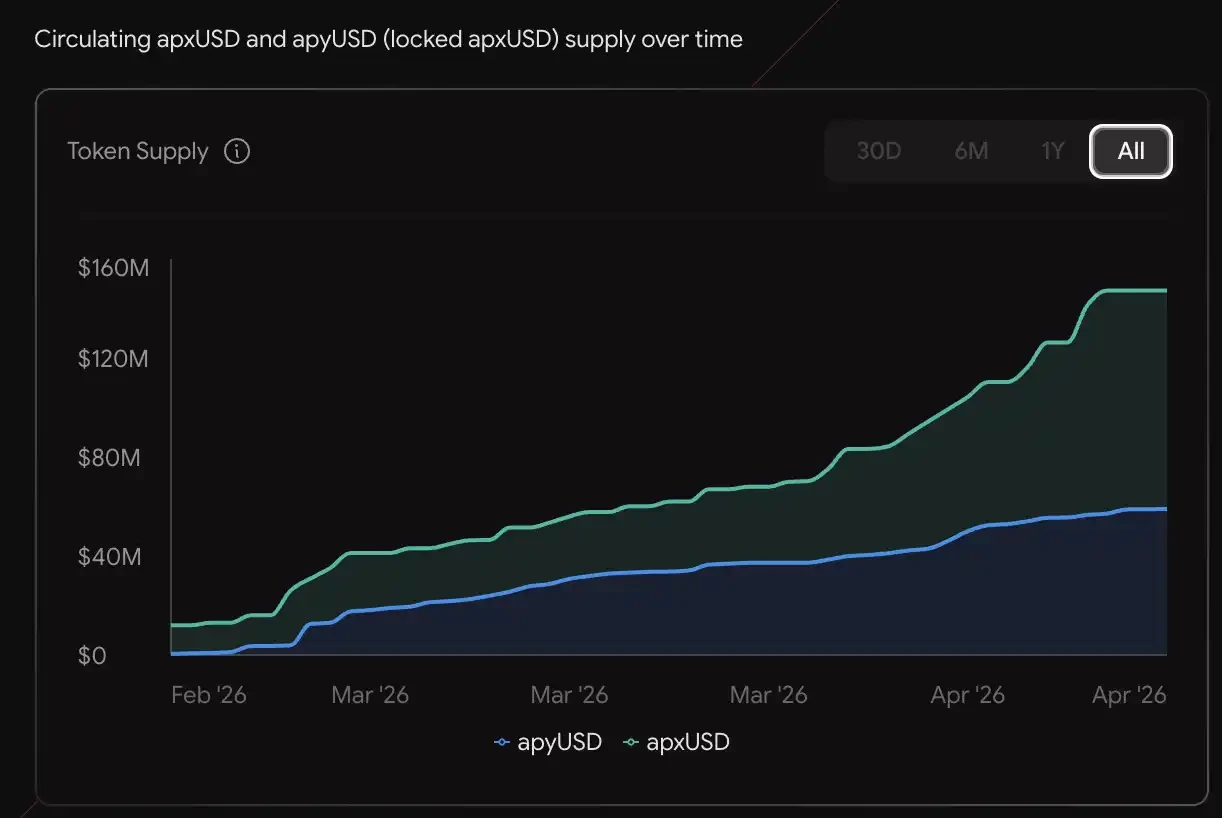
The Apyx Protocol employs a dual-token model. apxUSD is the base stablecoin, overcollateralized by preferred shares such as STRC and SATA, along with U.S. Treasuries; apyUSD is the staked version that captures underlying dividend and interest income, currently offering an annualized yield of approximately 12.78%. The total supply has reached $130 million, with corresponding yield and leverage products already available on Pendle and Morpho.
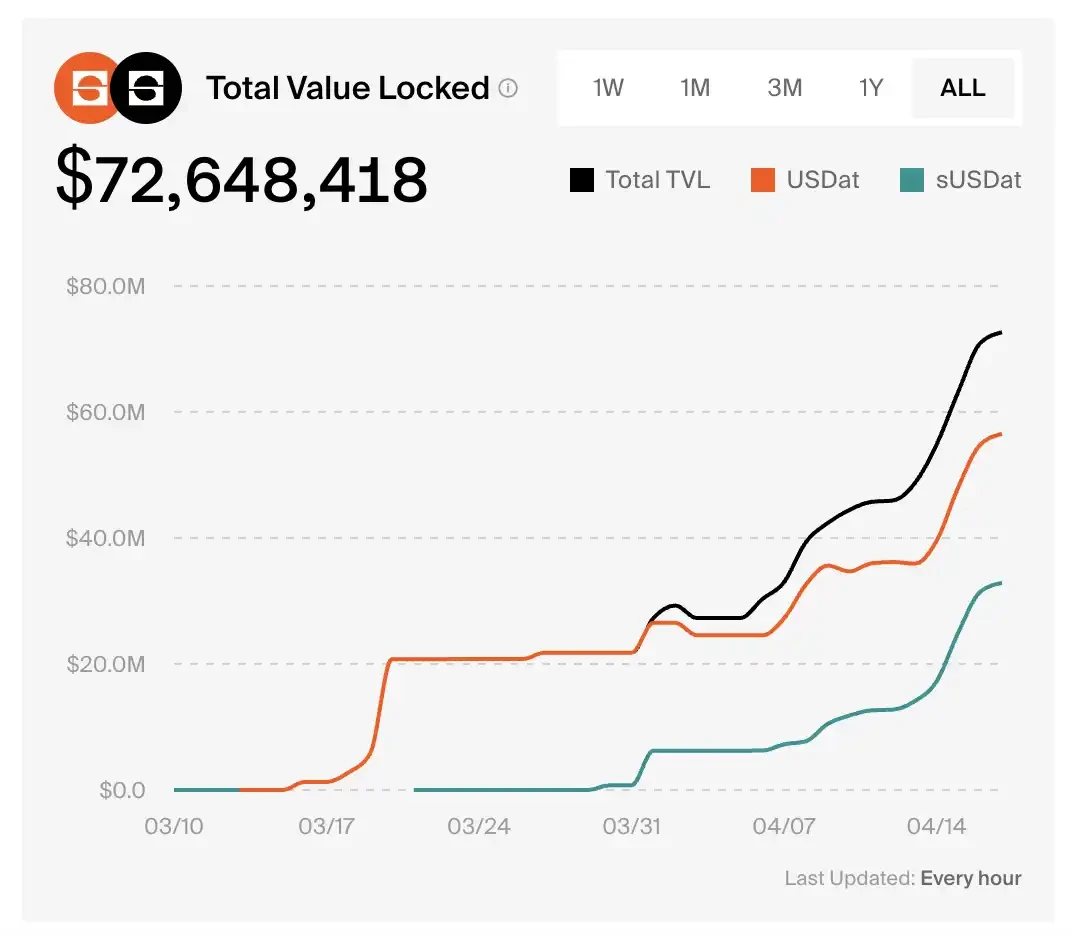
Saturn Credit's sUSDat is a staking-based interest-bearing stablecoin that accrues STRC yields, with the protocol's TVL surging from zero to $72.6 million in just over a month.
According to Pendle market data, the current annualized yield for PT-sUSDat is 9.2%.
Success also comes from Xiao He
The more successfully Saylor’s carefully designed financial machine operates, the harder it becomes to ignore this question.
The strategy currently holds nearly 3.5% of the total BTC supply and continues to increase at a rate of billions of dollars per month.
What was BTC's original value proposition? A decentralized monetary asset that does not rely on any single entity and cannot be manipulated by anyone unilaterally.
When the perpetual preferred stock of a publicly traded company becomes the primary marginal buyer of BTC—a decentralized, entity-independent currency asset that no single party can manipulate unilaterally—is Bitcoin straying from its original form?