





Author: Wanxiang Blockchain
From April 20 to 23, the 2026 Hong Kong Web3 Carnival, co-hosted by the Wanxiang Blockchain Lab and HashKey Group, was successfully held at the Hong Kong Convention and Exhibition Centre. On April 21, on Stage 1 · Wind, Alven Lin, Partner in FinTech and Blockchain at Summer Capital, moderated a panel discussion with Ben Zhai, CEO of Robo.ai; Chan Kin-chau, Executive Director of Hong Kong Robot Group; and Sun Zexuan, CTO of the AI Hardware Division at Dreame Technology. The panel explored the topic “From Selling Products to Selling Services: Exploring Subscription Economies and Assetization in Smart Hardware.” The following text is compiled from the live discussion, with minor edits for clarity that do not affect the original meaning.
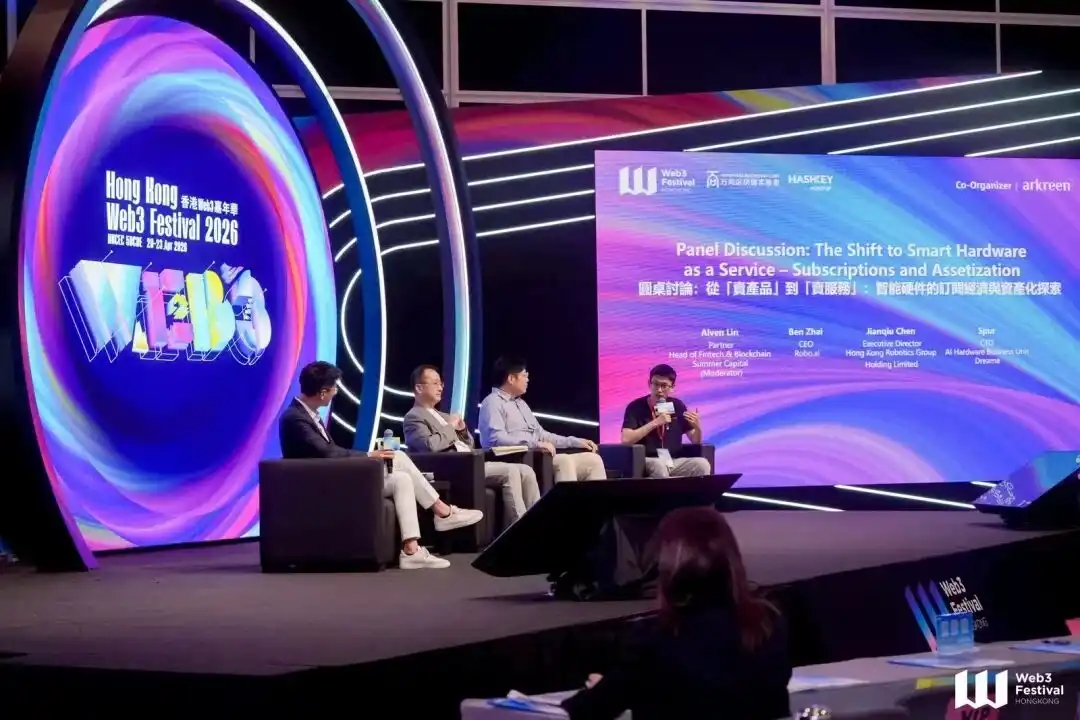
Alvin: Welcome to the Hong Kong Web3 Carnival. I’m Alvin, your host for this panel and a partner at Summer Capital, focusing on finance and blockchain. Summer Capital is a multi-strategy investment firm based in Hong Kong that has been active in the crypto market since 2017. We are also one of the primary investors and founders of Solana Company, the second-largest DAT company on Solana, and earlier today we co-hosted an event here. Today, we’re honored to have three distinguished guests from the smart hardware industry to discuss subscription-based business models in smart hardware and potential growth opportunities. Let’s begin with brief introductions from each of our panelists.
Ben: My name is Ben, and I’m from a company headquartered in Dubai that’s listed on Nasdaq. Since our listing, we’ve undergone several transformations, particularly over the past couple of years—transformations that align closely with today’s theme and the conference’s focus. I’ll share more details with you later. Our company is called Robo.ai.
Chen Jianqiu: Hello everyone, I’m Chen Jianqiu from Gangzi Robotics. Gangzi Robotics primarily provides end-to-end robotic solutions, covering the entire value chain from product development and scenario expansion to operational services and subsequent RWA asset tokenization. I’ll share more details with you shortly. Thank you.
Sun Zexuan: Hello everyone, my name is Sun Zexuan (Spur), and I’m from Dreame Tech. Dreame Tech primarily focuses on robotic vacuum cleaners. Previously, I worked as a researcher at the Blockchain Laboratory of Institut Polytechnique de Paris, where I successfully launched a rocket during my time in France. I am now the technical lead of the AI Hardware department, with expertise in both AI hardware and blockchain. Today, I’m excited to share some insights with you—all thanks.
Alven: Thank you to our three guests for your introductions. Today, our guests bring highly diverse backgrounds—ranging from robotics and AI to B2B hardware sales experience and extensive consumer product lines. Subscription-based business models for hardware are relatively common in the software industry, typically referred to as SaaS. However, this model is not as widespread in the hardware sector. Nevertheless, some innovative approaches have emerged, such as battery swap services offered by certain electric vehicles, which essentially function as a hardware subscription model. Still, not all hardware devices commonly adopt this subscription approach.
Today, I’d like to discuss the following topics with our three guests: past experiences and challenges in smart hardware sales; exploration and reflection on transitioning from selling products to selling services; practical applications of assetization and RWA under hardware subscription models; and emerging trends in the hardware industry driven by current AI models. Let’s begin with the topic most familiar to everyone: hardware sales. Your companies have extensive experience selling products to both B2B and B2C markets, covering robots, drones, and a wide range of consumer products. In this process, I’d like to ask each of you to share your successful experiences or key challenges in traditional hardware sales—and whether these challenges have gradually pushed you toward transitioning to a services-based model. Jianqiu, please begin.
Chen Jianqiu: Okay, thank you, Alven. From the perspective of selling services, this is currently a very rigid demand. There is still a significant gap between existing robotic products and actual user services. We’ve engaged with many B2B clients who truly want to solve specific operational problems—such as deploying robots for patrolling or providing health guidance. What they’re seeking is service; the product is merely a tool to enable that service. However, the gap remains substantial. Clients may approach robot manufacturers, but manufacturers are often unwilling to provide services—they’re only interested in selling products. To address this, we’ve conducted extensive exploration, including developing our own cloud-based AI brain, specifically designed to support operators. This requires service personnel to assist site operators in implementing these functionalities.
There’s an interesting point here: it’s difficult to educate customers to become robotics experts. However, we can build an operational platform where the operator masters the required knowledge and tools, directly empowering the end users. The ultimate outcome of this service is simply cost reduction and efficiency improvement—both of which generate direct economic value. Once economic benefits are achieved, many other issues, such as product pricing, naturally resolve themselves. That’s essentially it—thank you.
Ben: Over the past many years, I’ve been involved in founding several companies with subscription-based elements. The earliest subscription or SaaS model essentially began with Salesforce at the end of the 1990s. At that time, Salesforce was achieving tremendous success in the U.S. capital markets, and everyone began to see the SaaS model as incredibly popular. Later, this model gradually expanded from software services to hardware and other industries. As the host mentioned, I was also fortunate to be involved in founding several new energy vehicle companies in China over a decade ago—one of which became highly influential and introduced a fairly revolutionary innovation across the entire automotive industry. Today, new energy vehicles account for half of all new vehicle sales annually in mainland China. But back twelve or thirteen years ago, people had strong fears about new energy vehicles due to range anxiety and safety concerns.
Our founder, Mr. Li Bin of NIO, responded to users’ concerns with a highly innovative initiative: separating the vehicle from the battery, since the battery accounts for approximately 40% of the total cost. To alleviate anxieties around range, safety, and long-term value depreciation, he created an entirely new model called BaaS. Just as SaaS stands for Software as a Service, Mr. Li introduced BaaS—Battery as a Service. This model represents one of the first instances of a subscription-based approach applied to large-scale intelligent equipment.
I previously worked for another new energy vehicle company that later went public on Nasdaq, and at the time, it claimed to be a true subscription-based service model. So, over a decade ago, several companies had already begun experimenting with this approach, though many challenges remained—I’m sure the host will mention them later. Personally, I feel that whether it’s subscription models, BaaS, SaaS, or the future blockchain integration of smart devices, they’re essentially all quite similar at their core: the fundamental goal is to lower user barriers to entry, reduce heavy capital investment, and maintain steady cash flow. The underlying idea is the same; it’s just that the products we’re now addressing have become increasingly diverse. Let’s now hear from Dreame and the other panelists.
Alven: Now, in the smart home appliances and smart hardware devices sector, Dreame has become one of the top companies in China and even globally in terms of shipment volume. Could you share what your most successful experiences have been? In terms of selling across so many product lines and international distribution channels, what have been your key successes? And what challenges do you anticipate facing?
Sun Zexuan: Actually, I’m from the Dreame AI Hardware team, and our main product right now is the Dreame AI Ring. So today, I’ll primarily address your questions around the topic of subscriptions.
Currently, in the AI ring market, Oura Ring is the market leader, with a business model primarily based on subscriptions, serving approximately 2 million subscribers. This indirectly demonstrates that Oura is essentially a software company rather than a hardware company. Our strategy for the Dreame AI Ring is to offer users free basic services through a one-time purchase model, targeting Oura’s fully subscription-based competitors. We aim to rapidly attract price-sensitive users and those who dislike subscriptions, particularly in the Chinese market.
In the long term, the overall value of AI hardware is expected to stabilize. Therefore, the sustained value of AI-enhanced services, combined with high-quality data, continues to grow. Our outlook for the future is clear: the future will belong to business models built on AI services. As for why Mijia iterates so quickly, it’s primarily due to Mr. Yu’s strategic vision and broad perspective—he has instilled greater momentum in every entrepreneur, every BU leader, and every product manager, giving us more opportunities for innovation. That’s why our iteration speed is so strong. That’s about it.
Alven: Great, thank you to Spur for the insights. Based on the presentations from the three speakers, you may have noticed that hardware sales and subscription models are not mutually exclusive. In many cases, acquiring customers through hardware sales is the most fundamental service approach, while subscription models help enhance user retention and extend the customer’s paid lifecycle.
Sun Zexuan: Let me add to our strategy. We use high-value hardware as an entry point to acquire high-quality data and build long-term relationships and trust with users. In the future, we will leverage cutting-edge AI and high-quality data to develop deeply personalized SaaS services that users are willing to pay for continuously. We are also advancing primarily through software.
Alven: Understood. In this process, hardware subscription is essentially integrated with hardware sales. Compared to traditional pure software subscriptions, what are the subtle operational differences in this model? What do you think is the barrier to entry for users when purchasing this subscription service? Or, what ultimately motivates users? What challenges have you encountered?
Sun Zexuan: I’ll still use our AI ring as an example, since it’s our current core business. Our AI ring was launched in October 2025 and appeared on the CCTV Spring Festival Gala in 2026. After AWE 2026, we received orders worth 100 million RMB, with monthly sales ranging between 5 million and 10 million RMB, and we are currently expanding into overseas markets.
Our mission and vision are: I believe the ring is the ideal entry point for a sensor. In the future, we aim to build the next-generation AI interaction interface. A ring has the advantage of possessing precise bodily data sensing capabilities. Second, it can integrate AI and offer powerful AI interaction abilities that understand users. Given these strengths, it serves as an excellent sensor and entry point. As a result, more users are willing to adopt such a device, interact with it, and access their personal health data to better serve themselves.
Chen Jianqiu: Actually, our use cases also have some differences because our products have higher value. For example, the charging patrol robots we currently develop cost anywhere from several hundred thousand to over a million yuan per unit. Many customers feel the initial installation cost is too high, potentially requiring investments of hundreds of millions of yuan. Therefore, we carefully consider this aspect. Our goal is to serve operators effectively. In addition to the cloud-based “brain” mentioned earlier, we are also exploring all-in-one operational services, including operational platforms and personnel. Furthermore, we are actively exploring a dedicated niche in the robotics field: RWA (Real-World Assets). We have already launched the world’s first RWA platform for robots and will soon roll out the first robotic RWA project. This approach helps project owners transition from a one-time purchase model to a subscription-based, monthly payment model. From a first-principles perspective, people are more accustomed to paying monthly fees—for instance, in the future, the largest application market may be robotic caregivers, where users would prefer paying a few thousand yuan per month for service rather than spending hundreds of thousands upfront to buy the robot outright. Therefore, subscription models make it easier for high-value robots to enter countless households.
Ben: Just now, Mr. Merlin introduced their product called Arkreen. This company is also a Singapore-based blockchain firm in which we and Hash Global have jointly invested. I can use our reasons for investing in Arkreen to address the question you just raised. You mentioned cars costing $300,000 to $600,000, with batteries accounting for 40% of the cost—remove that 40%, and the barrier to entry drops significantly. Your robots are also expensive, often costing hundreds of thousands of dollars. In contrast, Arkreen’s individual product is not costly—perhaps around $500. However, they are now considering deploying it in Africa, where $500 is still a substantial amount for local businesses or end users. So, in a sense, whether it’s SaaS, BaaS, or the future RaaS model for robots, the ultimate goal is always to lower barriers to entry. If now you could charge for one minute with just a penny, or for half an hour with ten cents, this approach would greatly reduce both the regular and emergency usage thresholds. Although SaaS or subscription models have existed for nearly thirty years, I believe that as services, hardware, software, AI, and various robots and new products continue to emerge—especially in new contexts where users are unfamiliar with the products and uncertain about their safety and durability—the subscription model or its variants remain an excellent approach. This also connects in some way to the next step of tokenization—tokenization essentially means breaking down large things into smaller pieces.
Alven: Yes, so the speakers have also introduced another topic, which is something I’d like to ask about and discuss with everyone: When subscription models introduce new cash flow mechanisms, how can these assets be capitalized—even leveraged into the currently popular concept in Hong Kong’s Web3 space: tokenization, or RWA (Real-World Assets). I’ve noticed there’s been significant discussion on this at this conference. How have you structured your overall RWA architecture? From legal frameworks to sales and user-facing platforms, could each of you share from your perspective what explorations or practical initiatives you’re currently undertaking? Legal structure is one aspect—how assets are securitized, then tokenized; after tokenization, how do you enable interaction with existing crypto-native DeFi protocols and the broader community? What lessons or insights can you share from your experiences?
Ben: Let me use Arkreen, which we invested in last year, as an example. When we went public in 2021, we listed on Nasdaq under the concepts of new energy vehicles and smart cars, and since then, we’ve undergone several adjustments. In fact, last year we recognized that the integration of intelligent assets and smart assets represents a highly viable path forward. Therefore, since last year, we’ve made various investments and experiments in blockchain companies, DePIN firms, and the tokenization of smart hardware.
I’ve always said that our investment in Arkreen serves as our ticket, or rather, our tuition fee and advertising cost, to enter Web3, blockchain, and digital currencies—as a Nasdaq-listed company that evolved from traditional new energy vehicles. Last year, beyond investing in Arkreen, we also attempted to transform our original new energy vehicles into smart vehicles, then into autonomous vehicles, and further extended this to other unmanned and intelligent equipment. Last year in Dubai, we announced Robo.ai, claiming it as the first smart vehicle equipped with a digital wallet and a digital identity. These digital wallet and digital identity features correspond to each device having its own unique identifier. We are currently collaborating with Arkreen and other partners to explore how all future autonomous vehicles and robots can become devices with independent digital wallets and digital identities. As peer-to-peer payments gradually shift toward machine-to-machine payments, how do we accelerate the realization of the so-called “machine economy”? I believe this is not far off. Therefore, we are making various attempts, and today, I also hope to use this opportunity to find more partners.
When it comes to the concept of RWA, this term has actually been around for four to five, even six years. Initially, it primarily referred to real estate projects. But today, after attending the Hong Kong Web3 Festival over these past two days, I sense a significant shift—compared to last year, although our scale this year may have been slightly smaller due to various factors, there is clearly much greater emphasis on hardware and real-world assets. Last year, 90% of the discussions still revolved around the traditional model. But this year, look: our very first keynote speaker was the CEO of Lotus, a traditional automotive manufacturer. While I don’t believe the content he presented represents substantial innovation in Web3, simply inviting him as the opening guest sends a powerful signal: the industry is moving from the virtual world, digital assets, and smart assets toward integration with real-world assets.
Alven: Great, thank you. General Jianqiu, do you have any insights to share regarding your product and your RWA segment?
Chen Jianqiu: Alright. RWA is indeed very popular right now and is a major topic at this conference. Currently, RWA primarily exists as a financial instrument, and its core still depends on the quality of the underlying assets. In the early stages, real estate-related RWA returns may not be particularly high, but as robotics technology and products mature, the returns and reach of robotics will continue to expand.
Let me give an example using one of our main current projects: destination charging. We deploy mobile charging robots—charging vehicles—in the underground parking lots of residential communities and office buildings. This is actually an excellent case study. From the user side, we can integrate with stablecoins to allow users to pay for electricity using stablecoins. On the RWA side, once users purchase shares in the robots, when their stablecoins enter the smart contract, the corresponding earnings are automatically distributed to them in proportion to their shareholdings. The entire process can be fully transparent and represents a naturally aligned integration.
Second, our robotic products themselves generate significant cash flow. We’ve calculated that the return on investment is actually very high. We also offer operational services and cloud-brain services, with all data encrypted on-chain—this is precisely the direction we’re exploring in collaboration with Arkreen. This includes data from the charging process, which can all be recorded on-chain. This represents a compelling intersection between robotics and Web3. We’re not limited to our own products; in the future, we welcome partners like Ben and Dreame to join us in exploring the robotics RWA space. We also encourage more on-site partners to engage in further discussions—thank you.
Alven: I’d like to ask if Dreame has any initiatives or explorations in the Web3 space? How do you view the potential of RWA within the subscription economy model, or the possibilities of RWA in general?
Sun Zexuan: Our division is not currently focused much on hardware assetization; we are primarily concentrating on data assetization and data privacy. However, I believe it’s worth considering whether hardware that is tightly coupled with data could be converted into RWA in the future. That’s about it.
Alven: Yes. Just now, I felt that the convenience blockchain brings to assets isn’t just about transparency, but also fairness and accessibility. Moreover, a wide range of data can be recorded on-chain, making data flow clearer and data sovereignty more complete. Additionally, in the Web3 space, there’s a unique economic model called token incentives—many Web3 projects use tokens to incentivize user behavior. If hardware subscriptions represent a form of long-term user payment, could a combination of “incentives + user subscriptions” create a flywheel effect in this space? For instance, users actively provide usage feedback and on-chain data, and in return, receive incentives that unlock more advanced services and products. Do you think this mechanism is feasible?
Sun Zexuan: I think it’s highly feasible. I believe the two greatest areas of synergy between AI hardware and blockchain are trust and incentives. Regarding trust, we aim to protect users’ private data through privacy-preserving computation enabled by blockchain cryptography—this is the first point. The second is tokenomics, which can be understood domestically as loyalty points. Since the AI ring can continuously monitor users’ physiological data—including sleep patterns, heart rate, and activity levels—we intend to reward users with tokens when they engage in positive behaviors. In the future, these tokens can be used to offset subscription fees, granting access to more advanced AI-enhanced services. Thus, there is a strong connection and alignment between tokenomics, blockchain, and fintech. I strongly believe that blockchain and Web3 are supported by two key technological pillars: cryptography and fintech. Together, these will drive the advancement of Web3 and accelerate the overall efficiency of human systems.
Alven: Okay, thank you. What do you think, General Jianqiu?
Chen Jianqiu: Actually, this is quite fascinating. Incentives can encourage our users to engage more deeply with the ecosystem. For example, in the health sector, users can upload more data—this not only helps them maintain more comprehensive health records, but also enables our institution to train better models. In the robotics business, incentives can drive more users to participate in the robotics ecosystem, fostering human-robot coexistence. For instance, during charging, users might need to plug in or unplug the charger; by actively participating in these actions, they can earn Token rewards, which they can then use for their own charging sessions.
On the other hand, when a bot encounters temporary issues, user assistance can help integrate them into the ecosystem, thereby reducing our operational and maintenance costs. This is therefore an excellent technical and behavioral model.
Ben: I think there’s a paradox inherent in subscription models, tokenization, and the lowered barriers we just mentioned. What is this paradox? On one hand, tokenization, SaaS, and BaaS models lower barriers and fragment value; on the other hand, to truly leverage these models effectively, the barriers are actually higher.
I once had the privilege of serving as the chairman of the NIO User Trust for several years. NIO excels in user service, resulting in exceptionally high user retention. Nearly 70% of NIO’s new car buyers are referred by existing users—a figure that is hard to imagine in the automotive industry. However, achieving this requires tremendous effort. I believe that all subscription-based, tokenization, value-disaggregation, or SaaS models face three key barriers:
First, capital. You need a massive amount of capital investment.
Second, consistency. I need to have a consistent experience in order to renew my subscription—whether it’s next month or next year.
Third, trust. As Midea just mentioned, for service providers or hardware providers, this is our commitment. What I’m doing isn’t a one-time transaction.
A true moat can only be built when all three conditions—capital, consistency, and commitment—are met. Otherwise, if the moat is poorly constructed, you risk being overwhelmed very quickly. So I don’t think this is simple. Whether it’s Web3 logic or blockchain logic, when you return to fundamentals, it’s not much different from traditional business. At its core, it’s still about human nature.
Alven: Yes, I believe that the next phase of Web3’s development must return to the fundamental principles of traditional business. Token economy design shouldn’t be viewed purely as the utility tokens or incentive tokens we discussed earlier—it must instead focus on how to empower projects or companies to create value and foster user loyalty during service delivery. Several speakers have repeatedly mentioned one term: AI. The progress of AI over the past few years has been undeniable—foundational large models, embodied intelligence, emerging world models, and the integration of AI with crypto are all widely discussed. I’d like to ask each of you: What is the current state of your company’s AI initiatives or product lines? In the age of AI, how do you see it significantly transforming your existing hardware, products, or services? And are you also facing substantial challenges that require transformation and adaptation? In this process, will AI change users’ subscription habits and behaviors?
Ben: We changed our listed company name to Robo.ai in August last year. I believe this was a very meaningful decision—a signal—that we made in moving away from being a traditional new energy vehicle listed company. But your latter question is even more important. After the name change, we restructured our business model, team, and board. What remained? What remained was a true return to the essence of business: real cash flow, real revenue, real profits, a genuine team, and our own proprietary technology. For us, the challenges have been immense. That’s precisely why I’m eager to seize this opportunity to collaborate with partners here like Hongzi Robotics and Dreame. In fact, last year Dreame was also considering entering the automotive space and reached out to me—their CEO visited Dubai multiple times. I hope, through this platform, we can establish deep, practical, and actionable collaborations with everyone. I also want to thank Arkreen for providing this platform—it’s essentially given our company a small but valuable promotion. Thank you.
Chen Jianqiu: AI has been incredibly popular in recent years, with technology evolving rapidly. The term I’ve heard most this year is probably “agent.” We have several strategic areas: one is robotics, another is a robot similar to a health screening device—essentially more of a health-focused project, somewhat akin to Dreame. We’re also developing AI agents for both traditional Chinese and Western medicine. As you can see, our Hongzai robot’s TCM agent recently achieved the top global rating, but behind this success lie many challenging stories. These experiences reflect our deep exploration of user needs and a more profound investigation into the technology itself.
In the AI era, creating an agent isn’t difficult—but creating a good one is extremely challenging, especially in such a fiercely competitive environment. Therefore, we must focus more on the user’s perspective and help them solve real, tangible problems. There are many interesting aspects here that we can explore together later. For instance, in health agents, there are common issues we all face. Take this example: we all know what a healthy daily routine should look like, but due to social obligations or business commitments, it’s often impossible to live up to that ideal. For example, if I have to attend a dinner event at night, should I drink baijiu, wine, or spirits? There are many intriguing points here. Through extensive device-based monitoring, we’ve observed that drinking beer might lead to better rest, while drinking wine could leave you feeling drained the next day. These insights can be backed by data, helping us maintain better health even when our lifestyles aren’t ideal. This is the kind of change AI and agents are bringing to our lives. Thank you.
Sun Zexuan: I believe that for AI hardware, AI is the most important. In the future, I think most hardware companies will base their offerings on AI services, and our company is certainly built on a subscription model centered around AI services—that’s our core business model. Therefore, we are currently fully focusing on and intensifying our efforts in AI.
Alven: From what I’ve heard, AI will give rise to many new service paradigms on your existing hardware products. Under these paradigms, numerous new user subscriptions are likely to emerge—whether it’s the health agent mentioned earlier or other features on your products. My final question is more open-ended and still centers on the intersection of hardware, AI, and crypto. Quickly, to all three of you: where do you think the most likely convergence point will be?
Chen Jianqiu: I believe the most likely application is using AI to help you earn money. When AI has access to crypto, it essentially gains trust, credentials, and payment capability—allowing it to make quick decisions and help you earn some extra income. I think this is a very direct use case. Looking further ahead, in future healthcare scenarios, there are many ways AI and crypto could be combined, and there are numerous opportunities here.
Sun Zexuan: For our business unit, I believe the most important point is that AI serves as the next-generation interface for human-computer interaction. The best integration of AI lies in solving a wide range of scenarios—for example, combining NFC payments with blockchain to create a seamless payment experience.
Ben: I completely agree with payment. Payment is undoubtedly the most challenging yet most exciting prospect, and also the area with the greatest opportunity for us in the machine economy.
Alven: It seems there’s still tremendous potential in this direction. Due to time constraints today, we didn’t get to cover many topics, but thank you to all three guests for sharing your long-term experience from your respective companies and industries. I believe the combination of AI, crypto, and smart hardware holds enormous potential. Thank you all for your time and participation.