



Author: 798.eth, creator of the Chinese community for web3.devmeebits
There is a Merge Lab on http://slonks.xyz. Opening https://slonks.xyz/merge-lab shows a strange image: on the left is Slonk #608, a regular male punk avatar with slop=15; on the right is Slonk #645, a regular female punk with slop=3; in the middle is the merged result, featuring black hair, blue eyes, and yellow hair fragments combined, with slop=161, +146 slop.
Use this image as the entry point to Slonk economics—it’s 100 times more intuitive than reading the whitepaper.
Mechanism
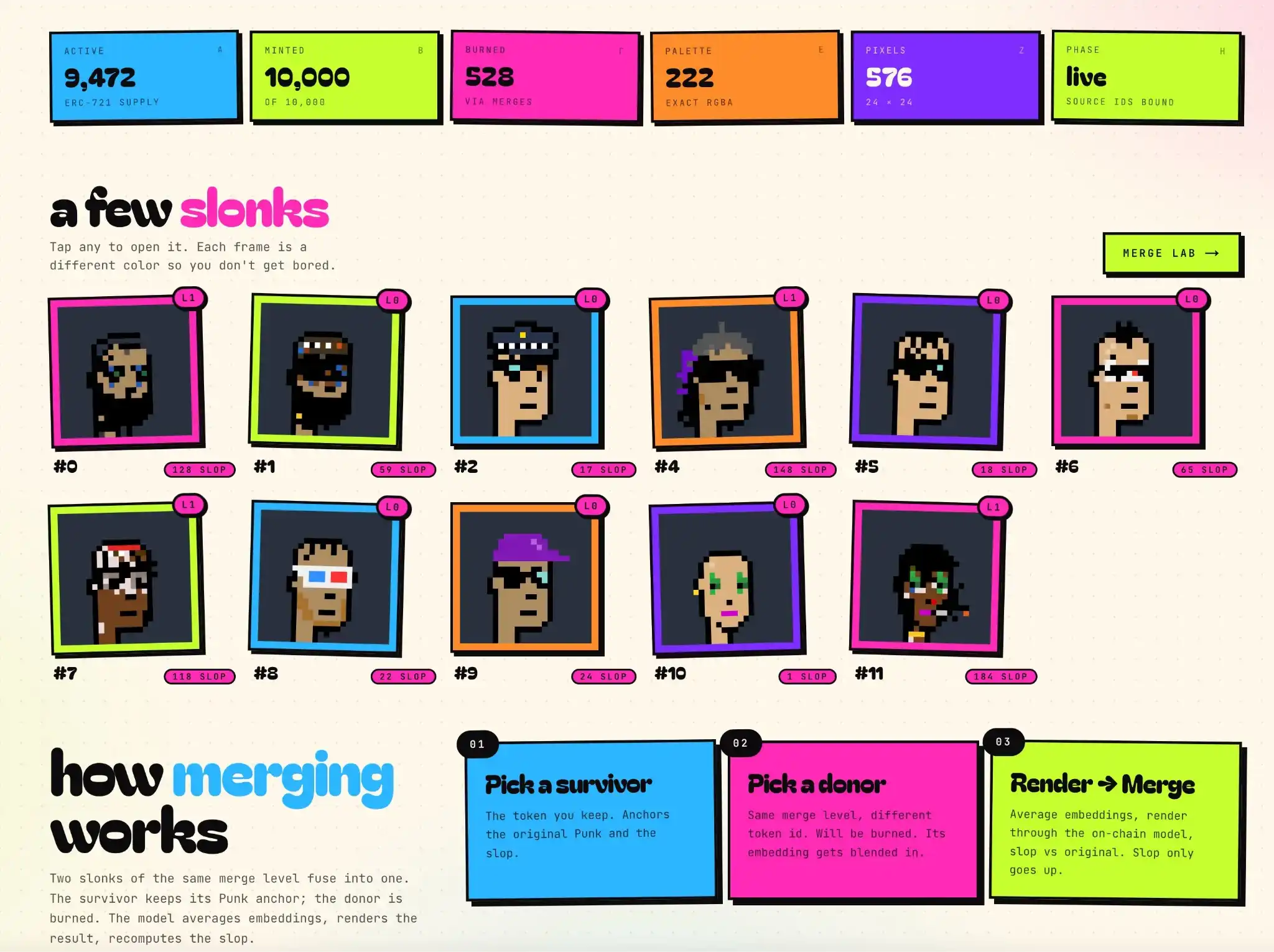
Slonks is an NFT collection that reconstructs CryptoPunks using an on-chain neural network model. Each Slonk corresponds to a CryptoPunk source, with the model rendering reconstructions using a 24×24 pixel canvas and a 222-color palette. The model is not perfect—the pixel difference between the rendered image and the original Punk defines the Slonk’s slop value. Slop ranges from 0 to 576, as the canvas contains a total of 576 pixels.
The core mechanism of the $SLOP token scheme being developed is called voiding. Holders send their Slonk into the Void contract, which mints a corresponding amount of $SLOP based on the current slop value. A Slonk with slop=15 voids to produce 15 $SLOP; a Slonk with slop=400 voids to produce 400 $SLOP. The $SLOP supply cap is 5,760,000, equal to 10,000 × 576—the maximum possible slop value if every Slonk is completely wrong.
Merge is another path. One Slonk becomes the survivor, the other becomes the donor; the donor is permanently destroyed, and the survivor upgrades to the next merge level, receiving a new embedding. The new embedding renders a new image, which is then recompared with the survivor’s source, and the slop value is recalculated.
Regarding the logic behind the increase in slop after merging, there was a previous misunderstanding—here we need to correct a subtle mechanism detail (thanks to jef’s response): the increase in slop is not random, nor is it simply due to a decline in the hybrid model’s simulation capability; rather, it is determined by the morphological difference (DIFFERENCE) between the two source punks. For example, pairing a hoodie with a large head and a female with a small head creates the maximum morphological difference, resulting in the highest possible slop after merging. Therefore, to achieve maximum $SLOP yield, look for pairings with the greatest morphological difference—feel free to try it out in Merge Lab!
Merge doesn't mint $SLOP yourself, but after merging, void can mint more $SLOP. This path isn't explicitly stated in the whitepaper, but it's mathematically valid. In the example from #608 + #645, originally both voiding together could only mint 18 $SLOP; after merging, #608 alone can mint 161 $SLOP. The cost is permanently losing Slonk #645.
Data and Deflation: The rank is a scar from burning
Slonks deployed on May 1st, 5 days have passed. Current totalSupply: 9,505, cumulative mint: 10,012, cumulative burn: 507. 5.06% of Slonks have permanently disappeared from the chain.
Daily burn counts: Day 1: 0, Day 2: 79, Day 3: 175, Day 4: 60, Day 5: 69, Day 6: 124. The 175 on Day 3 was a spike from the community’s concentrated test merge, and the surge to 124 on Day 6 was driven by increased strategy momentum following the $SLOP whitepaper. The merge rate is accelerating, not slowing down.
Note that voiding has not yet been activated. The $SLOP contract has not been deployed, and all current burn activity is purely merge behavior—players have been strategically consuming based on SLOP values prior to the $SLOP launch.
Burns keep Slonks deflationary, and the Slonks' mergeLevel is the scar of that burn.
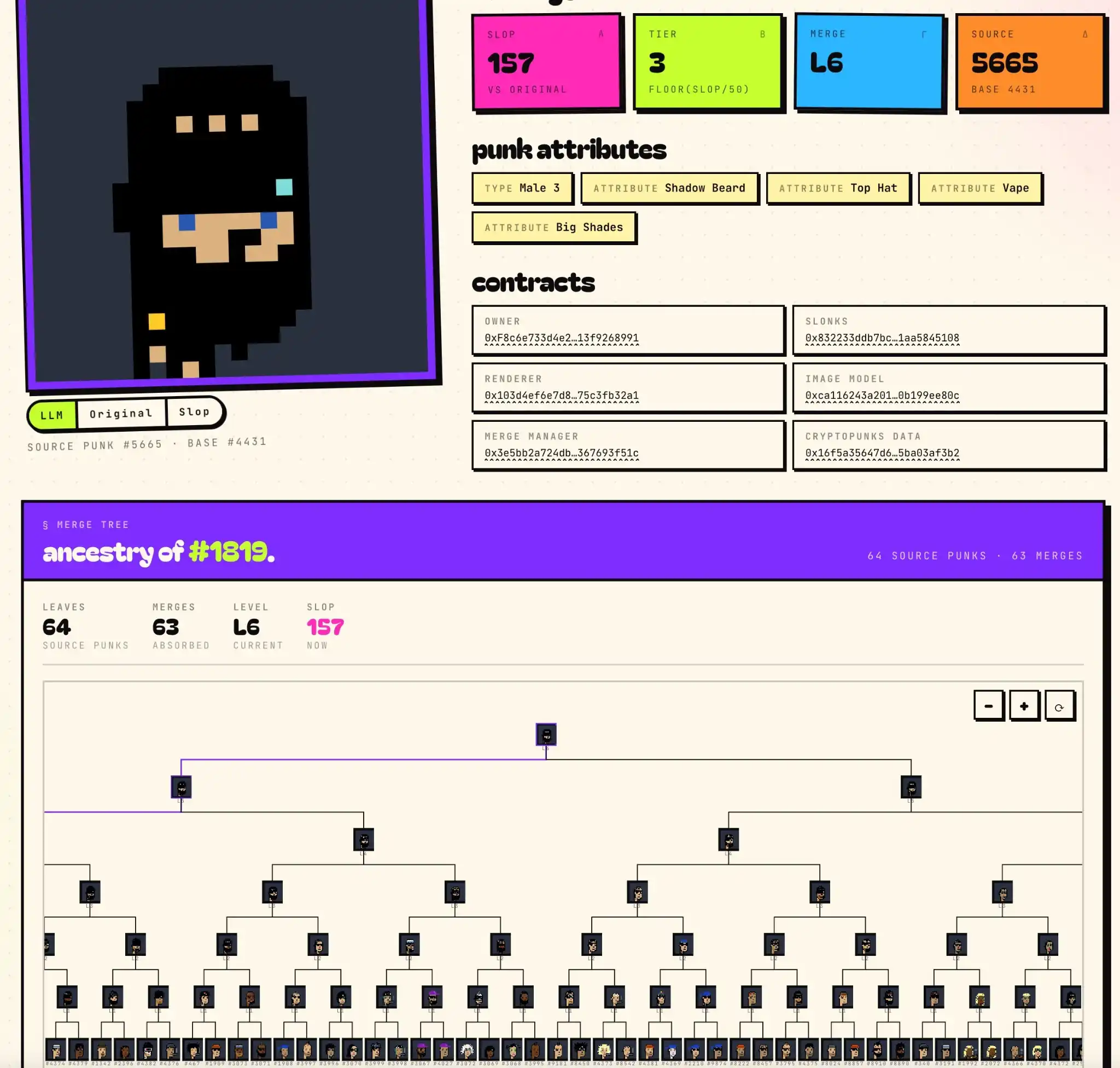
Less than 5% of the collection should have a mergeLevel greater than 0. mergeLevel is a strange field in the contract. The tokenURI reveals it—OpenSea can filter by it—and each Slonk on-chain records its level number, but the contract exposes no view function for it, and no mechanism depends on it to distribute rewards.
The only hard constraint is same-level merging. L0 can only merge with L0, L1 with L1. That means each level up requires burning twice as many Slonks of the same level: L1 burns 2 L0s, L2 burns 4 L0s, L5 burns 32 L0s, and L10 burns 10% of the total collection of Slonks. The theoretical maximum is L13, requiring 8,192 L0s to produce just one—far more than the entire collection can support.
Upgrading comes at a geometric cost without a geometric reward—completely opposite to traditional games. In Slonks, upgrading means burning one同类 at a time in the incinerator. The level number doesn’t track how many times you’ve won; it counts how many of your own kind you’ve burned. mergeLevel is currently an empty trait. The team has preserved the interface for it, but whether $SLOP economic incentives will ever be attached remains unknown. However, from the visuals after merging, it’s clear that level is simply the mark of how many同类 you’ve destroyed.
Dual valuation
At this point, the factual foundation is solid. Slonks does not have a single valuation logic; instead, there are two conflicting valuation frameworks.
The first valuation metric looks at the rarity of the source Punk. Within the CryptoPunks community, 9 Aliens, 24 Apes, and 88 Zombies are widely recognized as rare. If a Slonk’s source is Alien #2890 or Ape #5275, no matter how accurately the rendering is done, it cannot eliminate the inherent scarcity premium of the source. The lower the slop and the higher the fidelity of such a Slonk, the more it preserves the visual recognizability of the Alien’s green face or the Ape’s monkey face. Low slop is the core value of these Slonks.
The second valuation method looks at the amount of $SLOP that can be minted through voiding. The higher the SLOP, the more $SLOP is minted. This valuation is completely unrelated to how rare the Source Punk is. A regular male Punk with a SLOP of 400 will void 400 $SLOP. An Alien with a SLOP of 15 will void 15 $SLOP. In terms of $SLOP value, Punk variants with high SLOP are far more valuable than Aliens with low SLOP.
The two valuation sets directly conflict on the merge decision.
If you hold a low-slop Slonk with source Alien, the merge will do two things.
- First, give it a new embedding, so the rendered image no longer faithfully replicates Alien’s green face.
- Second, destroy one donor Slonk.
The result is that you end up with a Slonk with increased slop, but visually, it no longer appears as an Alien, an Ape, a Zombie, or any rare Punk. The scarcity premium conferred by the CryptoPunks community is reduced to zero.
What you gain is the potential to void minting 100 $SLOP in the future. The price of $SLOP has not been launched and is unknown, but the secondary market value of Alien is verifiable. This trade has a negative expected value for holders of rare source Slonk.
For holders of common-source, low-slop Slonk, merging has a positive expected value. This type of Slonk lacks both source scarcity and $SLOP quantity value, placing it in a valuation discount. Turning it into a high-slop Slonk through merging is its most valuable possible action.
Evolution
Extending this logic to the entire collection level yields a Darwinian picture.
Slonks with poor model reconstruction are the fittest. They slop heavily and are inherently goldmines of voiding; no one merges them, so they survive.
Well-reconstructed Slonks consist of two layers. Rare sources survive, as no one dares to merge them for fear of compromising visual recognition. Common sources are recycled and consolidated as donors to be used in merges to upgrade other Slonks.
The final collection will evolve into two coexisting types: one with high slop — “perfect failures” where the model renders the punks unrecognizable but with high voiding value; and another with low slop — “rare faithful reconstructions,” sourced from Alien/Ape/Zombie, retaining visual recognizability and commanding high secondary market value.
Slonks in the middle ground continue to disappear. Slonks from ordinary sources with ordinary slop have no valuation advantage and are natural donors for the merge. They contribute to two types of survivors and permanently exit.
5 days, 5%. This rate will continue to rise as the merge tool gains adoption and the $SLOP launch approaches. Slonks is an NFT project designed to actively disappear. Its scarcity is not a fixed number of 10,000 at launch, but rather a dynamic result calculated by every merge decision made by the market.
Wrap up
Slonks and unipeg are both playing scarcity, but in opposite directions. Unipeg accumulates dust, making it difficult to assemble whole units, with NFT quantities oscillating around 6,000. Slonks, on the other hand, directly burns tokens—over 500 have been destroyed in five days, with no sign of slowing down, and the process is irreversible.
The merge is described in the whitepaper as a neutral mechanism, but on-chain, it is not. Merge is a method by which Slonks achieve portfolio valuation optimization through self-consumption. Each merge is a market vote to permanently remove one Slonk from existence in exchange for an upgrade in slop for another.
Five days ago, it was 10,012. Today, it's 9,505. $SLOP hasn't launched yet, and elimination has already begun.