





Author: Jae, PANews
While DeFi lending leader Aave struggles amid the Kelp DAO hack, another established protocol, Sky, has not only drawn significant attention and real capital from whales, with its TVL surging over 25% in the past two weeks, but has also seized the momentum by announcing two major initiatives aimed at paving the way for its institutionalization strategy through governance reforms.
Internally, the protocol proposes a motion to simplify treasury management by shifting expenditure patterns from human-led governance voting to rigid rule-based constraints;
Externally, we are building Laniakea, an institutional-grade on-chain capital allocation infrastructure, aiming to capture the liquidity of $300 billion in idle stablecoins.
Sky is accelerating its occupation of the ecosystem position in DeFi infrastructure.
From community governance by individuals to rule-based governance
On April 25, Sky founder Rune Christensen posted on the governance forum that the asset transfer from Genesis Capital to Grove has been completed, marking the official conclusion of the protocol’s genesis phase.
During the genesis phase, Sky followed a human-governed decision-making approach: community voting determined expenditures and discretionary fund allocation, providing sufficient flexibility for early ecosystem growth. However, as asset values surpassed $10 billion, the resulting uncertainty and high governance costs gradually became a constraint on the protocol’s credibility.
The most direct signal is S&P Global assigning Sky a credit rating of B-. S&P Global explicitly identified Sky’s key issues: uncontrollable governance risk and opaque capital position.
For a protocol backing tens of billions of dollars in stablecoin value, governance uncertainty is itself a significant systemic risk.
To address this, Sky's governance solution involves streamlining and restructuring the Treasury Management Function (TMF), reducing the complex five-step waterfall structure to a simplified four-step fixed framework.
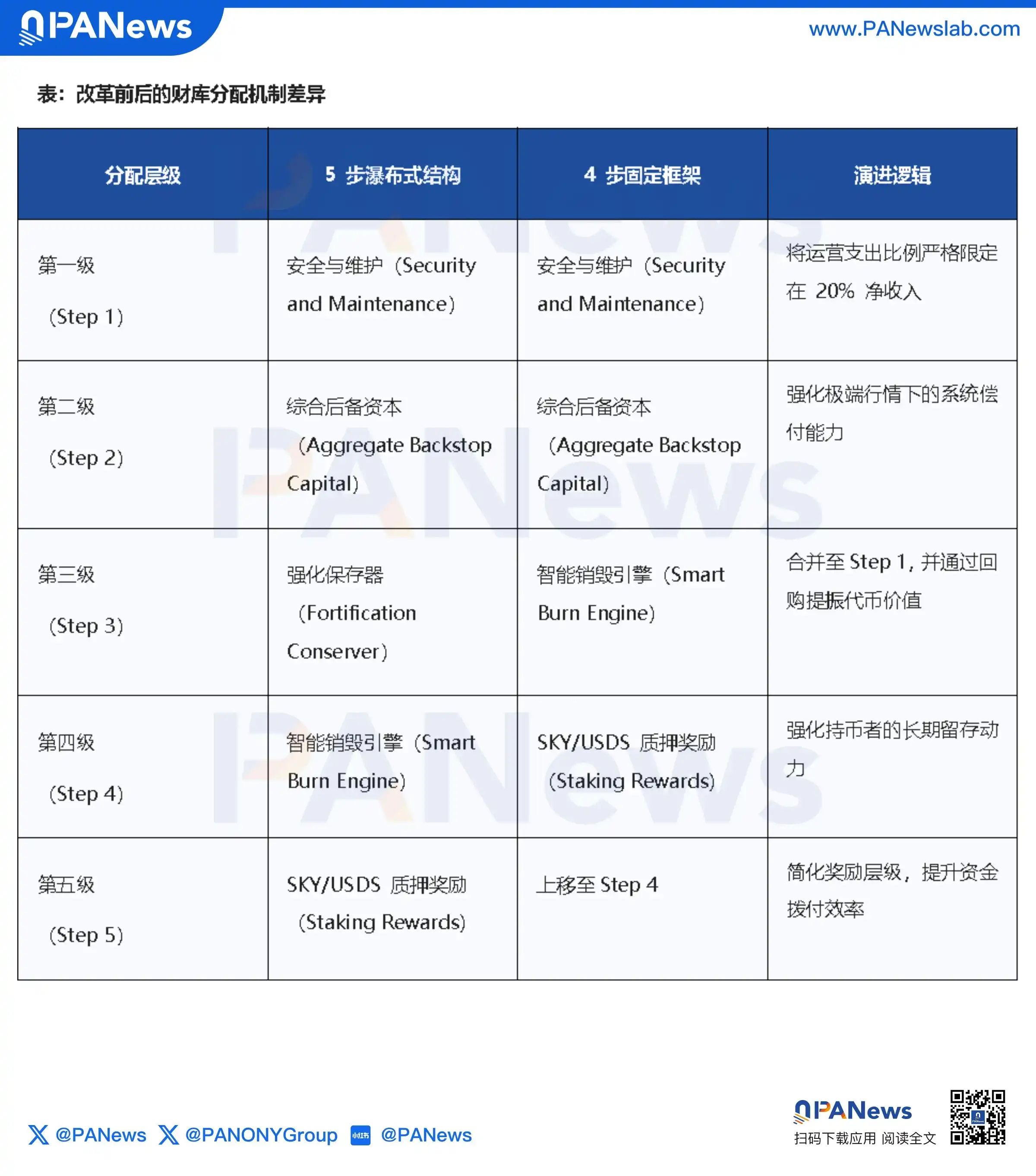
The most important constraint is the protocol’s hard cap on operational expenditures. Sky has transitioned from rule by people to rule by law, locking treasury powers into the cage of code.
In the old system, the community's discretion limit for Step 1 was as high as 21% during the Genesis phase, and was originally intended to be set between 4% and 10% in the Post-Genesis phase.
However, if the ratio is floating, each adjustment requires a complex governance vote.
Therefore, the new proposal directly overturns the entire old system by permanently locking the expenditure ratio at 20%. This means governance friction will be significantly reduced, and at least 80% of the protocol’s net income will be retained within the system for reserve accumulation, token burning, or distribution to holders.
For SKY holders and ecosystem partners, a fixed expenditure ratio offers greater predictability than highly uncertain governance decisions. A rigid 20% expenditure allocation makes the treasury’s cash flow more transparent and harder to manipulate through governance.
Sky may have voluntarily relinquished governance power, but it has also submitted a letter of intent titled “Certainty.”
Build an institutional-grade on-chain capital operating system
While Sky is amending its internal constitution, it is also opening its doors to the outside world.
On April 28, Sky announced it is building Laniakea, a standardized infrastructure framework designed for institutional capital deployment within its Sky Agent Network, aimed at addressing the over $300 billion in idle funds in the stablecoin market.
Please note that this Agent is not the same as the typical Agent. Sky Agent refers to a Capital Agent, not an AI Agent as commonly understood.
The Sky team believes that, for a long time, institutional capital has been slow to enter, primarily due to the absence of five key elements: shared infrastructure, standardized smart contracts, risk accounting, data systems, and legal frameworks.
Laniakea aims to bridge the infrastructure gap through standardization across four dimensions:
- Smart contract standardization: Template-based deployment eliminates the cost of institutions reinventing the wheel;
- Risk governance standardization: Uniform risk measurement and sequential loss allocation;
- Standardization of data infrastructure: Protocol codes will be stored in a machine-readable format to support AI-powered real-time risk control;
- Legal Compliance Standardization: Provide a plug-and-play identity and KYC registration system, a shared legal framework across product lines, and collateral-backed accountability mechanisms established at every operational level.
Under the Laniakea architecture, Sky will no longer be a "lender," but rather a network platform for capital agents.
- Primes: Also known as Tier-1 agents (Sky Agents), they function similarly to on-chain fund managers, competing for capital allocation quotas and developing investment strategies in accordance with Laniakea’s unified standards, such as Spark, which manages DeFi lending, and Grove, which handles private credit and RWA;
- Halos: Specific financial products incubated by Primes on Laniakea’s shared infrastructure, encompassing a range of yield streams, from government bond RWA to private credit.
This layered architecture enables Sky to integrate the specialized expertise of different agents for diversified asset allocation while maintaining a unified framework, significantly enhancing the ecosystem's scalability.
In other words, based on Laniakea, Sky’s role will shift from a “direct operator” to a standardized on-chain operating system designed for institutional capital.
PANews believes that the protocol's primary revenue will come from stability fees, spread income, and taxes.
The stability fee is Sky’s most traditional and reliable revenue stream. Any Halos managed by Primes that wish to be used as collateral to mint USDS within Sky must pay interest to Sky, known as the stability fee. Laniakea has lowered the barrier to entry for institutional participation, meaning more institutional assets will enter the system. As the total amount of USDS minted increases, the total stability fees earned by the protocol will also grow.
Primes, as a professional asset manager, brings yield strategies to Sky. The protocol provides liquidity for assets at lower costs through USDS, with Sky earning the net spread between the strategy yield and the cost of USDS funding (such as deposit rates). Laniakea’s standardization enables Sky to simultaneously manage hundreds of spread channels, creating economies of scale.
Each independent Prime is essentially a franchise of Sky. Generally, Primes issue their own tokens and are required to remit a certain percentage of their tokens or a portion of their business revenue to Sky. Even if the protocol is not directly involved in issuing a specific sub-product, as long as the Primes are Halos issued on Laniakea, Sky can generate revenue through taxation.
It is worth noting that, since the protocol state is machine-readable, AI will take on functions such as capital allocation and liquidation management.
By reading the standardized data interface of Laniakea, AI can enable real-time monitoring of cross-asset exposure, collateral quality, and liquidity depth. When risk signals such as abnormal spreads occur in underlying collateral, the AI automatically adjusts the credit limits or liquidation thresholds of corresponding Halos based on predefined "machine rules," providing institutional users with algorithmic-level capital protection.
Additionally, machine readability makes Halos a "standardized LEGO" that can be optimized by AI models. AI can automatically shift capital allocations across different risk levels based on market interest rates and volatility to seek the optimal Sharpe ratio.
Overall, Laniakea’s AI compatibility will empower institutional capital and Primes at the levels of risk management and investment decision-making.
Positioned in the infrastructure layer, but the transformation carries three hidden risks.
Sky's two actions are not separate initiatives but a coordinated strategy. The standardized treasury management mechanism provides governance certainty for institutional capital, while Laniakea provides technical certainty.
Sky's move also reflects a broader logical shift occurring across the DeFi market: from competition at the application layer focused on the frontend to competition at the infrastructure layer focused on the backend.
The development path of DeFi lending protocols is evolving from single liquidity pools toward a layered architecture. The launch of Laniakea is effectively Sky positioning itself to capture the infrastructure layer. Once Laniakea becomes the preferred entry point for $300 billion in idle stablecoins, Sky will ascend to become the central hub for on-chain capital allocation.
It is important to note that Sky’s transformation journey is not without risks:
- The second-order博弈 of governance rights: Although the rules lock in spending ratios, the authority to amend "the rules themselves" remains in the hands of governance voting. If a governance attack occurs, the long-term effectiveness of the rules may be called into question;
- Increased technical complexity: Building infrastructure that is machine-readable and supports real-time AI monitoring presents significant challenges; any vulnerability could be amplified during large-scale deployment;
- Agency delegation risk: Primes hold significant authority over capital allocation; although there is a loss accountability mechanism, under special circumstances, the profit-sharing arrangement between the agent and the protocol may face dual legal and technical challenges.
From a stablecoin issuer to building the on-chain capital hub Laniakea, Sky is about to complete its transformation from a single DeFi protocol into an institutional-grade operating system.
As institutional capital flows in through standardized interfaces, Sky will embark on its next chapter.