





Author:Area Bitcoin
Translated by: Felix, PANews
Abstract: Silent payments can reduce address reuse and enhance overall privacy.
The privacy of Bitcoin transactions is receiving increasing attention. As the demand for safer and more private on-chain transactions grows, a new proposal has emerged: Silent Payments.
This article will explore what Silent Payments are, their importance to the Bitcoin network, and the structure of Silent Payment addresses.
What is silent payment?
Silent payments are a way to receive Bitcoin without revealing private information such as your balance or transaction history to anyone who can see your public address.
This concept originates from a proposal called BIP 352, which suggests using reusable addresses in Bitcoin.
Imagine this: if you want to accept Bitcoin donations or need to receive multiple payments within a year, what would you do? Currently, you either need to create a new address for each transaction or reuse the same address, which compromises your privacy and allows anyone to track all incoming and outgoing transactions associated with that address using a blockchain explorer.
However, with silent payments, you only need to provide a reusable public key address without worrying about privacy leaks.
The concept of silent payments was first proposed in March 2022. Recently, the BIP was integrated into the official codebase, marking an important milestone in the development of this technology.
This integration indicates that the technology has undergone sufficient review, and wallet developers can begin implementation, although some minor adjustments may still be needed.
Why is this important?
A Bitcoin address is currently similar to a bank account. However, because the blockchain is completely transparent, anyone can view all transactions associated with a particular address through a block explorer.
If you reuse the same address, every transaction you receive will be public.
Silent payments change this: you simply share a public address, and the transaction details are only visible to the sender and the receiver. This is achieved through a cryptographic technique that allows the receiver to receive funds to a completely different unique address each time, and only the receiver can identify and access these funds.
"Silent Payment" is not a new concept; it evolved from the "Stealth Address" concept proposed in 2012.
However, up until now, this concept has not been effectively and practically implemented in Bitcoin.
The previous section mentioned the concept of an anonymous address, but what exactly is it?
Stealth Addresses and BIP 47: Challenges and Limitations in Pursuit of Privacy
Bitcoin transaction privacy has been a central concern since the network's inception. Over time, various proposals have emerged to enhance privacy, among which stealth addresses and BIP 47 stand out. These were originally proposed by Peter Todd.
The following discusses the limitations and challenges these methods face when pursuing higher anonymity and transaction efficiency.
Hidden address
Stealth addresses are one of the earliest attempts to improve the privacy of Bitcoin transactions.
The idea is simple: let the recipient generate a unique and private address that only they can access through cryptographic means.
But there is a major obstacle: to make the system work, an additional key needs to be added to the blockchain, typically using the OP_RETURN field.
This brings about two serious disadvantages:
Loss of Anonymity: Adding extra data on the blockchain makes it evident that the transaction used a stealth address. Any observer can identify this technique, which compromises anonymity.
Inefficiency and high costs: Increasing the amount of blockchain data makes transactions bulkier, less efficient, and more expensive, which contradicts Bitcoin's principle of maintaining a lightweight and easily accessible system.
At that time, an alternative approach also emerged: using an existing key in the transaction to avoid adding extra data.
However, due to the technical complexity and the lack of efficient tools at that time (for example, the Lipsack P library that now simplifies these calculations), the idea was put on hold.
BIP 47
Another proposal aimed at addressing these issues emerged over time: BIP 47.
BIP 47 introduced the concept of a notification system, rather than adding data to the blockchain with every payment. In this approach, the sender only needs to upload the data to the blockchain once, and the recipient can identify this data and use this "key" to simplify future payment processes.
Advantages of BIP 47:
Clear identification of the payee: The payee can easily determine which part of the on-chain data is intended for them, making the verification process simpler.
Reduce extra data: Only add notification data once, which saves space and resources compared to adding data every time with an anonymous address.
Disadvantages of BIP 47:
It is more complicated for the sender: each payment requires the sender to first send an on-chain notification, which is equivalent to an additional transaction, making it very cumbersome for large-scale use.
Blockchain inefficiency: Data added for notifications is unrelated to actual payments and is considered inefficient.
Payment traceability: If multiple payments are made to the same person, the recipient may discover that the funds come from the same source, which compromises anonymity (whereas in silent payments, the sender remains completely anonymous).
Identity Exposure: In notification transactions, the sender's payment code is revealed to the recipient, which could be problematic in situations requiring high anonymity (e.g., donating to sensitive causes).
Although BIP 47 has its advantages (such as clear receiving addresses), significant disadvantages like additional transactions and lack of full anonymity have limited its popularity.
Silent Payments aim to address these issues and provide a more intuitive and private user experience. Compared to BIP 47, the only drawback of Silent Payments is the need to scan the blockchain, but this trade-off may be worthwhile for the significant privacy improvements they offer.
In summary, both stealth addresses and BIP 47 have contributed to Bitcoin privacy, but their respective limitations have hindered widespread adoption.
Silent payment has now become a promising solution, attempting to combine the advantages of both:
Strong privacy
High efficiency
Simplified user experience
How to operate silent payment?
For users, the operation is very simple.
Assume you have a Bitcoin wallet connected to your own node. You generate an SP (Silent Payment) code, which can be shared in the form of a QR code. Anyone who supports silent payments can scan the QR code or enter the code to make a payment... That's all there is to it.
For recipients running a full node, the cost is almost zero due to optimized measures that make the process efficient.
However, the recipient has to do a bit more work. The recipient must check every new Taproot transaction on the network to determine whether it contains a payment to their silent payment address, which requires additional processing by the wallet software.
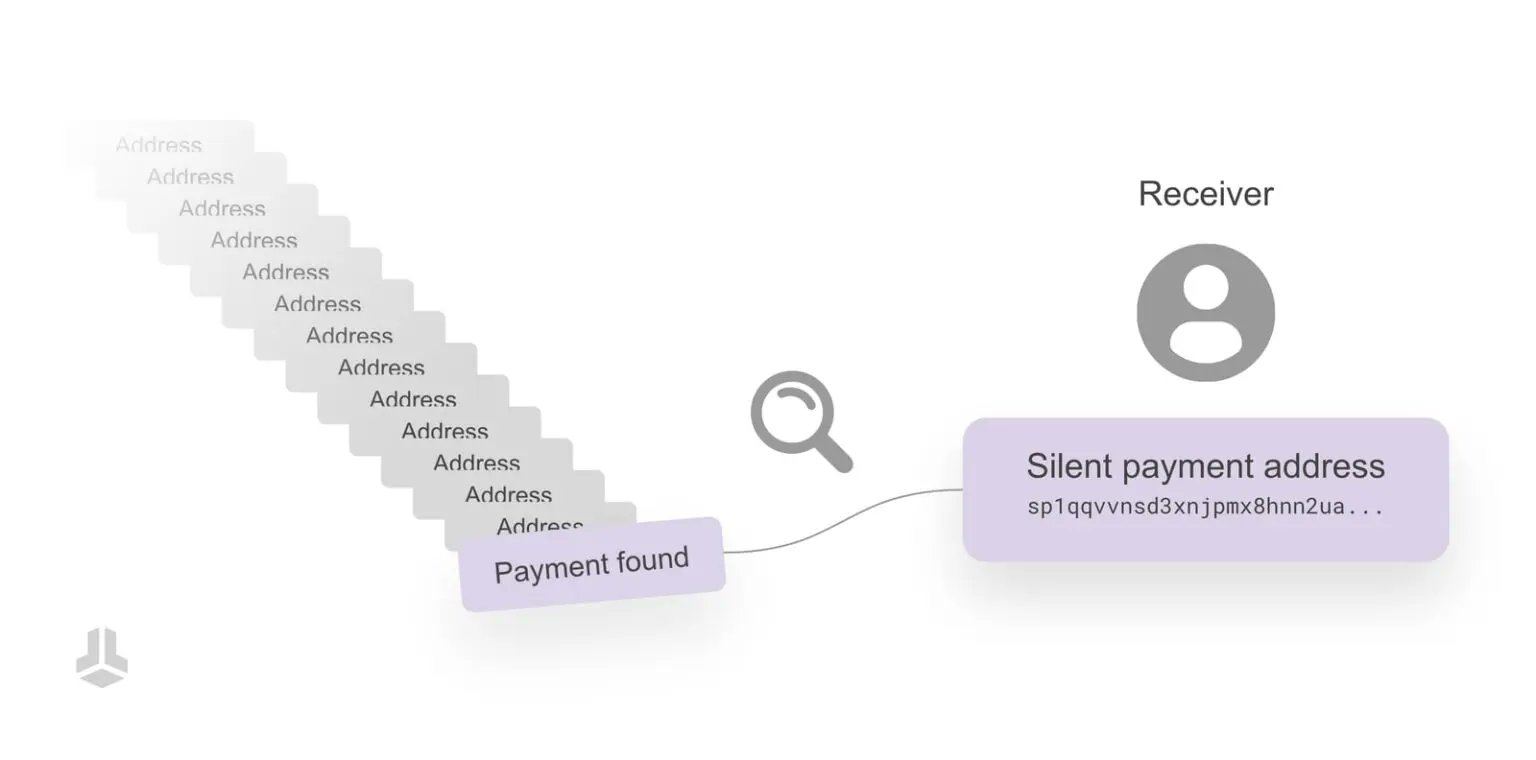
What does a silent payment address look like?
The structure of a P2TR (Pay-to-Taproot) address is the same as a Taproot address. Taproot addresses use the "bc" prefix to indicate a Bitcoin address, followed by a "1" and the version byte, with the remaining part encoded in bech32m.
Silent payments also use the bech32m encoding, but with the prefix "sp1" (indicating that this is a silent payment address). Additionally, this address contains two public keys. These two public keys do not directly reveal where the Bitcoin is going, but instead provide instructions for generating a Taproot public key script.
In practical use, users can generate, share, and securely reuse Silent Payment addresses just like regular Bitcoin addresses, without compromising privacy—this is its core advantage.
Which wallets support this address?
Currently, wallets that support silent payment addresses include: Cake Wallet and BitBox.
Since silent payments are still under development and have not yet been widely adopted, Cake Wallet is among the earliest wallets to implement Bitcoin silent payments. The wallet is currently available in public beta versions for both Android and iOS.
The following is how to Cake Wallet Using silent payment:
Click the "Silent Payments" button in the card/box on the wallet home page to start scanning the blockchain for these transactions.
It should be noted that because silent payment transactions are anonymous, the wallet must actively scan blocks to search for transactions.
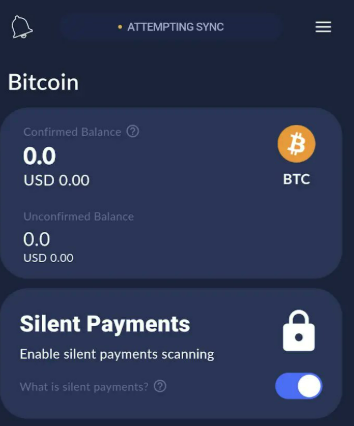
After the scan is completed, the silent payment verification will be automatically closed when the latest block is reached.
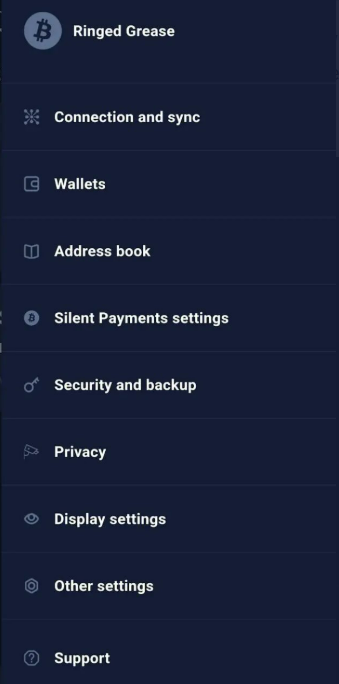
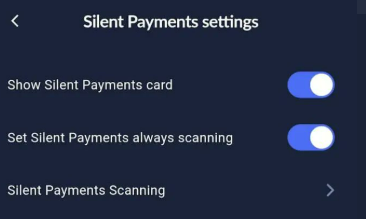
If you want your wallet to continue automatically checking for new blocks for Silent Payments, go to "Menu" -> "Silent Payment Settings," and enable the "Always Scan for Silent Payments" option.
BitBox
Like the hot wallet Cake Wallet, BitBox is among the first hardware wallets to support silent payments, significantly enhancing user privacy protection.
With silent payments, senders can generate a unique address from a recipient's fixed public key. This is especially useful for activists, NGOs, and charities: they can share a reusable address to receive donations without revealing their identity, the donors, or the donation amounts.
This integration allows BitBox users to support various causes and make payments while avoiding unnecessary exposure of their financial activities to third parties.
Label function
One of the initial challenges with silent payments was identifying who sent the payment. The solution was to introduce labeling.
So, what is a tag?
Tags allow you to distinguish between different senders when using a single silent payment address, without compromising privacy or significantly increasing scanning costs.
This technology allows additional information to be added to a silent payment address without compromising user privacy. It is achieved by deterministically fine-tuning the spending key.
Simply put, an expenditure key is like a digital signature that authorizes the use of funds in an address. By making slight adjustments to this key, different payment sources can be identified.
For example, suppose you have two silent payment addresses:
An activity on X
Another activity on Nostr
With the tags, the first parts of these two addresses are the same (indicating they both belong to you), but the latter parts are slightly different, helping you identify the source of the payment.
When you check the funds this way, you can see that some payments come from X users and some come from Nostr.
This flexibility achieves a balance between protecting privacy and collecting useful transaction information.
Of course, if you want complete anonymity, you can use a standard silent payment address without a label, ensuring that the sender has no identifiable information. However, if you need to track the source of the payment, labels provide an efficient way to do so.
This technology can be applied in various scenarios such as exchanges, social media platforms, and personal use, allowing you to manage multiple online identities without obvious connections, or simply obtain more payment information when needed.
Exchange Silent Payment Example
If the exchange adopts this technology, interesting application scenarios will emerge.
Suppose you are depositing funds into an exchange. With silent payments, the exchange no longer provides you with a reusable deposit address, but instead generates a silent payment address for you.
Each time you make a payment to this address, the exchange can automatically identify it as yours (via the tagging mechanism), without you needing to manage multiple addresses. In addition, this technology is also very useful for automated withdrawals.
You can reuse the same silent payment address across platforms without managing different extended public keys (xPub) for each platform, greatly simplifying the process.
Conclusion
Silent payments have the potential to completely transform the way Bitcoin is used, offering a simpler and more intuitive experience while significantly enhancing privacy.
If this technology is widely adopted, the reuse rate of on-chain addresses may significantly decrease, creating a safer and more private environment for everyone.
Silent payments present a remarkable opportunity to combine user incentives with best privacy practices, making future Bitcoin transactions more private and secure than ever before.
Related Reading:Over 1.7 Million BTC at Risk of Attack? Bitcoin Re-Enters Quantum Debate, Public Chains Launch Defense Campaign