



U.S regulators could still offer clear guidelines for the crypto sector even if the broader market structure bill, the CLARITY Act, fails to become law.
Notably, the U.S. Securities and Exchange Commission (SEC) has already issued interpretive guidance on how to apply federal securities law to certain crypto assets.
The guidance is under White House review, with Bloomberg reporting that it will establish a ‘token taxonomy’ to help categorize crypto assets that fall under SEC jurisdiction.
An SEC spokesperson further clarified that,
“As Chairman Atkins said, the Commission will consider interpretive guidance around a token taxonomy for crypto assets – in line with market structure legislation – to ensure that investors and innovators have a clear understanding of their regulatory obligations.”
Worth noting that this is separate from the SEC’s pending rulemaking proposal on crypto asset offerings.
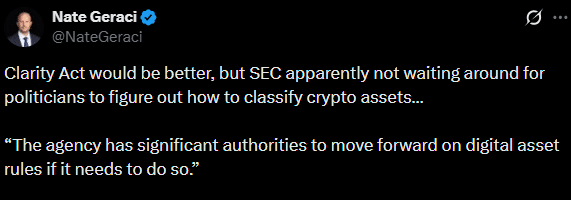
For ETF Prime’s Nate Geraci, the move would be net positive, especially if the CLARITY Act stalls.
“CLARITY Act would be better, but SEC apparently not waiting around for politicians to figure out how to classify crypto assets…”
Source: X
Such regulatory clarity would establish an enforceable framework that allows crypto firms to register with the regulator, conduct disclosure requirements, and engage with investors, amongst other things.
In fact, some analysts who viewed the CLARITY Act as a ‘bad bill’ advocated for this route to safeguard the market.
CFTC pushes for prediction market rules
Separately, the Commodity Futures Trading Commission (CFTC), which handles derivatives trading, has pledged to unveil clear rules for booming prediction markets.
Like the SEC, the CFTC also submitted a proposal for rulemaking for the multi-billion-dollar prediction markets.
Besides, CFTC Chairman Mike Selig had pledged to unveil crypto perps guidelines by next month. Collectively, these regulatory moves could allow key players to operate even if the CLARITY Act fails to hit the finish line.
In fact, the bill stalled earlier in the year as the crypto and banking industries failed to reach a stablecoin yield deal.
Surprisingly, the White House has openly criticized banks for their hardline stance on stablecoin rewards and sided with the crypto industry. The ongoing rift could make it challenging to have full bipartisan support to advance the bill.
Even so, the current pro-crypto regulators may still offer the much-needed guidelines for players to operate with clear rules for the road.
Final Summary
- The SEC submitted proposed guidelines on how to treat crypto assets that fall within federal securities law.
- CFTC also pushed for rules for prediction markets, with experts billing the updates as ‘better’ if the CLARITY Act stalls.