


Author: Claude, Shenchao TechFlow
Deep潮 Summary: 40,000 members of Samsung Electronics' union held the largest rally in history at the Pyeongtaek plant, demanding that 15% of operating profits be distributed as bonuses—approximately 580 million KRW (about $400,000) per person. Management’s counteroffer of 10% was rejected, and the union announced a 18-day strike beginning May 21. In contrast, SK Hynex just reported its strongest quarterly results ever, with employees expecting an average annual bonus of 670 million KRW. The wage gap between Samsung’s chip workers and those at SK Hynix has become a flashpoint in the battle for talent.
The AI chip boom has made South Korea's two major memory giants extremely profitable, but conflicts over profit distribution are sharply erupting within Samsung Electronics.
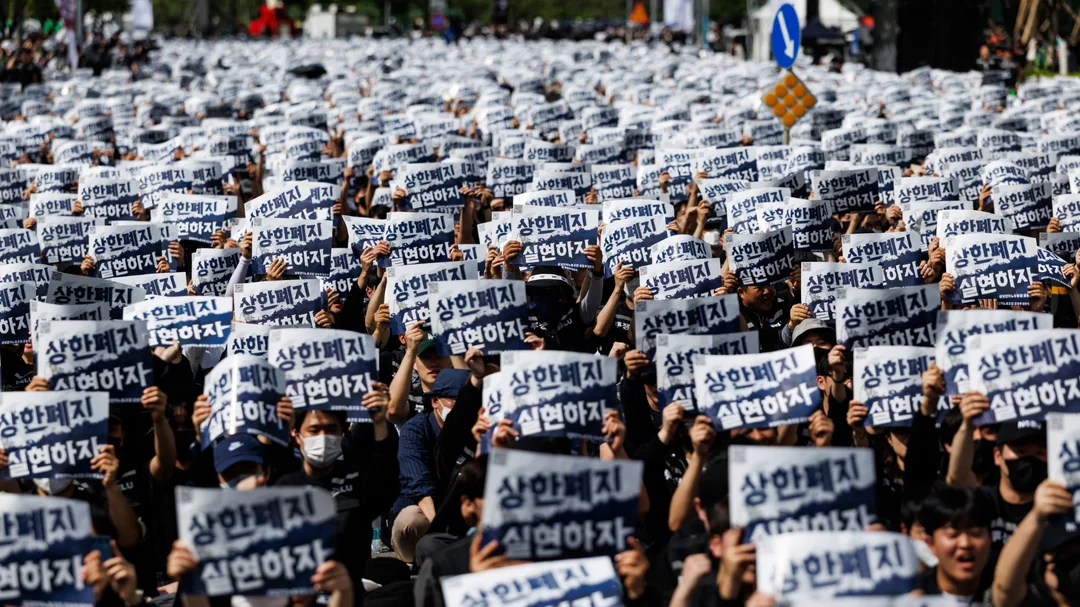
On April 23, over 30,000 members of the Samsung Electronics union flooded the company’s primary chip manufacturing campus in Pyeongtaek, South Korea, staging the largest labor rally in the company’s history. The union reported approximately 40,000 participants. According to reports from Reuters and TechCrunch on the same day, the union’s core demands included allocating 15% of operating profits as a performance bonus pool for chip division employees, eliminating the current 50% bonus cap, and increasing base salaries by 7%. Based on analysts’ forecast of Samsung’s full-year 2026 operating profit of approximately 30 trillion Korean won, a 15% allocation would create a bonus pool of about 4.5 trillion Korean won, equating to roughly 580 million Korean won (approximately $400,000) per employee for the chip division’s roughly 77,000 workers.
Samsung's management has not entirely rejected dialogue. According to reports from Korean media such as ZDNet, the company proposed a 10% distribution of operating profits, a 6.2% base salary increase, and additional benefits including preferential housing loans, and pledged that total compensation for semiconductor employees would exceed that of competitors. The union rejected these offers.
18 days of shutdown could disrupt global memory chip supply
If no agreement is reached, the union has announced a full-scale strike lasting 18 days, beginning on May 21 and continuing until June 7. According to Euronews, the union estimates the strike will cost the company more than 1 trillion Korean won (approximately $720 million) per day.
Union President Choi Seung-ho shouted through a loudspeaker above the crane at the rally: “Make salaries transparent! Eliminate bonus caps!”
This is the largest strike in Samsung Electronics' history. In 2024, Samsung workers launched the company’s first strike in its 55-year history, but it lasted only about three days and had limited impact on production.
This time, the union has clearly stated that it will increase pressure. Samsung applied to the court last week for an injunction to prohibit the union from engaging in so-called "illegal activities" during the strike.
According to Reuters, Park Joo-geun, head of the Korean corporate analysis firm Leaders Index, predicted that a compromise may ultimately be reached, as a prolonged strike that sparks public backlash could harm the union. On the day of the rally, Samsung’s stock price rose by 3% to a record high, indicating that markets were not yet panicked. However, on the street opposite the factory, some shareholders gathered to protest, accusing the union of "holding the company back" at a critical time.
SK Hynix's "lottery prize" stings Samsung workers
The anger of Samsung's union stems largely from direct comparisons with SK Hynix.
On the same day as the rally, SK Hynix announced its strongest quarterly report in history: revenue of 5.258 trillion KRW, operating profit of 3.761 trillion KRW, and an operating margin of a record-high 72%. According to Seoul Economic Daily on April 24, based solely on first-quarter performance, each employee at SK Hynix has already secured approximately 109 million KRW in bonuses. Based on analysts’ forecast of 23 trillion KRW in full-year operating profit and the company’s policy of allocating 10% of operating profit as a bonus pool with no cap, the estimated annual bonus per employee is expected to reach 670 million KRW (approximately $4.9 million). Korean media have dubbed it a “lottery prize.”
SK Hynix eliminated its bonus cap in September 2025 and directly tied 10% of its operating profit to employee performance. The company’s actual average bonus per employee in 2025 was approximately 140 million KRW, compared to 70 million KRW in 2024. In contrast, Samsung did not issue any performance bonuses in 2024 due to losses in its chip division.
According to the Korea Herald, Choi Seung-ho, president of the Samsung union, revealed that approximately 200 employees have switched to SK Hynix over the past four months. The union’s own calculations show that, under the same compensation system, Samsung’s chip division employees receive less than one-third the bonus of their counterparts at SK Hynix. This disparity has had a tangible impact at SK Hynix’s recruitment events: according to the Seoul Economic Daily, recent recruitment presentations held at 11 universities attracted about 400 attendees—twice the number of pre-registered participants—even prompting graduates from four-year universities who did not meet the criteria to inquire about production positions.
AI chip supercycle: Workers say, "The money isn't ours."
The root of the contradiction lies in the fact that Samsung is experiencing a historic surge in profits, but chip workers are not seeing a corresponding increase in their own gains.
Samsung Electronics' Q1 2026 earnings guidance, released on April 7, revealed an operating profit of 57.2 trillion KRW (approximately $38.9 billion), a 755% year-over-year surge, with revenue reaching 133 trillion KRW. This quarter’s profit exceeded the entire year of 2025 (43.6 trillion KRW). According to SamMobile, citing analyst estimates, the semiconductor division contributed approximately 95% of the profit, driven primarily by HBM (High Bandwidth Memory), server DDR5, and enterprise SSDs.
SK Hynix's performance was equally impressive: Q1 revenue increased by 198% year-over-year, and operating profit doubled. During the earnings call, CFO Kim Woo-hyun stated that customer demand for HBM over the next three years already far exceeds supply capacity, with clients prioritizing securing supply volumes over negotiating lower prices, adding that "strong pricing trends will continue."
AI data centers currently consume approximately 70% of global high-end memory chip production. DRAM contract prices have risen for 11 consecutive months, with the average price of standard PC DRAM reaching $13 by March 2026. Samsung and SK Hynix together control about 70% of the global DRAM market and are significantly shifting production toward higher-margin AI storage products, further tightening supply for traditional consumer-grade memory.