





The Hong Kong Web3 Carnival Side Event has successfully concluded.
Author and source: Desun
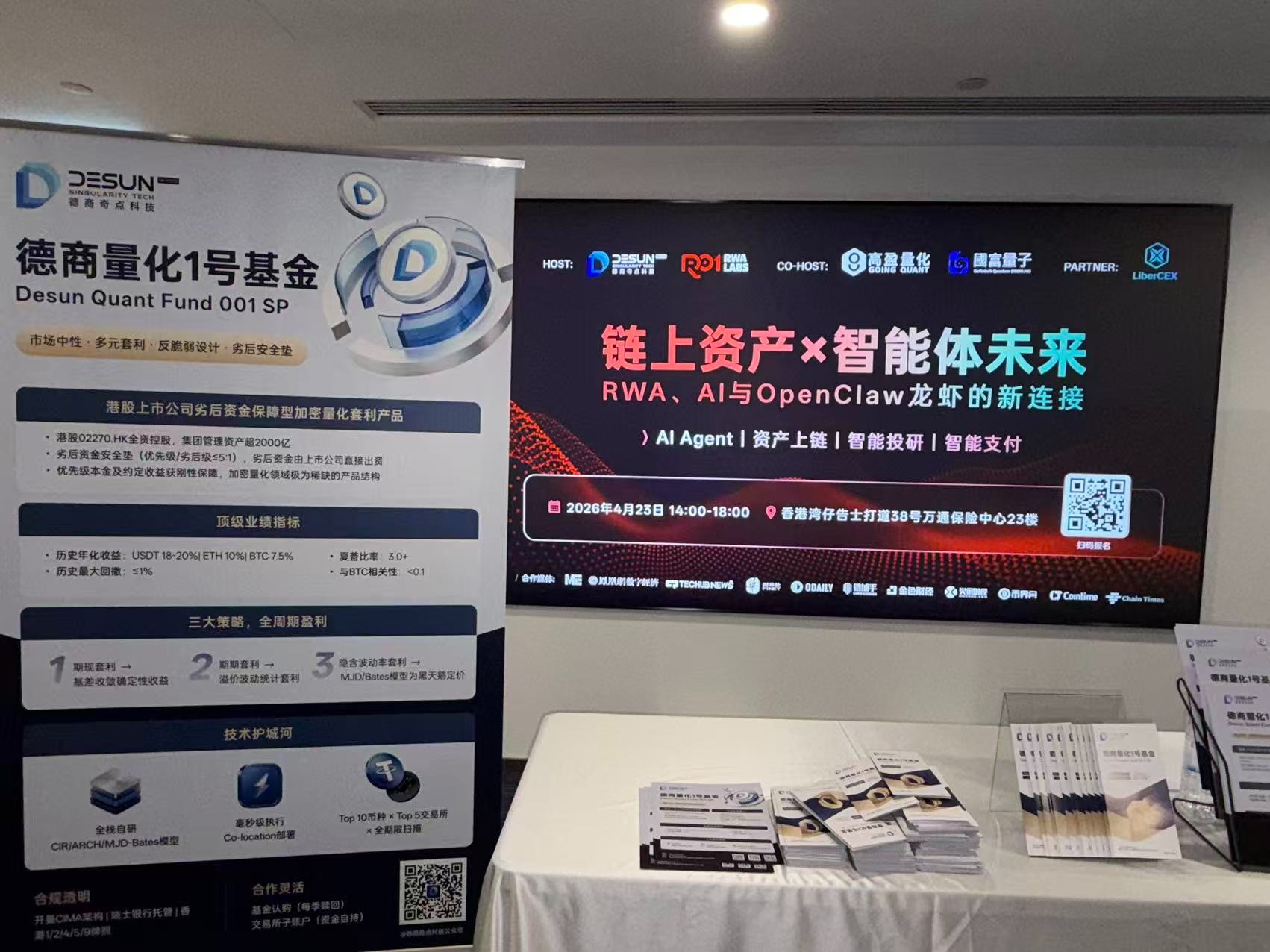
On April 23, the "On-Chain Assets x Agents: The Future Seminar," hosted by German tech firm Singularity Tech and Huaxia Digital Capital, with co-hosts Gaoying Quant and Guofu Quantum, was successfully held at the Manulife Center in Hong Kong. Over a hundred guests from financial institutions, RWA project teams, AI technology platforms, industrial capital firms, and ecosystem partners gathered to explore the next phase of evolution in the integration of on-chain assets and agent technologies.
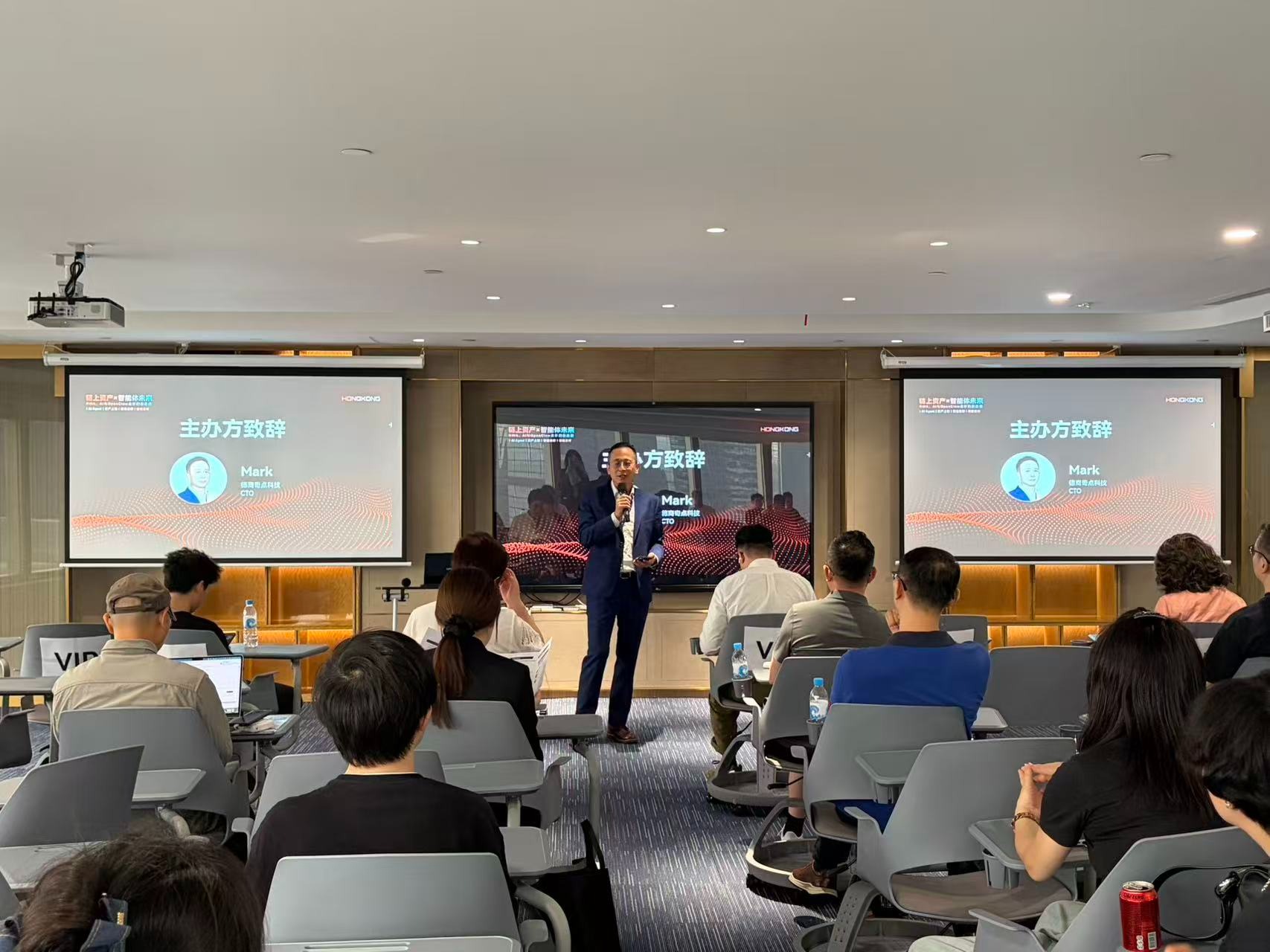
Mark, CTO of Deshang Qidian Technology: On-chain assets x agents is multiplication, not addition.
At the opening address, Mark, CTO of Desheng Qidian Technology, pointed out that there is a common perception in the market regarding the relationship between RWA and AI—people often say “RWA + AI,” as if the two are merely simple modules stacked together.
But true paradigm shifts are never addition—they are multiplication.
He explained that Sino-German Singularity Tech precisely bridges the two sides of this multiplication sign, along with the underlying transaction network. Assets, intelligence, and transactions represent the unified direction of Sino-German Singularity’s three business segments: digital finance, securities finance, and industrial finance. RWA solves the problem of “tokenizing assets,” enabling real-world value to be recognized, accessed, and settled by intelligent agents; AI solves the problem of “autonomous execution,” allowing systems to make decisions, issue commands, and complete transactions. When these two layers are truly integrated, a chemical reaction occurs: assets are no longer static digital certificates but productive assets managed around the clock by intelligent agents; AI is no longer merely a recommendation system but an economic participant with asset accounts, payment capabilities, and risk control boundaries.
“RWA × AI equals a new species.” Mark set the tone for the day’s discussion with this concise judgment.
He also pointed out that this paradigm shift is particularly significant for Hong Kong. As a key hub connecting international capital with Asian assets, Hong Kong has both a mature regulatory framework and a strong industrial foundation. Whoever can implement the "multiplication effect" first will gain a competitive advantage in this wave of financial infrastructure development.
Ye Kai: From Asset Tokenization to Agent-Driven New Trading and Service Networks
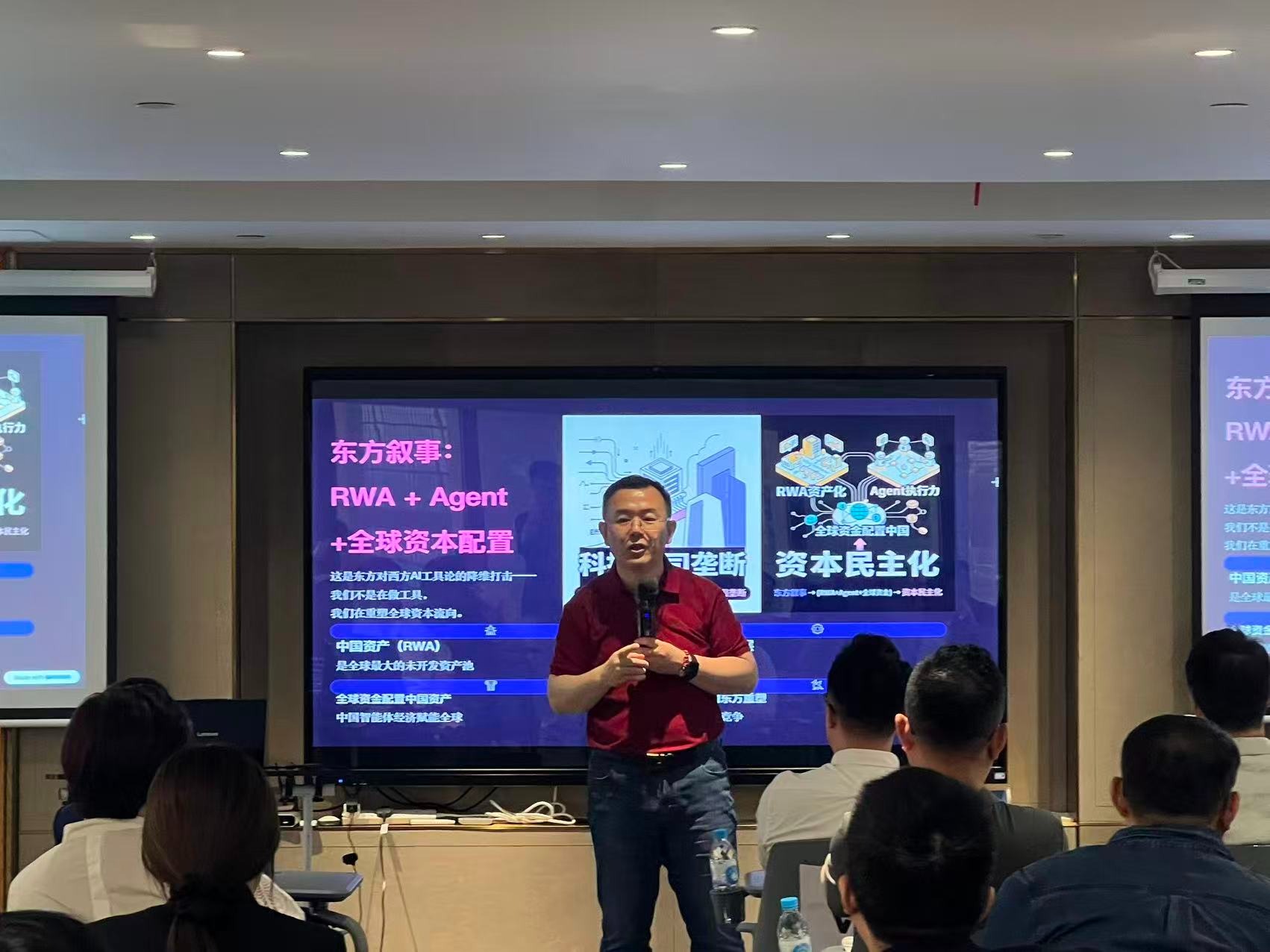
Ye Kai, Co-Founder of Huaxia Digital Capital, systematically outlined the evolution path of integrating RWA with AI agents in his keynote speech. He noted that while the starting point of RWA is “tokenizing assets,” the endpoint goes far beyond this—the true value lies in whether these on-chain assets can be recognized, orchestrated, and traded by AI agents, thereby forming a continuous service network.
Ye Kai believes that the integration of RWA and AI is driving transformation at three levels: First, assets are evolving from statically tokenized assets to being actively managed by agents, becoming callable, pricable, and tradable productive assets; second, agents are upgrading from auxiliary tools to autonomous execution layers for trading and services, forming a new trading network; third, the efficiency and scope of global capital allocation are being redefined, and Hong Kong, as a connecting node, has the opportunity to become the hub of this new network.
He concluded that the financial system of the future will no longer be about “people seeking assets or services,” but rather about “people setting intentions, agents orchestrating assets, and asset networks automatically completing transactions and settlements.” This is precisely the embryonic form of a “new transaction and service network driven by agents.”
AI is entering the core financial infrastructure, evolving from an efficiency tool to a systemic capability.
During the AI-themed discussion, multiple guests from investment research, quantitative finance, and financial technology sectors agreed that AI is evolving from a supportive tool into a systemic infrastructure.
AI is transitioning from a "tool" to an "economic actor." On-site perspectives focused on three key directions:
1. The implementation path of AI is shifting earlier—institutional-grade RWA research and analysis agents, stablecoin treasury management, and programmatic payments are becoming the first areas to generate real revenue.
2. Financial processes have been restructured—“With payment capability, AI can transition from a ‘recommendation system’ to an ‘execution system.’” Middle-layer services have been significantly streamlined.
3. Operational Automation Acceleration — Agents are now handling advisory, risk management, clearing and settlement, and ongoing operations around the clock, transforming the cost structure and service efficiency of financial institutions.
OpenClaw Lobster and AI Agent: A New Collaboration Paradigm Is Emerging
As one of the key discussion topics of this workshop, the AI Agent system represented by OpenClaw Lobster is seen as driving a new organizational and collaborative structure.
Lobster Mode is not a tool, but a scheduling super gateway. The core of multi-agent systems lies in system proactivity, reentrancy, and agent-like reasoning.
Under this logic, the traditional "human + system" structure is evolving into a hybrid collaborative system of "human + AI agent + asset network."
The fundamental unit of future markets will no longer be humans and software, but the deep collaboration among humans, agents, and assets. Some also argue that AI agents are transitioning from the execution layer to the system layer, taking on higher-level functions such as information integration, workflow orchestration, and strategic assistance—truly shifting from “humans seeking services” to “agents proactively seeking resources and completing transactions.”
Hong Kong: A key structural opportunity for the convergence of RWA and AI
In discussions about regions and institutional environments, Hong Kong is widely regarded as playing a key role in this round of transformation.
What Hong Kong’s RWA aims to do is turn assets that global capital is willing to engage with into on-chain products. Its core advantages are primarily reflected in three aspects:
• A relatively mature regulatory framework for digital assets
• Ability to connect international capital with Asian markets
• Financial infrastructure conditions oriented toward industrial implementation
RWA has formed a real asset pool and entered a stage that is verifiable, observable, and configurable. Hong Kong is at the forefront of this structural window of opportunity.
Roundtable Discussion: Industry opportunities are shifting from "point innovations" to "systemic capability competition."
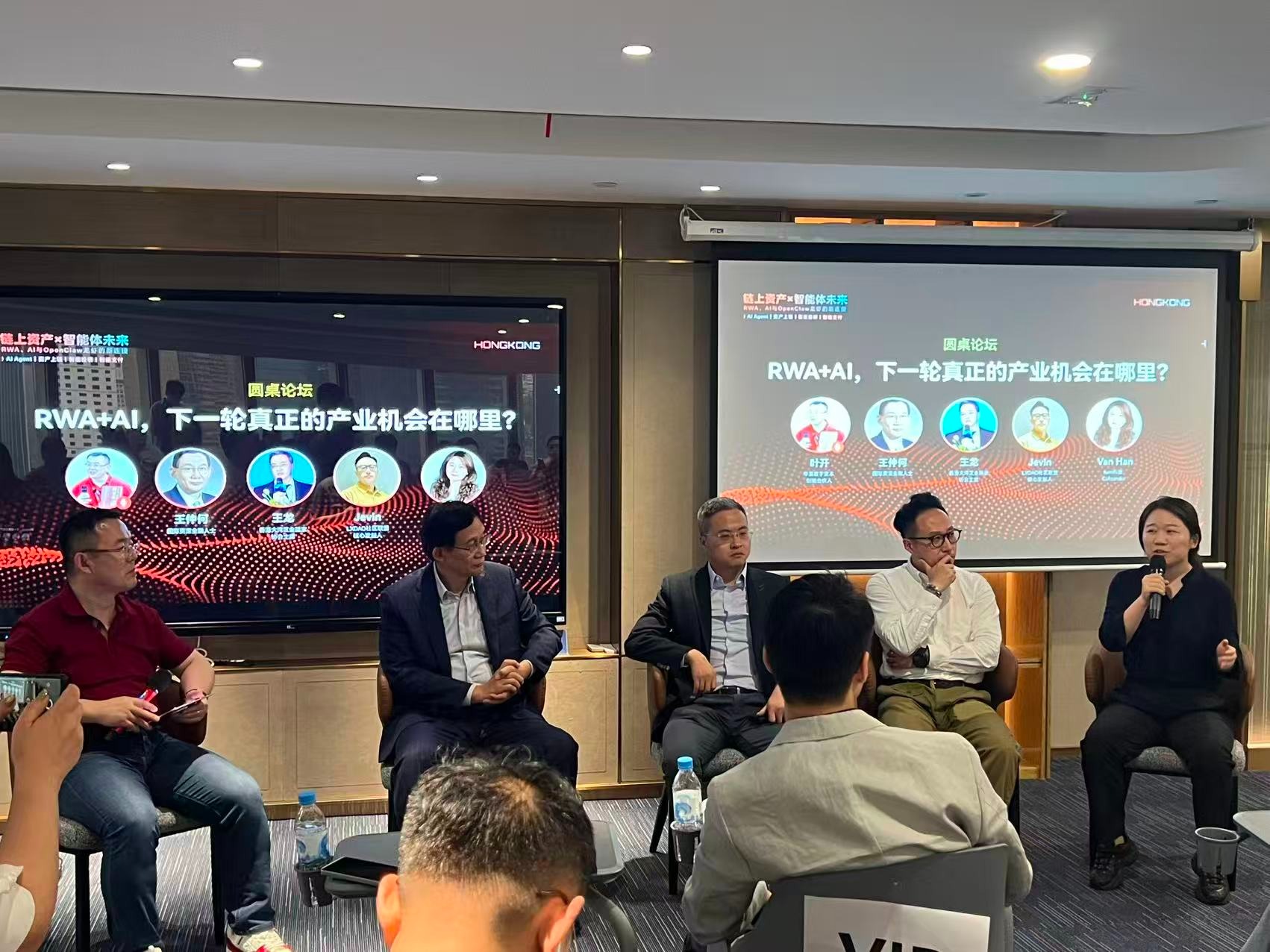
In the roundtable forum session, moderated by Ye Kai from Huaxia Digital Capital, panelists including international financial expert Wang Zhonghe, Chairman of the Hong Kong Greater Bay Area Financial Association Wang Long, core initiator of the LXDAO Community Alliance Jevin, and co-founder of Lumi Technology Van Han engaged in an in-depth discussion on “The Next Wave of Industry Opportunities in RWA + AI.”
The key points focus on three main themes:
The core bottleneck of RWA isn't a lack of assets, but rather a professional team capable of translating traditional finance terminology into on-chain financial language. Closed-loop capabilities are more important than the story of going on-chain.
• The practical applications of AI—investment research, risk control, and programmatic payments—are listed as the top-priority implementation paths.
• Evolution of the Agent Role—Jevin specifically noted that Agent tools like OpenClaw Lobster are evolving from efficiency tools into genuine business entry points and collaboration infrastructure, and that A2A payments may eventually reshape the entire network of value flow.
All panelists agreed that the key variable over the next year will shift from "single-product capabilities" to "systemic financial and technological synergy."
Industry consensus: Finance is entering a "system reconstruction phase"
The core consensus reached at this seminar is that RWA is no longer just an issue of tokenizing assets, and AI is no longer just an issue of efficiency tools—their convergence is driving a systemic restructuring of financial infrastructure.
The agent economy is not an AI upgrade, but a upgrade in transaction logic. In the next stage, what will truly be valuable is not the token itself, but the continuously operated on-chain asset system.
During this process, the boundaries between asset structures, agent systems, and real-world industries are gradually blurring, giving rise to a new financial system characterized by “automated collaboration + asset networking.”
About Desheng Qidian Technology
Desheng Qidian Technology is the core fintech subsidiary of Desheng Industrial Investment Services Group (02270.HK), a listed company on the Hong Kong Stock Exchange, dedicated to becoming Asia’s leading provider of alternative assets and digital financial services.
The company leverages its proprietary, cutting-edge quantitative trading system as its core engine, focusing on low-risk arbitrage strategies in the digital asset market—including spot-futures arbitrage, futures-futures arbitrage, and implied volatility arbitrage—alongside machine learning-enhanced strategies, to generate resilient, cycle-resistant value for clients. Its flagship product, the DeShang Quantitative Fund No. 1, achieves industry-leading risk controls through a market-neutral design, a subordinate capital safety cushion provided by a listed company, custody by a Swiss bank, and compliance licensing in Hong Kong, ensuring that the principal and agreed returns for senior investors are fully guaranteed by the subordinate tranche. The fund has delivered consistently stable historical performance with a Sharpe ratio exceeding 3.0.
In addition, leveraging deep insights into digital finance and traditional capital logic, the company provides customized services such as total return swaps (TRS) and over-the-counter derivatives strategy design for overseas institutions and ultra-high-net-worth clients. It has also strategically expanded into a full-cycle RWA (real-world asset tokenization) business, creating a comprehensive service chain spanning quantitative investment to asset digitization, driving the deep integration of traditional capital with the digital future.