





Original text:Robinhood's Tokenized Stocks: The Good, The Bad, and The Fix》
Translated by: Ken, Chaincatcher
Legendary investor Warren Buffett holds an almost religious and firm opposition to the concept of "stock splits."
The reason why Berkshire Hathaway Class A shares trade for over $700,000 per share is because Warren Buffett believes that stock splits are merely symbolic actions that do not change the underlying value of the business. In Buffett's world, if you cut a pizza into eight slices instead of four, you don't actually get more pizza. You just end up washing more plates.
Although from a valuation perspective, a stock split may not be considered a "major event," it is a highly regulated activity that is overseen by the U.S. Securities and Exchange Commission (SEC) and enforced by stock exchanges.
When a company announces a stock split, it must file a Form 8-K and notify its shareholders in advance before the change takes effect. This critical time window allows the transfer agent to adjust the share register, brokers to update their internal systems, and data providers like Bloomberg to revise their data feeds—ensuring that a $500 stock that splits 10-for-1 does not appear to have suddenly dropped to $50 overnight due to a market crash.
Stock splits are not the only corporate actions that require such a high level of coordination. Dividend distributions also bring similar complexities.
On the ex-dividend date, the stock price is adjusted downward according to the dividend amount. Some funds, especially high-yield funds, take this practice to an extreme. They frequently distribute income, but most of these distributions are return of capital, effectively returning investors' original principal rather than paying investment gains. Although the number of shares remains unchanged, the fund's net asset value is steadily eroded over time.
Tracking the performance of these funds requires a clear distinction between price return and total return.
Suppose you hold 100 shares of a high-yield ETF, with each share priced at $100 (total investment of $10,000). The fund distributes $5 per share each month, of which 90% is a return of capital. After 12 months, you have received $60 in cash per share (a total of $6,000), but the fund's net asset value (NAV) has dropped from $100 to $46. At this point, the total price return is negative $5,400, but the total return is $10,600 (the remaining NAV of $4,600 plus the $6,000 in distributions), representing a positive 6% return.
These are exactly the kinds of problems that blockchain is supposed to solve.
A single shared ledger that can be atomically updated and simultaneously visible to everyone. If everyone reads data from the same chain of records, corporate actions such as stock splits and dividends will instantly propagate throughout the entire system, eliminating the cumbersome and hectic reconciliation processes currently performed among separate, isolated intermediaries.
It was precisely this commitment that led Robinhood (@RobinhoodApp) CEO Vlad Tenev to be warmly welcomed by the market when he announced a tokenized stock strategy in June 2025.
Six months have passed, Robinhood's token has officially launched, and data continues to flow. Unfortunately, some issues have begun to surface.
Advantages
Robinhood's statement became a catalyst for the market.
Other publishers quickly took action to launch competing products. Backed Finance (acquired by Kraken) launched xStocks (@xStocksFi) on Solana, followed by Ondo Global Markets (@OndoFinance), which also introduced its tokenized stock product.
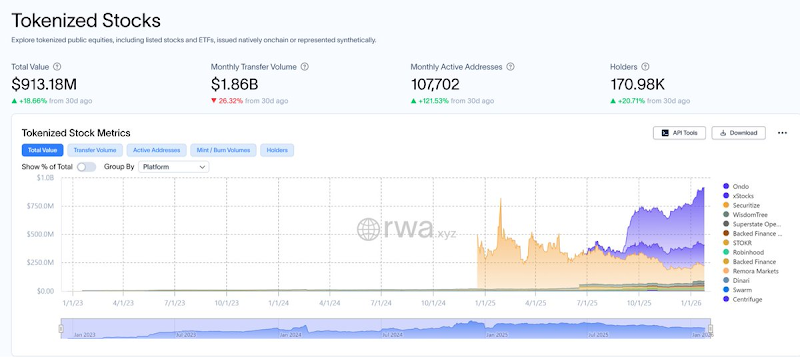
RWA.xyz data as of January 23, 2026
Tokenized stocks have experienced a true breakout year. In just the second half of 2025, this asset class grew by 128%, pushing its total asset value close to $1 billion.
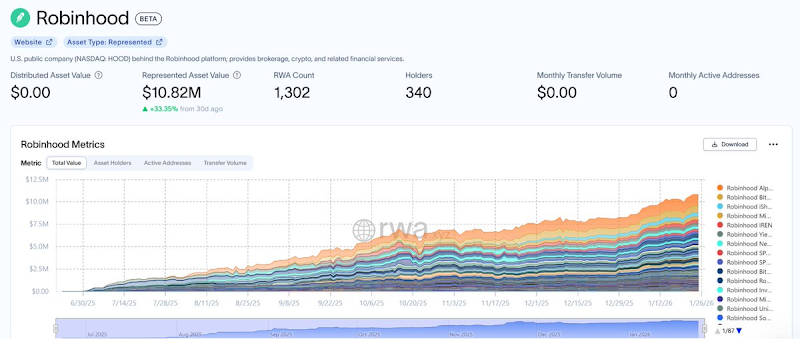
RWA.xyz data as of January 23, 2026
Robinhood's tokenized U.S. stocks and ETFs are now available to European customers. Each token is issued on the Arbitrum network, fully backed by stocks held by Robinhood, and enables 24/5 trading with zero commissions. Relevant data is available on RWA.xyz.
However, it turned out to be much more complex than expected to accurately capture the metrics of Robinhood's tokenized stocks.
Disadvantages
Most blockchain data platforms assume tokens follow standard conventions when indexing them. For ERC-20 tokens, this means tracking minting and burning events, accumulating the supply from zero, and calculating market capitalization as supply multiplied by price.
This works well for the thousands of tokens on Ethereum and other EVM networks. However, the ERC-20 standard was not originally designed for securities that undergo corporate actions. It natively does not support stock splits, reverse splits, or benchmark adjustments driven by dividends.
Therefore, Robinhood had to use custom contracts to properly handle these events to ensure the rights of its end users. These tokens function correctly within the Robinhood App, but their mechanisms are opaque to external data platforms and incompatible with DeFi protocols—because both assume the tokens conform to the ERC-20 standard.
When we compare the token supply calculated using the standard ERC-20 logic with the actual on-chain data, the differences are so significant that they cannot be ignored. For some tokens, the data deviates by 10 times, and for others, it's even as high as 100 times.
Almost all errors can be attributed to two causes: (1) dividend-induced erosion of net asset value and (2) stock reverse splits.
Net Value Erosion Caused by Dividends in High-Yield ETFs
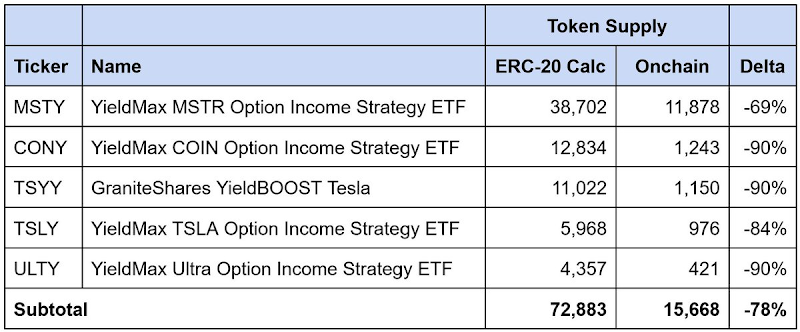
Data as of January 23, 2026
These are high-yield income ETFs that frequently distribute dividends, and 90% or more of these distributions are classified as "return of principal." Each distribution returns cash to investors, but it is primarily a return of the initial investment rather than investment earnings. The number of shares remains unchanged, while the net asset value steadily declines over time.
Robinhood's contract solves this issue by separating "shares" from "tokens." The number of shares held by investors remains unchanged, but an internal multiplier adjusts the reported token supply downward as principal repayments accumulate, reflecting the reduction in the underlying net asset value.
However, data platforms following the standard ERC-20 model simply add up the minted and burned amounts. This approach fails to capture the rebasing adjustments, thereby overestimating the circulating token supply and consequently overestimating the reported market capitalization.
Reverse stock split
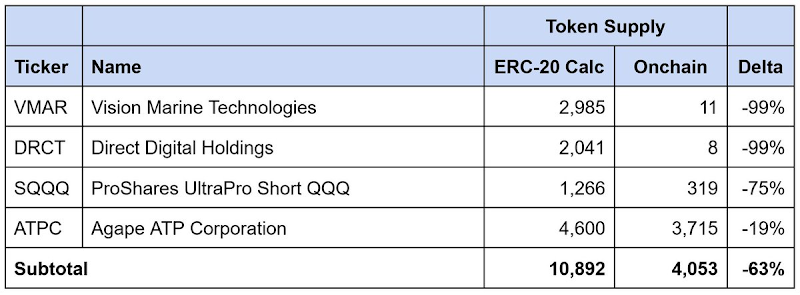
Data as of January 23, 2026
The same issue also appears in reverse stock splits. A reverse stock split increases the price per share by consolidating shares, usually to meet the listing requirements of an exchange. The number of shares decreases proportionally, while the price per share increases proportionally, keeping the total value unchanged.
Similarly, Robinhood's contracts adjust the token supply to reflect reverse splits, whereas third-party platforms following the standard ERC-20 model will overestimate the circulating supply and reported market capitalization.
Total data discrepancy of Robinhood
Data as of January 23, 2026
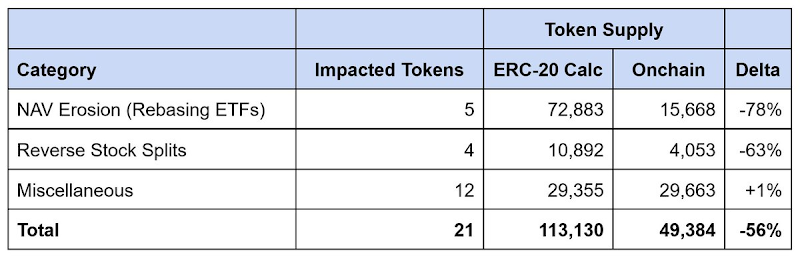
Among the 21 tokens we identified with data mismatches, the reported supply was overestimated by approximately 64,000 tokens, with discrepancies as high as 56%. High-yield ETFs accounted for about 90% of this gap, while reverse stock splits explained the remaining portion.
Any data platform that relies on standard ERC-20 logic to calculate supply will significantly overestimate the market capitalization of Robinhood tokenized stocks, often by multiples.
Solution
Tokenized Stock Taxonomy: Models and Infrastructure
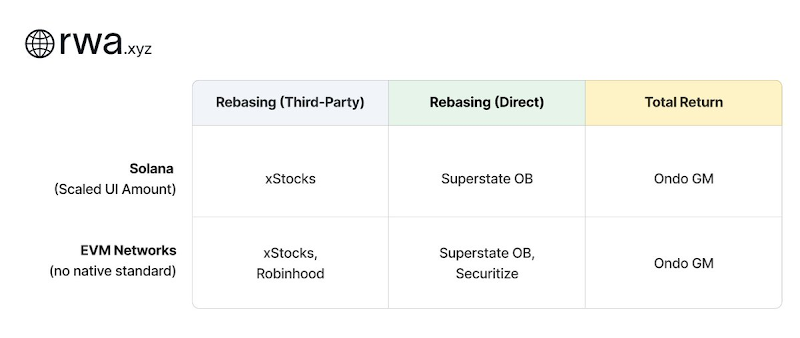
Tokenized stock issuers have adopted different approaches in handling corporate actions. They can generally be divided into two categories.
Rebasing Models
The base adjustment model maintains a parity between the token price and the spot price: that is, one token should always trade at a price close to one share of the underlying stock. When corporate actions occur, token balances are automatically adjusted to maintain this relationship. Issuers adopting this approach are divided into two camps based on their relationship with the underlying asset issuer:
- Third-Party Basis Adjustments: The issuer operates independently from the company whose shares are being tokenized. xStocks (@xStocksFi, part of Backed Finance / Kraken) and Robinhood (@RobinhoodApp) both adopt this approach. The tokens are backed by custodied shares; however, since they have no direct relationship with the underlying issuer, they only replicate economic exposure without conferring legal ownership.
- Benchmark Adjustment (Direct): The issuer partners with a publicly traded company to tokenize its shares. Superstate's Opening Bell (@SuperstateInc) and Securitize (@Securitize) operate as U.S. Securities and Exchange Commission (SEC)-registered transfer agents and serve as official shareholder registrars. Since the tokens are issued in coordination with the company, the tokens themselves are legitimate securities, and holders enjoy actual shareholder rights that cannot be provided by third-party models.
Both of these structures require multiplier infrastructure to reflect corporate actions on-chain.
Solana's Token-2022 standard natively provides a UI scaling extension. Issuers only need to update a multiplier, which adjusts the balance displayed in the user interface without changing the original token amount. For example, a 2-for-1 stock split would change the multiplier from 1.0 to 2.0; the wallet would display double the balance, while the underlying original token count remains unchanged. Since this standard is native to Solana, data platforms can directly query changes in the multiplier.
There is currently no equivalent standard on EVM networks. Issuers like xStocks and Robinhood have had to build their own multiplier mechanisms. While balance adjustments are accurate and wallets can display prices consistent with spot values, these implementations are all custom. Third parties relying on standard ERC-20 calls cannot detect when a multiplier changes or query its current value. As a result, it is necessary to understand each issuer's specific implementation individually.
Because of this, Chris Ridmann from Superstate and Gilbert Shih from Robinhood jointly drafted ERC-8056, a proposal aimed at introducing a standardized "scaled UI amount extension" for ERC-20 tokens. This will provide data platforms with a unified interface for tracking corporate actions across different issuers.