





Original author: @Decentralisedco
AididiaoJP, Foresight News
In a previous article, we explored how HIP-4 brings structured products to Hyperliquid. Robinhood has a similar approach, recently entering the prediction market space, as outlined in the table below.
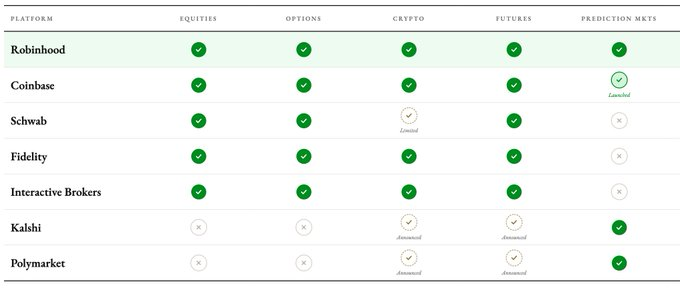
Fidelity, Schwab, and Interactive Brokers grew up in an era before prediction markets existed. Even spot cryptocurrency represents only a small portion of their overall offerings. In contrast, Robinhood serves a younger demographic that may want to bet on sports events, go long on semiconductor stocks, trade Solana frequently, and hold crude oil positions in futures markets. A generation raised on "monitoring the situation" will flock to platforms like Polymarket or Kalshi if Robinhood cannot offer the same risk assets.
One way to mitigate this risk is to offer event contracts. These are binary instruments that settle to either "yes" or "no." Each contract trades between $0 and $1, reflecting the market’s real-time probability of the event occurring. If your judgment is correct, the contract settles at $1; if incorrect, it settles at $0. The cost to enter a contract equals the probability of the event happening. For example, a contract priced at $0.60 for the Strait of Hormuz being open before May 30 signals the market’s belief in that outcome. If most participants are confident an event will occur, there is little room to profit from it.
On Robinhood, these tools can be used as hedging instruments. You can go long on the Strait of Hormuz remaining open while also going long on oil prices, assuming that if the strait remains closed, oil prices will stay elevated.
Robinhood launched its prediction markets business in March 2025, routing client trades through KalshiEX. Within nine months, users had traded 12 billion contracts, with approximately 70% of the annual trading volume concentrated in the fourth quarter. In the first quarter of 2026, Robinhood recorded 8.8 billion event contracts.
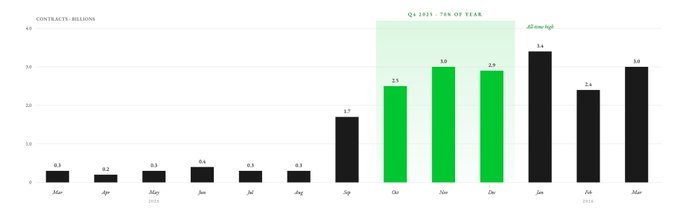
In 2025, over 1 million Robinhood customers traded event contracts. Robinhood did not launch these markets or build liquidity itself; instead, it directly integrated Kalshi’s prediction markets. Robinhood acts as a distribution layer by providing its customers with a dashboard. The entire infrastructure is currently supported by Kalshi (details to follow).
Kalshi and Polymarket dominate the market, accounting for over 90% of total trading volume in prediction markets. Robinhood distributes Kalshi’s contracts to its 27.4 million paying users, who invest across multiple asset classes including stocks, cryptocurrencies, futures, and options. Kalshi is merely a prediction market platform and cannot match this distribution capability.
In fact, Robinhood accounted for 50% of Kalshi's trading volume in its first year.
Although Coinbase allows users to trade stocks, cryptocurrencies, futures, and options (via its acquisition of Deribit), it only launched its prediction market business this past January. In contrast, Robinhood’s prediction market business has been operating for over a year and has generated annualized revenue exceeding $415 million. Robinhood’s monthly active users also far exceed Coinbase’s, at 13.5 million compared to Coinbase’s 9.2 million.
Prediction markets could evolve further on Robinhood. Currently, they exist as a standalone hub within the app, disconnected from the rest of the platform. But soon, they could be integrated across assets—Robinhood’s stock traders could directly purchase contract outcomes on prediction markets.
Imagine you open Nvidia’s stock page ahead of its earnings report. You’d see the usual information: the stock price and options chain. But now, you’d also see an event contract beside it: “Will Nvidia exceed Q2 revenue expectations?” The contract is trading at $0.72, indicating the market assigns a 72% probability to it exceeding expectations. You believe the market is underestimating demand for Nvidia’s products.
In this scenario, Robinhood allows you to buy shares, purchase call options, or buy 500 "Yes" contracts at $360—if your judgment is correct, you could earn a $140 profit ($0.28 profit per contract × 500 contracts).
Robinhood places all three tools on the same screen without requiring tab switching.
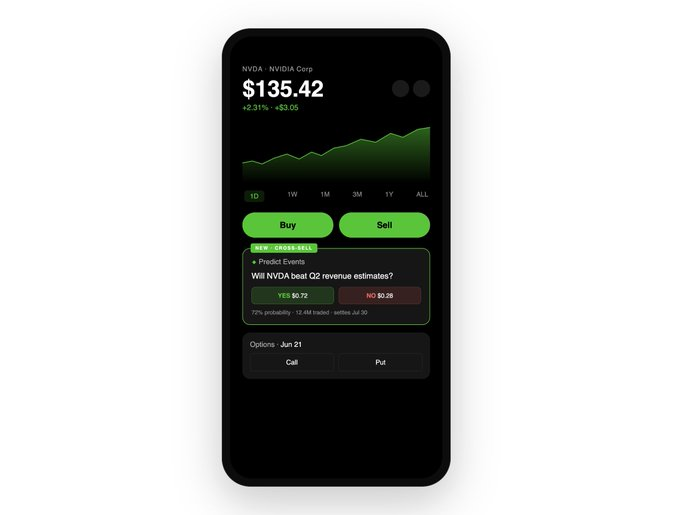
As previously illustrated with crude oil, you can also use these tools to hedge positions. You can bet on Nvidia exceeding expectations while simultaneously shorting the stock to hedge your prediction market wager. Thus, Robinhood enables you to build cross-asset hedging strategies on the same screen in under a minute.
So far, this integration on the stock trading page has worked well for Robinhood, but it’s still leaving money on the table. That’s about to change, as Robinhood is about to take the next step.
Richer information for pricing context
Robinhood’s moat lies in providing users with all the information they need, at the time and place they need it most. The era of buying Bitcoin on Coinbase, trading options on Deribit, holding stocks on Robinhood, and trading crude oil futures on IBKR is over. Users want to avoid switching contexts and platforms.
Once Robinhood integrates prediction markets into all asset pages, it transforms from a passive broker into an information-pricing platform. In addition to prices and analyst ratings, Robinhood will provide real-time probability markets for relevant events surrounding each stock. These event contracts reflect the real-time consensus of participants with real money at stake, helping users make better decisions—even if they’ve never traded a prediction market contract before.
Take Nvidia as another example. The stock price at any given moment reflects the sentiment of those holding the underlying equity. Associated with equity are legal rights, shareholder reports, analyst questions, and a framework developed over more than 400 years to protect investors. But often, traders may not care about these factors at all. The information they want to price might simply be: “Will Nvidia beat revenue expectations?” In such cases, prediction markets could arguably serve as a better source of pricing information than stock prices. Robinhood’s attempt to bring together derivatives, event contracts, equities, and other instruments under one roof is precisely aimed at capturing value from all users who might want to trade on that event.
But Polymarket and Kalshi have been doing this for years—what is Robinhood’s moat? Why build these markets in-house rather than simply integrating third-party markets into its platform to generate additional revenue? Cross-selling and trading volume more clearly reveal the incentive structure.
Cross-selling is also a regulatory moat.
In March 2026, two bipartisan bills were introduced aiming to ban sports-related event contracts at the federal level. Legal barriers also exist at the state level. This poses an existential threat to platforms like Kalshi, which derived 89% of its fee revenue in 2025 from sports-related event contracts. Approximately 60% of Polymarket’s open interest also comes from sports-related event contracts.
If sports contracts face legal setbacks, Kalshi and Polymarket will be hit the hardest. Without this dominant category, they cannot sustain valuations exceeding $20 billion. Although Robinhood initially launched with a heavy focus on sports markets, its cross-selling capabilities have enabled it to diversify revenue into stocks and macro events such as earnings reports, Federal Reserve decisions, CPI data, and employment reports.
For Robinhood, sports are just one component of revenue. For Kalshi, the sports category is nearly everything. Any regulatory crackdown on sports-related markets could impact Kalshi and Polymarket’s claims to valuations above $2 billion. Robinhood now occupies a higher position in its value chain through its joint venture, Rothera.
In November 2025, Robinhood established a joint venture named Rothera LLC. The joint venture subsequently acquired MIAXdx—a CFTC-licensed Designated Contract Market (DCM), Derivatives Clearing Organization (DCO), and Swap Execution Facility (SEF). This fundamentally transformed the economic model, control, ownership, and clearing and settlement processes for event contracts.
Relying on Kalshi to provide event markets limited the types of contracts Robinhood could list on its prediction market. Rothera enables Robinhood to list any event contract at any time.
From an economic perspective, this could mean Robinhood captures the one-cent fee currently going to Kalshi, doubling its event contract revenue. If Robinhood can direct half of this revenue to its own entity, its prediction market income could increase by 50% to $620 million at current event contract fee rates.
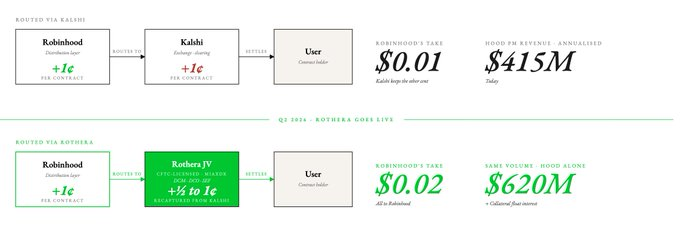
We have reason to remain optimistic about this joint venture, as its latest quarterly results reveal that Robinhood has begun allocating resources to Rothera. The first-quarter 2026 results included $14 million in joint venture-related costs. There’s also a secondary benefit: once prediction market contracts are routed through Rothera, the collateral backing open positions will be recorded on Robinhood’s balance sheet, generating additional interest income. When the collateral value tied to open interest reaches approximately $100 million, this could add an additional $4–5 million in annual revenue.
Every trading platform has a simple mission: either encourage traders to move funds as frequently as possible and charge a small fee on each trade, or entice them to deposit large amounts of idle capital and retain the interest income. For Robinhood, it appears the latter strategy is being adopted.
Robinhood’s cross-selling moat achieved through prediction markets is similar to the moat we previously believed Hyperliquid gained through its HIP-4 event contracts. Hyperliquid’s unified risk engine integrates primitives such as spot, perpetuals, deployment markets, and prediction markets, ensuring efficient capital utilization in decentralized markets. The same logic applies to Robinhood, albeit within centralized markets.
Kalshi lacks Robinhood’s moat of distribution across different asset classes. A standalone prediction market product is worth far less than a prediction market embedded within a full suite of trading products. Coinbase has just entered the prediction market space, while Robinhood’s integrated platform, combining all asset classes with event contracts on a single screen, gives it a head start over Coinbase in the prediction market domain.
Let the numbers speak
Any discussion comparing the valuations of Coinbase, Kalshi, and Robinhood is essentially trying to answer the same question: What is the lifetime value of a user on each platform? Kalshi may have fewer users, but they pay significantly higher fees. The same user, if Robinhood could match Kalshi’s liquidity at lower fees, would trade entirely on Robinhood.
The market has already recognized this difference. Kalshi and Robinhood have similar valuation multiples (both at 15x), while Coinbase’s multiple is lower at 7.5x. For Kalshi, prediction markets account for all of its revenue. For Robinhood, they account for just 7%. For Coinbase, the figure is negligible.
Once Rothera launches, Robinhood can price more competitively than any independent prediction market platform. It can lower Kalshi’s fees, absorb margin pressure, and still grow, since every prediction market user is also a potential customer for stocks, options, and cryptocurrencies. Kalshi has not remained silent and is reportedly planning to launch cryptocurrency trading, starting with perpetual contracts. However, transitioning from a prediction market to a multi-asset platform is far more difficult than integrating prediction markets into a multi-asset trading platform.
Robinhood has spent over a decade building 27.4 million paying users, along with deep liquidity, market-making, compliance infrastructure, and user trust. Kalshi will have to start from scratch.
One way to understand the value of this business is to spin off Robinhood’s prediction market segment as a standalone entity. If it had $415 million in ARR and the same growth trajectory, what would it be worth? The simplest answer is 15 times Kalshi’s valuation, or $6.2 billion. However, under otherwise identical conditions, a Kalshi with Robinhood’s revenue stream would be valued significantly higher.
We constructed our three-year forecast model using the following assumptions:
- Contract volume: Under the base case scenario, 70 billion event contracts by 2028. This assumes a compound annual growth rate of approximately 40% over the next two years, based on Robinhood’s 8.8 billion contracts recorded in the first quarter of this year (annualized to approximately 35 billion).
- Rothera Economics: We expect effective revenue per contract to rise from $0.01 to $0.015 in a bear market scenario, or $0.02 in a base/bull market scenario (after three years).
- Cross-selling uplift: 1.0x multiplier in 2026 (cross-selling not yet live), 1.1x in 2027 (basic stock page launch), and 1.2x in 2028 (mature adoption). This assumes cross-selling adds only 10–20% incremental trading volume on top of organic market growth forecasts.
- Robinhood total revenue: Using consensus estimates, $5.4 billion in 2026, $6.4 billion in 2027, and $7.2 billion in 2028.
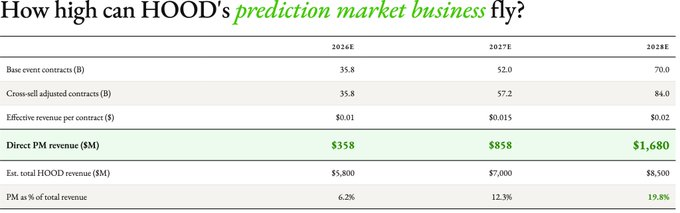
We then conducted stress tests for three scenarios—bear market, base case, and bull market—for the year 2028.
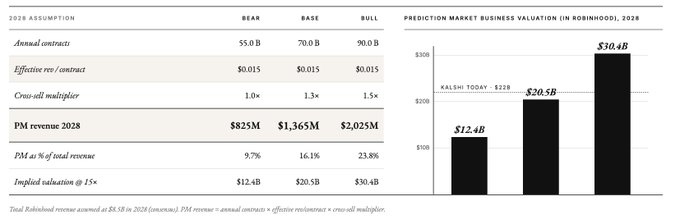
Even in a bear market scenario, Robinhood forecasts that its prediction market business will generate $825 million in revenue by 2028—more than three times Kalshi’s 2025 revenue of $260 million. Using Kalshi’s current revenue multiple of 15x, Robinhood’s prediction market business would be valued at $12 billion under this scenario, and up to $30 billion under the most optimistic scenario by 2028.
What we’re likely seeing is a company with a distribution moat entering a brand-new market and capturing most of the value for itself. The open question is whether Polymarket and Kalshi will replicate OpenSea’s 2021 trajectory—or whether they can successfully reinvent themselves as new threats emerge. Polymarket has recently expanded into perpetual products, but its users are unlikely to shift to perpetual trading simply because prediction markets were their original intent. In contrast, Robinhood benefits from a core user base that has consistently gravitated toward its high-risk, zero-fee trading tools. The latter appears to hold a distinct advantage.
Today, the market views Robinhood as a traditional financial broker with an added prediction market product, which is why prediction markets account for only 7% of its revenue. But if Robinhood CEO Vladimir Tenev delivers on his stated direction, Robinhood will become a platform that simultaneously prices financial opinions on earnings, interest rates, elections, and commodities in real time, while also enabling trading in the assets driven by those opinions.
A standalone prediction market will only attract those who already trade event contracts. In contrast, a prediction market integrated into a retail brokerage becomes an information-pricing engine for everyone else. Vertical integration of capital aggregators is ubiquitous.