



After leaving Meta, Tian Yuandong also started his own business.
Just now, the startup Recursive_SI officially launched and disclosed its founding team, which includes Tian Yandong.
In addition to Tian Yuan Dong, the founding team includes Richard Socher (CEO), Tim Rocktäschel, Jeff Clune, Tim Shi, Caiming Xiong, Alexey Dosovitskiy, and others.
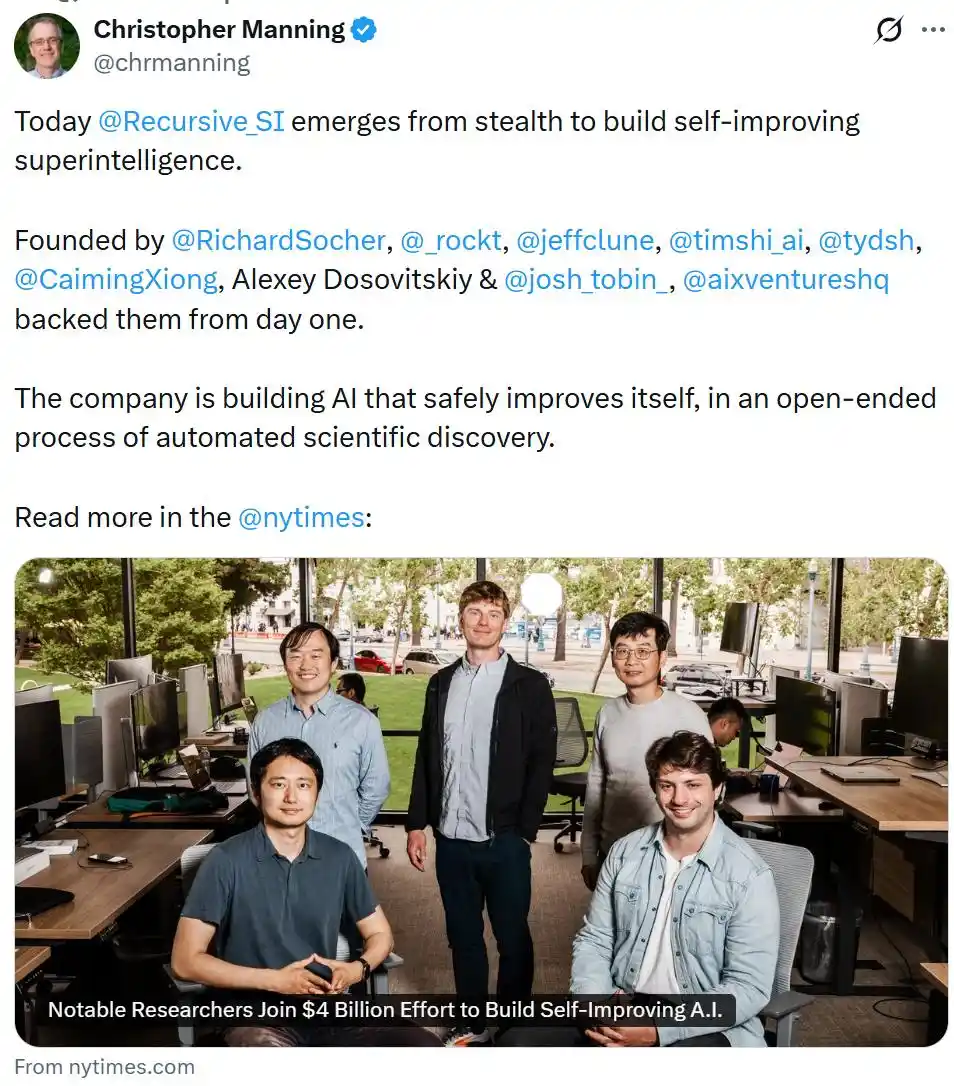
These founding members previously helped establish the AI research labs at Salesforce and Uber and have held leadership roles at teams including OpenAI, DeepMind, Google Brain, and Meta, bringing extensive research and entrepreneurial experience.
Recursive_SI is dedicated to building an artificial intelligence that can autonomously conduct experiments and safely improve itself—continuously evolving through an open-ended, automated scientific discovery process, widely regarded as the most likely path to superintelligence.
Recursive has raised $650 million at a $4.65 billion valuation, led by GV (Google Ventures) and Greycroft, with significant investments from AMD Ventures and NVIDIA.
The team has grown to over 25 members and continues to expand, attracting many talented individuals, including Zhuge Mingchen, who will soon join.
Zhu Ge Mingchen is a founding member of Recursive. He earned his Ph.D. in Computer Science from King Abdullah University of Science and Technology (KAUST), where he was advised by Professor Jürgen Schmidhuber, known as the "father of LSTM." His research focuses primarily on coding agents, recursive self-improvement (RSI), and next-generation machine paradigms.
Since 2023, Zhu Ge Mingchen has been systematically exploring the direction of Recursive Self-Improvement (RSI).
During the MetaGPT era, he proposed that agents should possess mechanisms for continuous self-optimization and capability evolution, and has since consistently advanced this research direction. Among these, GPTSwarm is regarded as one of the earliest RSI system paradigms in the LLM era, being the first to systematically propose and validate a self-organizing collaborative framework based on graph-based agents, using dynamic graph structures to enable coordination, feedback, and capability evolution among agents—a core idea subsequently widely adopted by numerous follow-up multi-agent and agentic AI works. Agent-as-a-Judge further explored continuous feedback and self-assessment mechanisms in long-term tasks, aiming to address issues of continuity and stable optimization for agents in complex tasks. Meanwhile, research on NeuralComputer pushed further toward next-generation AI system architectures, exploring novel machine paradigms that integrate memory, reasoning, and autonomous evolution capabilities.
It is evident that the Recursive research team has deep academic experience in the area of recursive self-improvement.
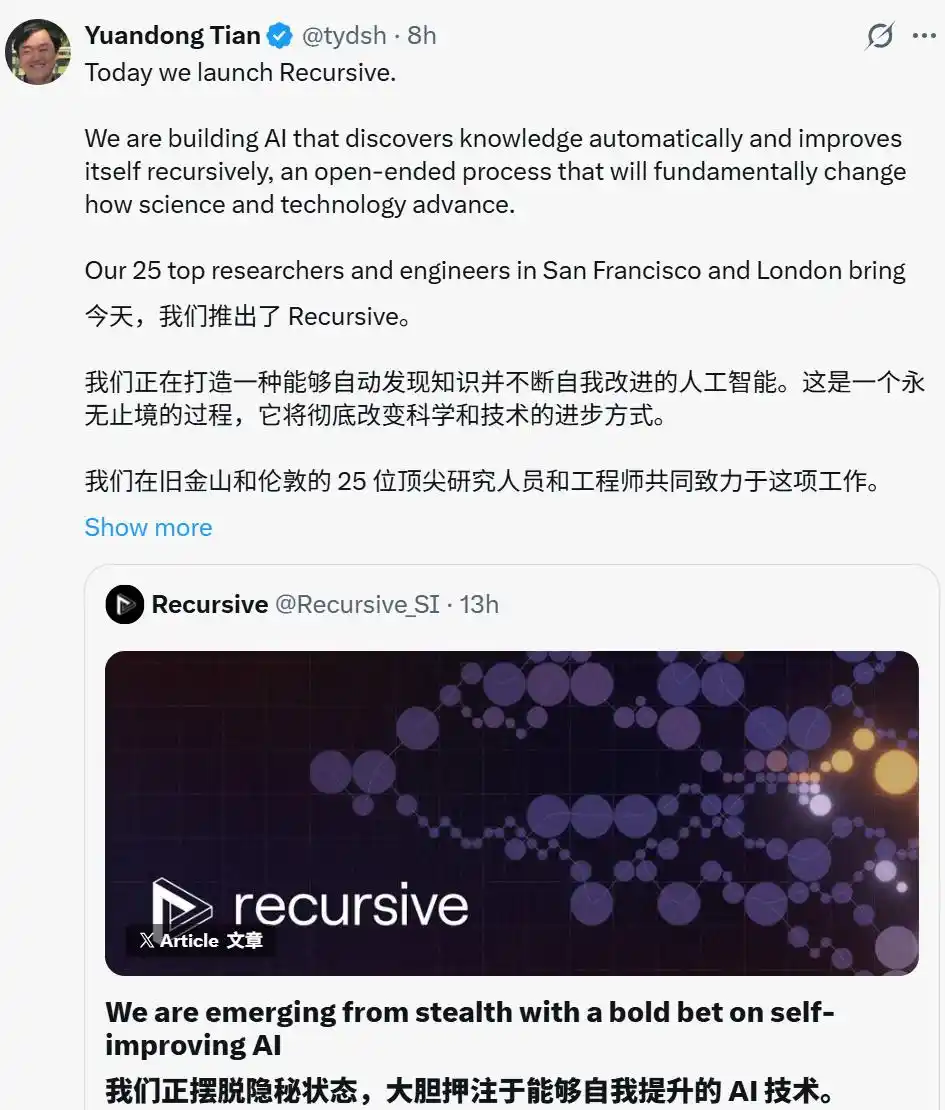
Founders including Tian Yandong have promoted on X: We are building an artificial intelligence that can automatically discover knowledge and recursively self-improve—an open process that will fundamentally transform how science and technology advance.
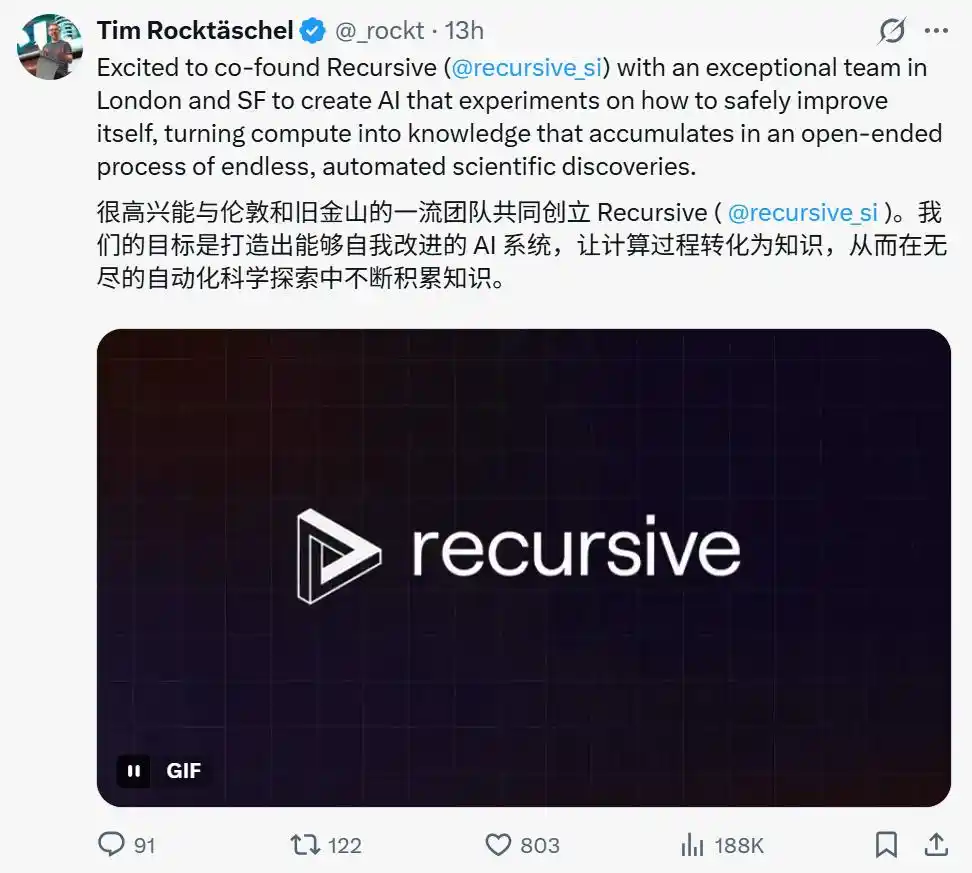
The team is at the forefront of the industry across multiple core areas of recursive self-improving artificial intelligence.
Members have made significant breakthroughs in open-ended algorithms, quality diversity algorithms, AI-generated algorithms, self-improving programming agents, automated red-teaming and capability discovery, prompt engineering and its automation, learning challenges and environment generation, foundational world models, deep learning for natural language processing, vision transformers, retrieval-augmented generation, and AI scientists.
Therefore, we are truly looking forward to the next phase of research on Recursive_SI.
This article is from the WeChat public account "Machine Heart," authored by Machine Heart, edited by the Machine Heart editorial team.