





Since the beginning of 2026, multiple capital pools with considerable earning potential have emerged in the Berachain ecosystem. Among them, the Pre-deposit event recently launched by Prime Vaults has stood out particularly, becoming one of the most attractive earning protocols currently available. Although overall returns have slightly declined as TVL continues to rise, the APY of the PrimeUSD pool remains around 23% (supporting multiple stablecoins for staking), while the APR of the PrimeBERA pool even reaches as high as 118%, still ranking among the top earning tiers in the current DeFi market.
In addition to the above pools, Prime Vaults also supports staking of BTC and ETH, with the corresponding PrimeBTC and PrimeETH pools currently offering APRs of 5.87% and 9.22%, respectively. These rates are among the higher end of the industry, balancing stability with strong returns.
Focusing on the Prime Vaults protocol itself, it is primarily positioned as a smart strategy machine gun pool protocol, aiming to address the pain points of traditional DeFi vaults, such as high risk, reliance on short-term incentives, and asset siloing, providing a more stable and sustainable yield solution, and offering users a foolproof one-click yield method, simplifying the complexity of participating in DeFi.
A unified yield architecture centered around "On-chain savings accounts"
Focusing on the product itself of Prime Vaults, which centers around the concept of "on-chain savings accounts," its goal is to provide users with sustainable passive returns while ensuring principal safety and a minimum level of yield. Unlike traditional DeFi Vaults that commonly feature isolated asset structures, Prime Vaults adopt a unified architecture to centrally manage and allocate funds, significantly enhancing capital allocation efficiency and overall risk control capabilities.
Its most core innovation lies in the unified revenue model.
Under this model, various assets deposited by users (such as USDC, WETH, WBTC, WBERA, etc.) are not tied to a single strategy or a single asset pool, but are consolidated into a shared liquidity pool. The system dynamically allocates them to multiple risk-adjusted strategy combinations based on real-time returns and risk conditions. This design enables funds to "intelligently flow" between different assets and different strategies, capturing better return opportunities without compromising security.
The unified yield model itself also supports cross-chain and parallel multi-strategy operations. Prime Vaults can allocate funds across different chains and protocols, deploying liquidity to the most efficient yield scenarios, while executing multiple strategies such as lending and liquidity provision in parallel. This approach not only reduces the friction costs caused by frequent internal swaps, but also minimizes the problem of liquidity fragmentation, making the overall yield distribution smoother and more stable.
Its revenue sources are not dependent on a single incentive mechanism, but are composed of multiple factors including base interest rates, strategy returns, and cross-chain opportunities. These are ultimately consolidated, settled, and distributed to users, reducing the risk of significant fluctuations in returns from a structural perspective.
Let's take the earnings path of WBERA and stablecoins in Prime Vaults on Berachain as an example:
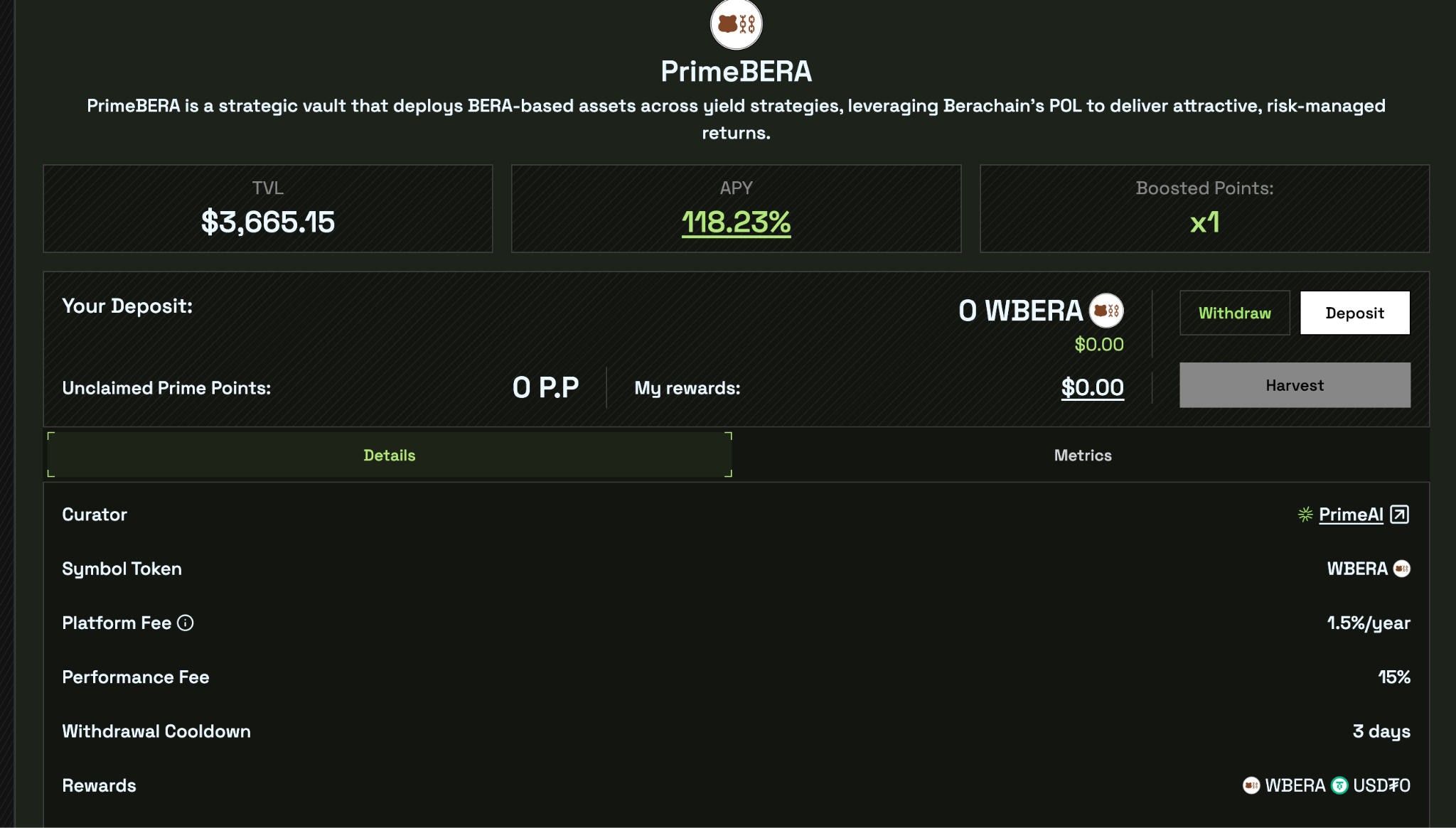
High Yield Generation Logic under WBERA Deposits (PrimeBERA)
In the Berachain ecosystem, the high-yield capabilities of Prime Vaults are most typically reflected in native asset pools such as PrimeBERA.
Taking the example of a user depositing 1,000 WBERA into the PrimeBERA Vault, these funds will not simply be used for a single BERA staking or liquidity mining, but will first enter the unified liquidity pool of Prime Vaults, participating in cross-strategy scheduling together with assets such as ETH and BTC. On this basis, the system prioritizes deploying the funds into Reward Vaults and high-efficiency strategies within the Berachain ecosystem that have passed the whitelist screening.
The core source of revenue under this path comes from Berachain's PoL mechanism. As is well known, PoL itself does not directly reward transactions or staking behavior, but instead incentivizes contributions to network security and ecosystem activity through the governance token BGT.
As protocol-level participants, Prime Vaults can deploy liquidity from the unified pool into designated Reward Vaults (such as BERA staking or BERA-related LPs) and receive approximately 33% of the incentive redirection from validators' BGT emissions. This portion of BGT is not directly exposed to users, but is instead converted into WBERA through an auction mechanism and automatically reinvested into users' shares, thereby forming continuous compounding.
In addition to this, the system will also route part of the WBERA liquidity to high APY LP pairs on Berachain (such as the BERA/USDC pool), thereby obtaining dual income from trading fees and PoL subsidies. If the local Berachain opportunities decline in a certain phase, funds may also temporarily flow to lending or yield strategies on other chains such as Arbitrum, under the premise of controllable risk. However, the overall management will still use the Berachain ecosystem as the income anchor.
In the early stage of the current pre-deposit, due to the still small TVL scale and relatively fixed PoL incentive pools, PrimeBERA's APR once amplified to about 118%, of which approximately 80-100% of the earnings directly came from BGT emissions, and the rest was contributed by the base interest rate, trading fees, and cross-chain strategies. All earnings are uniformly settled after the system's periodic harvest and automatically added to the user's net asset value, without the need for manual claiming. It should be noted that this high APR is essentially the result of amplified early incentives. As TVL grows, the level of returns will gradually return to a more sustainable range, but its long-term support logic still comes from the systematic incentive mechanism of PoL.
Stable Return Generation Logic for USDC Deposits (PrimeUSD)
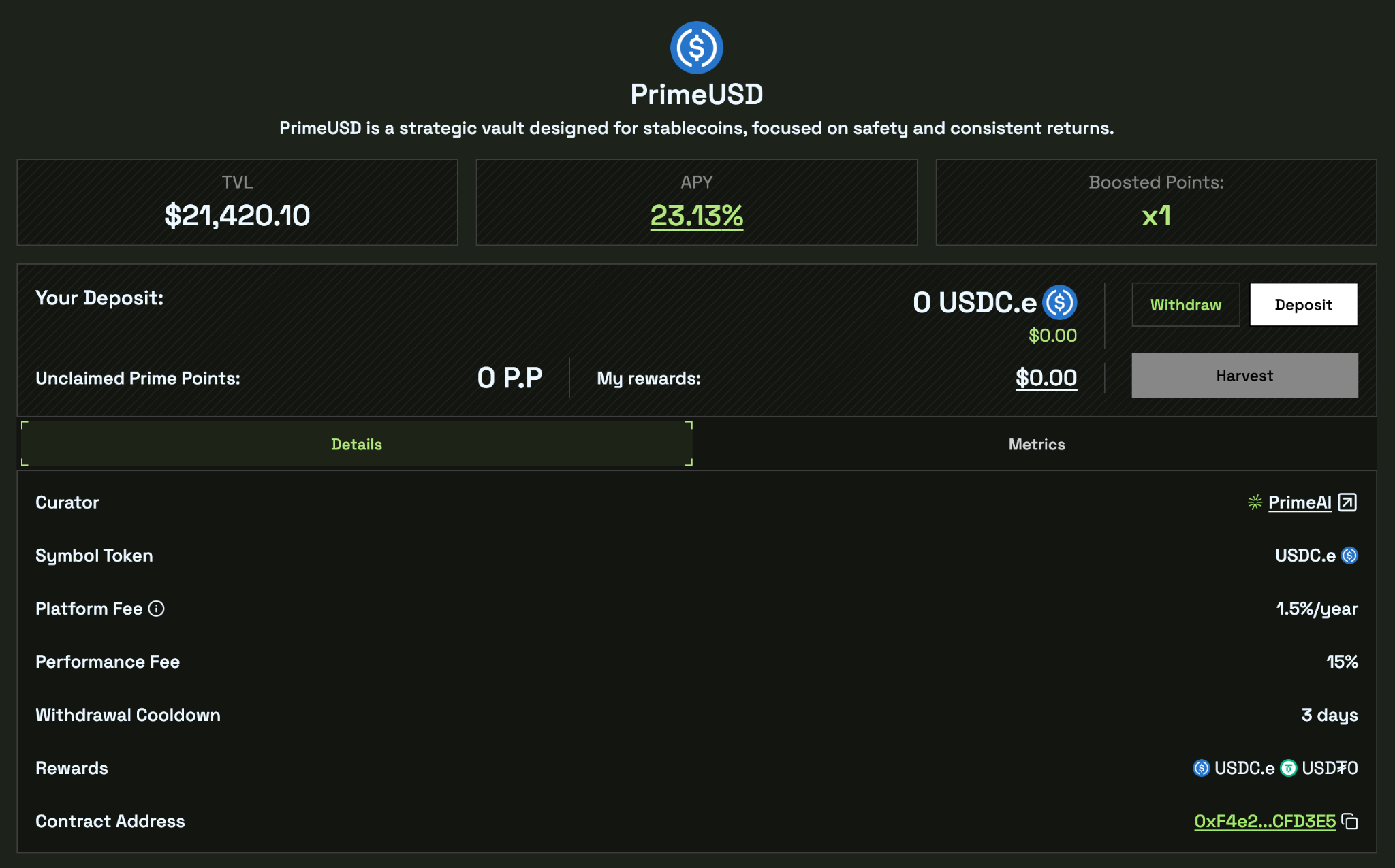
Compared to the high volatility return path of native assets, PrimeUSD better demonstrates the structural advantages of Prime Vaults in stablecoin scenarios. Taking the example of a user depositing 1,000 USDC into the PrimeUSD Vault, this portion of funds also first enters a unified liquidity pool, rather than being restricted to a single USDC strategy. The system will prioritize deploying the USDC into lending markets within the Berachain ecosystem to obtain stable base interest rate returns, with the benchmark return typically aligned with the supply rate range of major lending protocols (approximately 5–10%).
Based on this, Prime Vaults will further leverage Berachain's PoL mechanism to "add a layer of leverage" to stablecoin yields. By directing USDC liquidity to stablecoin pools or related Reward Vaults that meet PoL incentive criteria, the protocol can additionally obtain BGT subsidies. This enables USDC to no longer just passively earn lending interest, but also indirectly participate in Berachain's liquidity security and governance incentive system. As the Berachain RWA-related ecosystem gradually matures, this path may in the future also add extra yield sources from off-chain cash flows mapped onto the chain.
In addition, the unified yield model also allows the system to combine a portion of USDC with ETH or BTC under controlled risk, participating in multi-asset-driven strategies (e.g., stablecoin + volatile asset LP structures), thereby earning trading fees and incentive yields. Unlike traditional stablecoin Vaults that can only "do USDC strategies with USDC," Prime Vaults enhance the overall efficiency of capital units through cross-asset collaboration.
At the current stage, PrimeUSD's APY is approximately 23%, of which about 10% comes from the base lending rate, while the rest is contributed by PoL incentives, cross-asset strategies, and cross-chain optimizations. Principal and earnings are clearly separated within the system, with principal prioritized for protection, while earnings are settled periodically and can be flexibly withdrawn. Compared to traditional Vaults (such as models relying solely on a single asset or a single derivative income), Prime Vaults enhance the resilience of stablecoin returns in volatile environments through a multi-source, low-correlation earnings structure.
Risk Management System
While building a robust income system, Prime Vaults clearly adopts "safety first" as the fundamental principle in product design.
The system buffers and constrains the risks common in DeFi through multi-layer mechanisms, rather than simply pursuing a high APY.
To protect asset security, the protocol clearly separates user assets into principal and earnings. The principal is only deployed into strategies that have undergone strict screening, and the impact of strategy volatility, impermanent loss (IL), or adverse events is absorbed by the IL Reserve Fund (non-permanent loss reserve fund), aiming to safeguard the principal as much as possible under normal market conditions.
At the same time, Prime Vaults has set a minimum yield guarantee mechanism for different assets, with the benchmark referring to the deposit interest rate level of major lending protocols (such as Aave V3). Even in the case of incentive decay or a weak market, user returns will not fall below industry benchmarks, thus avoiding the typical Vault risk of "high yield—high fall." The size and use of the reserve fund are dynamically managed by the system to ensure solvency of the entire protocol while assuming risks.
Based on this, Prime Vaults has further introduced multiple system-level protective measures, including circuit breakers that automatically trigger under extreme market conditions, as well as a protocol health index for real-time monitoring of capital exposure and solvency. All key data can be verified through On-chain Proof of Reserves (https://app.primevaults.finance/proof-of-reserves), ensuring transparency in fund deployment paths, asset locations, and protocol endorsements.
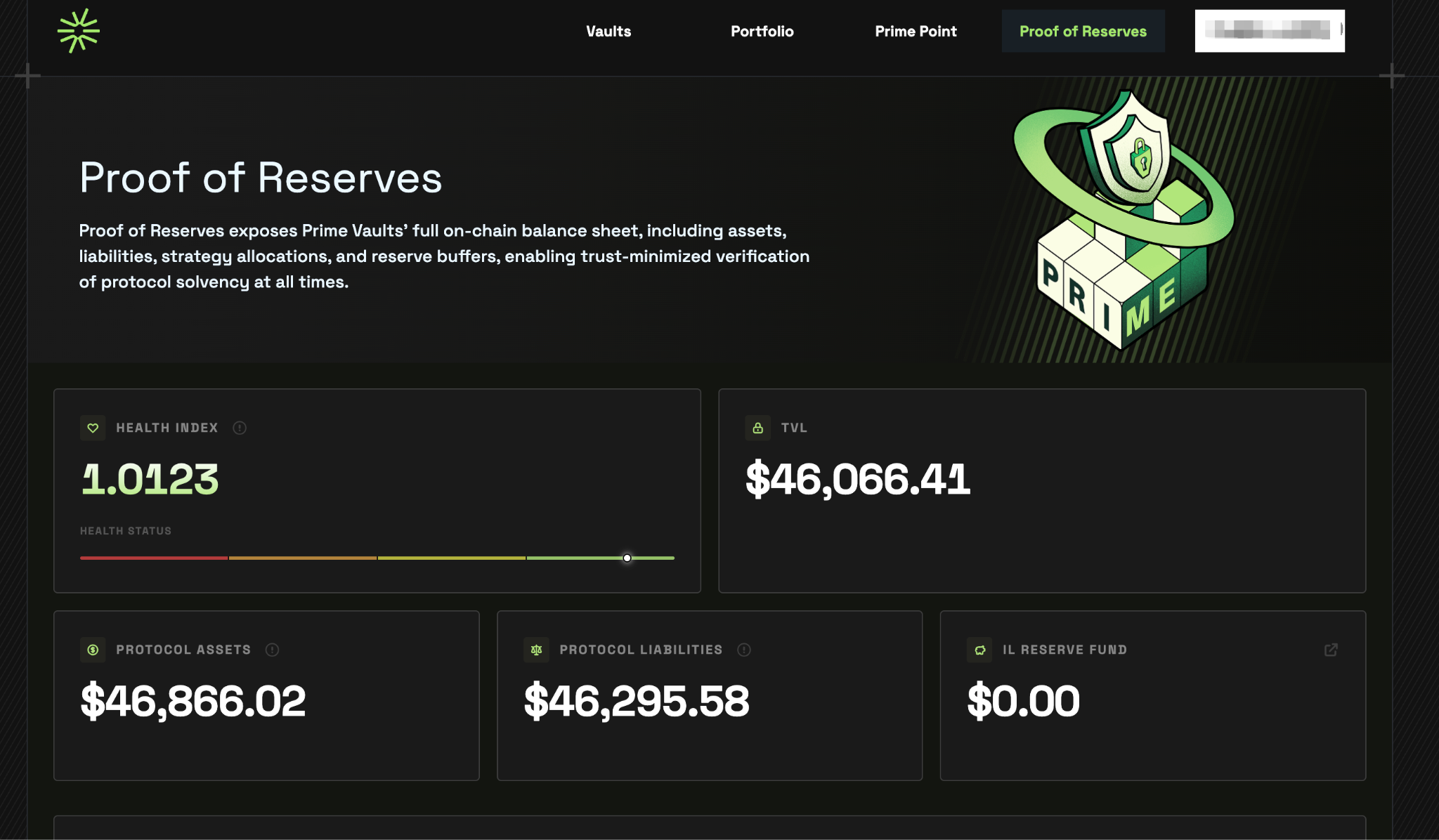
Based on this framework, Prime Vaults positions its product more as a verifiable and composable on-chain savings account, rather than a high-risk-return Vault in the traditional sense. This mechanism, built on structured risk control and a unified yield model, makes it more suitable for users who seek stable returns without the need to frequently monitor and adjust their strategies, and also forms its core differentiation in the current DeFi market.
Potential points incentives
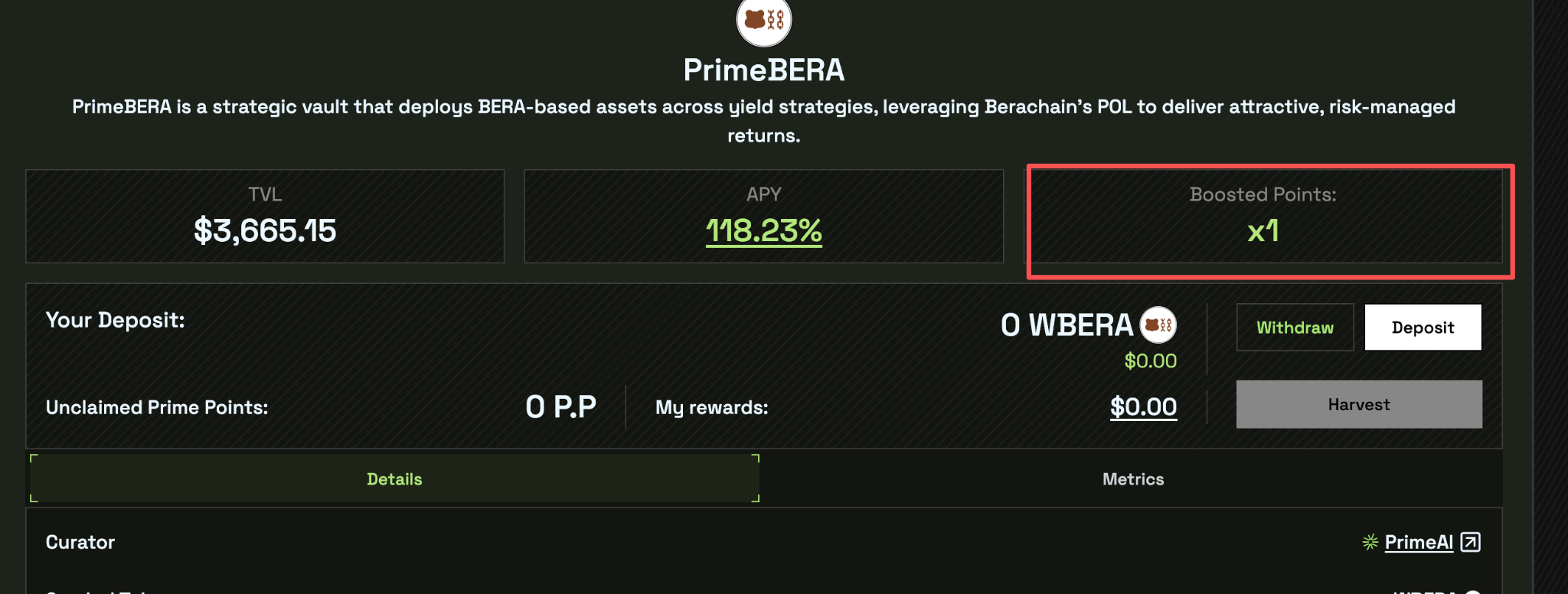
Currently, when we participate in its Pre-deposit deposit promotion, we can see a Boosted Points section, which means that participating in deposits will earn us points rewards, and we can see our specific points details in its Prime Point section.
For users familiar with the Berachain ecosystem, it's a familiar recipe. Combined with Prime Vaults, a newly launched project with a currently healthy growth momentum, the points system is likely to serve as an important reference dimension for user incentives and rights distribution at key milestones in 2026 (such as TGE), with potential airdrop expectations. Therefore, for Berachain users who previously missed early opportunities like Infrared Finance or Kodiak, Prime Vaults may currently offer a new participation window that provides multiple benefits.