





Article by: Mah, Foresight News
On February 28, the United States and Israel launched a joint airstrike on Iran, resulting in the death of Iran's Supreme Leader, Ali Khamenei. The attack shook the Middle East's geopolitical landscape, and in the 21st century, as战火 continues to spread, its war impacts have sent ripples through prediction markets in the crypto world.
Polymarket and Kalshi have become another battlefield, where traders bet on the timing of attacks, regime changes, and ceasefire dates, with trading volumes soaring to astronomical levels.
In times of war, someone is always quietly making a fortune.
Polymarket has become a barometer for conflict. Since December last year, they have offered markets on "When will the U.S. strike Iran?" with various date options.
The prediction market "Will Khamenei step down before February 28?" recorded a single-day trading volume of $95.93 million on February 28, becoming one of the largest geopolitical markets in platform history, with a trading volume of $54.15 million on March 31.
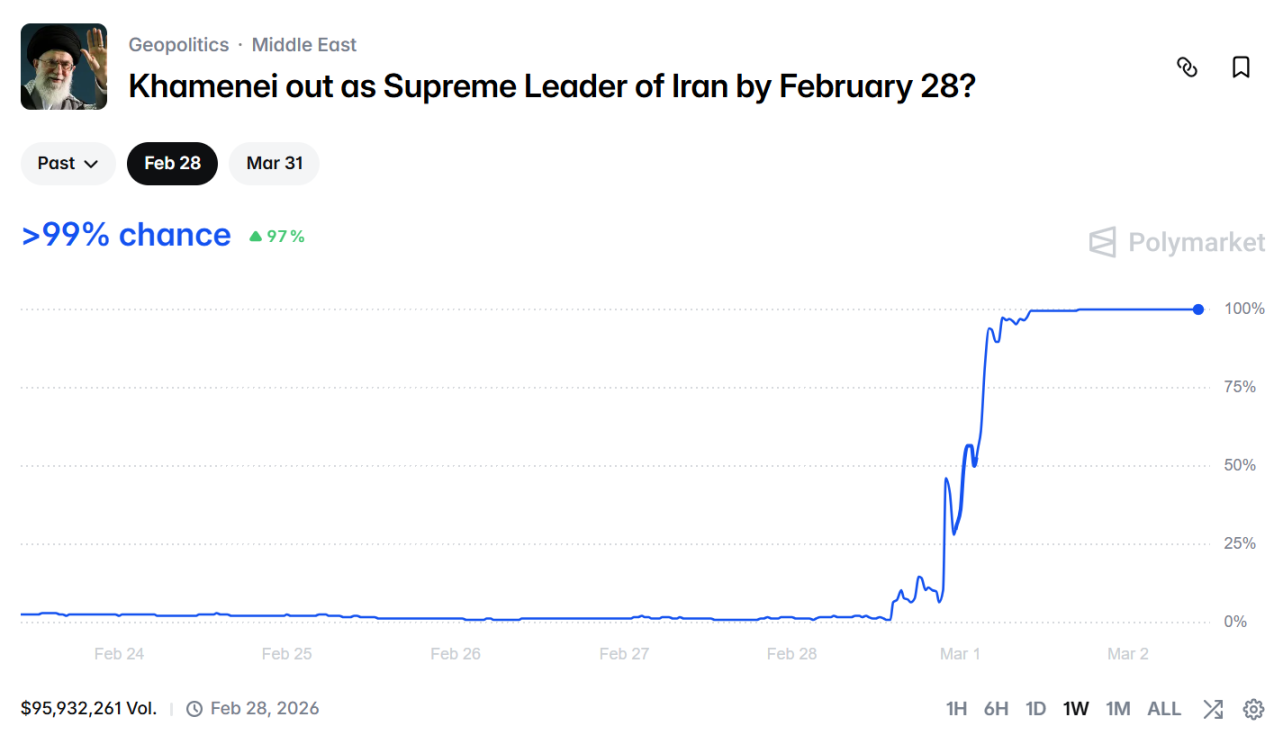
After the attack was confirmed, this market quickly settled as "Yes" (it is still in the final dispute period), because Ayatollah Khamenei's death directly resulted in his "removal from office."
Although Polymarket currently charges no trading fees on the vast majority of standard markets on its platform—including all political, geopolitical, pop culture, and long-term macro events—it introduced fees on specific high-frequency trading markets in early 2026, significantly boosting its revenue growth as its brand reach expanded.
In addition, Polymarket Global employs a profit-based fee model. The core principle is that users do not pay fees when placing buy or sell orders, but the platform charges a 2% fee on net profits when users realize gains—this model taxes only the "winners."
For example, as shown in the figure, if the winner's total net profit is $10 million, their single prediction market revenue reaches $200,000.
Traders flocked to these markets not only for the thrill but also because they reflect news in real time—much faster than traditional media. As soon as news of the attack broke, contract prices moved instantly, demonstrating the market’s “efficiency.”
There are always winners in war. In the past, those who profited from conflict were typically arms dealers, oil giants, or intelligence brokers—think Lockheed during World War II or oil magnates during the Cold War, who reaped enormous profits through contracts and resource monopolies. Ordinary people? At best, they were mere spectators, for whom war meant loss and uncertainty. But today, crypto prediction markets have disrupted this dynamic. Platforms like Polymarket allow retail investors to bet on geopolitical events—from the timing of U.S.-Iran airstrikes to the probability of regime change—with just a few clicks, giving them a share of the profits.
However, participating in this game blurs moral boundaries. This shift is poignant: the "profits" of war have expanded from physical supply chains to digital gambling tables. Arms dealers still profit, but prediction markets have turned ordinary users into new players. They don’t produce missiles, yet they can “predict” explosions on the blockchain and reap substantial gains.
When conflicts escalate, platform trading volumes surge, and wartime economics have gone digital.
But this has also raised many questions—will the thrill of making money dilute sympathy for real suffering?
Kalshi, as another player, also got a share of the pie. Its market on "Will Khamenei step down?" saw trading volumes ranging from tens of millions of dollars (varies slightly by source). On the day of the attack, trading in this market surged, reaching tens of millions of dollars in a single day.
However, Kalshi's approach has sparked controversy. The platform's rules include a "death not settled" clause, meaning that if a resignation is caused by death, the "yes" contract will not be paid out in full.
After the attack, Kalshi suspended the market, and CEO Tarek Mansour posted on X explaining that they oppose profiting from individual deaths, so settlements would be based on the last trade price before the death, with all fees fully refunded. Mansour emphasized this was to uphold a “moral底线” and prevent the platform from becoming a “death betting pool.” Some users complained it felt like a rule change mid-event, but Kalshi maintained it was a pre-existing clause, with details only clarified the day before the attack.
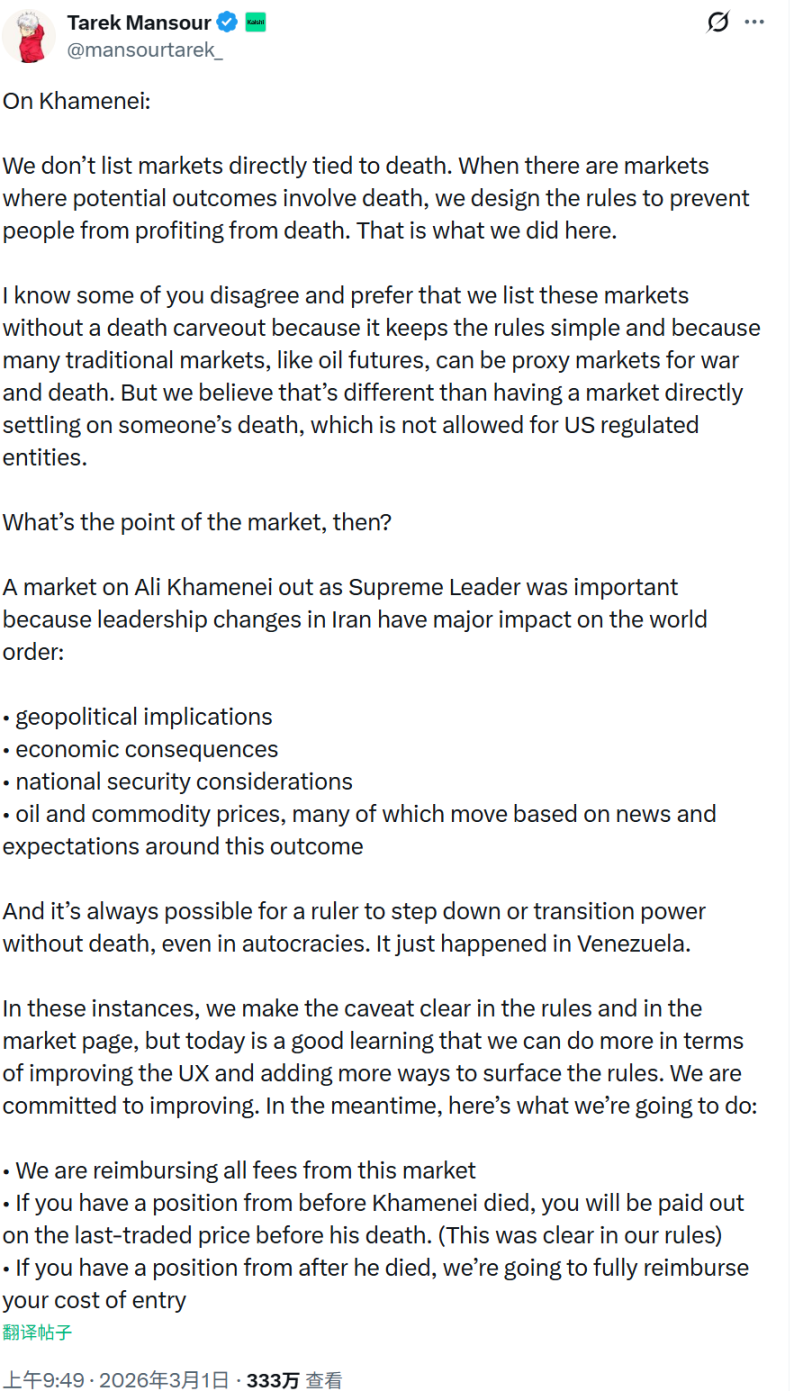
As a result, the platform lost money but gained a reputation for “not profiting from the dead.”
Polymarket's high user anonymity has attracted global capital; Kalshi is more compliant but restricts markets related to war and assassination.
However, while most players are betting based on intuition, some insiders are quietly making huge profits.
On Polymarket, some accounts placed bets with uncanny timing, raising suspicions of insider trading. Blockchain analysis firm Bubblemaps found that six newly created wallets bet on a U.S. strike against Iran on February 28, collectively profiting around $1 million just hours before the attack.
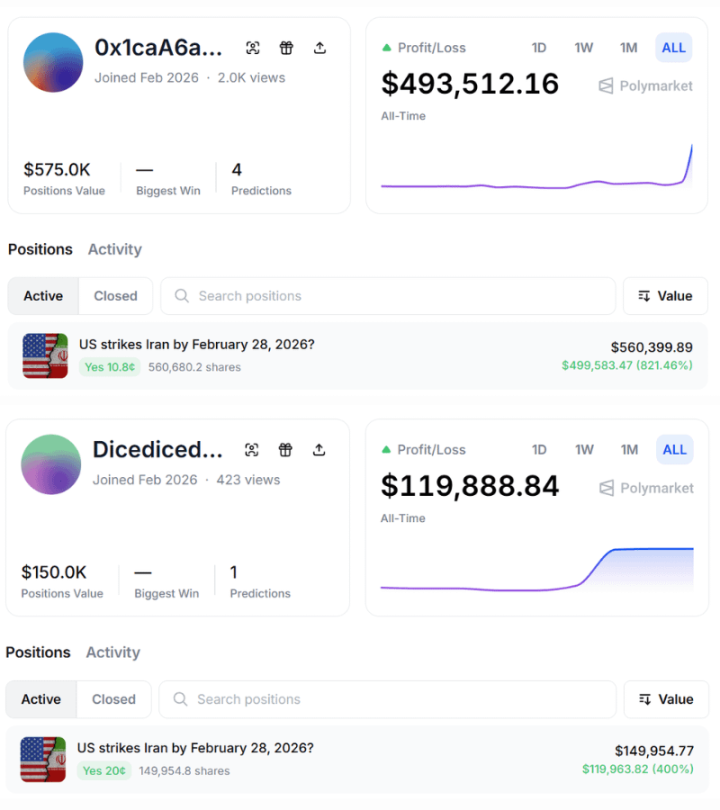
These six wallets were all created in February this year, with nearly all trading concentrated on contracts predicting the timing of U.S. military strikes. Some positions were established hours before the first reports of explosions in Tehran, with contract purchase prices as low as approximately $0.10. Analysts say that this type of concentrated betting ahead of major geopolitical events exhibits characteristics similar to previously observed "suspected insider trading" in prediction markets.
However, the report also noted that the relevant accounts had previously incurred losses on other predictions, and the U.S. government had publicly warned of possible military action weeks earlier; thus, the timing of the trades alone is insufficient to directly prove illegal activity.
These are not isolated cases. Polymarket has faced similar concerns in the past, such as regarding the 2024 Super Bowl or events in Venezuela. But this time, the scale is larger and involves national security. The CFTC has previously warned about insider trading, and Kalshi recently penalized Artem Kaptur, an editor from MrBeast’s team, for insider trading. Polymarket operates overseas under looser regulation, making it a gray area.
U.S. Representative Ritchie Torres is advancing legislation called the Financial Prediction Markets Public Integrity Act of 2026, which aims to restrict government officials with access to non-public information from participating in related prediction market trading. Meanwhile, Polymarket has recently faced regulatory restrictions or bans in several countries, including the Netherlands, France, Italy, and Singapore.
Of course, not everyone wins. Many people bet on the wrong dates and suffered heavy losses. Currently, Polymarket has updated its website header to pin all prediction markets related to the situation in Iran.
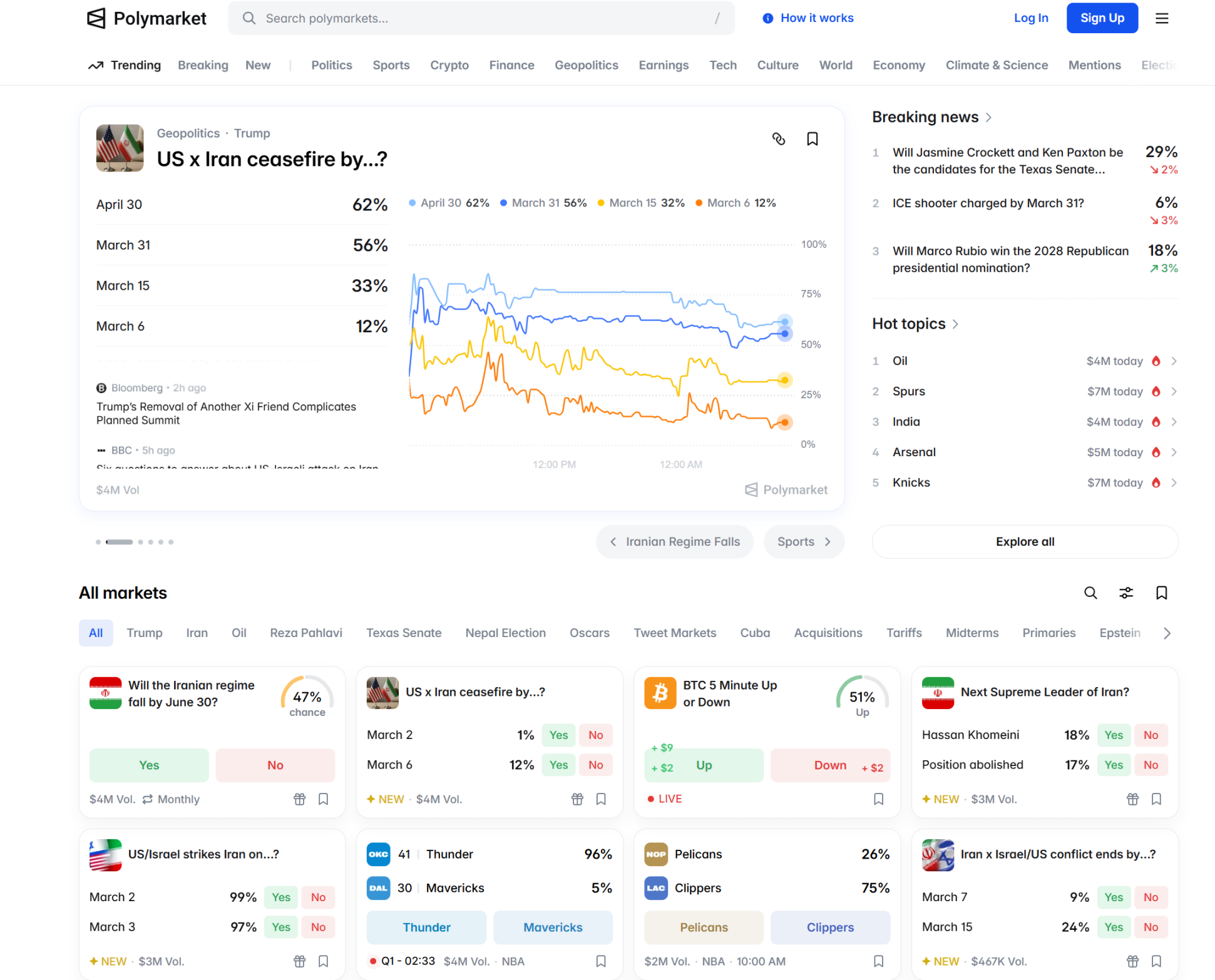
Overall, this "war profiteering" reveals the double-edged nature of prediction markets: on one hand, they provide real-time data and insights; on the other, they are vulnerable to manipulation or insider exploitation.
Under the trend where everything can be wagered on, partial betting in prediction markets may require stricter regulation and clearer rules. After all, the stakes are real money, but behind them lie real lives.