





Original | Odaily Planet Daily (@OdailyChina)
Author | Azuma (@azuma_eth)

Iran has become the focus of the world.
On February 28, the United States and Israel launched a large-scale military strike against Iran, targeting approximately 30 locations within Iran, including the Iranian presidential palace. Iran's Supreme Leader Khamenei has confirmed his death in the attack.
In this incident, prediction markets once again demonstrated their intelligence value distinct from traditional channels. Hours before the airstrike, the probability in markets related to “whether the U.S. military would strike Iran” had already risen significantly, and on-chain monitoring detected heavy bets from new addresses—in such globally watched public events, prediction market movements once again outpaced mainstream media reporting.
This should have been the moment when prediction markets once again declared victory following the 2024 presidential election, but Ayatollah Khamenei’s death has plunged the industry into a heated debate over ethical boundaries.
Is death considered a resignation?
From a micro perspective, the focus of the contradiction lies in the event of whether Khamenei will step down as Iran's Supreme Leader. As the most closely watched development in Iran's situation, leading platforms such as Kalshi and Polymarket had long offered betting options on this event. However, the manner (or pace) in which Khamenei's rule ended clearly caught people by surprise.
After Hamenei's death was confirmed, Kalshi CEO Tarek Mansour was among the first to speak out on social media against profiting from individual deaths. "We do not list markets directly tied to deaths. When a market could result in a death outcome, we design rules to prevent people from profiting off death."
Given that death has been confirmed, Kalshi will handle the event related to "Khamenei stepping down as Supreme Leader" as follows:
- All fees for this market will be refunded;
- This market will be settled based on the last traded price before the confirmation of the news regarding Khamenei's passing; all positions, regardless of when they were opened, will be settled at this price;
- If a user entered the position after Khamenei's death, Kalshi will fully compensate the price difference cost.
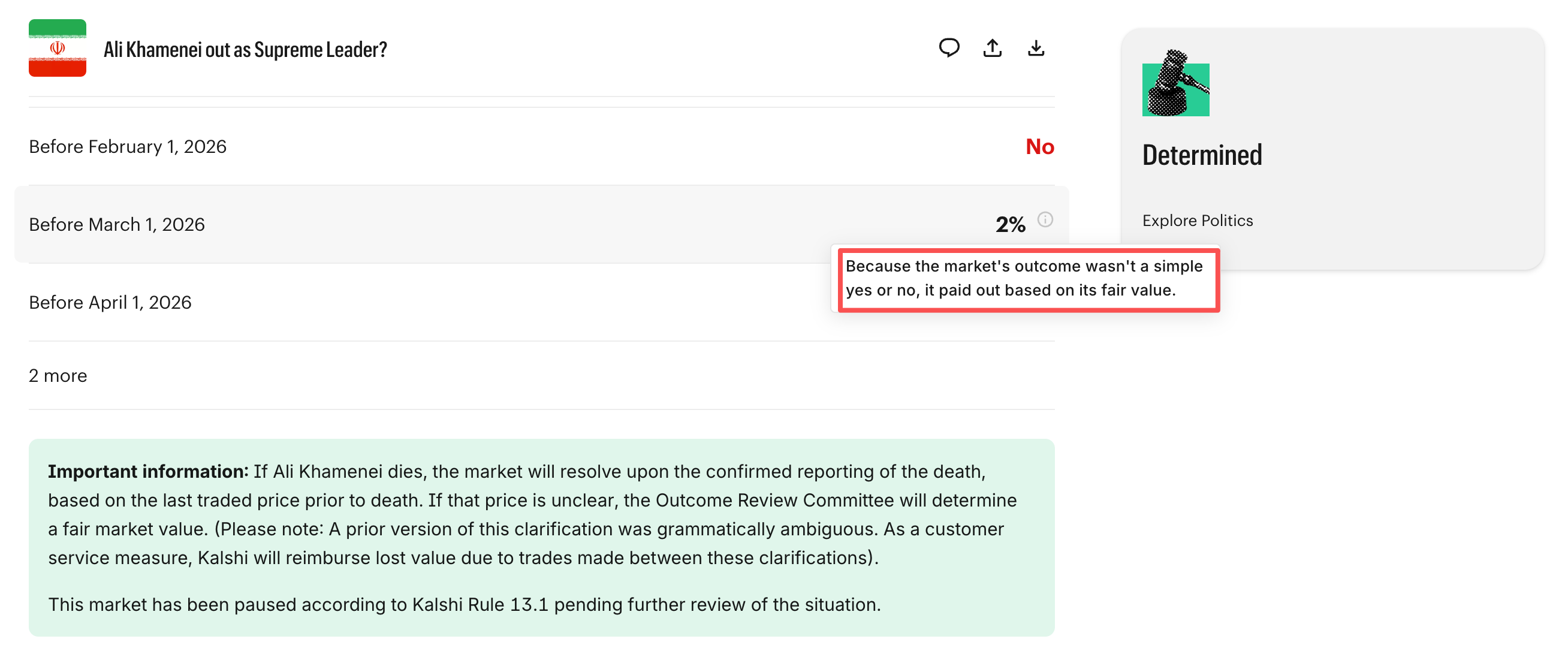
Visiting the relevant event page on Kalshi shows that the event has been suspended and specially marked by Kalshi, which has also noted that “since the market outcome is not simply YES or NO, payouts are made based on its fair value.”
Kalshi's approach has sparked intense discussion in the community.
- Supporters of Kalshi argue that avoiding events related to "death" aligns with mainstream values and regulatory constraints on commodity contracts (the regulatory framework under which prediction markets currently fall). In particular, given that prediction markets have already demonstrated some real-world counter-effects, failing to set boundaries could, over time, indirectly incentivize bodily harm or murder, leading prediction markets to gradually become dark-web-like.
- Opponents of Kalshi argue that this move undermines the fairness of prediction markets and diminishes their value as a hedge against real-world events—those who bet YES did not receive the expected returns; although Tarek Mansour claimed “no user will lose a single dollar in this market,” users who bet NO and exited early with a stop-loss did not receive the corresponding payouts.
In contrast, Polymarket has not made any statement regarding this matter, and trading remains active; the current price for YES shares on the event of resignation before March 31 is 99.9 cents, while NO shares are priced at 0.2 cents.
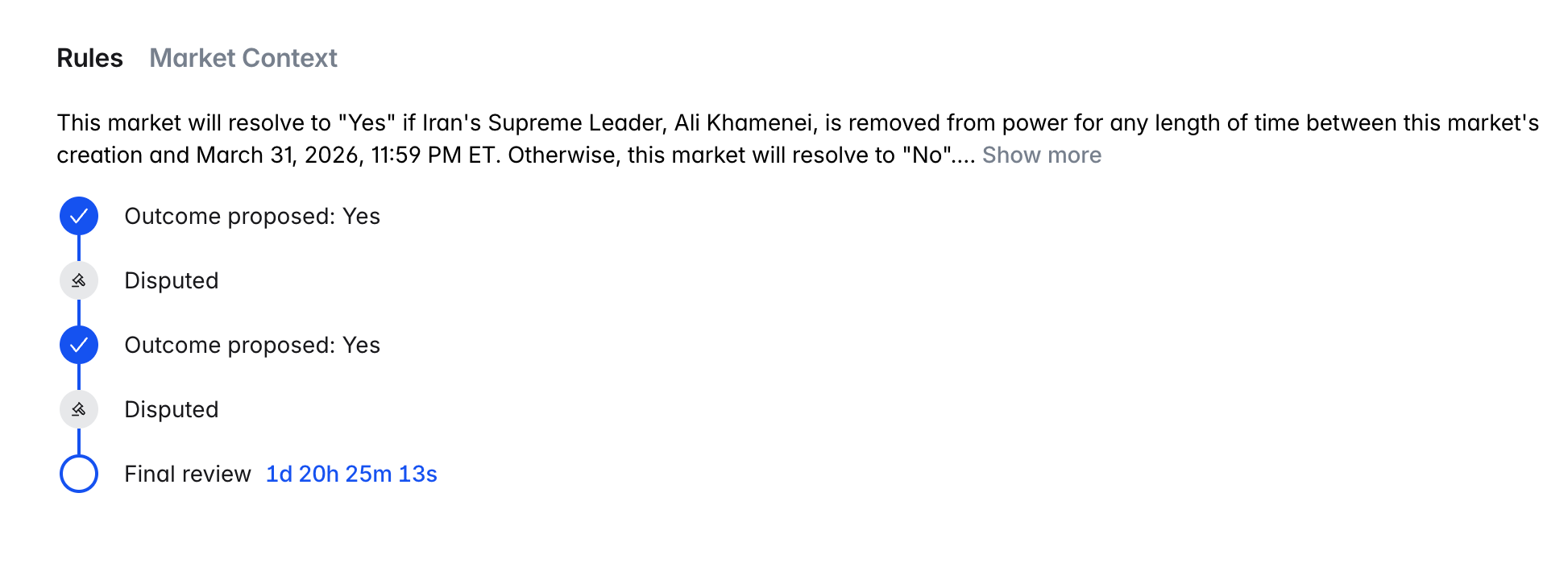
In the rule for determining this event, Polymarket explicitly states that “if Khamenei resigns, is detained, or otherwise loses his position or becomes unable to perform his duties as Iran’s Supreme Leader within the time frame specified by this market, it will be considered a removal from office,” which appears to cover unexpected death; however, discrepancies still arose during the settlement process—indicating clear divisions within the community.
- Odaily Note: For details on Polymarket’s resolution mechanism and the process for handling disputes, please refer to “Who Defines the Facts? The Power Truths and Potential for Abuse in Polymarket’s Resolution Mechanism”.
Calls for regulatory bans
Debates over whether prediction markets should list events related to "individual death" had already taken place among regulators long before the news of Khamenei's death drew widespread industry attention.
On February 24, just days before Khamenei’s death, six U.S. Democratic senators, including Adam Schiff, jointly sent a letter to CFTC Chairman Michael Selig, urging the CFTC to classify and prohibit any prediction market contracts settled based on or highly related to an individual’s death.
The legal basis cited in the letter states that, under federal commodities regulations, the CFTC has "categorically prohibited" contracts involving or referencing terrorism, assassination, war, or similar acts.
Adam Schiff and others have stated that such events could incentivize "bodily harm or even death" and constitute a "dangerous national security risk" — "these contracts may incentivize real-world harm by establishing economic rewards for disruptive events or physical injuries, and encourage actors to influence or facilitate such outcomes for personal gain."
The CFTC did not immediately issue a public response to the letter. Days later, as news of Khamenei’s death rapidly dominated headlines, Kalshi and Polymarket found themselves thrust into the spotlight before regulators had clarified their stance.
Free Market vs. Social Responsibility
Prediction markets offer a novel way to gauge the probability of future events using market mechanisms, but this does not mean they are suitable for all events.
From the perspective of the prediction market’s own operations, the platform will favor listing events with clearly defined outcomes that are resistant to manipulation by a single party, to avoid disputes over term interpretation or fairness; from the standpoint of external influence and regulatory pressure, prediction markets must also avoid events that contradict mainstream values—if the market’s design incentivizes people to disrupt social order or harm others for profit, it will face significant ethical and legal challenges.
The debate over whether to ban events related to "death" essentially reflects a fundamental divide between preferences for free markets and social responsibility. Those emphasizing free markets value the unique advantage of prediction markets in pricing future events and are reluctant to compromise this capability due to external restrictions. Those prioritizing social responsibility, however, worry that excessive permissiveness may gradually undermine public interest and social stability. This divide has always had a general resolution: as friction emerges and deepens, both sides gradually find an appropriate balance through negotiation and compromise.
Like every other emerging industry, regulatory frameworks and industry self-regulation for prediction markets will not materialize out of thin air. The future of the industry will be shaped by participants, regulators, and society alike. Paths are made by walking, and the death of Khamenei is pushing prediction markets to personally tread the boundaries of ethics.