





Source: Bankless
Author: David Christopher
Original Title: Did Prediction Markets Win the Super Bowl?
Compilation and organization: BitpushNews
This year's Super Bowl—between the Seattle Seahawks and the New England Patriots—though lacking the star power of last year's Chiefs vs. Eagles game with Taylor Swift's appearance, marked a turning point: prediction markets were for the first time clearly seen as a genuine competitor to traditional sports betting.
The two major prediction market platforms, Kalshi and Polymarket, have all set up markets around this game, halftime show, advertisements, and so on. Preliminary data paints an interesting and complex picture.
Before we begin, a quick explanation: sports betting companies have not yet compiled reports on their total betting amounts - this takes a few days. Therefore, this article is based on the analysis of predicted data from sports betting companies and the actual trading volume in prediction markets.
Sports betting forecast: New records again, but with a slower growth rate
The American Gaming Association estimates that U.S. sports betting companies will see wagers of about $1.76 billion on the 60th Super Bowl, setting a record and representing a year-over-year increase of about 27%. Although the exact figures vary slightly depending on the source, most forecasts point in the same direction: another record, continuing the eight-year growth momentum since the Supreme Court allowed states to legalize sports betting in 2018.
But the growth rate is clearly slowing down. Currently, 39 states and the District of Columbia have opened sports betting, and only Missouri is newly added in this cycle - meaning the explosive growth driven by market expansion in previous years is giving way to incremental growth. Against this backdrop, prediction markets have become another factor suppressing growth. Ed Birkin from H2 Gambling Capital told Fortune magazine that he estimates prediction markets will account for 80% of the year-over-year increase in betting activity this year, and predicts that the trading volume in prediction markets during the entire event will reach 630 million US dollars.
Based on the data currently visible, predicting market performance appears to be far below this figure.
Kalshi
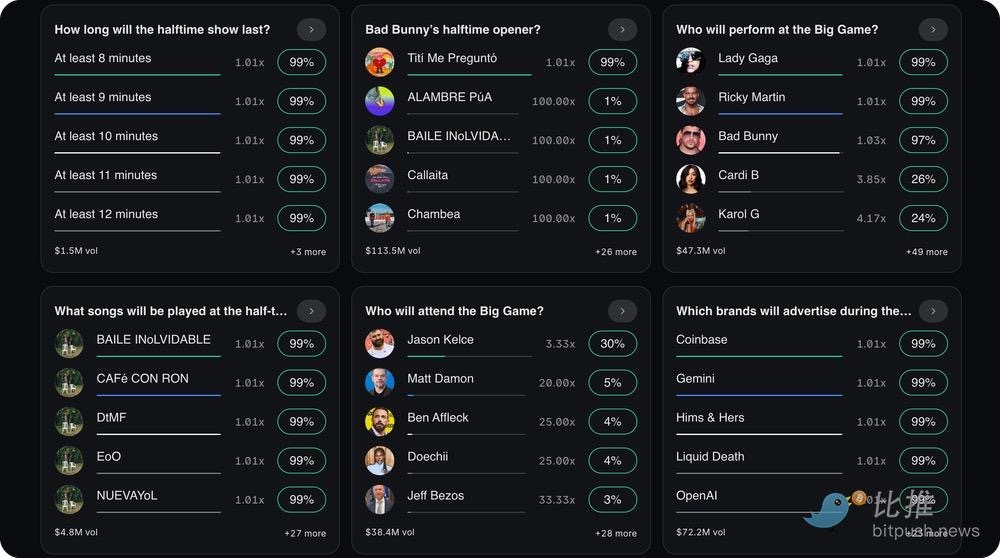
Kalshi's markets specifically for the Super Bowl (i.e., contracts directly tied to the game, halftime show, and broadcasts) generated significant but below-predicted trading volume:
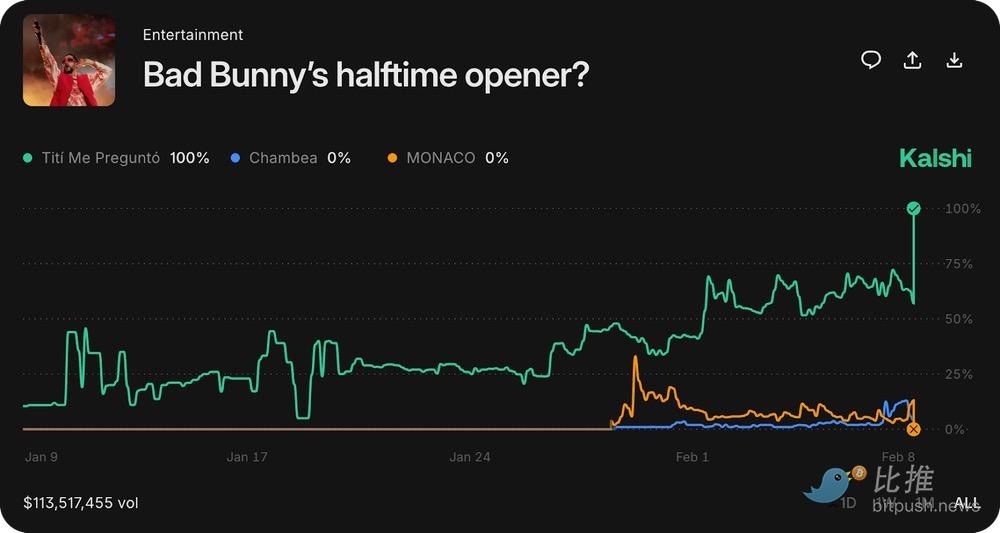
Bad Bunny Halftime Show Opening Song:113.5 million US dollars
Which companies will premiere ads:72.2 million USD
Who will perform in the competition:47.3 million USD
Combined trading volume in just these top few markets amounted to about 23.3 million US dollars, far below analysts' forecast of 63 million US dollars for the entire predicted market.
In addition, Kalshi's flagship NFL market—a "Who will win the Super Bowl?" contract open for months and spanning the entire season—saw total trading volume exceed $500 million. However, this figure reflects the accumulated trading volume for the entire NFL season, not just Super Bowl weekend. Even so, it still amounts to less than one-third of the estimated betting volume for the Super Bowl alone by sports betting companies.
For months, sports betting has accounted for the vast majority (over 90%) of Kalshi's total trading volume, benefiting from marketing channels that are no less, and even better than, those of sports betting companies.
First, Kalshi's federal regulation by the U.S. Commodity Futures Trading Commission means that U.S. users can use it directly through their mobile app, just like using a sports betting app. Combined with the advertising funding reserves provided by SuperVenture, as well asRobinhood's partnership, Kalshi stands out.
This foundation is paying off: In just January of this year, Kalshi had 1.9 million downloads, andDraftKingsandFanDuelThe new prediction market app launched in December last year has a combined download count of less than 100,000 (these two apps were launched in states where their traditional sports betting apps are not allowed, but have so far received a lukewarm response).
In addition, DraftKings partnered with Crypto.com last Friday to expand its event contract product, indicating that existing giants are taking this threat seriously.
Polymarket
Polymarket's peer-to-peer NFL season market trading volume is about $700 million—higher than Kalshi—but the situation is different for its Super Bowl-specific markets.
The top three Super Bowl markets on Polymarket have a total trading volume of about $76 million:
Home game market:55.26 million US dollars
Super Bowl MVP:12 million USD
Who will perform the halftime show:9 million USD
Polymarket lacks Kalshi's regulatory approval in the United States, which means U.S. users cannot access it directly through the mobile app. Technically, Polymarket now has a U.S. app after acquiring a CFTC-registered exchange last year, but it is still gradually opening up through a waitlist, and its Super Bowl products are limited.
Up to one week before the event, no sports markets were even listed on the app, and the full set of Super Bowl special features was only available on its global website.
Therefore, most American users still need to access it through websites or use a VPN and other methods. For casual sports betting players, this is not even on the same playing field as downloading Kalshi from the App Store.
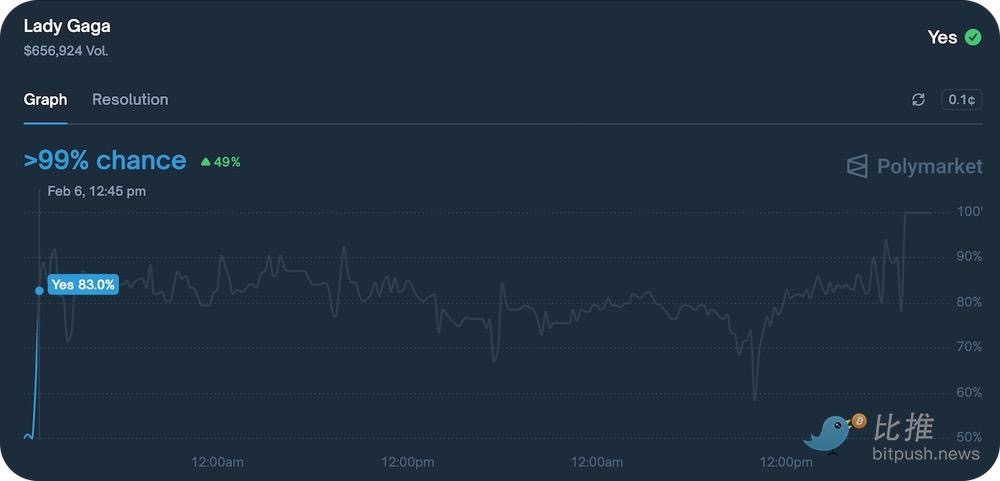
However, what truly sets Polymarket apart is its primary use case—information discovery. In the halftime performer market, Lady Gaga's probability had been steadily around 80% for days before the event—far in advance of her surprise appearance at the halftime show, which had not been previously reported by Billboard and indeed surprised everyone watching with me.
Regulatory progress
All of this is happening against the backdrop of unresolved regulatory conflicts.
Kalshi operates as a federally regulated exchange under the CFTC, which allows its sports contracts to move forward—especially after the new CFTC chair Michael Selig stated he would not block or cede regulatory authority to the states. State gaming regulators, who oversee sports betting companies, continue to take legal action to challenge Kalshi and its peers, and many analysts expect these cases to eventually reach the Supreme Court.
Currently, prediction markets operate in a gray area, allowing them to cover the entire country without needing individual state licenses—a structural advantage that makes it difficult for sports betting companies to easily replicate.
Summary
So, did the prediction market meet people's hype expectations for Super Bowl LX? It did not fully reach the predicted $630 million.
The total trading volume on the top Super Bowl specialty markets visible on the two leading platforms amounted to about $310 million—approximately half of the forecast. The NFL markets throughout the season achieved significant trading volumes on both platforms, but that was accumulated over months of football games, not a single week's surge during Super Bowl weekend.
The context is equally important. The 1.9 million downloads Kalshi achieved in January this year outshine the combined total of the prediction market apps under DraftKings and FanDuel.
This pressure has been clearly reflected in the stock prices—according to Forbes' observation, the stock price of Flutter Entertainment, the parent company of FanDuel, has declined for eight consecutive weeks, marking its longest downward trend in 23 years; DraftKings' stock price has been hovering around its low since 2023, down more than 60% from its historical high.
Bloomberg data shows that over the past three months, market expectations for Flutter's fourth-quarter earnings have been sharply reduced by nearly 49%, and expectations for DraftKings have also dropped by 29%. Imagine, if someone bet on "DraftKings will miss estimates" on Polymarket, they might now be quietly making a profit.
Prediction markets may not have conquered the Super Bowl overnight, but they have already entered the room—and for traditional sports betting platforms, the trajectory of this trend is already alarming enough.