








Written by: Frank
Since 2026, there have been no new developments in RWA.
Over the past five years, mainstream assets—from stablecoins to U.S. Treasuries, and then to funds and U.S. stocks—have been progressively brought onto the blockchain, tokenized into tradable new financial products, and have, to a significant extent, established the on-chain trading logic for TradFi secondary market assets.
But the primary market—the realm that harbors super unicorns like SpaceX, ByteDance, OpenAI, and Anthropic—remains firmly shut. Users can trade Tesla seamlessly on-chain, yet they struggle to secure a ticket to SpaceX before its IPO.
However, since last year, boundaries have indeed been tested: Robinhood has piloted tokenized private equity products such as OpenAI in Europe, Hyperliquid has launched perpetual contracts for companies like SpaceX, and this week MSX has launched on-chain pre-IPO share offerings for unicorns including SpaceX and ByteDance.
Although these actions follow different paths, they all point in the same direction: Pre-IPO, a previously highly closed primary market, is now attempting to embrace on-chain.
I. Pre-IPO: Embracing on-chain is current, necessary, and essential.
To understand Onchain’s significance for Pre-IPO, it is essential to clarify the unique role that “Pre-IPO” plays in the capital market lifecycle.
For a long time, the investment legends we’ve heard—such as Masayoshi Son’s six-minute decision to invest in Alibaba, a16z’s early bet on Meta (Facebook), or Sequoia’s successful pick of Coinbase—essentially tell the same story: securing a position in high-quality assets before they go public, capturing the “spread” between private and public market valuations.
Objectively speaking, this is also what they deserve.
After all, early-stage venture capital is fundamentally a game of probabilities: a16z may have invested in hundreds of failed social networks before hitting one Facebook; before and after backing Alibaba, Masayoshi Son missed or misinvested in countless internet companies... Ultimately, bearing extremely high costs of experimentation and enduring exit cycles that span a decade, while relying on a few successful investments to generate outsized returns that offset overall losses, is the core business logic of venture capital—and the "risk premium" that institutional capital rightfully deserves.
However, when we talk about Pre-IPO (just before listing), the logic undergoes a qualitative change.
Because this is a distinctly different stage—the final mile before going public—companies at this point have grown into super unicorns like SpaceX, ByteDance, OpenAI, and Anthropic, with highly mature business models and clear revenue streams. Investing at this stage carries significantly lower risk compared to early-stage venture capital, and even offers a degree of quasi-secondary market certainty.
Yet paradoxically, during this high-certainty phase, returns around IPOs remain astonishing; for example, with two representative stocks from 2025: Figma’s IPO price was $33, closing its first day at $115.50—a gain of over 250%—and Bullish also rose nearly 290% on its first trading day.
This means that institutions which secured allocations before the listing still took the most lucrative portion of the pie under extremely low risk.
Unfortunately, despite the existence of secondary market platforms for private company shares such as Forge and EquityZen, these platforms generally operate on a peer-to-peer OTC matching model, with minimum investment thresholds often reaching tens of thousands of dollars and access restricted solely to accredited investors—leaving ordinary users with no option but to enter the secondary market only after the company’s IPO.
From a capital efficiency perspective, this is inherently an inefficient structure: while unicorn valuations continue to rise, retail investors are shut out behind high walls—leading naturally to the question:
Since blockchain can lower entry barriers for U.S. stocks and enable asset tokenization, can it also allow users to share in the valuation growth of unicorn assets during the transition from private funding to IPO, through tokenization before they go public?
II. Strategic Choice: Perpetual Contracts or Tokenized Mirrors?
On-chain attempts before IPO have currently diverged into two distinctly different paths.
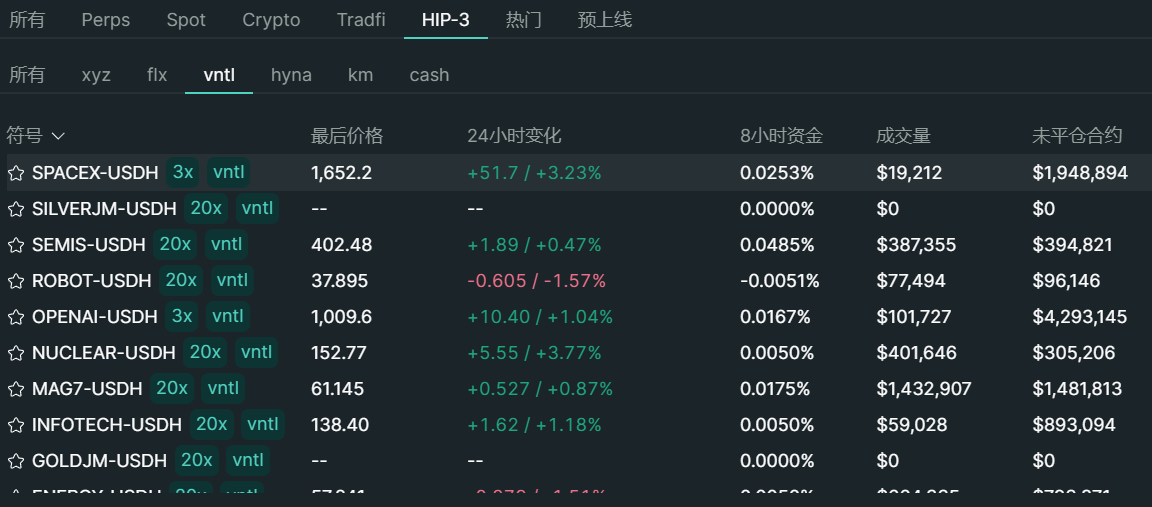
One approach is the perpetual contract model represented by Hyperliquid, such as under the HIP-3 framework, where developers can customize and deploy perpetual contract products for pre-IPO assets like OpenAI and SpaceX. The core logic combines pre-IPO assets with perpetual contracts without involving actual equity settlement—essentially bypassing equity ownership entirely and providing only price exposure, allowing users to bet on the valuation fluctuations of companies like SpaceX and OpenAI.
The advantages are also clear, such as an extremely low entry barrier—no accredited investor certification required—and instant transaction settlement without complex equity transfer procedures.
At a mechanistic level, we can simply view it as a bet on the valuation of unicorns like SpaceX, with liquidity jointly activated by market makers and leverage mechanisms. For this reason, it’s essential to continuously monitor whether oracles remain stable, risk controls are reliable, and liquidations remain fair under extreme market conditions.
Additionally, from a compliance perspective, this model remains in a gray area regarding whether it constitutes an indirect securities offering in major jurisdictions worldwide.
The other path is much more difficult: enabling users to actually hold tokenized equity assets, rather than merely trading their prices, all while remaining compliant.
Robinhood’s European pilot in June 2025 and MSX’s launch of a Pre-IPO section in March 2026 both point in this direction—both platforms have sequentially entered into strategic partnerships with the U.S. compliant asset tokenization platform Republic, aiming to tokenize actual Pre-IPO equity through SPV (Special Purpose Vehicle) structures, enabling investors to hold legally protected equity stakes.
The core value of this model lies in the fact that the tokens represent actual equity, held by a regulated third-party custodian, providing a legal and asset-backed foundation.
Specifically, Republic employs an "SPV indirect ownership" structure, whereby an offshore SPV holds shares in the underlying company, and the SPV’s ownership rights are tokenized and distributed to investors. Although this remains an indirect form of ownership, compared to pure derivatives, this model at least establishes a traceable chain: "token → SPV → equity."
The successful implementation of this model heavily depends on compliant infrastructure and must operate within regulatory frameworks such as those established by the U.S. SEC, partnering with licensed custodians like BitGo Trust Company to ensure asset security and legal validity. This means it is not merely a product innovation, but also a systemic undertaking.
Overall, these two paths represent two distinctly different value orientations: the former (perpetual contracts) aligns more closely with DeFi’s efficiency logic, prioritizing maximum liquidity and low entry barriers at the cost of lacking a genuine connection to underlying assets; the latter (tokenized equity mirrors) better reflects TradFi’s institutional logic, with the main challenge lying in establishing a compliant framework.
But regardless of the path chosen, a consensus is forming that a "semi-primary market" is emerging by tokenizing unlisted equity.
III. A Global Bridge from Robinhood to MSX: The Semi-Primary Market
The explosion of a market requires more than just a grand narrative—it critically depends on an entry-level product.
From a technical standpoint, tokenization technology has undergone years of engineering validation, with smart contracts, oracles, and on-chain compliance frameworks now capable of supporting complex financial products. From an application perspective, DeFi and TradFi have achieved initial integration, and global users are increasingly accustomed to accessing the era’s most scarce, high-quality asset growth opportunities through decentralized, permissionless means.
The on-chain tokenization of pre-IPO assets is at a historic tipping point. However, standalone DeFi protocols often struggle to independently handle user education, regulatory compliance, and large-scale capital inflows. At this stage, on-chain infrastructure that bridges traditional finance is often the most critical variable between narrative and execution.
Looking back, Robinhood's attempt in June 2025 was profoundly significant.
As a global benchmark for internet retail brokers, it enables European users to participate in on-chain share trading of star unicorns like OpenAI and SpaceX with minimal barriers, marking the first time a mainstream broker has clearly and on such a scale signaled its stance toward the on-chain Pre-IPO market. This demonstrates that regulatory frameworks can be flexibly adapted and confirms that retail users have genuine and strong demand for such products.
But Europe is only the beginning. The larger, faster-growing Asia-Pacific market also holds significant untapped potential, yet it still lacks a true entry-level platform.
This is precisely why MSX's newly launched Pre-IPO section is worth paying attention to.
On March 2, MSX partnered with Republic, the entity that originally supported Robinhood’s European compliance structure, to replicate this proven model in the Asia-Pacific market: tokenized equity offerings from top unicorns such as SpaceX, ByteDance, Lambda Labs, and Cerebras Systems are now available, with a minimum investment threshold of just 10 USDT.
To some extent, MSX is playing the role of an "Asian Robinhood"—connecting pre-IPO, scarce equity with global post-IPO liquidity through compliant tokenized structures in Asia-Pacific markets with relatively complex regulatory frameworks, bridging the hardest-to-cross "last mile."
From a broader perspective, the on-chain transformation of Pre-IPO has never been merely a one-sided demand from ordinary users—it is fundamentally a mutual endeavor:
- Regular users need a truly equitable entry point to share in the growth红利 of global top unicorns before listing, without having to wait outside the secondary market.
- Private equity and early shareholders similarly seek to introduce an unprecedented global pool of incremental capital, exchanging their holdings for diversified exit options through on-chain liquidity;
The needs on both sides aligned perfectly.
Thus, from Robinhood in the West to MSX in the East, the pre-IPO market is indeed transitioning from its original peer-to-peer matching model toward a tokenized era characterized by lower barriers and higher efficiency.
IV. Final Thoughts
The maturity and large-scale adoption of underlying technologies often do not immediately translate into product breakthroughs, but when sufficient accumulation is reached, the delayed wave of innovation can hit even harder.
In this sense, it is not unfounded to expect on-chain Pre-IPOs to become a mainstream asset class over the next three to five years: blockchain technology has matured to the point where tokenization infrastructure now has the engineering capability to support complex financial products, on-chain compliance frameworks are gradually becoming clearer, and mutual trust between institutions and users is being slowly but steadily established.
But logical consistency does not automatically lead to breakthroughs.
Is the compliance pathway clear enough? Are the risk control mechanisms truly reliable? Can liquidity between institutions and retail investors be effectively matched? Each of these is a necessary condition—none can be missing. More importantly, it’s not just Robinhood and MSX that need to step forward; more platforms must be willing to bear the cost of being the first to venture in, using real products and real users to pave a replicable path.
By 2026, we’ll know whether the on-chain transformation of pre-IPO offerings is just a fleeting conceptual trend or the true beginning of a fundamental reshaping of capital market access rules.