





Original source:Prediction Market Accuracy: Crowd Wisdom or Informed Minority?
Compiled by Odaily Planet Daily (@OdailyChina)
Translator | Wenser (@wenser2010)
Editor’s Note: Predictive market platforms such as Polymarket and Kalshi have long positioned themselves as “embodiments of collective wisdom” to distinguish themselves from gambling platforms and elevate their valuations through this narrative. However, a recent paper from London Business School and Yale University, after analyzing on-chain data from Polymarket, found that fewer than 4% of addresses drive price movements and achieve meaningful profits, while approximately 97% of addresses are largely “spectators,” with over 67% of users experiencing losses. Given that Polymarket’s number of user addresses has now exceeded 2.43 million, the study’s data may be somewhat outdated—but the underlying phenomenon it reveals remains deeply worth contemplating.
Below are the main core contents of this paper, compiled and summarized by Odaily Planet Daily.
Fact 1: The accuracy of prediction markets is not determined by "the wisdom of the crowd," but by a minority of just 3.14%.
This is the most central conclusion of the entire paper and a direct challenge to the industry narrative.
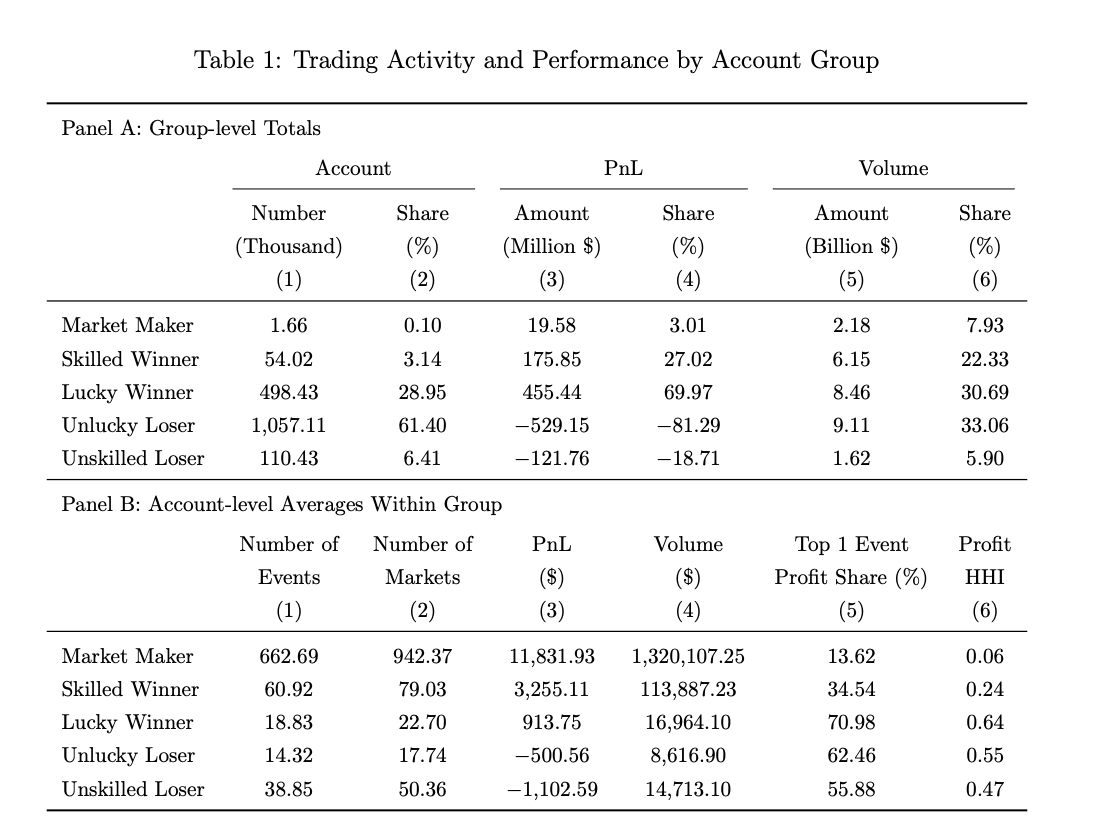
Previously, several industry leaders took pride in this: Kalshi CEO Tarek Mansour said prediction markets “harness the wisdom of the crowd,” Polymarket CEO Shayne Coplan repeatedly promoted the idea that “financial stakes can aggregate information more effectively than experts,” and Robinhood CEO Vlad Tenev called it “capitalism’s pursuit of truth.” But research data tells us: among 1.72 million Polymarket accounts, only about 54,000 accounts (3.14%) were identified as “skillful winners” (Odaily Planet Daily note: the paper defines these individuals as professional players who can consistently forecast and absorb information, and respond efficiently when news breaks).
The primary driver of price discovery in the market is this minority, not the mob lurking behind the “wisdom of the crowd” as is often assumed.
Fact two: Both making and losing money could be a matter of luck; 67% of participants are essentially "philanthropists."
In this paper, Roberto Gómez-Cram et al. used a set of sign-randomization statistical methods to classify all traders' accounts into four categories: skilled winners (3.14%), lucky winners (29.0%), lucky losers (61.4%), and skilled losers (6.4%).
The most counterintuitive number is that nearly 30% of winners are lucky— they made money, but contributed nothing to price discovery in their trading pairs, statistically indistinguishable from random coin flips.
In other words, making money in prediction markets is not the same as being able to predict the future; the group of losers, accounting for about 67%, bear all the losses and essentially pay for the information advantage of a few.
Fact three: 88% of the top players on the profit leaderboard make money by luck.
Among the top 54,000 traders on Polymarket ranked by actual profit, only 12% were also identified as "skill-based winners" by statistical methods.
In other words, the majority of large winners on the leaderboard achieved their significant profits through luck on one or two high-stakes bets.
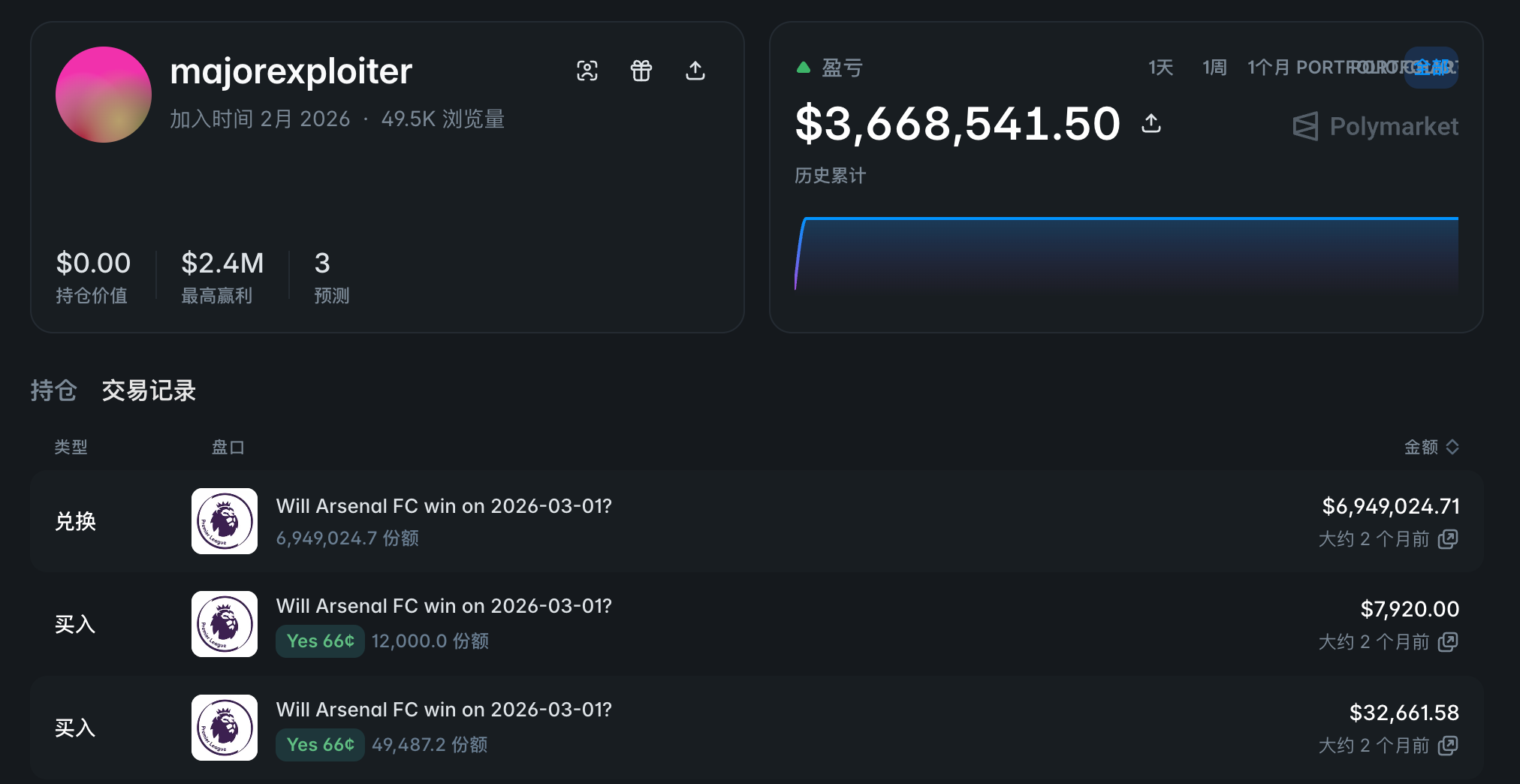
A notable example is the account @majorexploiter—in early 2026, this account wagered $4.5 million across three sporting events and earned over $3.6 million in profits.
This type of concentrated bet on yields is extremely unsustainable; 60% of the "luck-based winners" became losers in out-of-sample validation.
Fact 4: The skill effectiveness of prediction markets far exceeds that of the traditional fund industry.
Researchers randomly split the betting events into training and test sets for out-of-sample validation.
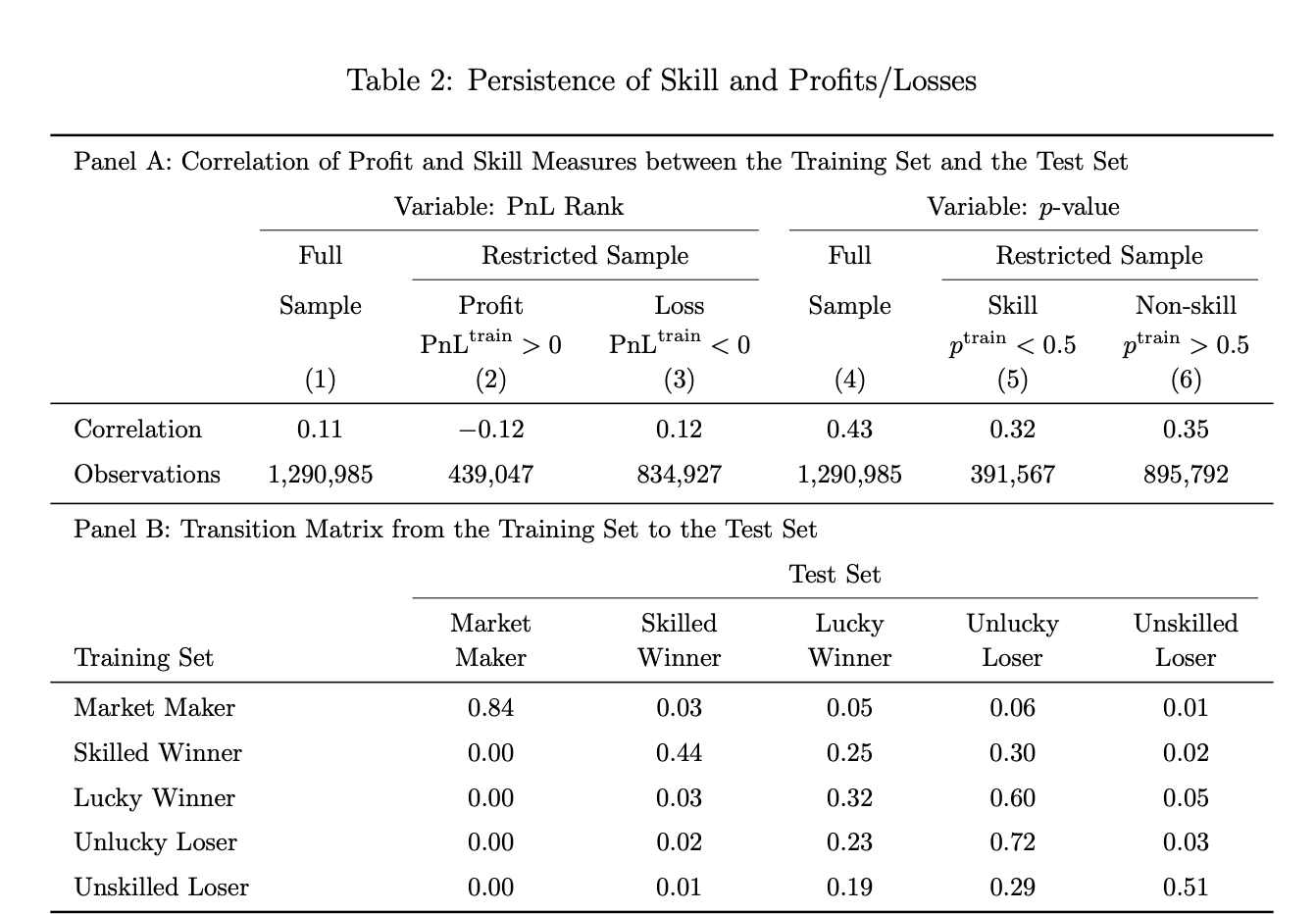
The results show that 44% of accounts identified as "skilled players" in the training set were still identified as "skilled users" in the test set; in comparison, U.S. actively managed mutual funds achieved only a 10% skill effectiveness in the same test.
Conversely, the “anti-skill” (consistent losses) also remains highly consistent: 51% of the “skillful losers” in the training set remained losers in the test set, while this figure rose to 20% for U.S. mutual funds.
The bottom line is that in prediction markets, the experts are truly expert, and the retail traders are truly retail.
Fact 5: Skill-based winning orders are highly correlated with the final outcome.
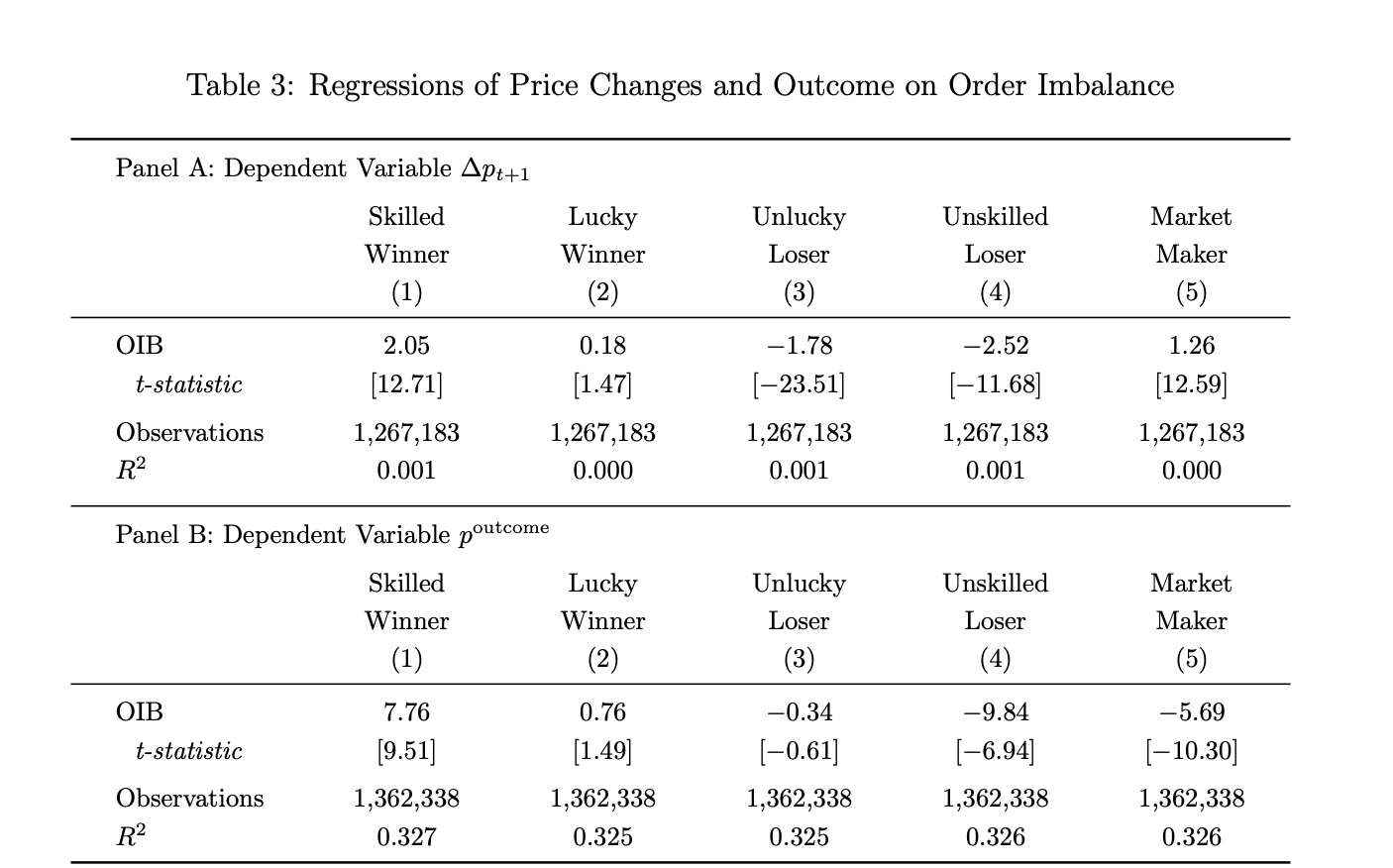
Researchers, using the constructed order imbalance formula, found that for every 1% increase in the net buying indicator (OIB) of skilled winners, the price in the next period rises by approximately 2 basis points, and the probability of the final event occurring increases by approximately 8 basis points, with very high statistical significance (t-values of 12.71 and 9.51, respectively).
The order flow of luck-based winners is not significant on either metric (t-values of only 1.47 and 1.49).
In other words, lucky winners, despite generating positive profits, engage in trading actions that carry no informational content—a conclusion that is highly robust from a data perspective.
The observed phenomenon from the research is that skilled winners are net buyers in markets that settle as “yes” and net sellers in markets that settle as “no,” consistently building positions in the direction of the final outcome. Market makers, by contrast, are typically net sellers in markets settling as “yes” and net buyers in markets settling as “no,” consistent with their role of following directional order flow and profiting from the bid-ask spread rather than placing insider orders.
Fact 6: Skilled traders are the only group that makes prices more accurate.
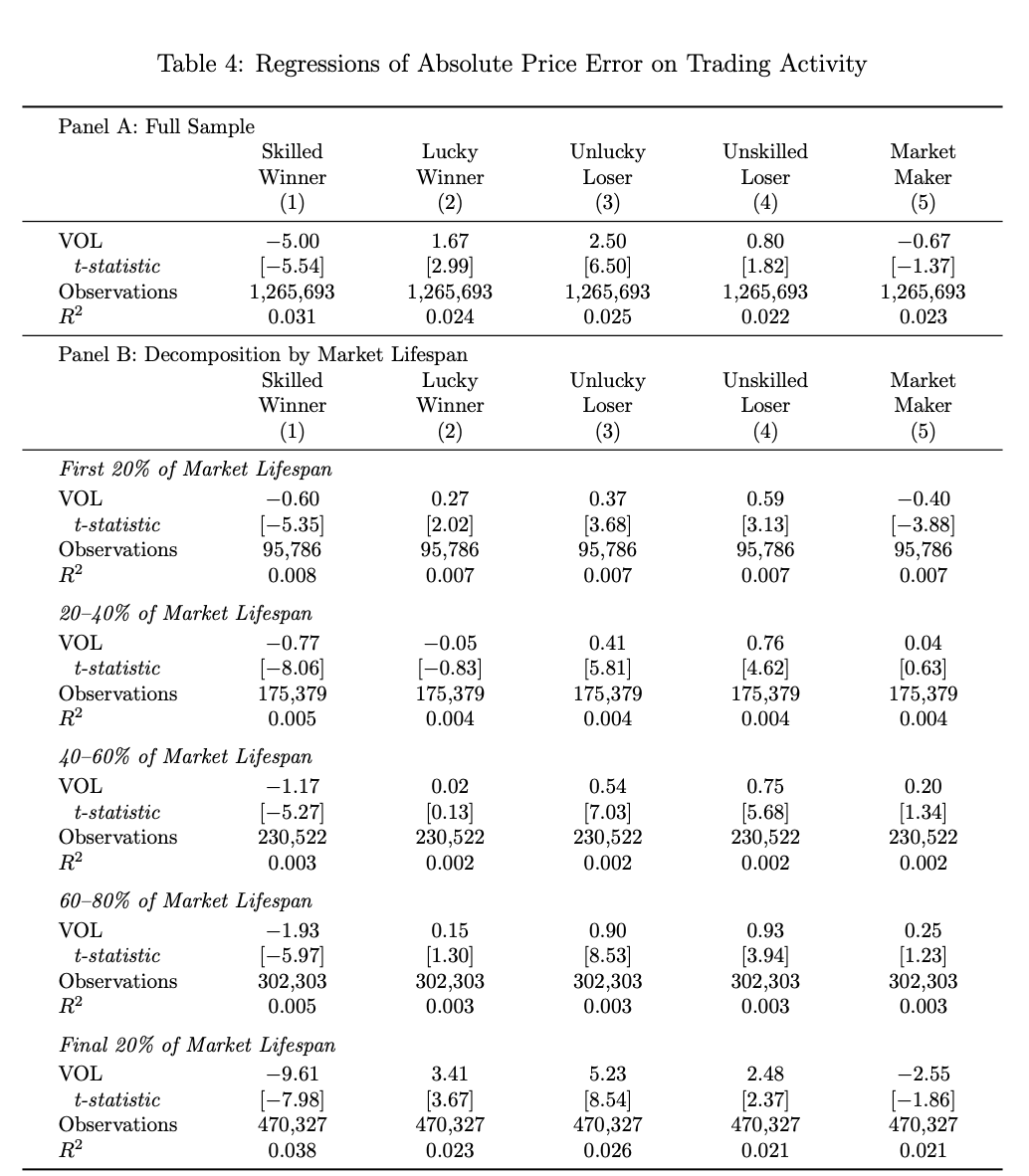
Based on the premise that "some trades actually drive prices toward the final outcome," researchers developed a "price discovery contribution metric" to measure whether prices in each time window moved closer to or farther from the final outcome.
The results show that this betting event significantly reduces pricing error only when the trading volume share of skilled winners increases (coefficient: -5.00, t-value: -5.54).
In contrast, the trading activities of the other three groups—luck-based winners, luck-based losers, and skill-based losers—cause prices to deviate from the final outcome; in fact, most people merely generate noise at the trading level, and this effect intensifies as the market approaches settlement. During the final 20% of the event’s lifecycle, the contribution coefficient of skill-based winners expands to -9.61.
Fact 7: Skilled winners are the only "News Trading" players.
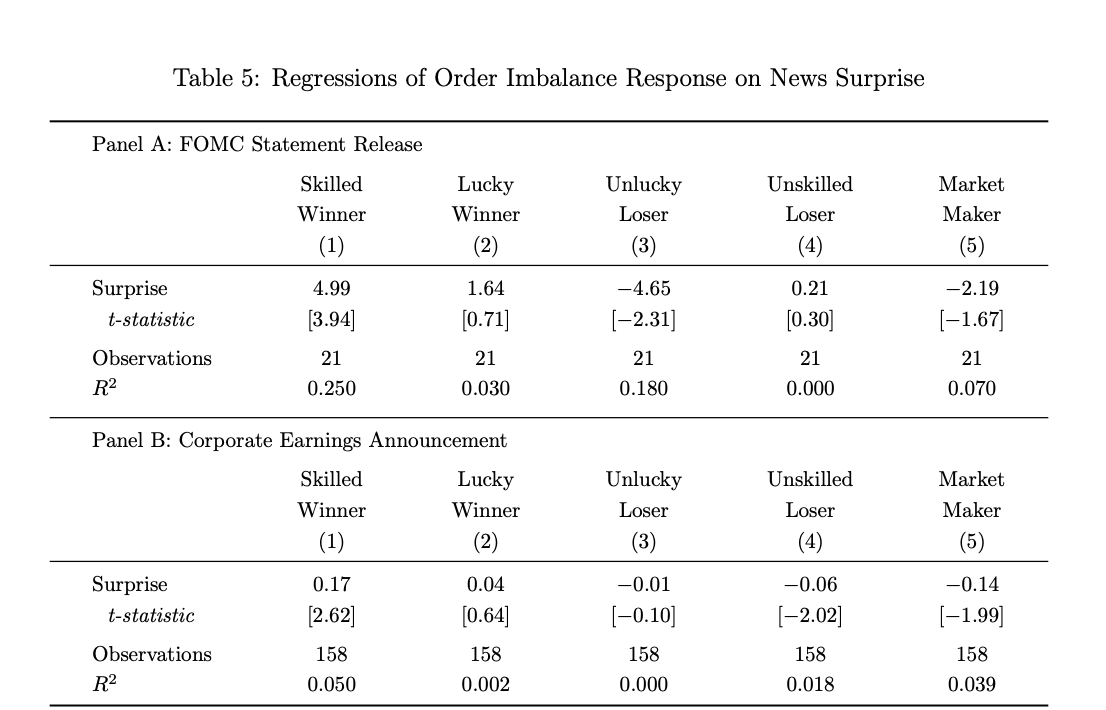
To minimize errors caused by delays in news dissemination, researchers selected two types of events with clearly defined information release times as study samples: FOMC interest rate decisions and corporate earnings announcements (Odaily Planet Daily note: the former is central to monetary policy expectations; the latter is essential for understanding a company’s fundamentals).
Research shows that only skilled winners' order flow exhibits a significant shift in the short-term window after the announcement, toward the "unexpected direction."
In FOMC surprise events, each 1% increase in the surprise direction corresponds to a roughly 5% increase in net buying by skilled winners (t=3.94); due to the relatively small magnitude of FOMC surprises (maximum around 6 percentage points), the counter-position buying is substantial. For earnings announcements, each 1% increase in the surprise direction corresponds to a roughly 17-basis-point increase in net buying by skilled winners (t=2.62). In contrast, all other groups show no consistent reaction to the news, and some even trade in the opposite direction.
Fact 8: Market makers profit from the spread in liquidity, not from information asymmetry.
Research shows that market makers on Polymarket account for only 0.1% of total accounts (approximately 1,660), but on average participate in 942 betting markets and earn $11,832 per account.
In addition, their order flow can predict short-term price movements (as they are continuously absorbing orders), but has a negative impact on predicting the final outcome of events (see Figure 3 above: coefficient -5.69, t = -10.30).
This means they temporarily took on sell orders from insiders, only to be “harvested” by them in the long term, profiting primarily from the bid-ask spread rather than directional bets.
Fact 9: Insider trading only impacts the outcomes of a few events.
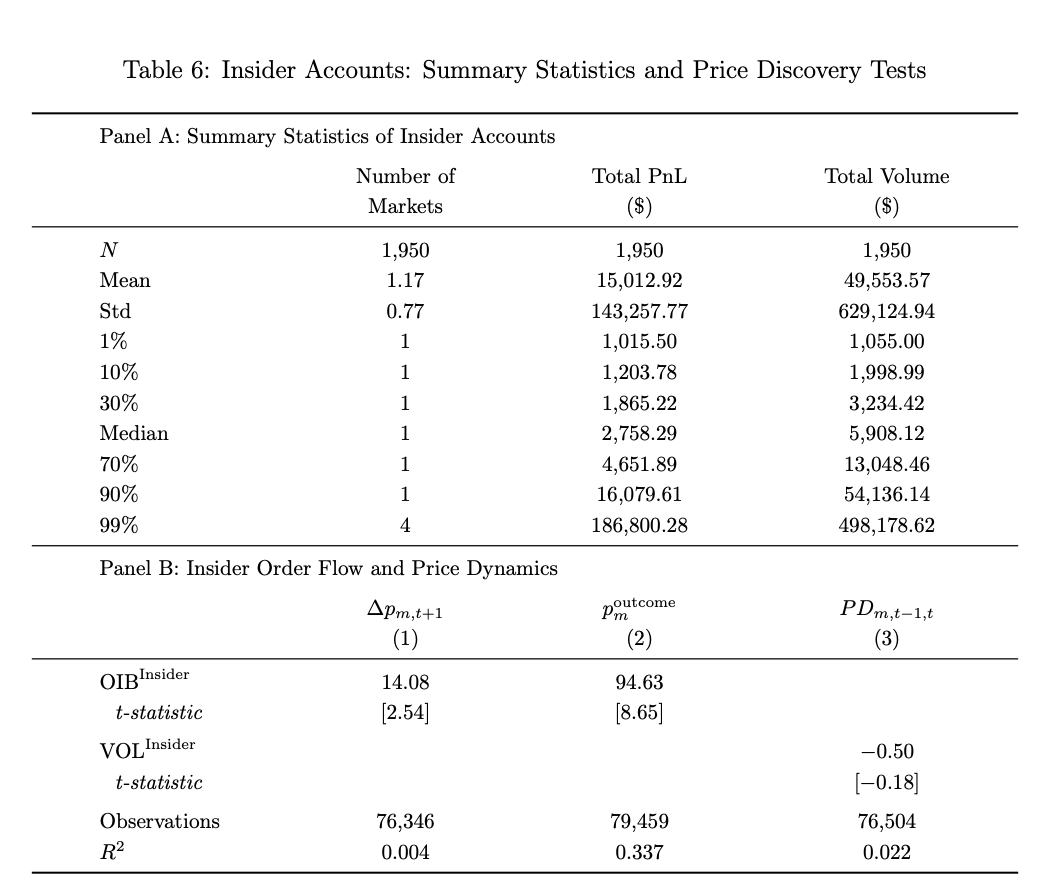
Given the inevitability of insider trading in prediction markets, this study also conducted data analysis on the impact of insider trading on price discovery. (Odaily Planet Daily note: The study uses two standard criteria to identify suspicious transactions. The first is timing—accounts opened shortly before a specific event, such as seven days prior, and closed after the event is settled; the second is belief intensity—accounts exhibiting concentrated activity on a single event contract, holding unusually large positions with trading volumes of at least $1,000 and profits of at least $1,000. Accounts meeting both criteria are classified as insider traders.)
Among these, the paper identified approximately 1,950 suspected insider trading accounts using two dimensions: account time characteristics and position concentration, with these addresses averaging $15,000 in profit per account.
Notably, the orders from these accounts demonstrated extremely high accuracy in predicting the prices and outcomes of certain events (final outcome prediction coefficient of 94.63, 12 times that of skill-based winners), but were concentrated on only a few events and made little contribution to price discovery in the overall prediction market.
Notably, the study breaks down the prediction market case of the “U.S. military raid on Maduro” event: three accounts placed bets days before the action, collectively purchasing contracts for an event with only a 10% probability of occurring, ultimately netting over $630,000 in profits—one of the account holders was later accused by the CFTC of being an active-duty U.S. military personnel. For details, read “After Four Months, Polymarket Helped Trump Expose a Military Leak—But at What Cost?”
Fact 10: The trading distribution in prediction markets is extremely unequal, akin to the power law.
By December 2025, Polymarket's trading volume increased from $3.3 million in December 2023 to $1.98 billion, growing over 600 times in two years; during the same period, its monthly active accounts surged from 1,600 to over 519,000.
Its operational data is impressive, but the truth behind the numbers is even more counterintuitive— the median active account on Polymarket has an average trading volume of just $72, while the top 1% of accounts average $74,000, a difference of over 1,000 times.
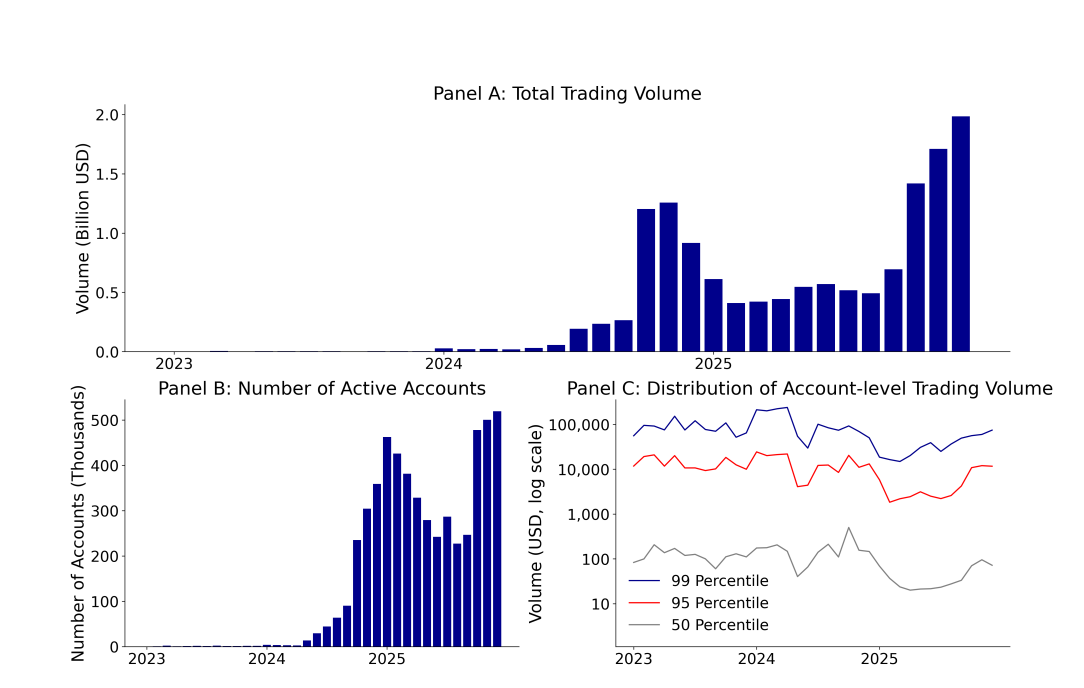
As of December 2025, Polymarket has recorded a total trading volume of $13.76 billion across 1.72 million accounts. However, the groups of luck-based losers and skill-based losers together account for 67% of all accounts, contribute 39% of the trading volume, and bear 100% of the losses.
Undoubtedly, this is not a fair market where everyone is equal and collective wisdom is centralized, but rather a zero-sum game ecosystem where a few set the prices, and the majority provide capital and bear the losses.