





Original Title: “Analyzing 40 Addresses on Polymarket’s Leaderboard: Only Three Ways to Profit”
Original Author: Leo, Prediction Market Researcher
What does the strategy look like for someone who made $10 million on Polymarket?
Using the Data API and on-chain data, we reverse-engineered the Top 20 rankings in both sports and crypto.
40 addresses, over 100,000 transactions, broken down one by one.
Don't look at the dashboard screenshots. Reconstruct every buy, sell, and redemption as strategy actions.
Method: Pull transaction records per address via the Polymarket Data API, verify profits and losses via the LB API, and reconstruct actual cash flows using on-chain REDEEM/MERGE data. Each address has between 2,000 and 15,000 transactions.
After breaking it down, I found that regardless of sports or Crypto, profit-making addresses fall into three categories. The differences between these three categories aren't just parameter variations—they're playing entirely different games.
First type: Directional — buy correctly and hold until the end
The most profitable strategy in the sports betting market was so simple I didn’t believe it at first.
Of the 18 active addresses, 14 only buy and never sell. They hold until settlement—winning positions are redeemed, losing positions go to zero, and no trading is performed.
Buying but not selling can yield completely different profits.
Swisstony: $494 million in trading volume, 1% return rate, net profit of $4.96 million. Fully automated, placed 353 trades in 30 minutes, covering five major leagues. Profit per match is small, but the volume is enormous.
majorexploiter: Return rate of 39%, with a single bet as high as $990,000. Over 600 trades were almost entirely placed on two Arsenal matches. Willing to place big bets—winning means millions.
One placed many bets, the other concentrated on one; both made several million. Their methods were opposite, but they shared one common trait: they had informational advantages on the events they bet on.
The top-ranked asset is losing momentum.
kch123, ranked #1 in sports betting, with total profits of $10.35 million.
However, as of the analysis in mid-March, the account lost 479,000 in the past 30 days. The win rate over the past 7 days was only 31% (15 wins, 33 losses). All 14,303 trades were buys, with zero sells. The average daily trading volume was 493 trades, and 74% of trades occurred with intervals of less than 10 seconds.
The machine that made ten million is losing speed. You won’t know this just by looking at the rankings—you need to analyze on-chain data to see it.
I tricked myself with my own tags
fengdubiying, sports rank 13, profit $3.13 million.
I labeled him as "sell-dominated" during batch analysis, suggesting he's a swing trader.
Breakdown of data: 93.6% of returns came from redemptions, while sales accounted for only 6%. The real strategy involved concentrated betting on LoL esports matches. The largest single-market bet was $1.58 million (T1 vs KT Rolster), with a win rate of 74.4% and a profit-to-loss ratio of 7.5 to 1.
Selling is his stop-loss tool, not his main strategy. Looking only at the buy/sell ratio on the dashboard, you would completely misinterpret what this person is doing.
Second type: Structural, not profiting from predictions
The crypto leaderboard is an entirely different breed. In sports, you bet on the outcome; in crypto, you're the house.
Dive Deep into Crypto Top 5: Three market-making bots trading crypto binary options, one price-threshold market maker using MERGE for inventory management, and one specialized in arbitrage around public milestone events (43.3% return rate).
Retail traders are betting on price movements, while major players are acting as the house.
How do market makers make money?
0x8dxd, BTC 5/15-minute market maker.
94% of trades are symmetric orders, simultaneously buying up and buying down. Running 24/7, with a median trade size of less than $6. The sum of the buy-up and buy-down prices is less than $1, with the difference in between being the profit. At least three independent addresses are running the same strategy.
Another market-making address is even more extreme: it almost monopolizes liquidity provision in the Economics category—982 buy orders, 0 sell orders, with a six-figure PnL. Profits come from maker rebates combined with the liquidity premium.
Good code doesn't equal profit
Seeing this, you might think market making is guaranteed profit? There’s an open-source Polymarket market-making bot on GitHub with well-engineered code: real-time WebSocket data, a triple-layer risk control system (stop-loss + volatility freeze + cooldown period), and automatic position consolidation. The author admits themselves: it’s not profitable.
The reason is that the pricing logic is penny jumping—inserting a one-cent bid ahead of the current best quote. In simple terms, it’s copy trading without any independent pricing capability.
No matter how well-written the code is, whether market-making is profitable depends on whether your pricing model can be more accurate than the market.
Another noteworthy data point: Based on on-chain transaction timestamps, over 70% of the arbitrage profits in Polymarket’s crypto price markets are captured by bots with latency under 100 milliseconds. Less than 8% of all wallets in the market are profitable. Bots with second-level latency are essentially providing liquidity to high-frequency traders.
Third: Cognitive — place fewer bets, but each one is based on careful judgment.
The third type of address is completely different from the first two. Transactions occur infrequently—perhaps only two or three times a month—but each one is backed by research.
Here are a few examples.
An address for a weather-based strategy, modeled using publicly available data from the meteorological bureau, enters trades only when the win rate exceeds 0.77, potentially executing only two to three trades per month, with each trade generating profits in the tens of thousands of dollars.
89% of the transactions at another address were buys of NO, with holding periods measured in months; the win rate is low, but the average payoff multiplier exceeds 9x, relying on a few large winning bets to cover all minor losses.
There’s an even more extreme one: in the FDV (fully diluted) market, do nothing but buy NO at 50–55 cents and collect $1 upon settlement. Win rate: 100%. It’s not luck—it’s that others haven’t noticed this pricing discrepancy.
But cognitive-type strategies aren't about "research deep enough to profit." I analyzed a case where someone built a probability matrix for BTC price deviations using 1.37 million rows of historical data—backtesting showed perfect results, but it collapsed immediately during rolling validation. Market efficiency improves rapidly; patterns that worked last month have already been arbitraged away this month.
The real edge is a deeper understanding of a particular asset class than the market pricing reflects, not a more complex model.
Comparison of three ways of living
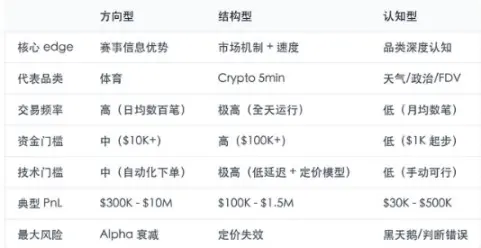
Comparison Table of Three Ways of Living
What am I doing myself?
After talking about others, let me talk about myself.
I’m running several lines simultaneously: crypto market making (structured), sports probability pricing (directional), and weather data modeling (cognitive). None of them are large—none come close to kch123’s daily volume of 493 trades or swisstony’s $4.94 billion in trading volume.
After unpacking these 40 addresses, the one thing I thought about most: understanding which game you're playing is more important than optimizing any parameter.
Trading with direction but no informational edge is just guessing, no matter how well you execute. Trading with structure but failing to keep up with timing makes you the one getting harvested. This isn’t鸡汤—it’s what I told myself after reviewing the data.
Currently, each line is running small-scale validations to confirm the existence of edge cases before scaling up. Don’t rush to expand—first, get one or two categories working smoothly.
Data sources: Polymarket Data API + LB API + Polygon on-chain data | Analysis period: January–March 2026
Want to try Polymarket? First, decide which game you want to play.