On April 7, Trump announced a two-week ceasefire between the U.S. and Iran. On April 21, the day before the ceasefire was set to expire, he posted a statement on Truth Social announcing an indefinite extension of the ceasefire.
Subsequently, Reuters, AP, BBC, Al Jazeera, and The Wall Street Journal all reported the extension of the ceasefire. Iran’s Foreign Minister acknowledged the decision to extend the ceasefire in a tweet.
In the real world, a ceasefire has continued under heavy restrictions.
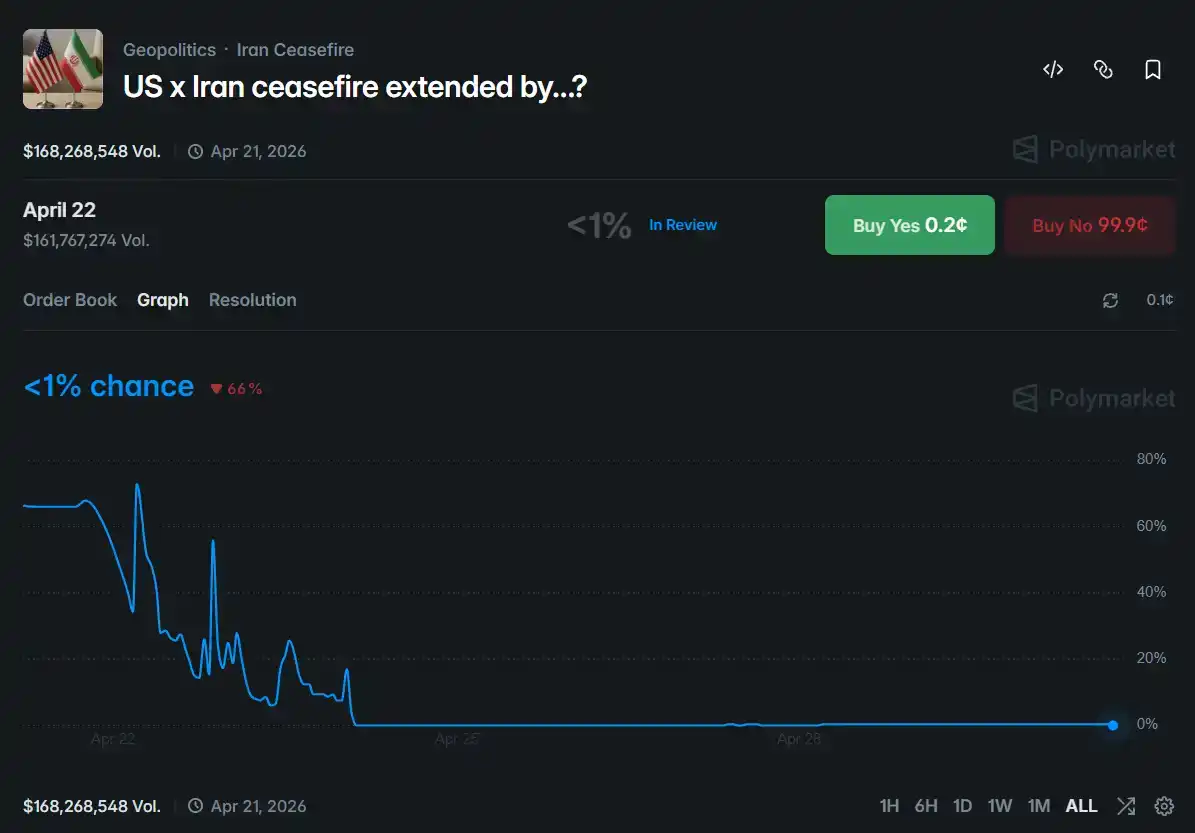
On Polymarket, the probability of "Yes" for the market "Will the U.S.-Iran ceasefire be extended before April 22?" is currently 0.1%.
In other words, the world knows the ceasefire has been extended, but the world’s largest prediction market believes it has not been extended.
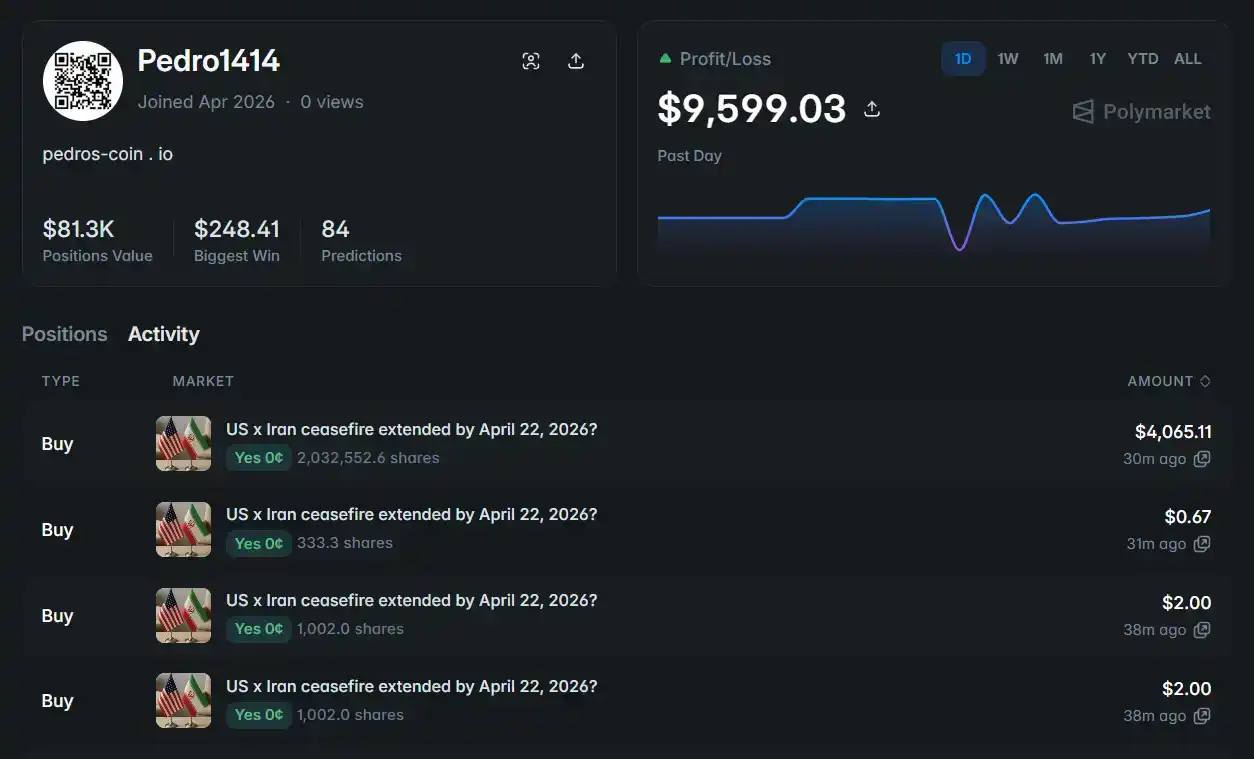
At this point in this controversial market, it's common to see bets expecting 100x returns: some traders wager anywhere from one dollar up to hundreds of dollars, attempting to create a rags-to-riches story.
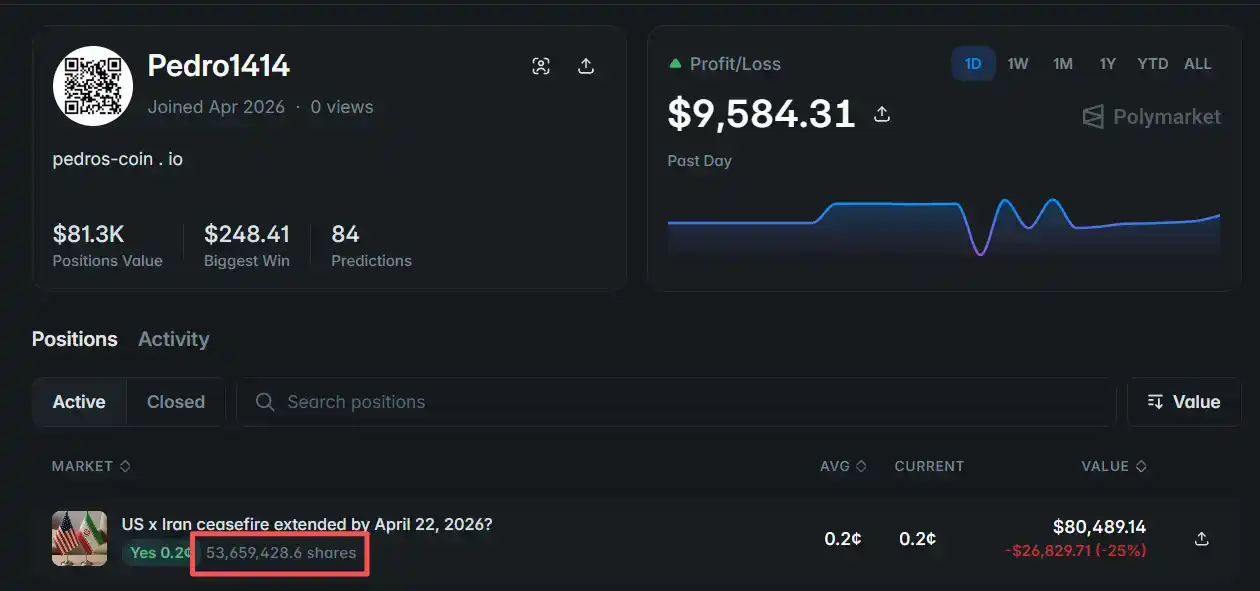
Over the past 24 hours, one account purchased $100,000 worth of "Yes," with a potential payout exceeding $50 million.
The official step in to change the rules—has the ceasefire been extended?
The controversy in this market was embedded in the rules from the very beginning.
Polymarket defines a "ceasefire extension" as requiring explicit public statements from both the U.S. and Iran, or achieving a "overwhelmingly credible media consensus." U.S. public statements must come from Trump himself on Truth Social.
The issue lies with Iran. The official statement from Iran used the term "acknowledged," rather than the "mutually agreed" required by the rules.
It was this wording that caused a $150 million trading volume discrepancy in this market: "Yes" holders believe that Trump’s statement, combined with uniform global media coverage, constitutes an "overwhelming consensus"; "No" holders argue that since Iran has not directly confirmed it in its own name, the condition has not been met.
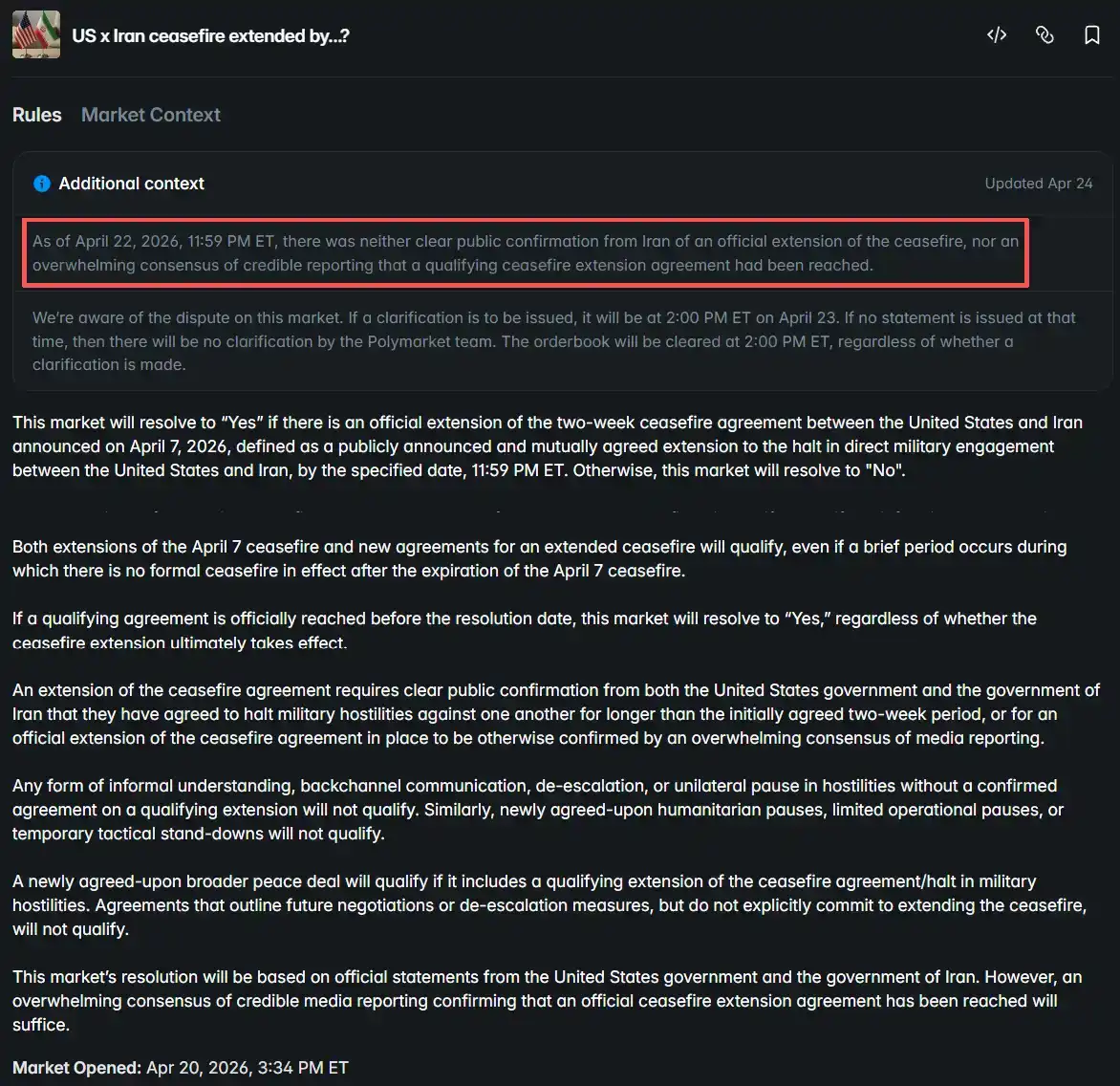
On April 24, Polymarket officially intervened, adding a clarification on the market page: As of April 22 at 23:59, no ceasefire extension meeting the "Yes" condition existed.
With official endorsement, market sentiment shifted abruptly, and the probability quickly fell below 1%.
As a result, numerous late-session traders who are well-versed in the game rules and trading strategies have emerged: buying "no" under the official determination has become a nearly risk-free, high-yield investment.
Among these individuals, the third-largest "No" holder comes from an account called NotBakerMcKenzie, betting approximately $8.5 million. Baker McKenzie is a top global law firm headquartered in Chicago that provides compliance legal services to prediction markets like Polymarket and has deep expertise in oracle settlement mechanisms and platform rules.
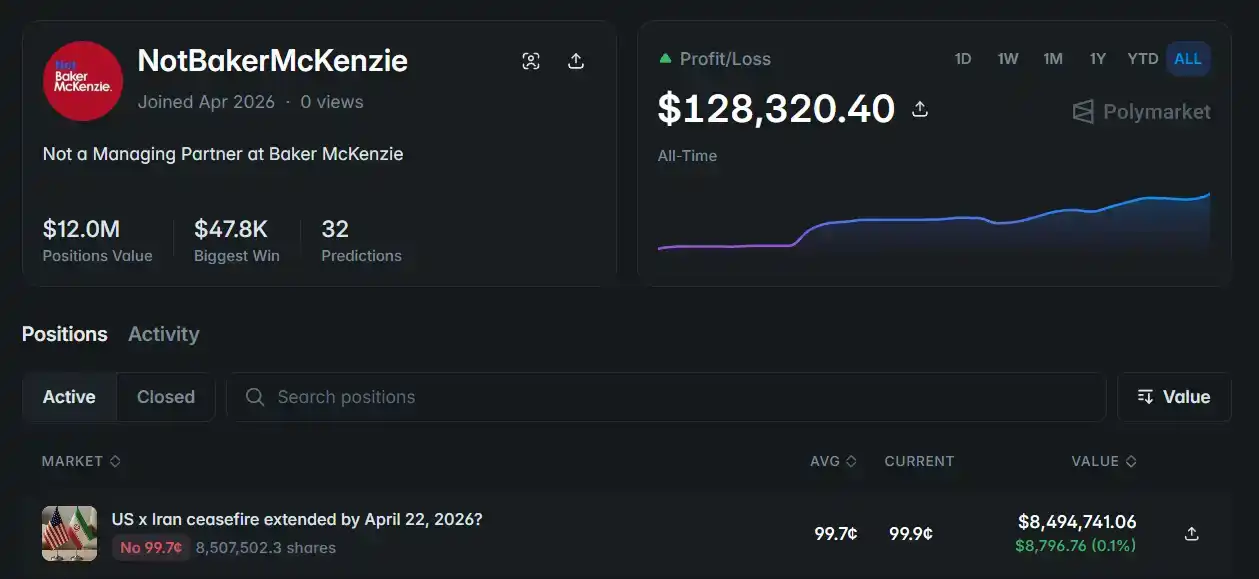
By interpreting the rules as a law firm and placing real money on the line, this move appears to be signaling to the entire trader community the ultimate direction of market settlement.
However, Pedro, the top holder of "Yes" tokens, clearly holds the opposite view: the Polymarket official statement can only serve as a reference for settlement; the outcome is determined solely by voting through the UMA decentralized oracle. As long as the UMA token stakers' vote supports "Yes," the official statement is irrelevant.
This is exactly what Pedro is betting on: risking $100,000 against the oracle voting outcome is a great deal compared to the potential $50 million return.
$50 million oracle attack
On Pedro’s Polymarket account homepage, there is a link that leads to a website for a token he issued—$pedros-coin. Although the site is filled with unfinished architecture and crude page design, the token’s design rules are strikingly prominent.
$pedros-coin cannot be purchased through conventional meme rules; the only way to obtain it is by action: earn 1 coin per hour of watching live streams, and 20 coins for each post on social media—all acquisition methods are tightly tied to online sharing.
The value of this token depends entirely on the market's probability of "yes" for whether the ceasefire will be extended. If the probability is 100%, each token is worth $1; if the final settlement is "no," the token is worthless.
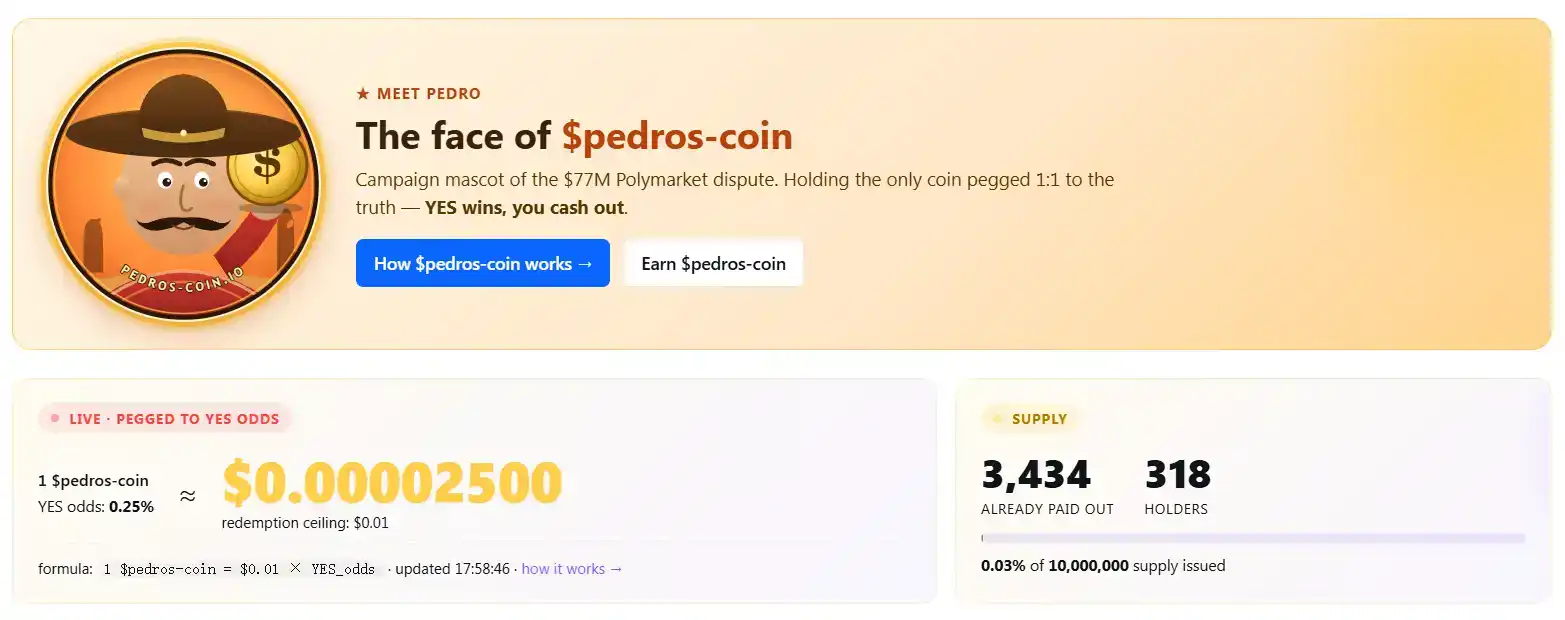
Pedro’s position in this market also perfectly serves as a collateral guarantee for token payouts—he holds 50 million "Yes" shares, with a potential payout exceeding $50 million, payable only if he wins.
Putting these elements together, the logic of this design becomes clear: Pedro tied the interests of hundreds of people to his “yes” position using $pedros-coin, encouraging them to consistently generate buzz online with the goal of creating enough public pressure before the oracle vote to convince as many stakers as possible that this market “should settle as yes.”
Narratively, this mobilization mechanism embodies a peculiar Web3 spirit—Pedro, having invested over $100,000 of his own money, rallied retail investors to unite through earned tokens, challenging the established dominance of large holders, and their bet aligns in reality with an actual existing ceasefire.
But another layer emerged in Pedro's Discord channel, making the matter no longer so straightforward.
Pedro playing dumb and the oracle大户 manipulating the market with transparent pricing
On April 30, a user named Euan posted a message in the Discord channel listed on Pedro’s personal website: “As you can see, I own the wealthiest UMA wallet. Open to bribes to swing the vote. DMs open.”
Two screenshots were attached next to the message: one showing ownership of 2.9 million UMA tokens, and another displaying the account page for borntoolate.eth.
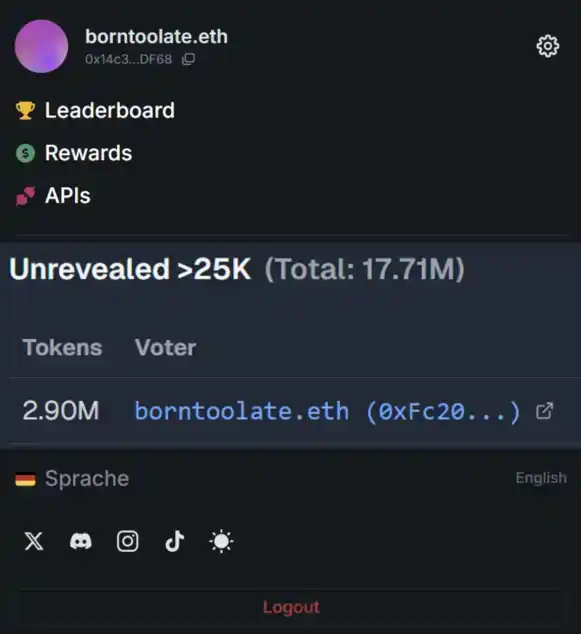
2.9 million UMA tokens, representing approximately 16.4% of the current total staked amount of 17.71 million tokens.
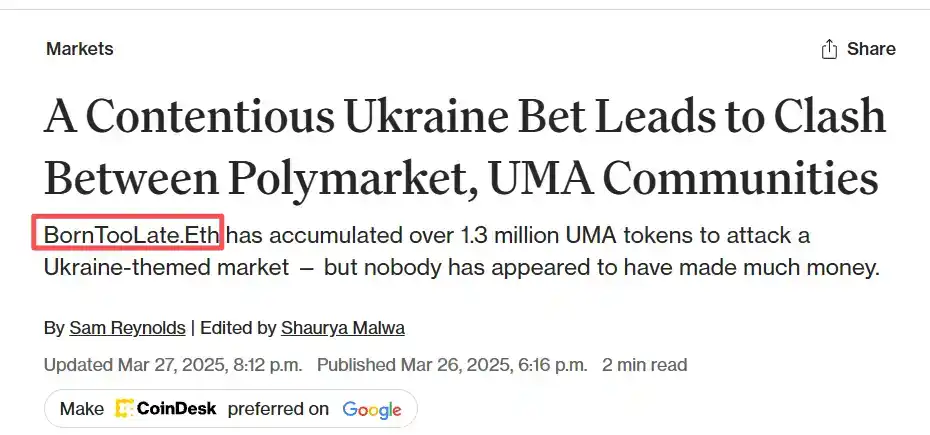
This single screenshot is already impressive enough, and the name "borntoolate" carries as much weight for longtime Polymarket players as the 16.4% figure does.
In March 2025, the Polymarket market "Will Ukraine agree to Trump's mineral resources agreement by the end of March?" was settled as "Yes" by oracle vote, despite ongoing negotiations and no formal signing.
This is precisely the notorious Polymarket oracle attack, orchestrated by borntoolate. With overall voter participation low, borntoolate exploited their large holdings and staking of UMA tokens to exert disproportionate influence, forcing the settlement outcome toward "Yes," contradicting the actual facts.
The core assumption of UMA’s security model is that “the cost of attack exceeds the potential gain”—an attacker must purchase enough UMA tokens to control voting, and this cost should exceed the profits they could obtain from the attack. However, the total market capitalization of the entire UMA protocol is currently only $40 million.
We cannot verify whether Euan is truly borntoolate. However, if the outcome of this settlement is reversed again, Pedro’s $100,000 bet could yield over $50 million in returns.
As of now, the results of the UMA oracle vote appear quite clear. Among the tokens with publicly disclosed votes, "no" votes exceed 10.27 million, while "yes" votes total only 25.
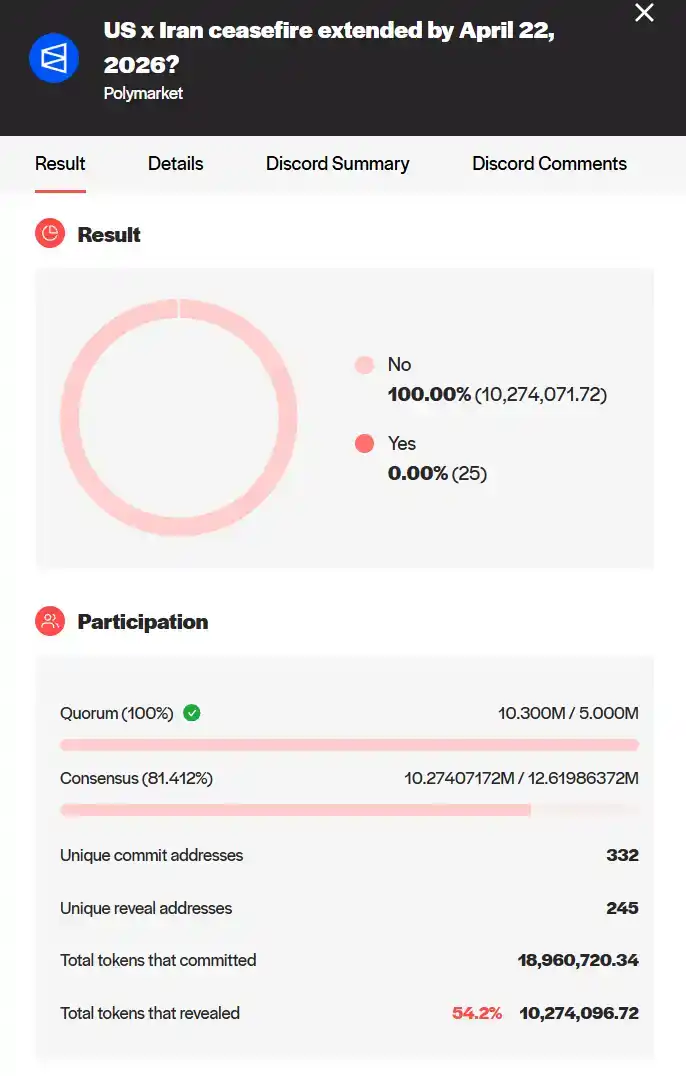
The only variable in this round of voting is the allocation of approximately 8.69 million UMA tokens whose votes have not yet been disclosed. If more than 2.33 million of these tokens vote "no," this round will be considered to have reached consensus, and the market will settle on "no." If this threshold is not met, the vote will be deemed invalid, and the dispute will carry over to the next round—which is the window Pedro is truly waiting for.
As of writing, Pedro is still buying "yes."