





Original | Odaily Planet Daily (@OdailyChina)
Author | Azuma (@azuma_eth)

Polymarket has suddenly become embroiled in a fee controversy.
Several community users noticed last night that they were charged unusually high fees when trading on Polymarket, resulting in significantly reduced shares or earnings compared to usual.
Overseas user Frosen (@frosen) even shared a screenshot showing he attempted to place an order for 100 shares at $0.001 in the "economy" market, but Polymarket’s frontend displayed the predicted payout as only $5.20 (normally it should be $100)—corresponding to an absurdly high fee rate of 94.8%!
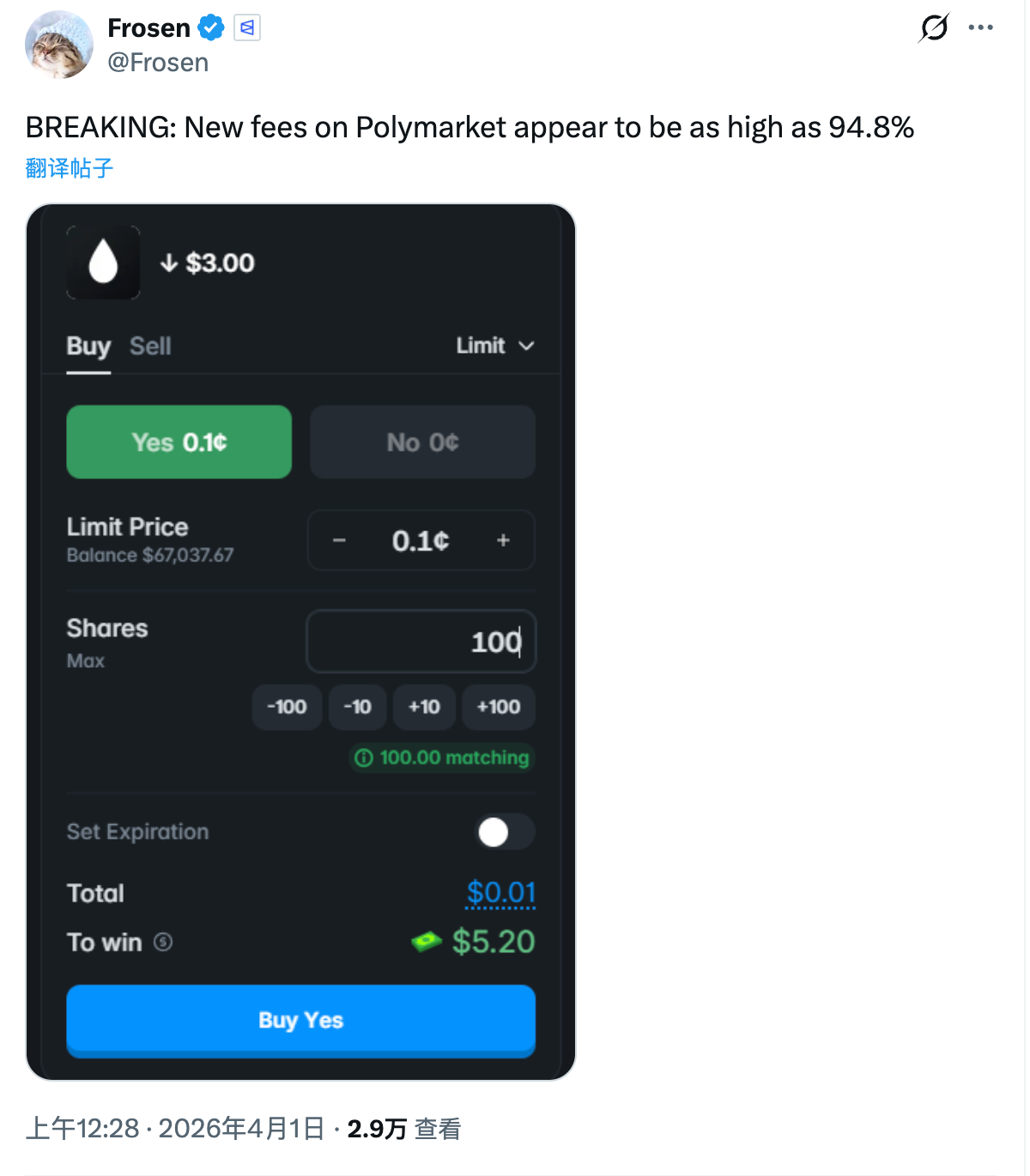
What’s going on? Is Polymarket desperate for money? According to Polymarket’s official disclosure and community surveys, Odaily found that the direct cause of this unexpected situation was Polymarket’s modification of the platform’s fee formula last night, which underwent three different versions:
- First, the "old formula" introduced on March 30: fee = C × p × feeRate × (p × (1 - p))^exponent;
- Then, the first change, which caused the unexpected situation—the formula (referred to as the "abnormal formula"): fee = C × feeRate × (p × (1 - p))^exponent;
- After recognizing the issue, Polymarket made corrections and introduced the current version of the "new formula": fee = C × feeRate × p × (1 - p);
- Note that in all three formulas, C refers to the number of shares traded, p refers to the price per share, and feeRate and exponent are variables.
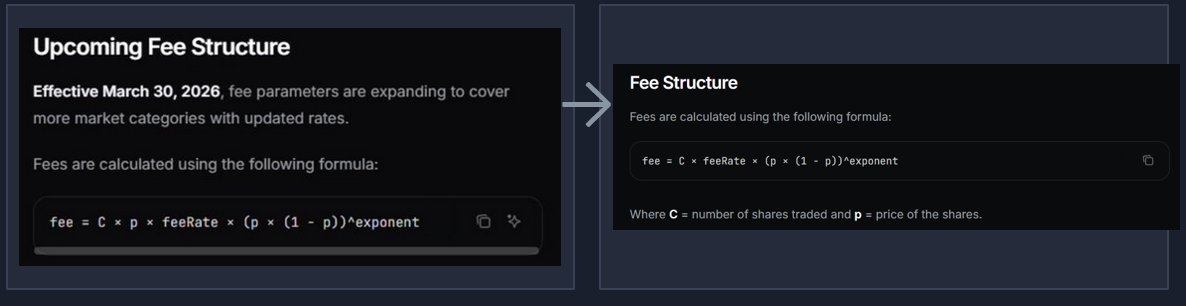
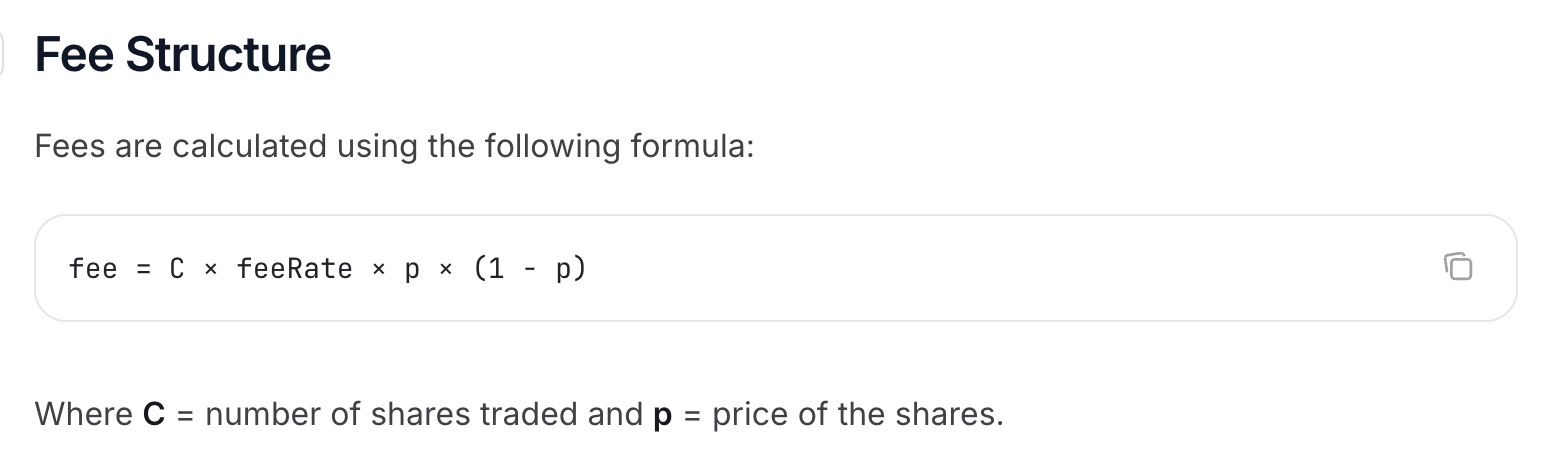
Breakdown of the abnormal formula: Where did the 94.8% outrageous fee come from?
You don’t need to dwell too much on the mathematical details—by simply comparing the “old formula” with the “anomaly formula,” you can easily see that the latter removes just one “ × p” (the multiplication symbol, not the lowercase x), resulting in one fewer multiplication by the shares price.
Since all shares on Polymarket are priced below $1, this inevitably leads to an overall increase in fees, and the lower the share price, the more pronounced the fee increase becomes due to the omitted multiplication—when share prices approach zero, absurdly high fees may occur.
How extreme this fee becomes also depends on the same variable, ^exponent, which exists in both the old and anomaly formulas. Literally translated, ^exponent means "raised to the power of exponent," and this variable primarily controls the steepness of the fee curve.
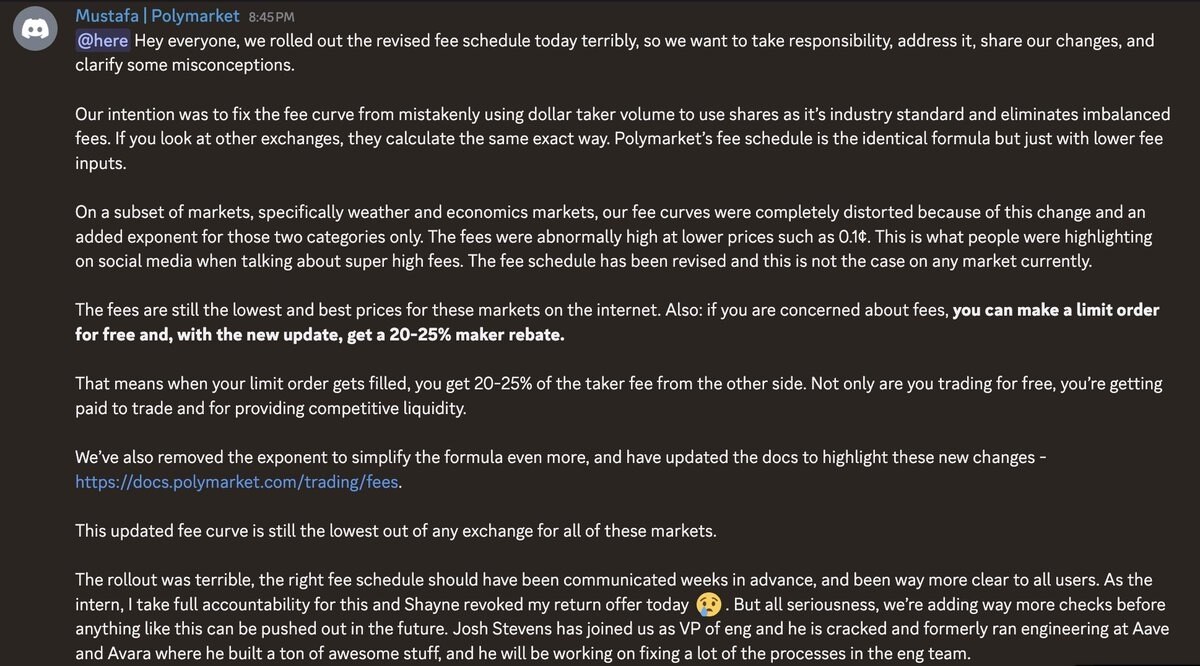
According to Mustafa from Polymarket, yesterday’s anomalous formula introduced an exponent only in the “Weather” and “Economy” market categories, with all other markets having the parameter set to 1 to ignore the variable. According to disclosure by overseas KOL Quant Chad (@Autonomous_Chad), the exponent parameter for both of these markets was set to 0.5 at the time.
Now return to Frosen’s case and plug in the corresponding numbers into the unusual formula: fee = C × feeRate × (p × (1 - p))^exponent. Here, C equals 100, meaning Frosen wishes to place an order for 100 shares; p equals 0.001, meaning $0.001 (0.1 cent); exponent equals 0.5, meaning raising (p × (1 - p)) to the power of 0.5; and the final fee rate is 94.8%.
Simply feed it to AI to reverse-engineer the feeRate level at approximately 0.03, while reconstructing the exact formula calculations Polymarket performed for this order.
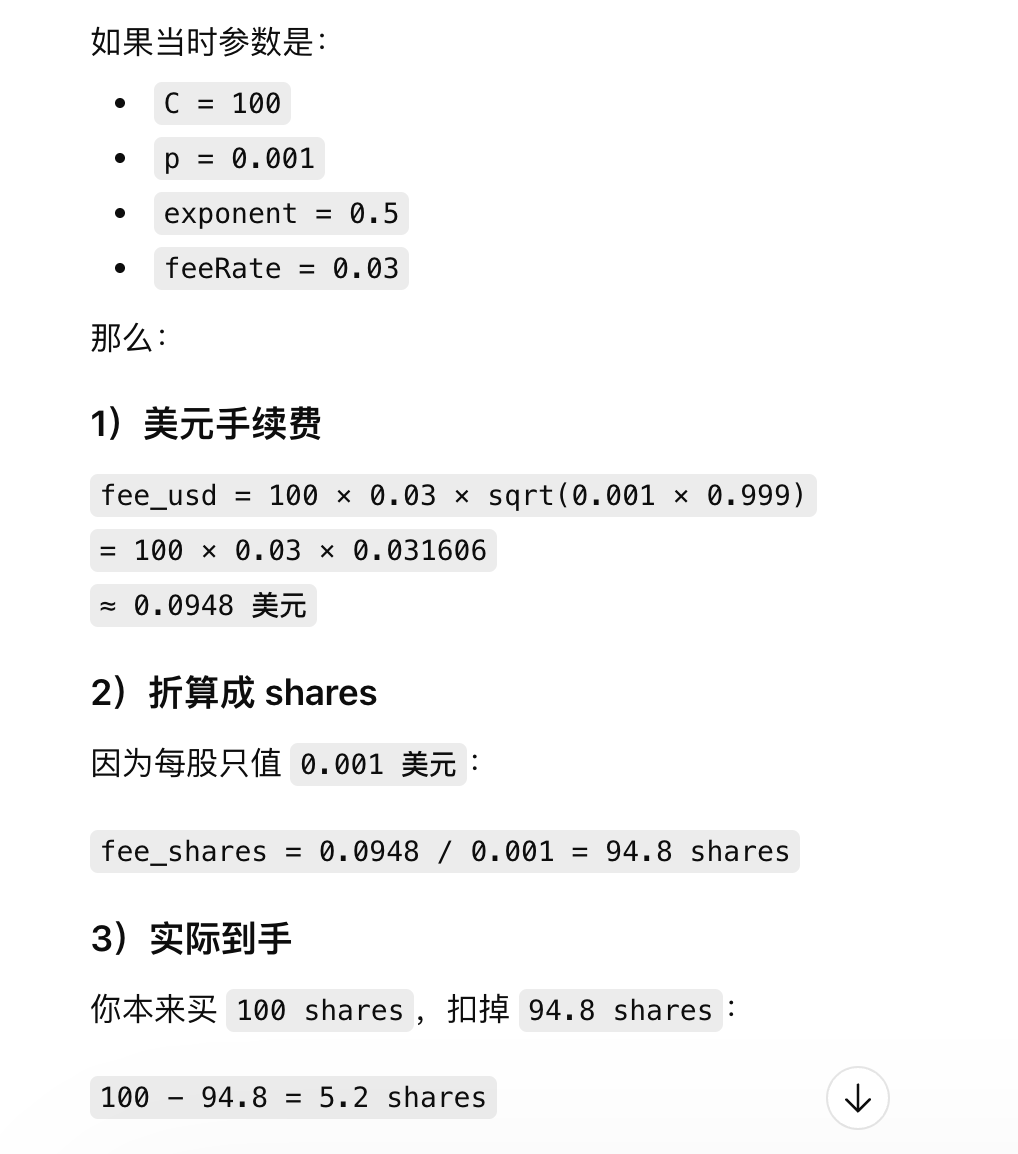
In simple terms, Polymarket calculated the fee for this order to be $0.0948 using an unusual formula. Since Polymarket deducts fees from buy orders by directly removing shares of equivalent value, and the share price at the time was only $0.001, this meant removing 94.8 shares. As a result, Frozen ended up with only 5.2 shares, meaning even if the prediction was correct, the potential profit would be just $5.20.
Polymarket's remediation measures
Shortly after the abnormal fee issue arose, Polymarket quickly responded by revising the formula to the current version: fee = C × feeRate × p × (1 - p). Compared to the abnormal formula, the new formula removes the “^exponent” — effectively changing the exponent parameter from 0.5 to 1 in the original abnormal formula, fee = C × feeRate × (p × (1 - p))^exponent.
In the anomaly formula, the effect of ^exponent is to raise the set of data p × (1-p) to another power. In Polymarket’s actual operations, the theoretical range of p × (1 - p) is between "0.000999 and 0.25"—when p is closer to 0.5 (share prices near $0.50), this set of data approaches 0.25; when p is closer to 0 or 1 (share prices near $0 or $1, with extreme quotes at $0.001 and $0.999), this set of data approaches 0.000999.
Within the range of "0.000999 - 0.25", regardless of the specific value chosen, increasing the exponent parameter from 0.5 to 1 directly reduces the final fee result in the formula calculation, thereby lowering the overall fee.
More importantly, this reduction has a significantly stronger suppressing effect on the abnormally high fees near extremely low price levels—when p × (1-p) = 0.000999, the fee under the new formula is only about 3.16% of the fee under the abnormal formula, equivalent to a decrease of approximately 96.84%; when p × (1-p) = 0.25, the fee under the new formula is 50% of the fee under the abnormal formula.
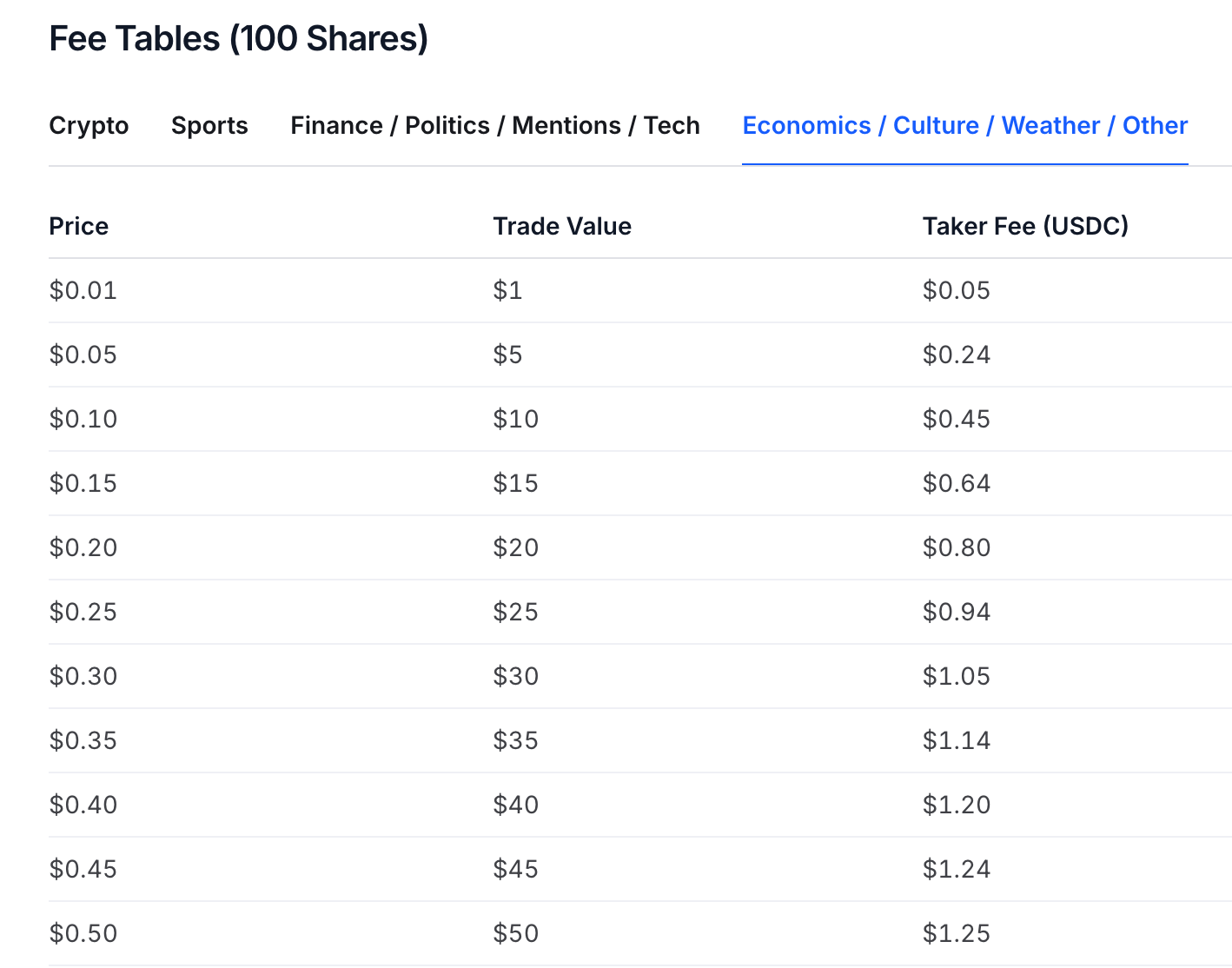
As shown in Polymarket's official documentation, after the new formula took effect, the fee at extreme outcomes in the "Weather" and "Economy" market categories has been reduced to 5%.
How can retail investors avoid fees?
I know most users are too lazy to look at the formula above, but they’re still concerned about Polymarket’s current fees.
Regarding this, Mustafa mentioned on the official Discord: "If you're concerned about fees, you can place limit orders for free, and after this new update, you can earn a 20%-25% maker rebate—meaning, when your limit order fills, you'll receive 20%-25% of the taker fee paid by the counterparty, so you're not just trading for free, but actually getting paid for providing competitive liquidity."
So adjust your habits—try to avoid placing market orders directly, and instead use limit orders more often. You can also experiment with Polymarket’s Split feature to indirectly build your position by placing limit orders to sell the opposite shares.