




Author: Shenchao TechFlow
After a long period of stagnation, the crypto space has welcomed another billion-dollar-valued project—but this time, the biggest highlight isn't the valuation itself.
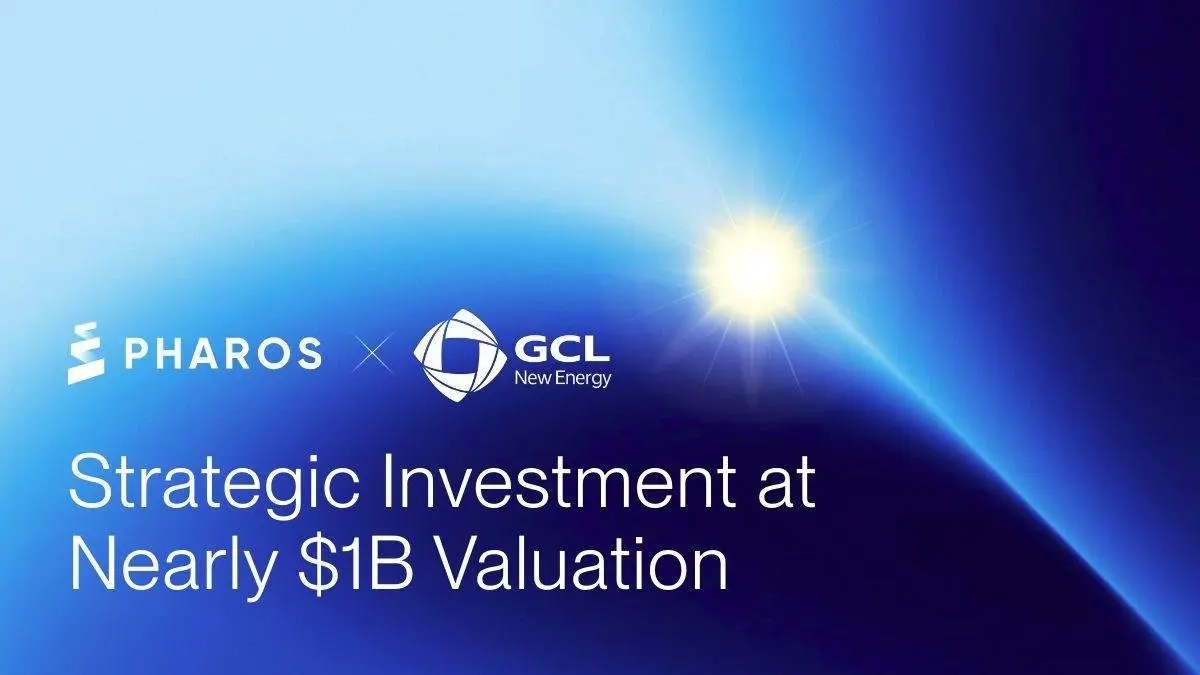
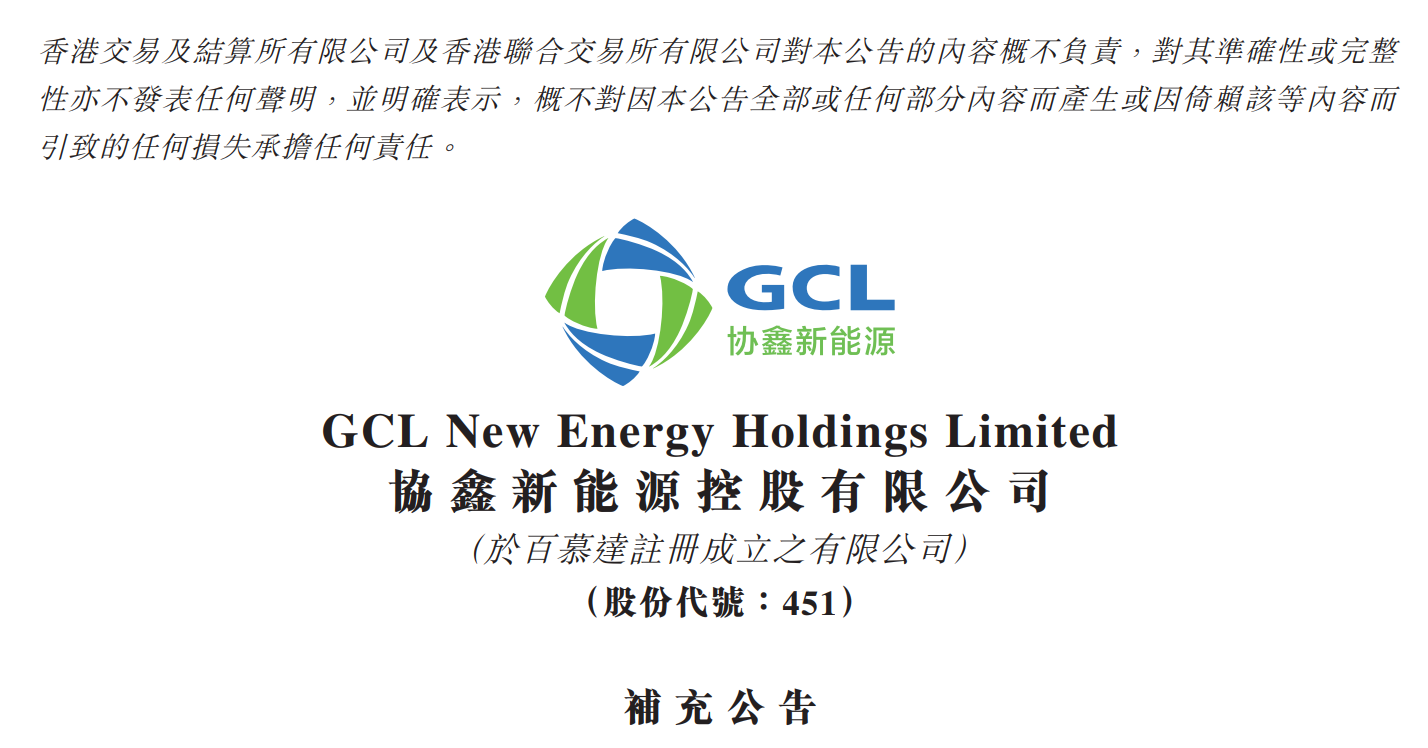
On March 14, 2026, Pharos, an institutional-grade, high-performance parallel Layer 1 blockchain built for real-world finance, announced a comprehensive capital partnership upgrade with GCL-Poly Energy Holdings Limited (0451.HK), a listed company on the Hong Kong Stock Exchange, quickly becoming a market focus.
The market is first drawn in by valuation: According to the latest agreement signed by both parties, GCL New Energy will complete its investment subscription in Pharos at a valuation of nearly $1 billion. The figure of $1 billion alone is enough to ignite community discussion.
But right after that, everyone discovered something even more interesting than the valuation:
According to the disclosure documents, this investment subscription is not a simple "sign-and-close" one-time transaction, but rather includes multiple conditions precedent and staged closing provisions. If any key condition is not met, the collaboration will instantly become void.
In simple terms, signing a partnership doesn't mean the money has actually been received—it all depends on the price performance of the Pharos Token upon listing.
All of this makes this investment subscription appear less like a typical crypto event and more like a capital博弈 with clear stakes between traditional markets and crypto—both sides aiming for mutual benefit, with predefined conditions as safeguards.
As the era of "unconditional funding" in crypto financing meets traditional capital, what should we expect from the future market?
New Ways in Crypto Financing: Token-Equity Binding with Gradual Unlocking
Many people compare this investment subscription to a Crypto version of "betting," as it effectively captures the risk management logic inherent in betting strategies.
In traditional capital markets, performance-based agreements are one of investors’ most effective risk-control tools: investors provide a high valuation, while founders commit to specific targets. If the KPIs are met, everyone wins; if not, the founders must repurchase shares at their own expense.
Traditional investment banks often focus on future revenue and profits, while Crypto emphasizes a metric highly characteristic of Web3: token listing performance.
But if you focus solely on the concept of betting, you may overlook the pattern of innovation behind this transaction.
How can shares representing traditional capital and tokens symbolizing crypto capital be better integrated? Pharos and GCL New Energy have taken the lead in demonstrating a sophisticated, mutually invested, synchronously activated, and staggered-vesting homologous capital model.
The first step in this structural innovation is Pharos’s pre-subscription for GCL New Energy shares.
Pharos will act as a pre-investor, subscribing to new shares of GCL New Energy at a price of HK$1.05 per share, with a maximum subscription of 183,480,000 shares (equivalent to approximately 10% of GCL New Energy’s outstanding shares). Compared to GCL New Energy’s current share price of approximately HK$1.23, this subscription represents a discount of approximately 15% to Pharos.
But at the table of capital, there are no free chips.
To truly secure these discounted shares, Pharos must meet GCL-Poly Energy’s “five-step” closing conditions within the 18-month validity period, with each step tightly tied to the future market performance of the Pharos Token.
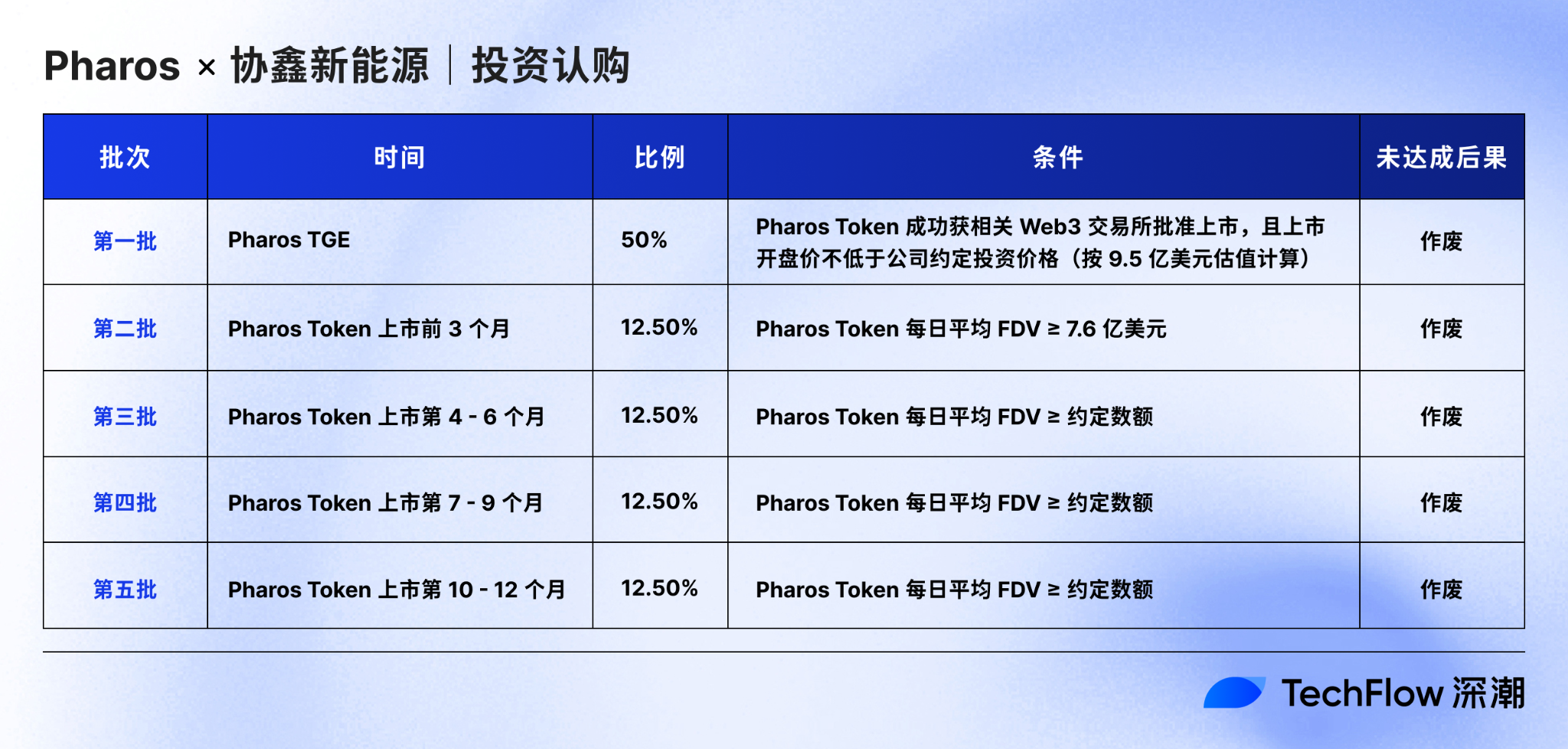
Once the Pharos Token meets the delivery conditions, Pharos’s subscription for shares in GCL New Energy will take effect simultaneously, and GCL New Energy’s subscription for Pharos Tokens will also take effect, with identical unlocking ratios.
Under this two-way binding:
- Pharos Token met performance targets, with shares and tokens settled together;
- The Pharos Token performed contrary to expectations, causing both shares and tokens to halt.
Taking the first and most critical batch as an example, after the successful listing of Pharos Token and its opening price meeting the target, Pharos will immediately deliver 50% of the share subscription to GCL New Energy, and GCL New Energy will acquire Pharos Tokens valued at approximately HK$96.73 million at a valuation of $950 million.
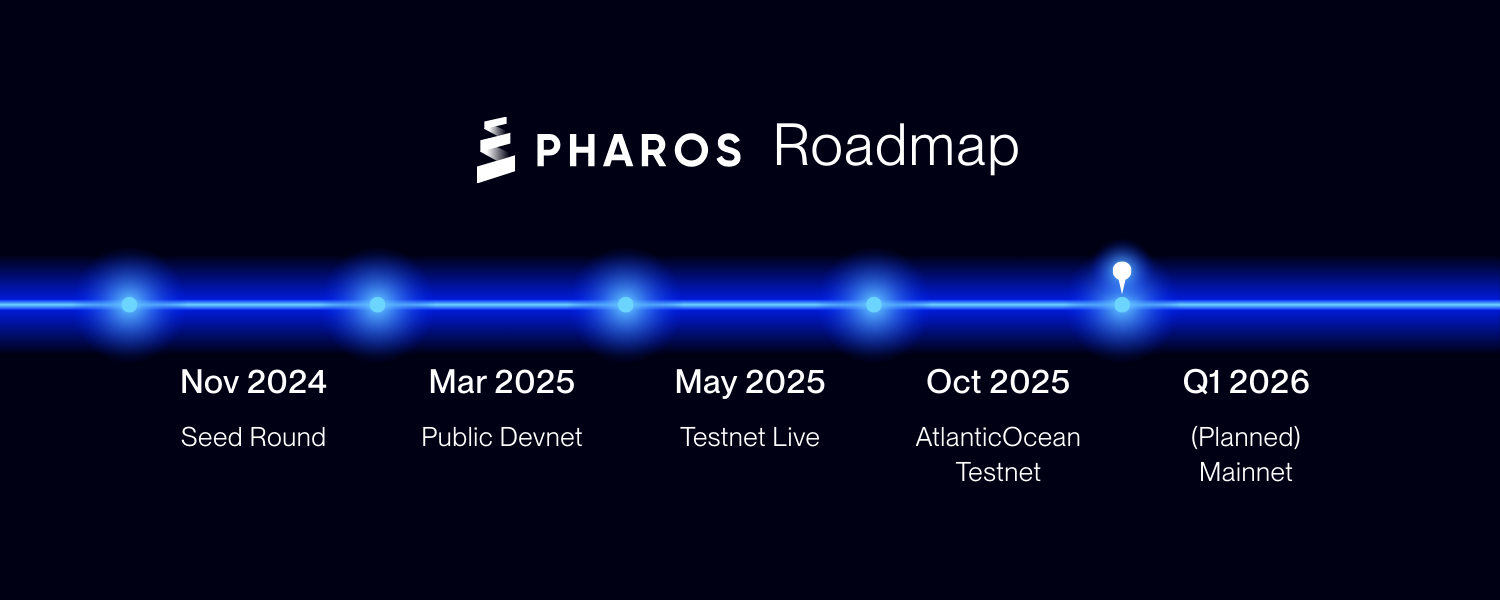
Under this investment subscription agreement, and following Pharos’s prior announcement that Anchorage Digital will provide regulated minting, distribution, and custody services for the Pharos TGE, Pharos may now be in the final stages leading up to its TGE.
Each gets what they need: one agreement, two ways to win
This special investment subscription transaction takes place precisely at this delicate moment in time.
Past experiences have shown us that the old fundraising model—where crypto projects rely on whitepapers to tell stories and liquidity speculation to support valuations—no longer works. The market has seen too many bubbles and too many crashes. What we need now is a vivid example that combines real assets, a compliant framework, and on-chain innovation.
The transaction between Pharos and GCL-Poly Energy serves as precisely this example.
Behind the complex terms is a strategic negotiation where both parties strive to lock in what matters most to them within the contract:
For GCL New Energy, this is an excellent model that offers both offensive and defensive advantages.
Investing in Pharos is an active bet on on-chain narratives, and introducing a wagering structure effectively manages risk: if Pharos underperforms, Jiaxing can exit promptly; if Pharos performs exceptionally well, Jiaxing not only receives tangible capital injection but also acquires tokens with high appreciation potential at the initial valuation.
For Pharos, the value of this transaction goes far beyond simply adding a new partner.
The first benefit is trusted endorsement. A Hong Kong-listed company willing to link its shares with tokens is itself the most significant public endorsement of Pharos.
The second gain is a demonstration of confidence. Pharos’s agreement to this set of stringent delivery terms largely signals to the market the project’s confidence in its future development. This stance is more persuasive than any technical whitepaper.
The third gain is the historic position as an industry first. Over the past year, we’ve seen numerous DAT cases of traditional public companies acquiring crypto assets. But this time, the trend has reversed: Pharos, through this subscription, directly became a shareholder of GCL New Energy, making it the first crypto project to strategically hold shares in a traditional Hong Kong-listed company.
To a large extent, this represents the first time that high-quality crypto projects in the crypto world have secured a genuine seat at the table and pricing power in traditional capital markets. Meanwhile, this transaction has received official support from the Hong Kong Stock Exchange, demonstrating Hong Kong’s forward-looking approach to embracing compliant crypto innovation and adding a strong compliance foundation to this transaction.
One contract, two ways to win.
In pursuit of a win-win outcome and rejecting a lose-lose scenario, more people are curious about the two main players driving this model innovation.
Keep in mind that Hong Kong-listed companies have always been known for strict risk controls and conservative practices—why would Pharos dare to include future price performance in a contract, and why would GCL New Energy tie shares of a listed company to a token that has yet to be validated in the market?
A closer look reveals that this seemingly bold cross-industry partnership is inevitably driven by mutual alignment.
Mirror Complement: The Inevitable Meeting of Pharos and GCL
At one end of this model innovation is GCL-New Energy.
As Asia's leading solar photovoltaic company, its core business focuses on the development, construction, operation, and management of solar power plants, along with electricity sales and related solar services. Despite holding some of the most high-quality green assets, it also faces common challenges of traditional assets: long construction cycles, slow return realization, and increasingly fierce financing competition.
What GCL really needs is not another power plant, but a financial instrument that can reorganize, relist, and revalue these off-chain assets.
At the other end of the table is Pharos.
As a parallel L1 designed for institutional-grade use cases, Pharos was clear from its inception: it is not about building another blockchain with higher performance, but about enabling real-world applications—including stablecoin settlements, institutional-grade DeFi, regulatory-compliant payment networks, and the on-chain circulation of RWA, particularly in energy, commodities, and infrastructure assets. In short, Pharos aims to become the foundational infrastructure capable of supporting authentic financial narratives.
Performance is the foundation of the "RealFi Infrastructure" vision. Pharos, designed with a modular architecture and a deeply parallel execution engine, offers sub-second confirmation times, high throughput, and low fees, enabling more efficient on-chain asset issuance, circulation, and real-time settlement.
Addressing the compliance concerns that institutions prioritize when onboarding to the chain, the Pharos protocol layer integrates ZK-KYC/AML and digital identity, supporting regulatory compliance while remaining open.
Before partnering with GCL New Energy, Pharos had already won the favor of capital and institutional investors:
According to public records, Pharos completed two funding rounds in November 2024 and September 2025, receiving support from prominent VCs such as Hack VC and Lightspeed Faction.
In terms of institutional partnerships, Pharos previously announced a collaboration with the decentralized finance platform Centrifuge. By integrating Centrifuge’s institutional-grade tokenization infrastructure and asset standards with Pharos’s “inclusive and execution-focused” Layer 1, the partnership enables the scalable on-chain distribution and operation of a range of institutional assets, including tokenized U.S. Treasuries (JTRSY) and AAA-rated structured credit products (JAAA).
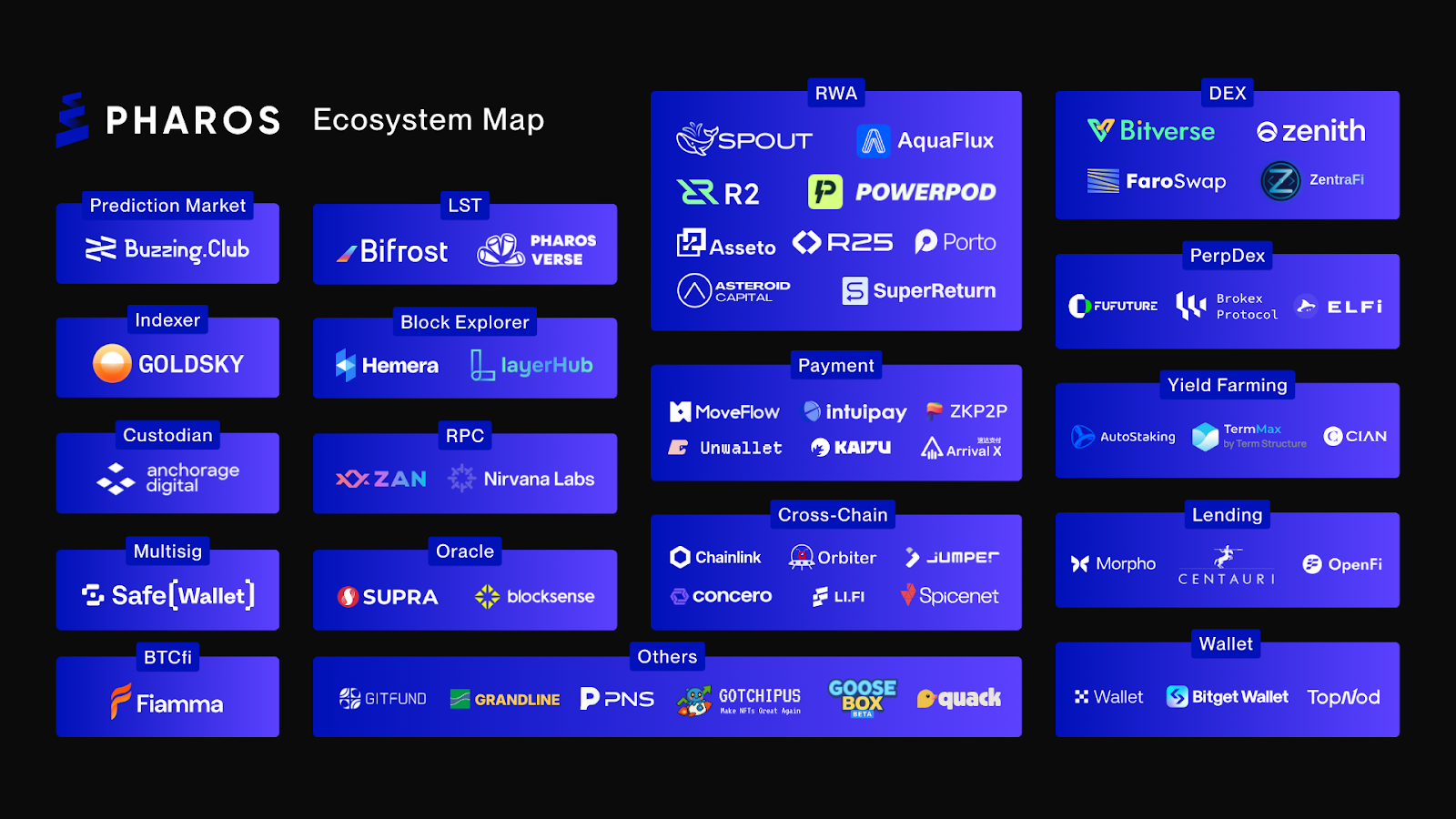
Putting the two counterparties together reveals an almost mirror-image complementarity between GCL-New Energy and Pharos.
For GCL New Energy, seeking a crypto vehicle that can unlock opportunities in Web3, RWA, and market revaluation, transforming offline heavy assets into new on-chain capital forms;
For Pharos, a traditional capital entry point is needed that can accommodate high valuations, compliant narratives, and the imagination of real assets, grounding the on-chain story in tangible assets.
From this perspective, this investment subscription is less like a partnership and more like an inevitable convergence. Interestingly, both parties have connections with Ant Group, which many netizens have jokingly referred to as the invisible bridge facilitating this convergence.
In December 2024, GCL Energy collaborated with Ant Digital Technologies to complete China’s first RWA transaction exceeding RMB 200 million for photovoltaic green assets. In June 2025, the two parties established a joint venture, “Ant Xinneng,” to further explore applications in energy AI and RWA.
At the same time, we know that Pharos’s co-founder and several team members come from Ant Group, whose AntChain has extensive enterprise-level blockchain deployment experience in the B2B space. This likely further enhances Pharos’s technical capability to implement institutional-grade RWA solutions and its ability to integrate institutional resources, indirectly paving the way for Pharos’s collaboration with GCL.
However, viewing this transaction merely as a capital commitment risks underestimating its true significance. The real story lies in what follows: the established partnership structure, the pathways for asset tokenization, and the broader scope of innovative collaborations to come.
According to the on-chain locked asset types disclosed by Pharos, we can see that among all of Pharos’s locked assets: 51% come from renewable energy assets held by distributed photovoltaic operators and centralized power station operators; 49% come from financial assets issued by fund management companies and credit asset issuers.
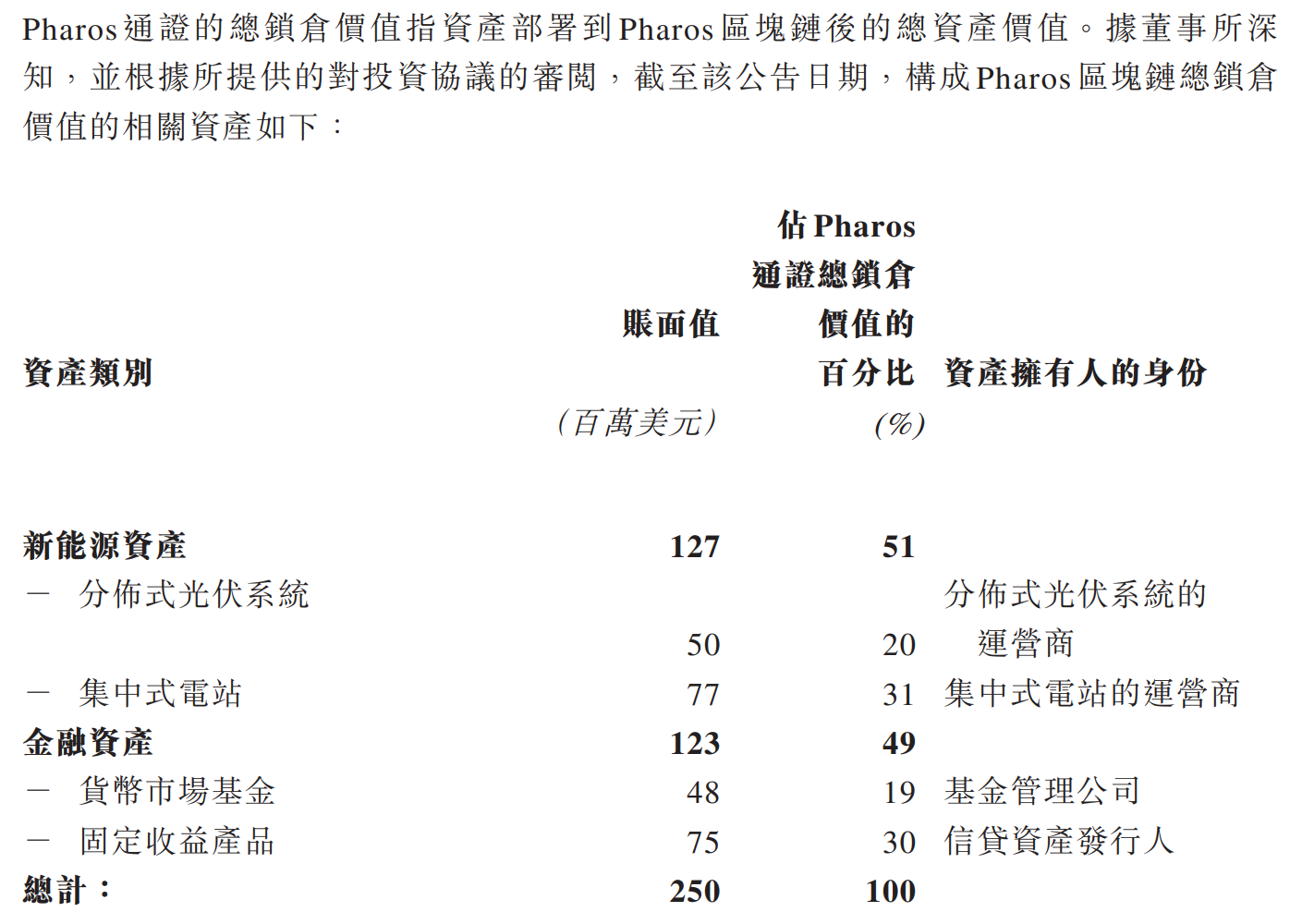
This strongly suggests that GCL’s assets, such as photovoltaic and new energy power stations, will almost certainly be tokenized on Pharos in the future.
This means that high-quality green energy assets in Asia, represented by GCL New Energy, will be able to transcend geographical limitations and connect more efficiently with global markets on-chain. Meanwhile, Pharos will also strive to bring high-quality RWA assets from Europe and the United States into Asia, enhancing Asian investors’ ability to diversify their global asset allocation.
Whether launching out or bringing in, this binding model based on the synergy among equity, tokens, and assets has the potential to unlock growth momentum far exceeding that of a single subscription.
Conclusion
Of course, everything is still in a very early stage.
In the current climate of high uncertainty about the future, it is completely natural to hear voices of concern and doubt.
Some community members believe that Pharos’s nearly $1 billion valuation was calculated based on the project’s stated total locked assets of $250 million, a figure disclosed solely by the project team without independent market validation.
Others are also concerned that the conditional phased delivery model may place excessive pressure on the Pharos Token’s secondary market. Given that the mainnet has not yet launched and the tokens have not been released, this can currently be viewed as a bet on confidence—but it remains uncertain whether this will later become a premature depletion of that confidence.
However, the differing voices precisely demonstrate the community's interest in the subsequent development of the event, while none of them hinder our ability to recognize the pattern of innovation revealed through this coin-stock collaboration:
In the past, crypto fundraising often involved securing funding first with a compelling story, then using that money to prove its validity;
Now, Pharos’s collaboration with GCL New Energy sends a strong signal through innovation leadership: the next phase of crypto may be won by whoever dares to write their story into contracts, entrust their narrative to the market, and turn promises into tangible, unavoidable realities.
In the bubble era, the most valuable thing was imagination; in the revaluation era, the most valuable thing is execution.
And this, perhaps, is the true value this investment subscription leaves for the industry.