





Author:Pendle is a decentralized finance (DeFi) protocol built on the

Key Points
- The Algorithmic Incentive Model (AIM) will officially launch at 00:00 UTC on January 29, coinciding with the end of the last vePENDLE voting period.
- This model is expected to reduce $PENDLE emissions by approximately 30%, while significantly improving incentive efficiency.
- Emissions will be automatically allocated based on LPs' genuine market contributions to the protocol and users, with weights determined by TVL and trading fee generation.
- LPs will receive higher TVL incentives to bootstrap initial liquidity; as the pool matures, the incentive focus will gradually shift toward fee generation.
- The protocol can amplify the reward scale through external incentives and is jointly incentivized by Pendle, enabling up to $1.40 in incentives for every $1 invested.
- With the original ve-boost mechanism removed, the APR for LPs is expected to increase overall, especially more significantly in high-volume pools.
Introduction
In the old system, $PENDLE emissions were determined by manual voting. Although this method was functional, historical data analysis shows that it was highly inefficient.
More than 50% of emissions are allocated to the 10 least profitable liquidity pools. In short, a large amount of emissions are wasted, rather than being genuinely "earned":
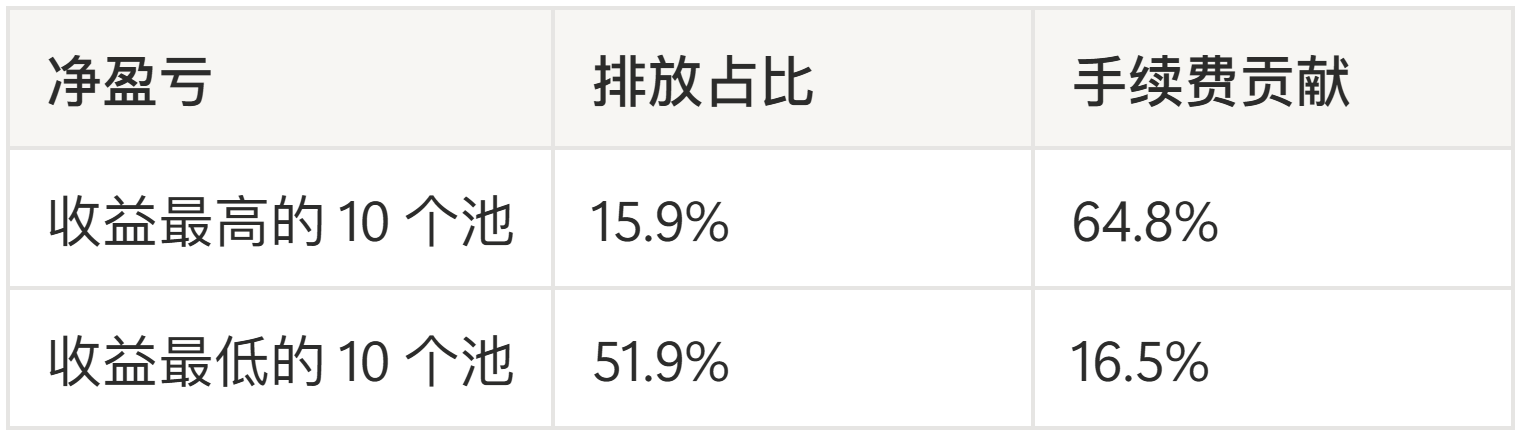
Through this upgrade, $PENDLE is expected to reduce overall emissions by approximately 30% and allow rewards to be automatically guided by liquidity and trading volume.
Algorithmic Incentive Model
The Algorithmic Incentive Model (AIM) allocates emissions based on the actual contribution to Pendle's liquidity pools. The measurement criteria include:
- TVL (Total Value Locked)
- Transaction Fee (Swap Fee)
AIM has abandoned a "one-size-fits-all" incentive structure, recognizing that incentive logic needs to evolve continuously with the capital pool's lifecycle.
The ultimate goal of the system is to:
Accelerate liquidity growth in the early stage, and then gradually shift to a fee-driven incentive mechanism as the capital pool matures.
The input data uses a weighted historical average over 2 weeks, with higher weights given to more recent data. For simplicity, this will be referred to collectively as "historical data" in the following text.
Customized incentive mechanisms for each phase of the protocol launch
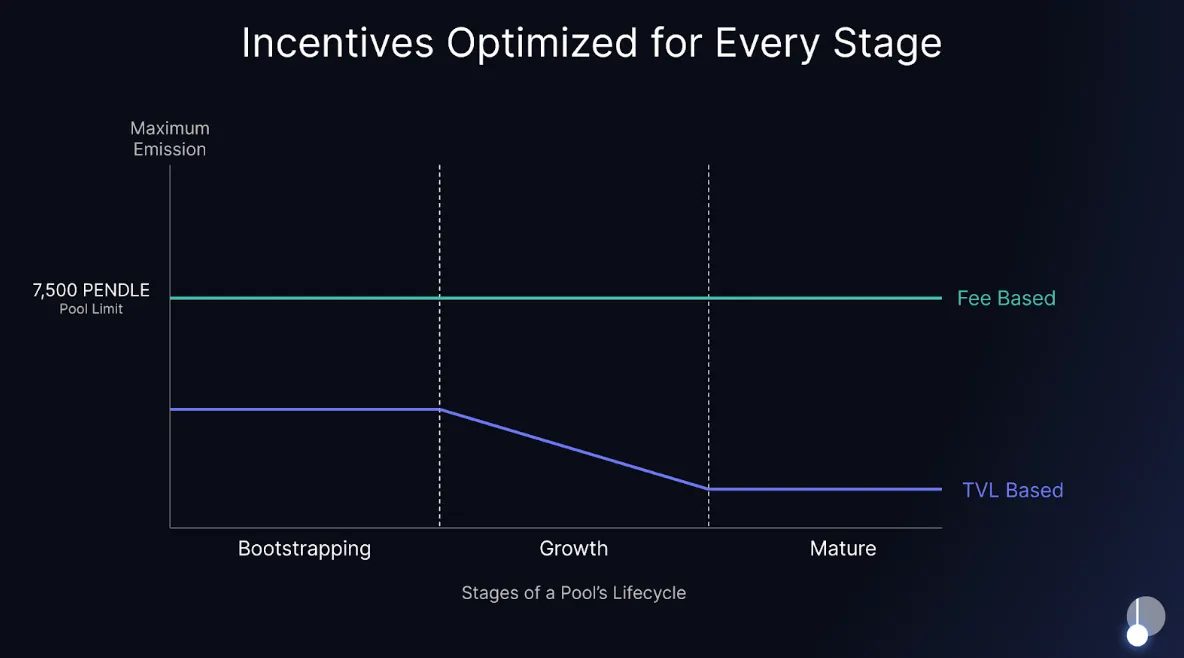
1. Bootstrap Phase: Building Liquidity
When the capital pool was first launched, the biggest challenge was insufficient liquidity. To address this issue, AIM provided TVL incentives in advance during the early stage, helping the capital pool accelerate its critical initial growth.
- The TVL of a资金池 (liquidity pool) directly determines its emission allocation.
- In the early stages, each $1 of TVL earns higher rewards.
As the capital pools gradually mature, TVL incentives will be gradually reduced, and the pools will need to rely on fee generation to maintain their reward shares.
Important Note: The transaction fee incentive is not subject to the pool's lifecycle limitations.
Whether it's Day 1 or Day 100, as long as the fee performance is sufficient, the资金池 (capital pool) can receive up to a maximum of 7,500 $PENDLE per pool solely from fees, ensuring that high-performing LPs throughout the entire period are rewarded.
2. Growth Stage and Maturity Stage: Incentives Based on Actual Contributions
After the capital pool matures and stable liquidity is established, the focus of incentives shifts toward demonstrating long-term value.
A truly sustainable liquidity pool is more than just "idle TVL"—it is:
- Promote trading activities
- Continuously generate transaction fee revenue for the protocol and users.
To ensure that incentives align with sustained contributions, the transaction fee incentive cap is set at four times the historical fees of the pool, and it is time-weighted (for more information on "time-weighting," please refer to the official documentation). This prevents one-time transaction spikes from receiving excessive rewards and ensures that incentives are tied to stable and continuous performance.
Joint Incentive: Reward Incentives Covering All Stages
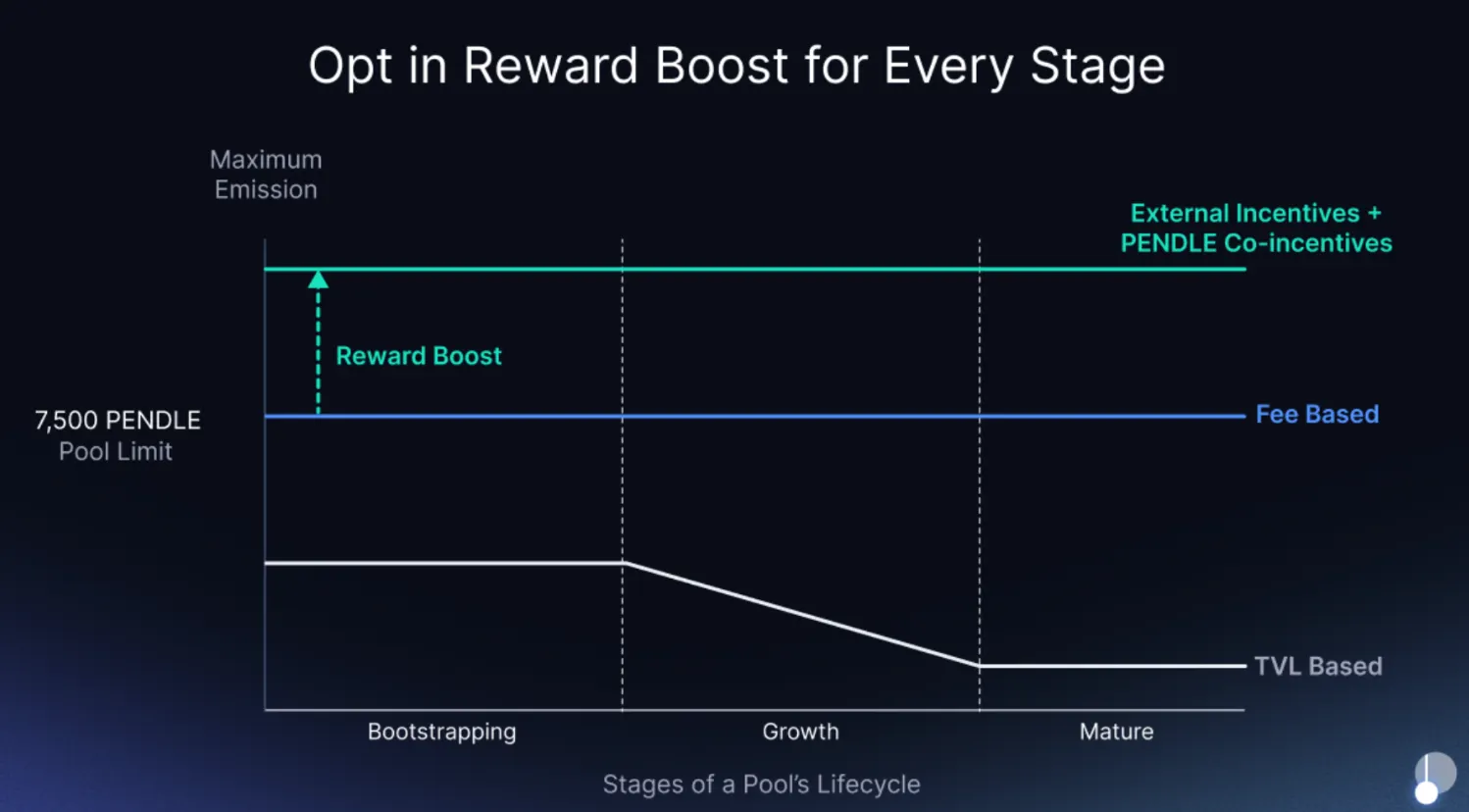
External agreements can be achieved through external incentive activities (External Incentive Campaign, EIC), directly provide incentives to Pendle's LPs or YT holders to further amplify market rewards.
For every $1 invested in the protocol:
- If incentives are provided in the form of $PENDLE → Pendle provides an additional subsidy equivalent to $0.4 in $PENDLE.
- If incentives are provided in other tokens → Pendle provides an additional subsidy of $0.3 equivalent in $PENDLE.
This means:
For every $1 invested in the protocol, up to $1.40 in total incentives can be leveraged.
This structure provides the protocol with more predictable and up to 1.4 times higher capital efficiency, while significantly reducing PENDLE emissions.
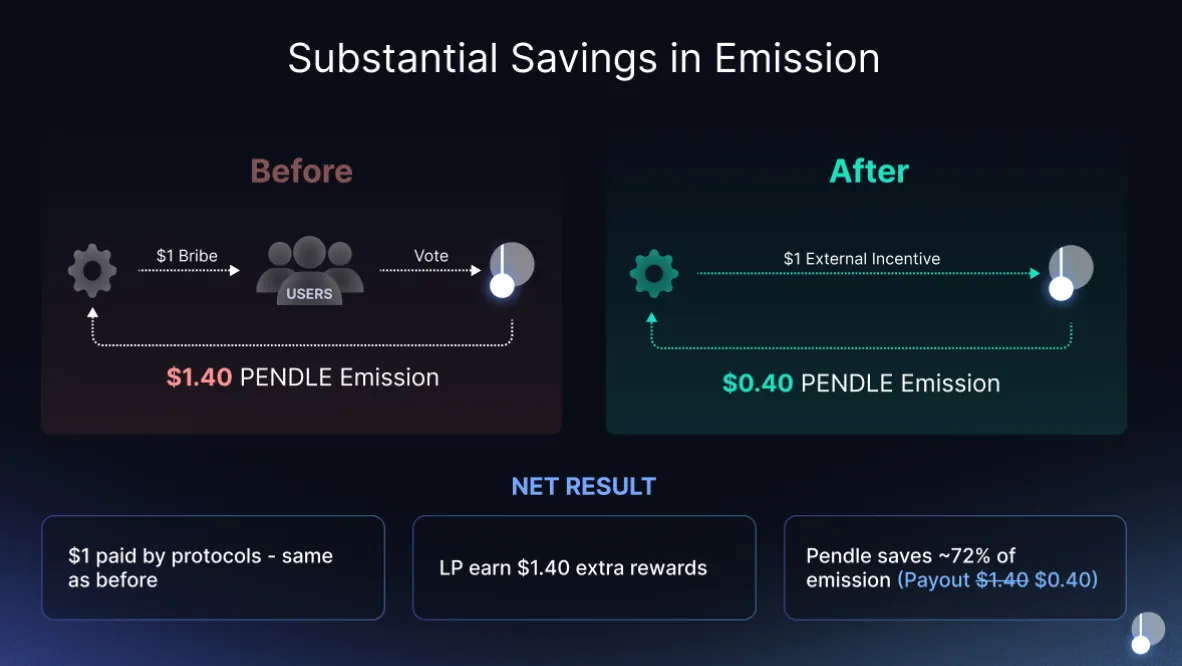
The EIC (Economic Incentive Contract) and combined incentives enable the protocol to directly control its market development direction at any stage of the cycle:
- Accelerate liquidity in the initial phase of launch
- Driving transaction volume during the growth phase
All of these can be further enhanced on top of the base allocation in AIM.
The weekly total budget for joint incentives is 9,000 $PENDLE (shared across all pools), and if demand exceeds the cap, it will be allocated proportionally.
Conclusion
The Algorithmic Incentive Model (AIM) will officially go live at 00:00 (UTC) on January 29, 2026, directly following the end of the last vePENDLE cycle. After this date, liquidity pools will automatically receive emissions based on their quantifiable and actual contributions to Pendle and its users.
By reducing waste and only offering incentives in efficient scenarios, AIM will:
- Reduce Pendle's operating costs
- Improve the overall return rate of the protocol and users
This marks the first phase (Phase 1) of the incentive system's restructuring. As more performance data is accumulated, the model weights will continue to be optimized to further enhance logical consistency and efficiency.
Last year, limit orders facilitated $2.3 billion in trading volume, accounting for 45% of Pendle's total trading volume. For high-volume pools like Ethena's USDe and sUSDe, this proportion exceeds 90%. This has consistently been a key driver in enabling smooth execution of large trades, and there remains significant potential for further efficiency improvements.
Phase 2 (Phase 2) In Phase 2, we will further maximize the effectiveness of limit orders through targeted incentives, guiding liquidity toward strategic concentration. According to our backtesting results, capital efficiency can be increased by up to 130 times.
More details will be announced soon. Stay tuned!
We will continue to iterate, optimize, and constantly raise our standards, committed to building Pendle into the leading fixed-income infrastructure globally.
For more information, please refer toOfficial Documentation
📍 The announcement data represents initial figures. Pendle will continue to refine and adjust various variable parameters as needed, while actively observing the actual performance of the design.