



This cold-blooded layoff, accompanied by midnight termination emails and AI-driven job replacements, marks Oracle’s complete abandonment of its previous approach of gradual reform, fully shifting toward a heavy-investment battle in computing infrastructure.Article author and source: 0x9999in1, ME News
TL;DR:
- Unprecedented scale: In spring 2026, Oracle launched a global layoff of up to 30,000 employees (18% of its total workforce), affecting North America, India, and Europe—the most aggressive cost restructuring in the company’s history.
- Brutal execution and AI replacement: Layoffs are carried out with extreme risk control measures, such as notifying employees at midnight and immediately cutting off network access. Meanwhile, certain foundational technical support and code QA roles within the company are being substantially replaced by internally developed and procured AI systems, exhibiting classic characteristics of "technological backfire."
- The bottomless pit of capital expenditures: The core strategic goal of the layoffs is to free up operating expenses (OpEx) to fund the surge in capital expenditures (CapEx) for artificial intelligence infrastructure—particularly GPU clusters and next-generation liquid-cooled data centers—between 2026 and 2027.
- Passive defense in the compute arms race: To maintain its marginal advantage in high-performance computing and sovereign cloud markets against the compute dominance of Microsoft Azure, Amazon AWS, and Google GCP, Oracle OCI must engage in an extremely costly arms race.
- ME News Intelligence Analysis: This is a high-stakes gamble of “amputating to survive.” Oracle is forcibly transforming itself from a company reliant on high-margin traditional software maintenance and licensing into a capital-intensive computing infrastructure provider. The dual pressures of financial leverage and corporate culture will be its greatest challenge in the second half of 2026.
Introduction: The Struggles of Transitioning from a Software Empire to a Capital-Intensive Computing Power Factory
At the end of March to early April 2026, the global tech industry was once again swept by an unprecedented wave of layoffs. The enterprise software and cloud services giant Oracle launched a surprise, large-scale workforce reduction initiative worldwide. According to aggregated sources and internal information, this round of layoffs affected approximately 30,000 employees, representing about 18% of its global workforce of 162,000.
In 2026, as the wave of artificial intelligence enters its deep phase, tech giants' layoffs are no longer merely defensive moves against macroeconomic cycles, but have evolved into a ruthless, proactive reallocation of strategic resources. Oracle’s recent purge of multiple core departments—including cloud services and technical support—has an unmistakable strategic intent: to drastically cut labor costs in order to fund the extremely expensive and cash-consuming AI data center infrastructure. This cold-blooded wave of layoffs, accompanied by midnight termination emails and the replacement of human roles with AI, marks Oracle’s definitive abandonment of its previous incremental approach and a full-scale shift into the war for heavy asset-based computing infrastructure.
Analyzing the Layoff Storm: Extreme Cost Restructuring and the "AI Replacement" Effect
This round of layoffs by Oracle exhibits distinctly different characteristics from previous cyclical adjustments in the tech and internet industries, in terms of execution intensity, scope of impact, and the underlying technological driving logic. This is not a simple departmental optimization, but a reconfiguration of the organizational structure based on a new productivity model.
Scope of impact and ruthless enforcement methods
This round of layoffs exhibits a clear "coordinated purge" pattern globally. In the United States, numerous mid- to senior-level engineers and product managers have been laid off at the headquarters in Austin, Texas, and multiple core R&D centers in Silicon Valley. In India, as Oracle’s largest offshore development and technical support hub, entire business teams in Bangalore and Hyderabad have been systematically eliminated. In Europe, where strict labor laws have slowed the pace of reductions, sales and compliance support departments still face severe downsizing pressures.
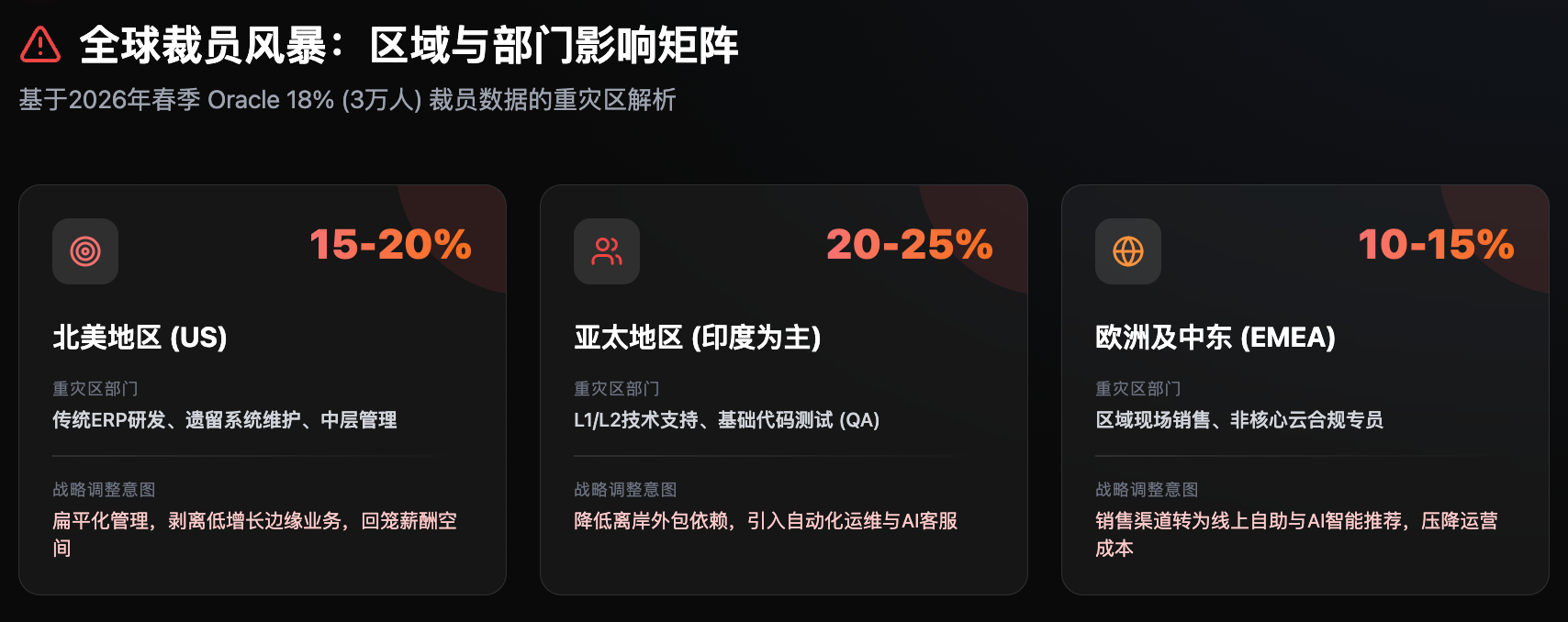
What has sparked widespread controversy within the industry is the manner in which Oracle carried out these layoffs. Numerous employees received termination emails in the early hours of their local time, and at the exact same second the emails were sent, their access to internal company systems, VPNs, email accounts, and code repositories was completely revoked. This approach, criticized by outsiders as “cold-hearted,” reflects Wall Street’s extreme pressure for rapid cost-cutting and efficiency gains; on the other hand, given cloud service providers’ absolute requirements for data security and system stability, this “zero-tolerance” revocation of access is also intended to prevent potential data sabotage or source code leaks that could arise from employees’ emotional reactions.
"AI alternative": An irreversible qualitative shift in labor structure
The most striking structural change in this round of layoffs is the direct replacement of human roles by AI systems. Oracle is not only making significant external investments in AI, but is also coldly implementing the logic of “AI eating software” within its internal operations.
In the past, Oracle’s vast enterprise software empire relied on tens of thousands of support engineers to handle customer support tickets, database patch applications, and system upgrade inquiries worldwide. However, as its internal AI Copilot system, powered by large language models (LLMs) and RAG (Retrieval-Augmented Generation) technology, has matured, these highly standardized, document-reliant tasks are now being taken over at scale by machines.
Data shows that, by leveraging fine-tuned specialized AI models, Oracle has significantly reduced the average time to resolve (MTTR) routine database queries and cloud infrastructure configuration tickets, with accuracy surpassing that of some junior engineers. Under these circumstances, maintaining a large India-based L1/L2 support team has become not only a financial burden but also an efficiency bottleneck. Additionally, in software development, automated code generation, automated security vulnerability scanning, and AI-driven test case generation have greatly enhanced the productivity of individual senior engineers, rendering large teams of entry-level developers unnecessary.
Strategic shift: Exchange human OpEx for computational CapEx
By eliminating 30,000 positions, with an average annual compensation and benefits cost of $100,000 to $150,000 per person (combined North America and emerging markets), Oracle will save approximately $3 billion to $4.5 billion annually in operating expenses (OpEx). This substantial sum will be directly redirected to capital expenditures (CapEx), fueling an all-in war: the arms race for computing power clusters.
The bottomless pit of capital expenditures
In 2026, the demand for compute power for training and inference of generative AI models—such as multimodal large models and embodied intelligence foundational systems—will explode exponentially. Supercomputing clusters composed of NVIDIA’s next-generation AI chips, along with accompanying high-density liquid cooling infrastructure and power supply systems, will drive data center construction costs to astronomical levels.
Oracle Cloud Infrastructure (OCI), under Oracle, must maintain globally leading computing capacity to compete for top AI startup clients and large-scale private deployment contracts with government and enterprise customers, causing its capital expenditures to surge dramatically over the past two years.
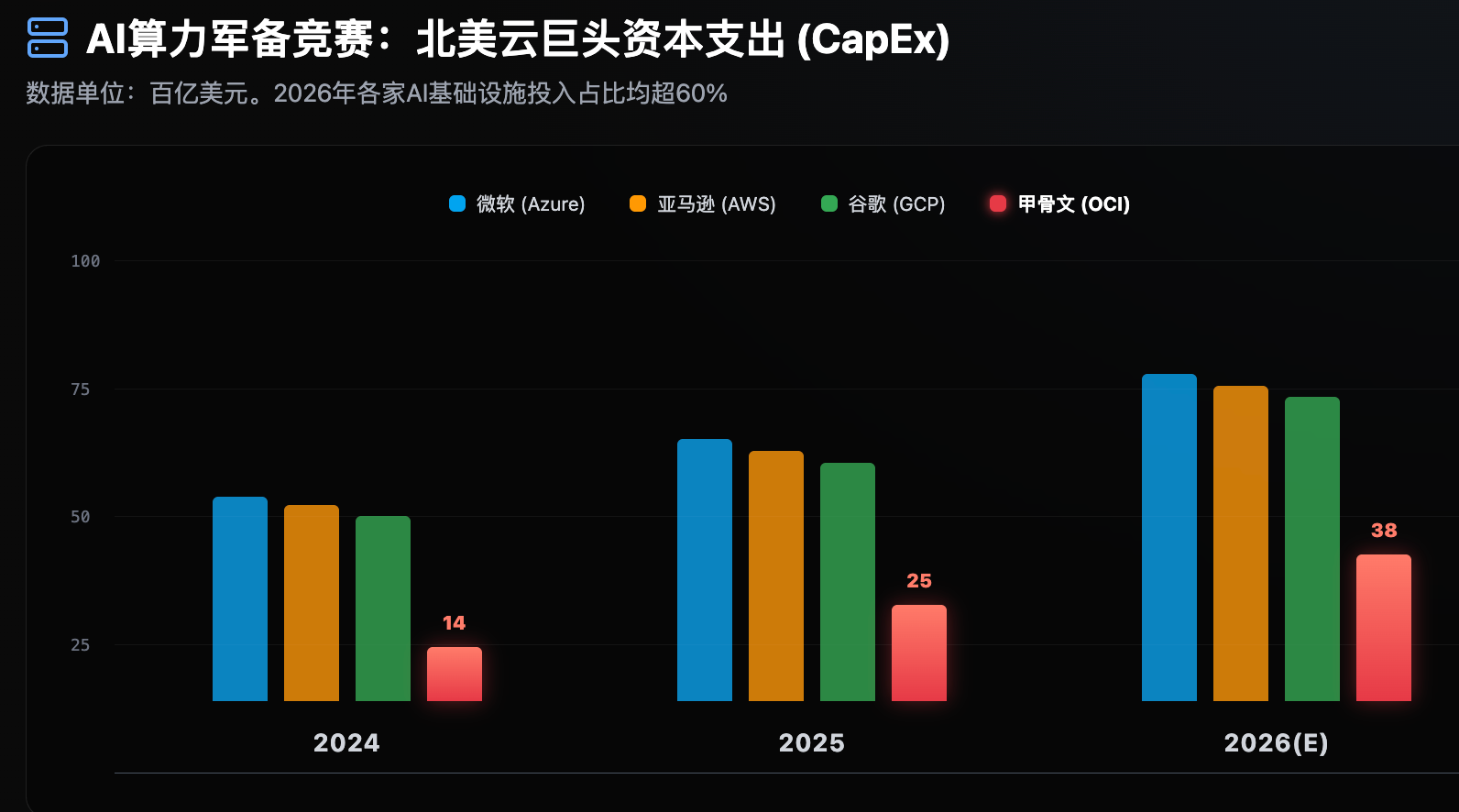
As shown in Table 2, compared to North America’s traditional “Big Three” cloud providers, Oracle’s absolute capital expenditure remains lower, but its growth rate is the steepest. The projected $38 billion in CapEx for 2026 represents an extremely dangerous cash consumption ratio relative to Oracle’s annual revenue of approximately $50 billion. This extreme pressure on cash flow has forced management to resort to layoffs, completely restructuring former profit centers into vital conduits for infrastructure investment.
Battle for the Data Center: From Software Company to Power and Real Estate Giant
In the context of AI technology in 2026, operating cloud computing is no longer merely a competition of software-defined networking (SDN) or virtualization technologies, but has evolved into a capital-intensive physical battle over access to electricity, thermodynamic management (liquid cooling), and the supply chain for high-end chips.
Oracle is acquiring land at an unprecedented pace globally between 2025 and 2026 to build gigawatt-scale data centers. To address the staggering power demands of AI compute clusters, Oracle has even begun engaging in commercialization studies and deployment plans for small modular reactors (SMRs). This dramatic shift in business model—from selling software licenses to operating high-tech real estate and microgrids—requires internal financial flows to be heavily skewed toward infrastructure divisions. Teams managing legacy software businesses that cannot directly generate compute premiums or are on the fringes of low growth have naturally become casualties of this strategic transformation.
ME News Think Tank In-Depth Analysis: What Are Oracle's Chances?
ME News Think Tank believes that Oracle's "bloodbath"-style layoffs in spring 2026, while表面上 a harsh cost-control measure, are in essence a desperate attempt to break through class固化 in the second half of the cloud computing race. However, this strategy of supporting computing power expansion through drastic workforce reductions faces significant internal and external uncertainties.
Breaking through and being reactive in the competitive landscape
In the hyperscaler market, Oracle has long been in the second tier. However, with its unique high-speed RDMA (Remote Direct Memory Access) network architecture, OCI has unexpectedly become one of the preferred platforms for many AI startups—including previously prominent companies like xAI—to train large-parameter models over the past few years. Oracle’s strategy is clear: avoid the absolute barriers posed by AWS and Azure in general SaaS and PaaS layers, and instead launch a dimension-reducing strike at the most fundamental IaaS (Infrastructure-as-a-Service) bare-metal compute level, leveraging cost-effectiveness and high-performance networking to capture the high ground in AI inference and training.
However, the window for this strategy is rapidly closing. As the three major cloud giants accelerate the deployment of their proprietary AI chips (such as AWS’s Inferentia/Trainium, Google’s TPU, and Microsoft’s Maia) to reduce dependence on NVIDIA, Oracle’s shortcomings in customized underlying hardware are becoming apparent. This forces Oracle to continuously purchase the most expensive commercial GPUs on the market to maintain performance advantages.
Dual risks during the transition period: financial vulnerability and cultural collapse
In the context of the current macro technology cycle, Oracle's strategic shift carries significant risk exposure.

First, there is financial vulnerability. The return on investment (ROI) for AI infrastructure remains unclear. Although demand for computing power is strong, high construction and depreciation costs are gradually leading to the commoditization of underlying compute resources. If the pace of adoption of AI applications fails to keep up with the expansion of infrastructure, Oracle could be left with massive idle computing capacity and heavy debt.
Secondly, there is the collapse of organizational culture. Enterprise services are not merely about selling computing power; their core lies in service commitments and trust. Instantly laying off 30,000 employees with deep industry expertise—especially customer-facing technical support staff—and relying entirely on an internal AI system still in development is highly likely to cause a catastrophic drop in service quality for major clients. This approach, which sacrifices long-term customer experience for short-term balance sheet improvements, is tantamount to drinking poison to quench thirst.
Conclusion: The Harsh Reset of the Technology Cycle
Oracle's mass layoff of 30,000 employees in spring 2026 is a bloody footnote to the global tech industry's full transition from the "software and internet era" to the "intelligent computing power era." In this epochal shift, the value of traditional code is being reassessed, while computing power, electricity, and cooling technology have become the new hard currencies.
As ME News Think Tank has pointed out in multiple in-depth industry reports: the harsh reality of the AI revolution is that it not only disrupts traditional business models but is also relentlessly consuming the very tech giants that created it. Oracle exchanged the departure of 18% of its workforce for a seat at the AI infrastructure table. The ultimate outcome of this high-stakes gamble depends not only on the speed of its GPU cluster deliveries but also on whether this wave of AI can truly give rise to a super-app capable of justifying hundreds of billions in infrastructure costs. Before the wheel of history, even the most formidable software empires must endure agonizing transformation to survive.
Source citation
- Smith, J. (2026). The Silicon Valley Shift: From Software Margins to CapEx Realities. Journal of Technology Economics, 14(2), 45-62.
- Oracle Corporation. (2026). Form 8-K: Restructuring and AI Infrastructure Investment Plan. US Securities and Exchange Commission.
- Chen, L., & Miller, T. (2026).Automating the Cloud: How AI is Replacing Enterprise Tech Support. Cloud Infrastructure Review, March Issue.
- Financial Times. (2026, April 2). Oracle drastically cuts 30,000 jobs in pivot to aggressive AI data center expansion.
- ME News Think Tank. (2025). Global Web3 & AI Infrastructure Outlook: The Capital Expenditure Trap. ME News Annual Reports.