




Author: Chloe, ChainCatcher
Over the past two years, prediction markets have become the most compelling narrative in the crypto industry. The entire sector reached nearly $10 billion in total trading volume by the end of last year, with monthly growth momentum significantly accelerating in the second half of 2025.
But at the other end of this celebration is a character who has always remained out of the spotlight and repeatedly subjected to user backlash: the oracle.
UMA's Double-Edged Sword
Over the past year, major controversies surrounding Polymarket—including bets on whether Ukrainian President Zelensky “wore a suit” (with cumulative trading volume reaching $237 million), Ukrainian mineral agreements (involving $7 million, where large holders manipulated votes using approximately 5 million UMA tokens), and whether the Trump administration would declassify UFO documents in 2025 (a $16 million market openly labeled by users as a “whale-proof” scam—have all directly traced back to UMA’s Optimistic Oracle and its token governance structure.
UMA’s Optimistic Oracle design logic is: anyone can propose a result by posting a deposit; if no dispute is raised during the challenge period (typically 2 hours), the result is assumed to be true; if a dispute arises, UMA token holders vote on the outcome using the Data Verification Mechanism (DVM).
The advantages of this mechanism are clear: it is cost-effective, capable of handling long-tail events, and able to resolve "subjective questions"—such as whether Zelensky’s outfit qualifies as a suit—that traditional price oracles cannot handle at all.
However, several controversies surrounding Polymarket have exposed flaws in this design. For example, in March last year, the event concerning a Ukrainian mineral agreement had a total trading volume of approximately $7 million, focusing on whether Trump would reach a rare earth minerals agreement with Ukraine before April.
Despite no agreement being reached, the market was settled as "Yes." According to reports from The Defiant and Cryptopolitan, the primary reason was a large UMA holder who held approximately 5 million UMA across three accounts, accounting for about 25% of the voting weight in this round, and pushed the vote toward "Yes." Subsequently, Polymarket explicitly stated in a Discord announcement: "This was not a system failure, but the result of the governance mechanism in action; therefore, refunds are denied."
Polymarket’s reliance on UMA is now facing systemic risk. The oracle, originally designed as a neutral truth-revelation layer, has become a tool for a small group to influence market outcomes due to the concentrated distribution of its governance token.
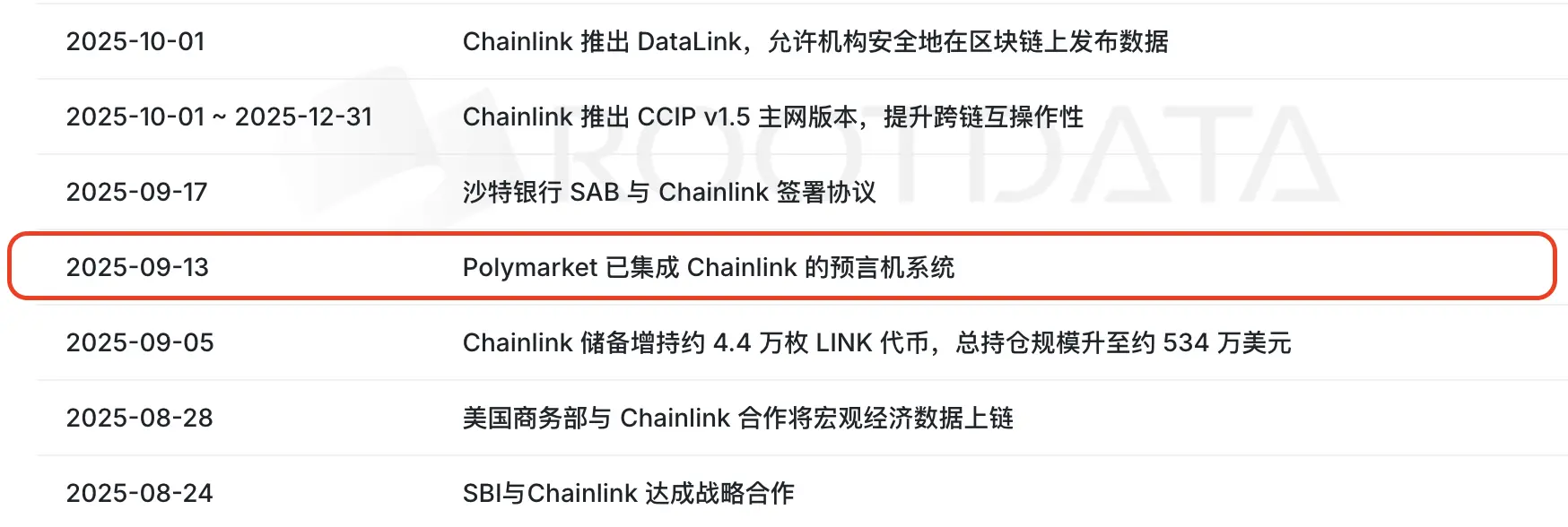
According to cryptocurrency data platform RootData, until September last year, when Polymarket began heavily promoting crypto events, it urgently needed to introduce a more deterministic data source, so it started delegating part of its settlement operations to Chainlink, an oracle with a completely different system.
Chainlink: Another Dilemma for the Leader
CoinDesk reported that Polymarket is integrating Chainlink to enhance the determination of its prediction outcomes. Both parties announced that Polymarket will use Chainlink to automatically settle markets tied to asset prices, reducing delays and the risk of manipulation. The initial focus will be on markets related to cryptocurrency asset prices, with concurrent exploration of applications in more subjective markets.
The significance of this partnership is that Polymarket now has an additional pathway—leveraging Chainlink to directly fetch market prices and enable automated adjudication—beyond its previous reliance on UMA’s “collective game-theoretic subjective consensus” mechanism.
From a market perspective, Chainlink is the undisputed leader in the oracle space, with a market capitalization share exceeding 87% and a TVS share of 61.58% (approximately $62.9 billion), significantly outpacing second-place Chronicle (10.15%) and third-place RedStone (7.94%).
Alternatively, its penetration in DeFi has nearly reached saturation. Mainstream protocols—from liquidations and pricing on Aave, GMX, and Synthetix, to secure oracles on Curve and cross-chain standards on Lido—almost all rely on different services provided by Chainlink.
Market share is reflected in its deployment. Chainlink provides 2,000 price feeds (on-chain persistent price services) across approximately 27 chains and has deployed Data Streams (low-latency, on-demand verified high-frequency price feeds) on 37 networks; the CCIP (Chainlink Cross-Chain Interoperability Protocol) mainnet now supports 70 public blockchains and L2s, with around 200 cross-chain tokens registered as CCIP-standard compliant.
This scale is equivalent to Chainlink expanding from being a "single-chain oracle service" to becoming an "information and asset exchange layer across multiple chains."
But saturation also means that DeFi is no longer its primary growth driver. According to Galaxy’s in-depth report, approximately 97% of Chainlink’s cumulative revenue (about $399 million) comes from Price Feeds, while VRF (Verifiable Random Function, used for NFT minting and on-chain gaming), Automation, and CCIP together account for only about 1.5%, 0.6%, and 0.5%, respectively.
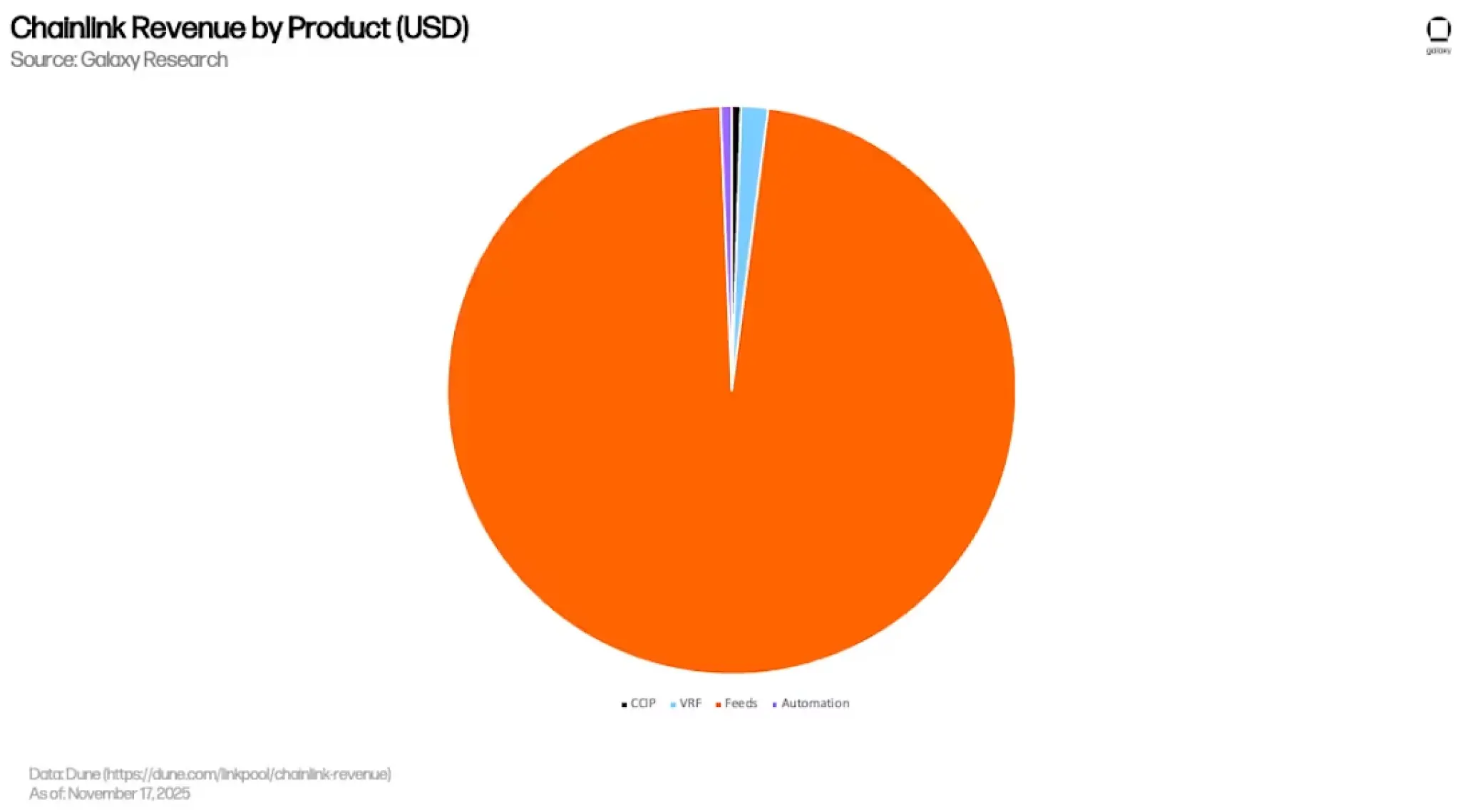
In other words, Chainlink’s cash flow is highly concentrated in its most mature and commoditized price feed business, a market that is already saturated with extremely limited room for marginal growth.
In response, Chainlink has bet its chips on three growth trajectories.
The first is RWA and institutional finance.
From Chainlink’s partnership matrix, it can be seen that previously, Chainlink collaborated with Swift and multiple institutions to complete a cross-chain tokenized assets trial; last year, it further partnered with 24 major financial institutions to advance the on-chain implementation of corporate actions data, while the DTCC Smart NAV pilot distributed mutual fund NAV data to the blockchain.
In the same year, Chainlink partnered with Mastercard to enable on-chain cryptocurrency purchases for over 3 billion cardholders; the U.S. Department of Commerce (BEA) also integrated core macroeconomic data such as GDP and PCE onto the blockchain via Chainlink Data Feeds, initially covering 10 public blockchains.
The second is CCIP cross-chain communication.
CCIP has become one of the leading standards for cross-chain interoperability. JPMorgan’s Kinexys, in collaboration with Chainlink and Ondo, completed a cross-chain DvP settlement trial for tokenized U.S. Treasuries; Aave uses it to enable cross-chain GHO transfers; Lido has adopted it as the official cross-chain standard for wstETH; same year, CCIP launched on Aptos, extending its reach into the Move ecosystem.
As of October 2025, the cumulative token transfer volume on CCIP has reached nearly $2 billion.
The third is prediction markets and the "financialization of event settlement."
The integration with Polymarket marks the beginning of this trajectory, representing Chainlink’s expansion from its original focus on “asset prices” into the broader domain of “event settlement.” As demand surges for prediction markets on asset classes such as U.S. equities, commodities, ETFs, and macroeconomic indicators that can be automatically settled, Chainlink has found a natural extension of its core pricing business.
Overall, while Chainlink holds a leading market position, the growth of traditional DeFi price oracles has plateaued; it must rely on RWA, institutional finance, CCIP, and the tokenization of prediction markets to build its next growth curve.
The potential along these curves is significant. According to BCG, the tokenization of RWA could reach $16 trillion by 2030, while SWIFT’s network processes $150 trillion in settlements annually—but settlement cycles are measured in years, whereas token holders’ patience is typically measured in days.
This mismatch may be the core pressure Chainlink, as the market leader, still faces in 2026.
Multiple oracles are eating into the prediction market pie.
In early April this year, Polymarket announced a partnership with Pyth Network.
On this platform, prediction markets for short-term price movements in commodities such as gold, silver, WTI crude oil, and natural gas, along with over a dozen U.S. stocks including NVDA, AAPL, TSLA, COIN, and PLTR, as well as major indices and ETFs, will have settlement data provided in real time by Pyth via WebSocket, sampled once per second by Polymarket.
Pyth, as a first-party data provider (with market makers and institutions such as Jump Trading, Jane Street, Blue Ocean, and LMAX directly publishing data), uses a pull-based model, enabling low-latency delivery of data to the application layer.
This division of labor is not unique to Polymarket. Kalshi, regulated by the U.S. CFTC, has also integrated Pyth as its settlement data source for its newly launched commodities hub, covering major commodities such as gold, silver, Brent crude oil, natural gas, copper, corn, soybeans, and wheat. Pyth Pro provides market makers at Kalshi with direct access to market data, with plans to expand to indices, equities, and foreign exchange in the future.
When both Polymarket and Kalshi choose Pyth as the settlement layer for traditional financial assets, it is no longer just an engineering decision by individual platforms, but rather a reflection of the entire prediction market sector’s converging demand for an “institutional-grade, high-frequency data settlement layer.”
Pyth has secured a portion of this market, but this segment is a subset of "traditional financial asset events," distinct from Chainlink’s crypto-focused offerings and UMA’s subjective ones.
From this three-layer division of labor architecture, we can observe the real-world landscape of the oracle赛道 revealed by prediction markets.
First, no single oracle can fully serve a mature prediction market.
UMA’s community arbitration mechanism cannot handle high-frequency prices; Chainlink’s on-chain feed model is not optimal for settling millisecond-level events; although Pyth has a clear advantage in low-latency pricing, it cannot handle text-based issues at all.
Second, each time Polymarket introduces a new oracle, it expands the scope of tradable events.
From UMA’s non-standard events, to Chainlink’s crypto assets, and then to Pyth’s traditional financial assets, each step brings more real-world uncertainties into the scope of on-chain betting. Following this logic, future macroeconomic indicators (GDP, CPI, interest rate decisions), central bank rate decisions, corporate earnings, and even AI model releases could all become market categories on Polymarket.
Markets can be created as long as there is a verifiable data source.
Conversely, for oracle projects, this means the rapid expansion of prediction markets will not allow any single oracle to monopolize the benefits. Each new market will be allocated to the oracle best suited to handle its specific data structure, with multiple oracles sharing the opportunities without overlap.
Conclusion
By 2026, the oracle赛道 has evolved from early "data pipelines" into a verifiable layer of truth underpinning the entire on-chain economy.
Its services now extend beyond DeFi liquidations and collateral valuation to include compliance verification for RWA on-chain, trusted cross-chain information transfer, and settlement of prediction markets for real-world uncertainties.
Prediction markets serve as a magnifying glass for observing this intense competition in the red ocean.
Polymarket’s three-oracle division, combined with Kalshi’s concurrent offerings on traditional financial assets, reveals a reality: no single oracle can fully serve a mature on-chain application. Each topic on the platform is assigned to the oracle best suited to handle its specific data structure.
Infrastructure fragmentation is already a reality. But when no single project can monopolize the benefits, who can truly become indispensable?