




Just now, NYSE announced the launch of a 24/7 on-chain stock trading platform. In simple terms, this means that U.S. stocks can now be traded on-chain around the clock.
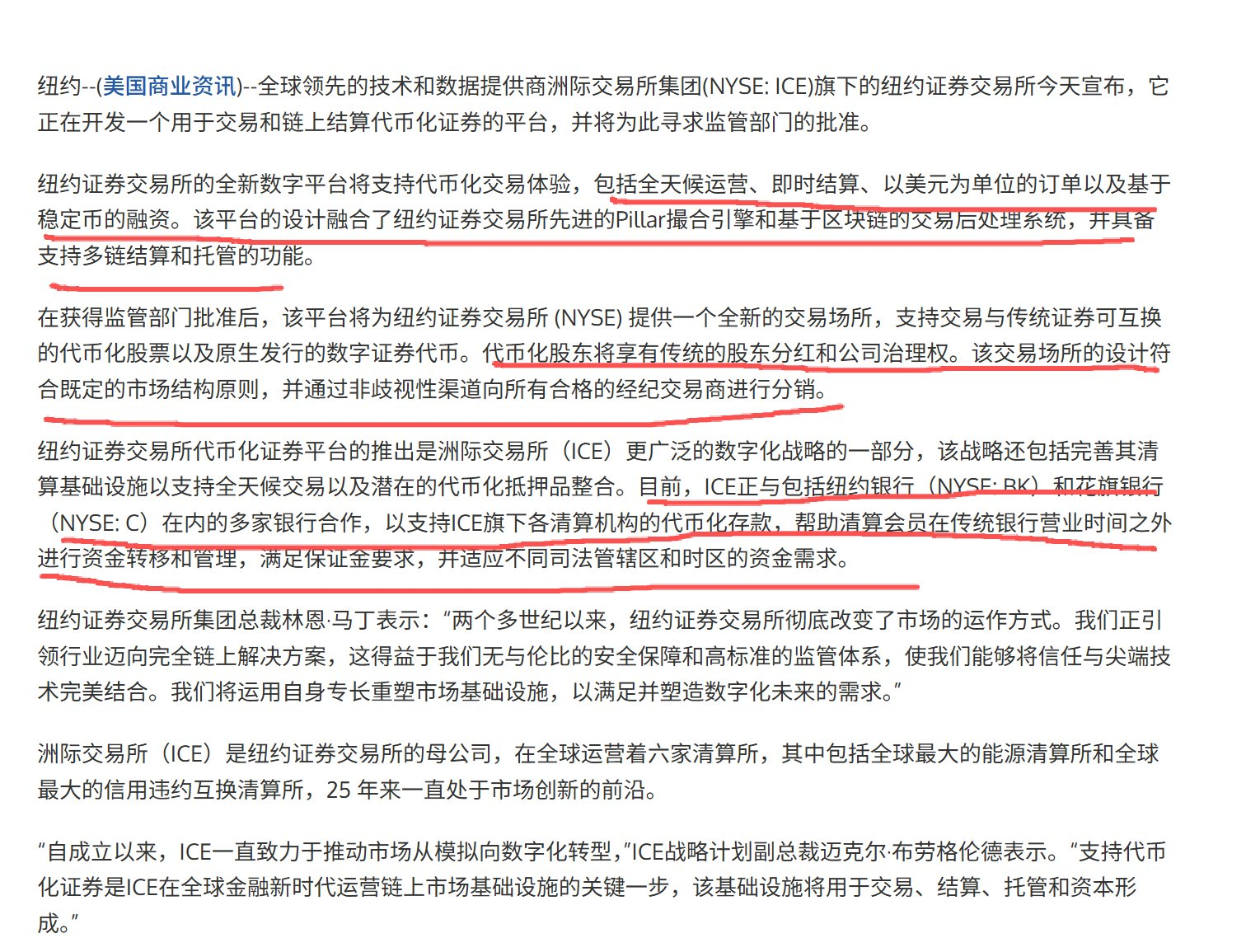
NYSE will launch a tokenized stock trading platform.
Many people's first reaction is: "Great! Stocks are finally going to be fully tokenized on the blockchain!" "Does this mean anyone can issue stock tokens?"
But if you really break this thing down, you'll find a counterintuitive conclusion:
The New York Stock Exchange's involvement does not mean that tokenized stocks have become more free; rather, it suggests that the era of private companies recklessly issuing tokenized stocks may be coming to an end.
First, let's explain in plain language: What is "tokenized stocks" (Tokenization of stocks)?
Without using professional terms, let's use the most straightforward metaphor.
- Stocks: You hold a "share" of a company through a brokerage.
- Tokenization: Through the infrastructure of brokers, users/institutions mint this "share" into a token on the blockchain.
Sounds great, right? That's exactly what Stablestock was thinking halfway through the year: Could Stablestock follow the Stablecoin model, tokenize stocks through an underlying brokerage model, and enable free trading on the blockchain? The problem lies here. Many compliance and technical issues would arise along the way.
I can give some examples to illustrate this: In terms of compliance, if you don't have a brokerage, you won't have the right to custody user assets, and users won't be able to transfer their shares into the brokerage. This means users can only buy from 0 to 1. In terms of technology, we can take stock splits and consolidations as an example. After tokenizing stocks and issuing tokens, once the underlying stocks undergo complex operations like splits or consolidations (which actually happen frequently with stocks), it becomes very difficult for smart contracts to handle such split or consolidation operations. If the oracle performs incorrectly, it can trigger liquidations for users of perpetual contracts, lending, and other trading products.
During our several months of exploring tokenized stocks, in addition to the aforementioned issues, we have encountered numerous technical challenges. These have made us realize that the foundation of stock tokenization lies in DTCC or Nasdaq/NYSE, rather than the companies issuing tokenized stocks. If Nasdaq/NYSE/DTCC do not resolve the underlying issues, the tokenized stock market will ultimately collapse midway.
II. If private companies can issue stablecoins, why can't they issue security tokens (stock tokens)?
Unlike stablecoins, stock tokens are not something private companies can arbitrarily issue. Private companies can issue stablecoins because "the U.S. dollar itself is freely circulating," but they cannot issue stock tokens because "the actual ownership of stocks is not held by brokers or companies."
Stablecoins are pegged to the US dollar. The US dollar itself is a freely circulating asset; as long as you have a bank account, you can receive, pay, and transfer money. Essentially, issuing stablecoins is just a matter of "redemption": when a user gives you 1 US dollar, you issue 1 stablecoin on the blockchain; and at any time, the user can exchange the stablecoin back for 1 US dollar. As long as the reserves are genuine and the redemption is reliable, this logic holds. The US dollar does not involve dividends, voting rights, or issues of "ownership registration," so the technical and legal structures are relatively simple.
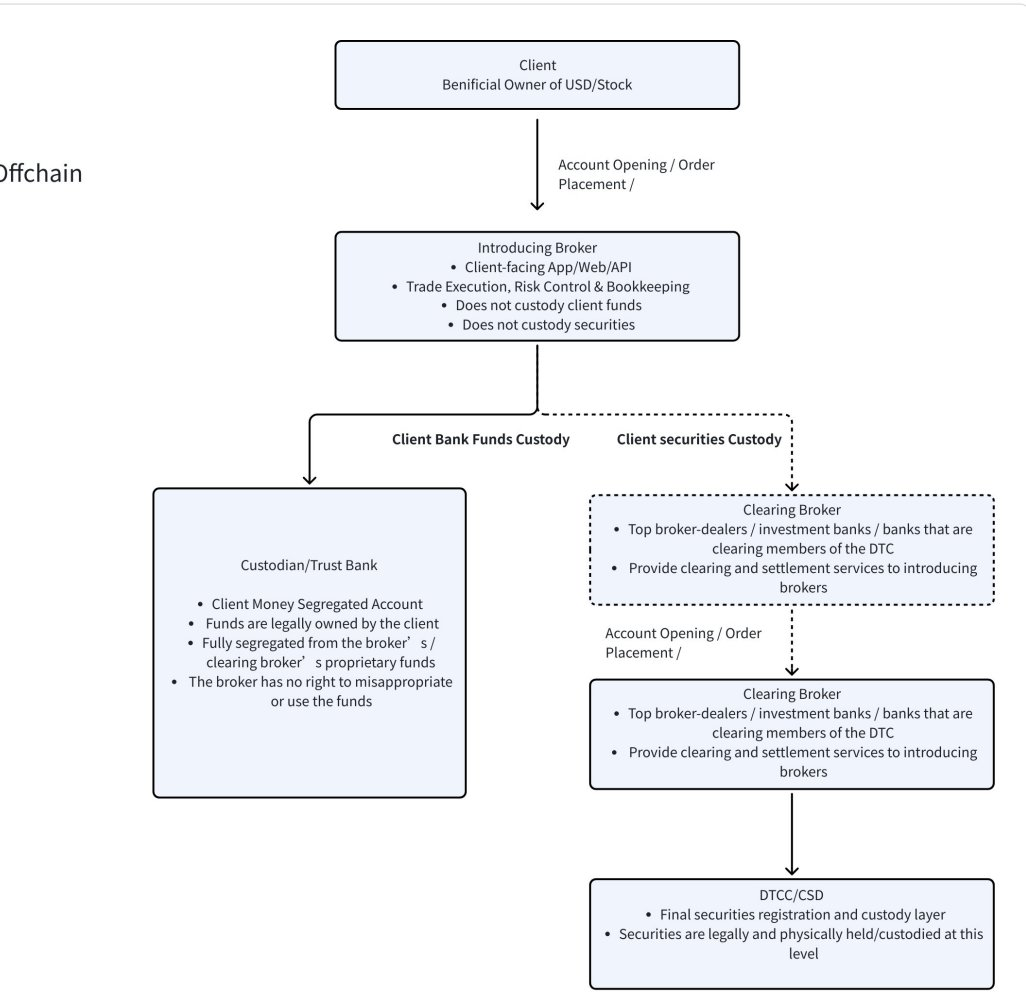
Stocks are entirely different. Stocks are not stored within a single brokerage; their final registration and custody are centralized in systems like DTCC (Depository Trust & Clearing Corporation). The stocks you purchase represent your identity as a shareholder of the company, not a freely transferable asset. Transferring stocks in or out requires settlement, reconciliation, and registration updates, which are far more complex than a simple bank transfer.
More importantly, various events occur continuously during the holding period of stocks, such as dividends, voting, stock splits, and additional share offerings. Each of these changes must be legally valid and accurately reflected in the shareholder register. This means that issuing stock tokens is not a "one-time" event, but rather entails taking responsibility for the entire lifecycle of the stock.
We can take examples such as transfers in and out, and stock splits or consolidations.
From the perspective of transfers in and out, a bank account is sufficient for this purpose. This is because the inflow and outflow of U.S. dollars naturally occur through the banking system; there is no need to notify anyone, and there is no need to update any "ownership register." However, stocks are not "money"—they involve a complete set of legal relationships and an ownership system. In fact, the actual location where stocks are stored is not within the broker. Many people think that if they buy stocks through a broker's app, the stocks are held by that broker. In reality, this is not the case. The final registration and custody of stocks are centralized in the DTCC (see the flowchart of stock and fund processes below). The company's shareholder list, stock splits, and voting are all based on the records of the DTCC. Unlike money, the transfer of stocks means a change in ownership, which requires updating the shareholder list, as well as adjusting dividend rights and voting rights. This is not as simple as a bank transfer; it involves reconciliation between different brokers, confirmation by the clearing system, and registration by the central custody system. Therefore, stocks have never been assets that can be freely and arbitrarily transferred. The business logic is entirely different from that of stablecoins.
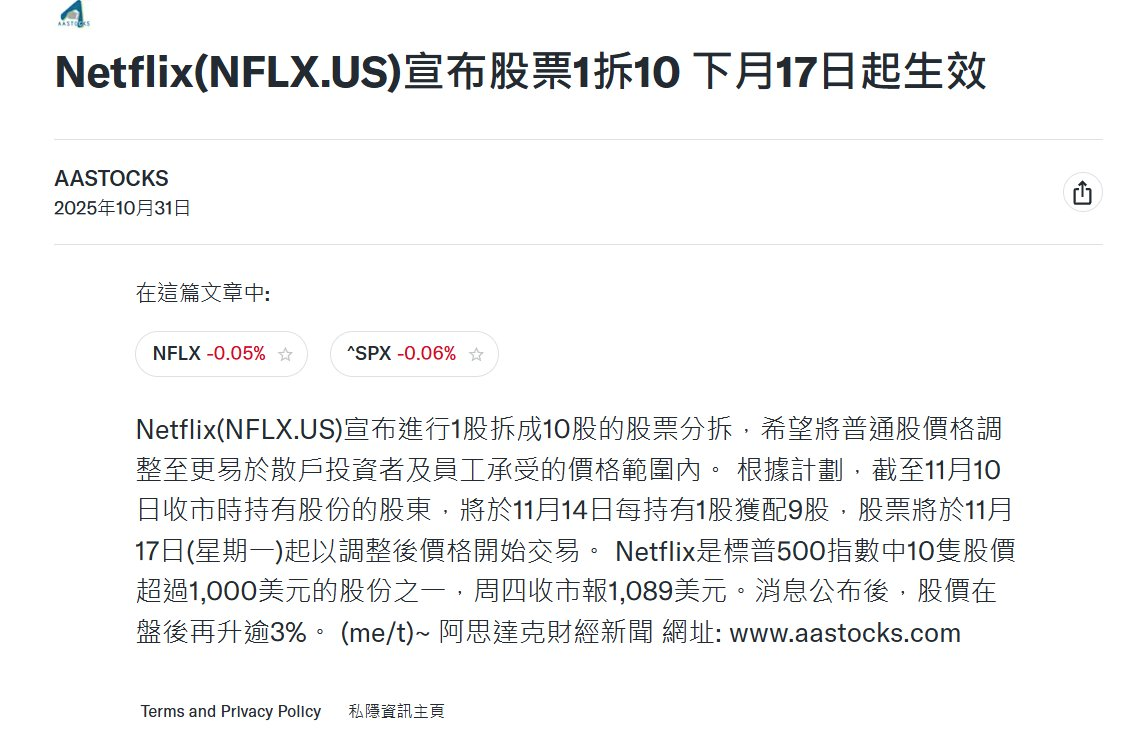
From the perspective of asset behavior, they are also completely different. For U.S. dollars, you just leave them as they are. However, stocks involve dividends, voting rights, stock splits, reverse splits, mergers, and additional share issues. Let's take a very real example: a stock split. On November 17, Netflix announced a 1-for-10 stock split. Suppose a user's stock issuer holds 1,000 NFLX shares in the broker's inventory (registered in the DTCC), and there are 1,000 NFLX tokens in circulation on the blockchain before the split. When the 1-for-10 split occurs, the broker automatically converts the 1,000 shares into 10,000 shares, requiring no action from the user, as everything is handled by the clearing and custody system. But what about the blockchain? It sounds simple at first: if the blockchain forcibly increases the supply by 9,000 NFLX tokens, then every existing user's 1 token would automatically become 10 tokens. But who executes this operation? Who ensures that every address is correctly processed? What if users have their tokens in DeFi, lending platforms, or AMMs? How do you split tokens locked in smart contracts? Who can guarantee that the price oracle can handle this in a timely manner (if it completely relies on off-chain pricing, the off-chain price might be 10, but the on-chain price is still 100)? If we don't split the tokens but only change the exchange ratio, i.e., 1 token equals 10 shares, the price system can easily become instantly chaotic. There will inevitably be discrepancies between on-chain and off-chain prices, leading to distortions. Every corporate action would require changing the rules. This is actually a very complex and high-frequency occurrence.
From the above examples, you will notice that whether it's transfers in or out, or stock splits and consolidations, the most important infrastructure is actually DTCC and NYSE/Nasdaq, not the stock token issuing companies.
Three, once the NYSE steps in, the rules change.
When the NYSE officially enters the tokenized stock market, it is not merely adding another "participant," but rather signifies a fundamental shift in the industry's focus.
In the early stages, the tokenization of equity mainly relied on private projects to explore solutions. These projects issued tokens that represented the value of stocks, aiming to address issues such as trading hours, cross-border limitations, and inefficiencies. However, the premise of this model is that there is no widely accepted and sufficiently authoritative "official version" in the market yet.
And the outcome of the NYSE incident precisely changed this.
Once a stock tokenization solution is supported by top-tier exchanges, clearing systems, and regulatory frameworks, market choices will become very clear: most clearinghouses, brokers, and users will directly access the official system rather than continue using privately issued stock tokens. The reason is simple — official solutions are inherently more comprehensive in their underlying capabilities.
These official stock tokens often directly interface with established clearing and custody systems, naturally supporting complex corporate actions such as stock splits, consolidations, dividends, voting, mergers and acquisitions, and additional share issuances. These are precisely the areas where privately issued solutions have long struggled to be fully developed and where problems most frequently arise. For institutions, the completeness of functionalities and the clarity of legal responsibilities are far more important than whether something is "natively blockchain-native."
More importantly, official endorsement itself creates a gravitational pull for liquidity. When clearing houses, market makers, banks, and large institutions all provide services around official tokens, privately issued stock tokens will inevitably face problems of insufficient liquidity, pricing discounts, and excessively high trust costs. Even if they can technically continue to exist, they will gradually lose economic significance. In essence, tokenizing private company stocks is about creating a side pool outside the substantial liquidity of traditional exchanges.
Therefore, what the NYSE's move represents is not a "full-scale boom in stock tokenization," but rather a very real signal: stock tokenization is transitioning from "parallel experiments" to "highly centralized and standardized" development.
Under this framework, opportunities no longer belong to projects that issue more tokens, but rather to participants who can smoothly integrate into the official stock token system and build user access points and trading experiences around it.
This is the real change in the industry after the NYSE's involvement.
Fourth, every upgrade in the underlying infrastructure of stock trading has caused a paradigm shift in the securities industry.
If we look back at the 100-year history of stock trading, we will find a very clear pattern: every shift in trading paradigms has given rise to a new generation of brokerage models.
The first major turning point occurred before the 1970s. At that time, stock trading entirely relied on paper certificates and manual intermediaries, making it nearly impossible for ordinary people to participate. The stock market was essentially a game for the elite. This is also the scene we often see in old movies: in the trading hall, brokers complete transactions by shouting bids and offers openly.
The second turning point occurred after the 1970s. With the establishment of the Direct Trading System (DTC), stock trading began to be centrally handled by large investment banks and brokerage systems. Institutions such as Morgan Stanley, Goldman Sachs, and Merrill Lynch started to execute trades and clear them on behalf of their clients. This was precisely the era depicted in "The Wolf of Wall Street": stock trading remained a professional activity, but it had become accessible to a broader client base through telephone communication.
The third turning point occurred after the 2000s. The widespread adoption of the internet and API-based trading completely transformed the barriers to entry in the stock market. Online brokers such as Interactive Brokers and Robinhood emerged, making stock trading truly accessible to the general public for the first time. History has repeatedly demonstrated that once a trading model undergoes a systemic change, the broker ecosystem is inevitably reshaped. We believe that by around 2026, stock tokenization will become an irreversible trend. As settlement and delivery gradually shift onto blockchain infrastructure, the entire stock trading system will enter a new phase of restructuring.
This upgrade of the stock tokenization system initiated by the NYSE, along with the stablecoin settlement system, represents a paradigm shift.
Meanwhile, companies like our Stablestock have gradually placed bets on the direction of "crypto-native brokers" in 2H25. Fundamentally, this is a bet on the continued global penetration of stablecoins. For the first time, stablecoins will enable a massive population that has long been excluded from the traditional financial system to participate in global stock trading with lower barriers and less friction. We believe this represents the reinvention of the next generation of brokerage platforms.
Five, Stablestock 1-2 Year Roadmap
We have decided that over the next 12–24 months, our core focus will be on building a next-generation neobroker that is more crypto-friendly and inherently native to on-chain ecosystems.
Imagine a future: within the same Broker App, users can not only settle transactions using stablecoins, but also:
- High-Leverage Spot Leverage (Launching in June)
- Perp (H1 Launch)
- Option (Launching in September)
- A hybrid cross-margin system combining crypto assets and stocks
- Prediction markets and simpler binary options
- IPO (launching in March)
- Hong Kong Stock Trading (Launching in March)
- Stock Lending
- Second-level deposit and withdrawal settlement
All of this is built on a unified crypto-friendly broker.
In addition, as this foundation continues to mature, we will gradually release complete developer documentation to empower independent developers to build their own applications based on StableBroker, such as:
- Lending Market
- AI Trading
- Wealth Management Vault
- Follow Trading
- Onchain ETF refers to an exchange-traded fund (ETF) that is
- Stock-backed Stablecoin
- And more innovative StockFi products
Looking ahead, there is still a long way to go to truly build a complete and mature infrastructure for tokenized stock brokerage.
VI. Final Remarks
The NYSE's involvement will indeed have an impact on a portion of crypto-native stock token projects. The past model of relying on "private placements" and "unformed regulations" will now face higher standards and stricter comparisons, making it more vulnerable to marginalization. However, this does not mean it is a systemic negative event.
On the contrary, this is more like a structural reshuffling brought about by industry maturation.
After tokenized stocks are integrated into more sophisticated clearing systems and official frameworks, the real beneficiaries will not be the projects issuing more assets, but rather the areas that build infrastructure around trading, settlement, and capital flows. Stablecoins will become more important entry points for capital; contracts and derivatives will gain clearer and more trustworthy underlying assets; and crypto-friendly brokers will become key bridges connecting the traditional securities system with the blockchain world.
Competition will certainly intensify, but this does not mean innovation will disappear. On the contrary, the direction of innovation will become more pragmatic: shifting from "how to tokenize assets" to "how to use assets more efficiently"; moving away from pursuing tokenization in form, toward addressing real user frictions in onboarding, trading, settlement, and asset holding.
If the tokenization of stocks in the past was an experimental exploration of boundaries, then with the NYSE's entry into the space, the industry is now entering a new phase—characterized by clearer rules, more professional participants, and innovations that are closer to real financial needs. For projects that truly understand the logic of both traditional finance and cryptography, this is not an endpoint, but rather a new beginning.