



In the Web3 world, the ideals of protocols are often the most overestimated aspects, while the usability of protocols is frequently underestimated.
On January 21, Dan Romero and Varun Srinivasan, co-founders of Farcaster (a project valued at over $1 billion and backed by top-tier institutions such as A16Z and Paradigm), announced that Neynar will acquire Farcaster. Over the next few weeks, Farcaster's protocol contracts, code repositories, official client, and Clanker will be transferred to Neynar, which will continue to operate and maintain them. Some members of the founding team Merkle, as well as Dan and Varun themselves, will step down from day-to-day management to pursue new endeavors.
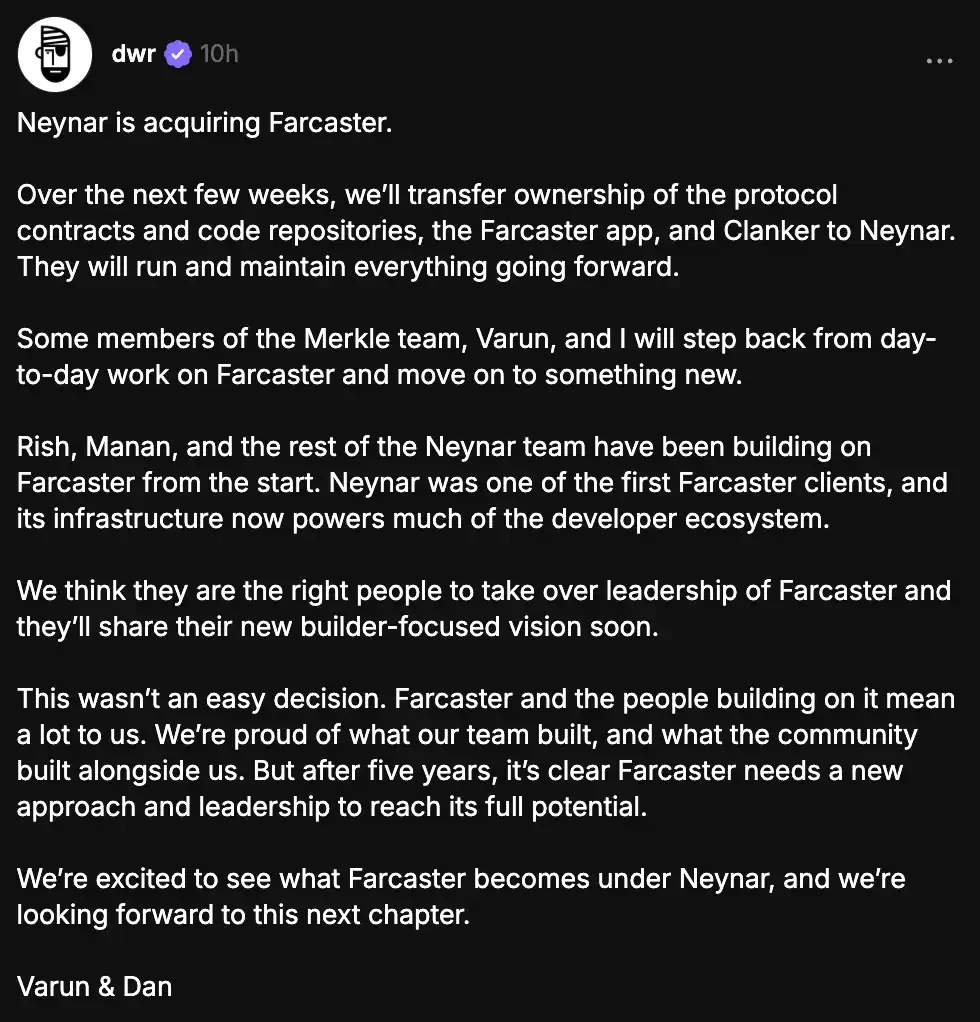
This acquisition takes place against the backdrop of Farcaster's recent ups and downs. The protocol once reached a $1 billion valuation in 2024 but experienced a significant revenue decline and user attrition in the fourth quarter of 2025. Rumors within the community previously suggested that Coinbase might acquire Farcaster, and now the deal is finalized. As the largest middleware and developer tools provider in the Farcaster ecosystem, Neynar has completed its transformation from a "shovel supplier" to a "mine owner" through this acquisition, achieving vertical integration across the protocol layer, application layer, and infrastructure layer.
When an open protocol has gone through a five-year trial period, what truly determines whether it can continue to grow is often no longer the narrative, community, or vision, but rather who can operate it stably as a sustainable product and platform.
Who is Neynar: The cloud service layer of Farcaster, the company most similar to Alchemy in the ecosystem.
If Farcaster is understood as an open social protocol, then Neynar's role is not in front-end content distribution, but rather in the underlying infrastructure. It provides hosted hubs, REST APIs, signer management, new account creation, and webhooks, enabling external teams to read and write Farcaster's social data (users, follow relationships, casts, interactions, etc.) without needing to build their own nodes or indexing systems.
Because of this, Neynar has long played a very practical role in the Farcaster ecosystem, reducing the cost of building a social application—from a burdensome DevOps task—into a service that can be paid for and used on demand. Many applications default to using Neynar as their data entry point. Even Dune's Farcaster data tables exist in the form of dune.neynar.dataset_farcaster_*. Some third-party analyses explicitly state that Dune's Farcaster table data is regularly provided by Neynar.
This explains the subtle illusion within the community: Neynar appears to be a tool around Farcaster, but in reality, it is more akin to the central infrastructure agent of Farcaster.
Neynar's leadership is deeply rooted in the Coinbase alumni network—a powerful Web3 startup ecosystem composed of former employees from Coinbase, the largest cryptocurrency exchange in the United States. This background not only defines Neynar's corporate culture but also served as a crucial connection that facilitated this acquisition.
Rishav (Rish) Mukherji (CEO / Co-founder): Rishav Mukherji graduated from Harvard University and previously served as a Group Product Manager at Coinbase. During his time at Coinbase, he gained extensive experience in scaling crypto products and building compliance infrastructure.
Manan Patel (CTO / Co-founder): As a technical lead, Manan Patel, also an alumnus of Coinbase, previously served as an engineering manager, leading engineering teams. He also has extensive experience at Uber and in game development. This technical background in handling high concurrency and real-time data streams is crucial for building social network infrastructure.
Understanding this acquisition requires acknowledging an often-overlooked fact: Neynar is not a third party that arrived later; it has been deeply integrated with Farcaster from the very beginning.
On one hand, it started by building applications on Farcaster and gradually evolved into a productized developer platform. This is the growth path repeatedly emphasized by Fortune in its funding reports—tools emerge from real-world development needs rather than being designed out of thin air.
More importantly, the capital structure is significant. In May 2024, Neynar announced the completion of an $11 million Series A round, led by Haun Ventures and USV, with follow-on participation from a16z CSX and Coinbase Ventures, among others. The names of the two Farcaster founders also appear on the list of early investors. According to pre-seed information compiled by CypherHunter, Dan Romero and Varun Srinivasan are also among Neynar's early investors or supporters.
This relationship implies that rather than being an outsourced team for a particular protocol, Neynar follows a very typical Silicon Valley crypto path: the Coinbase talent network + endorsements from top-tier funds + a developer tool business model. It is naturally more adept at creating paid products, APIs, and platform-based services, rather than pursuing a purely idealistic "decentralized social movement."
This makes the relationship between Neynar and Farcaster more akin to an ecological symbiosis: the protocol supports the infrastructure, and once the infrastructure scales up, it in turn becomes the default entry point for the protocol. As Farcaster enters a stage requiring stronger operations and commercialization capabilities, this structure naturally leads toward convergence.
Why now?
Before the acquisition, Farcaster had already undergone a significant narrative shift.
In December 2025, Farcaster will shift its strategic focus from "social-first" to "wallet-first." Dan Romero openly admitted that the team had tried the social-first approach for 4.5 years but had never found a sustainable growth model, while wallet and transaction tools instead showed a clearer product-market fit.
Farcaster is no longer just a social protocol; it is increasingly becoming a potential gateway to finance. The social feed is merely the interface. What truly creates a commercial ecosystem are asset activities, transactions, subscriptions, and payment pathways.
This is precisely where Neynar is closest to generating revenue. As developers and users shift their core activities from "posting" to "transactions and distribution," permission management, real-time events, signing, and account systems at the infrastructure layer will become the heart of the entire network—and Neynar is already positioned there.
From Neynar's own acquisition announcement, they did not frame this transaction as "expanding their territory," but instead clearly stated their objective: to maintain the protocol, run the client, operate Clanker, and help builders transition from ideas to recurring revenue.
When you provide critical infrastructure for an ecosystem over the long term, you gain control over usage volume, data pathways, and developer mindshare. However, you remain constrained by protocol direction, product priorities, and the strategies of official clients. If the protocol moves more aggressively toward wallet-centric, transactional, and subscription-based models in the future, infrastructure companies continuing to "outsource identity" will only amplify friction.
Acquisition here resembles a vertical integration, upgrading de facto control over the infrastructure layer into formal responsibilities for the protocol and client. This reduces internal friction and clears up property rights and decision-making issues for future commercialization paths.
What should Farcaster do in the next phase?
From Neynar's statements, Farcaster is unlikely to suddenly shut down or undergo drastic changes in the near future. They emphasize that there will be "no immediate changes" in the short term and that they will first focus on prioritizing their initiatives. Centered around builders, the network aims to facilitate easier development, smoother distribution, and more direct monetization loops. This suggests that Farcaster's goal may increasingly resemble a programmable social-economic operating system: the social graph provides the distribution foundation, wallets and transactions offer valuation tools, Frames/mini apps enable user interactions within content, and the infrastructure layer standardizes, productizes, and monetizes these activities.
Dan and Varun did not reveal their next move in the announcement, only stating that they would step away from their day-to-day work at Farcaster to pursue new endeavors.
But from a commercial perspective, this is not hard to understand. As Farcaster's main battlefield shifts from the protocol exploration phase to the operations and product development phase, what is needed is stronger execution and commercial discipline, rather than continuously telling idealistic stories about open social networking. Handing the steering wheel to a team that excels in developer tools, commercialization, and operations essentially transforms Farcaster from an experimental project into a viable, operable asset.
A founder's departure doesn't mean they're exiting the scene; it's more like a role transition. They bring a paradigm to a deliverable stage, then hand over the system to someone who can turn it into a business, while they themselves go on to seek the next, bigger structural opportunity. This is not unusual in the history of tech startups in Silicon Valley, and it's especially common in the crypto industry.