





On April 20, 2026, Xinhuo Group (1611.HK), a Hong Kong-listed company, announced that Fu Peng, former Chief Economist of Northeast Securities, has officially joined as Chief Economist.
Upon the announcement, Xinhuo's stock price rose more than 22% intraday and closed up nearly 18% for the day.
A few days later, Fu Peng also went viral on X. His tweets sparked intense debates among crypto-native users, and after he blocked several KOLs, community sentiment intensified further—people were criticizing him, supporting him, and analyzing him, making the Chinese Twitter sphere lively for several days.
However, perhaps all these voices are part of this promotional effort.
Because from the very beginning, we were not his target customers.
Why does Xinhuo need to bring in professionals from traditional finance?
In April this year, Bitfire(Bitfire)first appointed Fu Peng as Chief Economist, followed by the acquisition of Avenir Group’s approximately 20-person investment team and its accompanying trading system, integrating its Alpha BTC options strategy into Hong Kong’s Type 9 licensed regulatory framework to launch Bitcoin asset management services.
Behind the intense activity is a comprehensive transformation underway.
At the end of last August,Li Lin appointed former Huobi colleague Weng Xiaoqi as Co-CEO and officially announced the company’s full transformation, aiming to evolve from an OTC trader into a private banking-grade digital asset management platform.
The financial figures may illustrate how urgent this transformation is.
In the 2025 fiscal year, Xinhuo Group's total revenue reached approximately HK$8.661 billion, a surge of about 451% year-over-year.,revenueskyrocketedyetstillfacedlosses.Specifically,,the company's revenuecame almost entirelyfrom facilitating large-scale buy-sell transactions for clients and earning the spread,,namely,OTC bulk tradingbusiness,2025fiscal yearthis businessgeneratedrevenue of approximately HK$8.257 billion, with cost of salesreaching as high asapproximately HK$8.256 billion,resulting ina gross profit of less than HK$2 million.
In contrast, the company’s asset management business generated approximately HK$27.2 million in revenue for fiscal year 2025, with assets under management increasing from about $88.7 million at the beginning of the year to approximately $138.6 million by year-end, a growth of over 56% in six months. Although the revenue scale is still small, its business model differs entirely from OTC trading logic, as management fees and performance fees accumulate continuously with AUM growth.
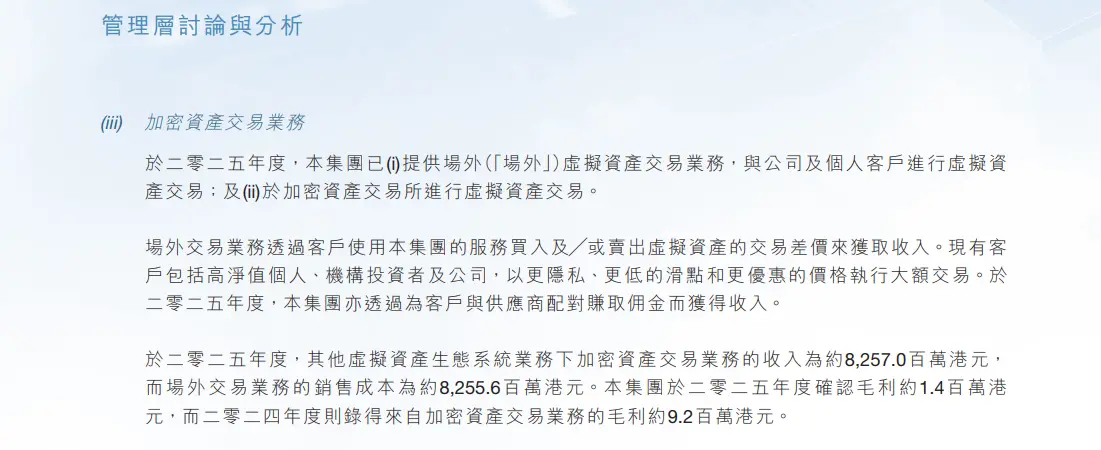
ImageSource:Bitfire Financial Report
This is also the rationale behind integrating Xinhuo into Avenir Group’s investment team.
According to reports, Avenir Group's Alpha BTC strategy involves holding spot BTC while selling call options to collect premiums, targeting an annualized return of 5% to 7% with historical drawdowns controlled at around 1%.
Fromthe productdesign itself, BTC is always held in the client’s own account; Xinhuo only gains API permissions to execute trades, not to withdraw funds—the separation of asset control and strategy execution is the standard operating logic for regulated asset management products under Hong Kong’s Type 9 license framework.
Livio Weng, CEO of Bitfire, said that with the addition of the new team, Bitfire has received approximately $500 million in initial investment interest from family offices and public companies.
However, there is often a gap between intended funds and actual funds received.
The funds Targeted by Xinhuo are not from crypto-native users, but rather high-net-worth individuals, family offices, publicly listed companies, and corporate funds considering asset diversification. These parties may not understand whitepapers or analyze K-lines, but before making any decision, they must pass compliance reviews, risk assessments, and investment committee approvals—any single hurdle canpreventprogress.
How to encourage traditional capital that has never engaged with crypto products to take that first stepisexactly the problem Fu Peng aims to solve.
Customersdefine Fu Peng’s positioning
When evaluating Xinhuo’s strategic value, don’t just look at his title,butconsider who his audience is.
Former Chief Economist of Northeast Securities, a million-follower in traditional finance circles, active on Douyin, WeChat Video Channel, and various offline closed-door forums,these areFu Peng'sidentities.
Hehas long been deeply involved in the circle that includes corporate executives, private banking clients, and core decision-makers of family offices.
These individuals are precisely the target customers that Xinhuo most needs—and finds most difficult to reach.
To some extent, what Fu Peng truly addresses is the barrier to understanding. For traditional capital, the main obstacles are not understanding and mistrust of crypto products, and what Fu Peng is best at is precisely the macro-level framing needed for this narrative.
The framework he had built over the years within the traditional finance sector—where the benefits of globalization have waned, the traditional economic system faces structural challenges, and the old order seeks new anchors of value,naturally paved the way for companies to reevaluate their cash reserve allocations.
Therefore, it is not difficult for Fu Peng to persuade traditional listed companies to convert the cash on their balance sheets into Bitcoin.
ForNeoFire,,having someone who speaks in macroeconomic terms familiar to customers come forward to endorse the platform will significantly reduce customer acquisition friction.customersare
This logic is not new. Before launching a Bitcoin ETF, BlackRock’s first step was also to have analysts with traditional finance backgrounds produce research reports.
Manycrypto KOLsmentioned,Fu Peng is more of a macro voice—following his content helps you understand what’s happening in the broader market, but trading based on his insights is another matter entirely.
Thisalsoaccurately describes Fu Peng’s role within this ecosystem—he is a provider of narratives, and trade execution is not within his responsibilities. Fornewhuo,whohasjustintegrated a trading team, this is precisely the type of role they need.
Following his debut after joining Xinhuo, Fu Peng introduced the FICC+C framework at the Hong Kong Institutional Digital Wealth Management Summit, integrating crypto assets into the traditional asset allocation framework—before an audience of institutional investors with traditional finance backgrounds. The speech did not introduce any specific products, yet it laid the foundational understanding for "why allocate to Bitcoin."
The complete business logic chain is thus formed: Fu Peng uses traditional financial language to reach target customers and open the door to trust; once customers enter, they go through OTC purchases, custody, and then enter the Alpha BTC strategy, with Xinhuo collecting corresponding fees at each stage. Fu Peng’s value lies at the top of the funnel, but what Xinhuo truly wants is to retain customers at the bottom of the funnel.
Why are crypto-native users so furious?
On April 25, Fu Peng posted a series of tweets on X, explaining in English the BTC funding rate logic and the position rent framework. Immediate skepticism followed from the crypto community, after which Fu Peng issued a Chinese tweet (since deleted): “Many people have no idea what I’m talking about, but the few large-scale BTC spot holders who survived the early stages know exactly what I mean.”
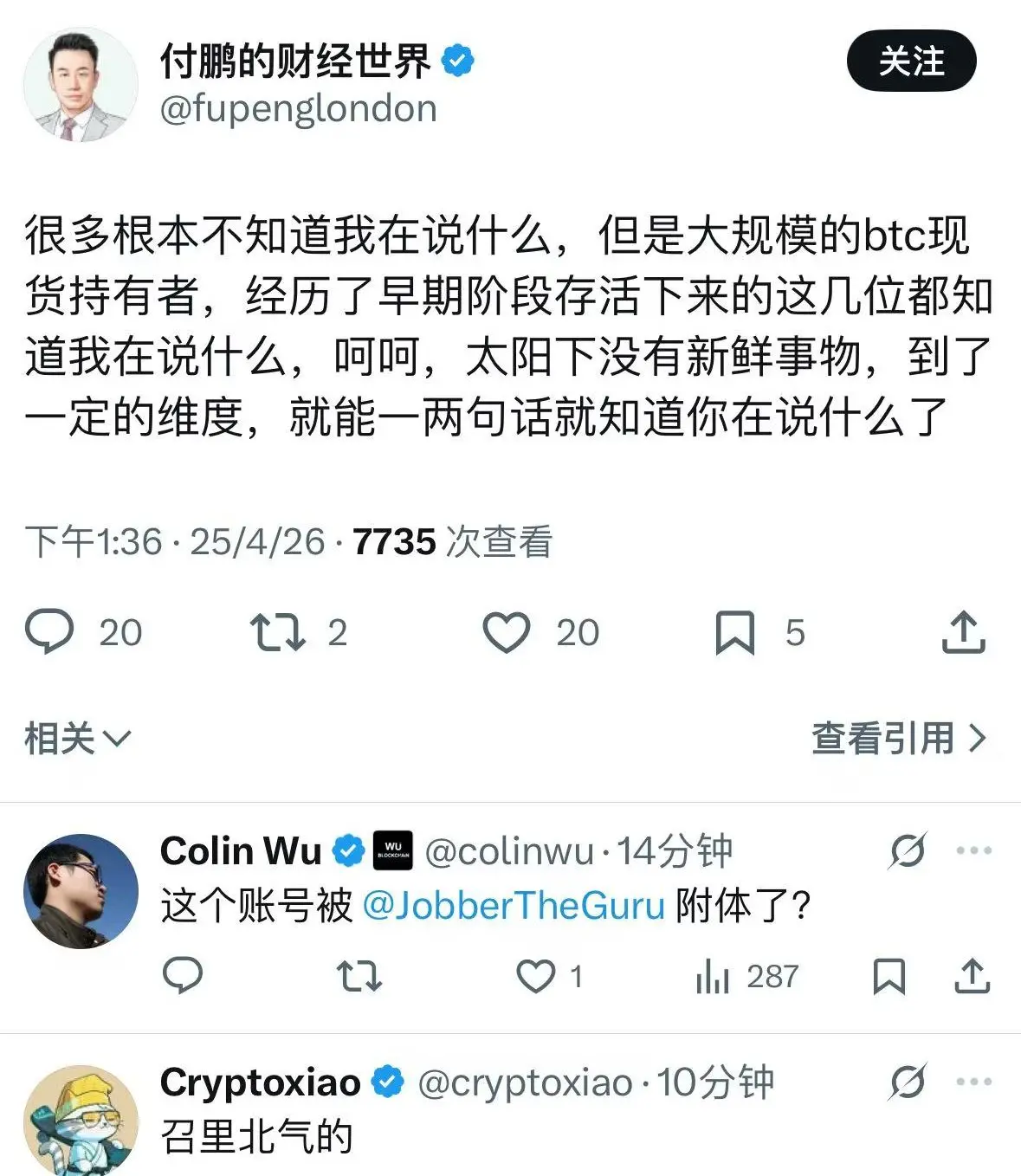
This tweet completely ignited community sentiment. The implication is clear—you not understanding it doesn’t mean I’m wrong.
In a community whose underlying culture values decentralization and questions authority, this kind of expression is hard not to provoke backlash.As X user @Nicole_yang88 said,,“I hope Master Fu Peng can ease up on the “Old money” lecturing tone.,The crypto space has its own community culture—more open, decentralized, and emotionally resonant; it’s fundamentally unsuited to one-way expert messaging.”
Subsequently, Fu Peng's account gradually blocked several top Chinese-speaking KOLs, further escalating the situation.
User直言, regardless of whether Fu Peng qualifies as chief economist, his recent block incident has made him the de facto chief traffic expert.
Whether intentional or not, Xinhuo leveraged this controversy to achieve zero-cost exposure across the entire industry.the crypto community’s lack of buy-in only confirms that this strategy was never aimed at them.
The outrage from the crypto community is actually understandable.
加密KOL土澳大狮兄对此表示,这个行业经历过这么多风浪还活下来的 OG,哪个没被冷嘲热讽过。一个传统背景的人突然进场,被质疑是非常正常的反应。与其防着群体批评,不如用实盘来证明自己,业绩是最好的证明。
Some hold an optimistic view.@Billions_2022_ believes that the entry of traditional capital elites like Fu Peng into the crypto industry signals that old money are shifting their stance on BTC from观望 to positioning/allocation,with institutions and wealthy seasoned investors being the primary drivers of this structural bull market.
Conclusion
Ultimately, Fu Peng is a precise move in Xinhuo Group’s customer acquisition strategy, but the game is far from over.
This uproar in the crypto community appears on the surface to be a cultural clash between a traditional economist and a crypto OG, but upon closer inspection, it’s simply the company leveraging Fu Peng’s influence in traditional finance to access customer funds that were previouslydifficultto reach.
However, whether this business model can succeed ultimately depends on actual conversion rates, how much of the intended capital will truly be deployed, and whether the gross margin in the next earnings report from Xinhuo will show structural improvement.
Regardlessofwhathappens,newfirehasalreadywonthetraffic.