





Recently, the term "AI payment" has become increasingly popular. However, the concept itself is still rapidly evolving, and different people often see different aspects of it. Some focus on user experience enhancements such as voice-based ordering and automated payments, while others are interested in integrating wallets with AI agents to enable them to make payments. But as some projects begin to emerge, the market is starting to realize that the core of AI payment is not just "payment" itself, but rather how AI services are priced, traded, and settled.
Taking Nevermined as an example, it is not building a single-point payment tool, but rather an infrastructure that enables AI services to be priced, charged, and settled. It provides capabilities including billing, access control, real-time settlement, and compatibility with agent protocols such as MCP, A2A, x402, and AP2. What it truly aims to solve is not "how to pay," but how to instantly turn an AI’s work into revenue.
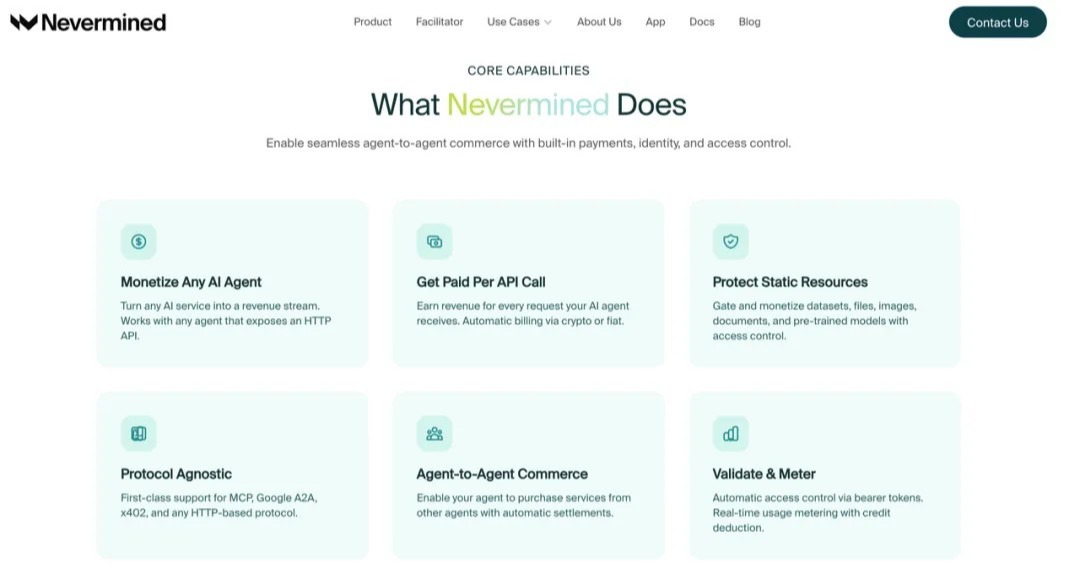
(The above image is a screenshot from the Nevermined website.)
It doesn't sell wallets, but rather a billing system for AI services.
Many payment products are more like cash registers, focused primarily on collecting money. Nevermined is different—it’s like equipping an AI service with a complete billing system. Each time an AI service is invoked, the system can determine whether to grant access, how much to charge, how to record the transaction after deduction, and how to handle disputes if they arise later.
This may sound technical, but it’s actually quite straightforward. Today, countless AI products are working hard, yet very few can consistently generate profits—not because of their capabilities, but often due to their pricing models. Traditional software can be charged by account, by year, or by package, but AI agents typically don’t operate this way. A seemingly simple task may involve multiple model calls, several tools, and numerous external services behind the scenes. Continuing to use traditional software pricing methods can easily lead to distorted pricing.
Nevermined captures exactly this step. It transforms previously hidden backend calls into individually billable business actions. In the past, people sold "software licenses"; now, they’re selling "each machine operation."
Why has this business started to become stable?
AI payments are becoming practically meaningful not because the concept is new, but because the way AI works is forcing payment models to evolve. Nevermined offers different models such as pay-per-use, pay-for-results, and pay-for-value, essentially answering a very practical question: How should AI services be sold?
In the past, many AI products were hard to sell, not because there was no demand, but because customers couldn’t understand where their money was going. Monthly subscriptions made them fear overpaying, while per-seat pricing didn’t align with actual usage. This is especially true in agent scenarios, where a single conversation may involve dozens or even hundreds of micro-operations. If the pricing model doesn’t closely follow the actual workflow of AI, commercialization will always feel awkward.
Nevermined’s solution turns calls, results, and access into billable events, integrating billing, authorization, and settlement into a single pipeline. As a result, customers no longer purchase an ambiguous “AI capability package,” but rather discrete, measurable, and trackable services. The true value of AI payments isn’t about machines making payments—it’s about ensuring the work machines perform is finally properly priced.
It also takes a crucial step by not locking itself into pure crypto payments. Public information shows that it supports bank cards, stablecoins, crypto assets, and real-time bank transfers. This choice is vital because to make AI payments a viable business, customers must be able to adopt it easily. The more open the payment channels, the more they resemble infrastructure; the higher the barriers, the more they become a toy for insiders.
It is no longer a conceptual project.
To determine whether such projects are still in the conceptual stage, don’t just look at how they tell their story—look at what’s actually shown on the product page. Nevermined’s public information shows it already has partnerships with CrewAI, Olas, Naptha, Mother, Helicone, aiming to provide payment and billing capabilities for next-generation agent marketplaces. Its official product page directly lists MCP tools, A2A services, x402 payments, as well as cards, stablecoins, and bank transfers as concrete product features—not just visionary statements.
More notably, there is publicly disclosed collaboration with the Olas ecosystem. Nevermined stated that, by leveraging Nevermined, Valory reduced the deployment timeline for payment and billing capabilities on Olas’s AI agent marketplace from six weeks to six hours. Olas’s public page also mentions the marketplace integration with Nevermined, enabling agents to pay and get paid, and supporting real-time, dynamic pricing for agent-to-agent transactions.
This at least shows one thing: Nevermined is not just停留在"未来机器会彼此交易"的想象里—it has already been put into real-world use. Of course, that doesn't mean it has already achieved massive revenue success. Public materials confirm that it has been productized, integrated into an ecosystem, and deployed in actual use cases; however, no clear figures on its exact earnings have been disclosed publicly. This distinction must be clearly understood.
The real sensitivity lies not in the technology, but in the legal identity.
The most challenging aspect of AI payments is often not whether the technology can be built, but what the platform legally becomes once it is built. Many technical teams tend to overestimate the neutrality of code, but regulators typically don’t buy into that argument.
Nevermined emphasizes traceability, auditability, real-time invoicing, and immutable logs in its product description—capabilities that are certainly beneficial from a business perspective as they enhance trust; however, from a regulatory standpoint, these features also raise concerns.
If a platform only provides billing logic, access control, and interface verification, and users retain full control over their funds—with payment authorization remaining on the user or wallet side—then it functions more like a technology service provider. However, once the platform begins collecting payments on behalf of others, distributing funds, conducting centralized settlements, holding custody of funds, or deeply intervening in stablecoin transfers, its regulatory profile changes significantly. Regulators have never been particularly concerned with what you call yourself; they care far more about whether you are handling money on behalf of others.
This is also the biggest difference between AI agent payments and traditional software services. Previously, software platforms primarily sold tools, but now these platforms are encountering issues closer to the core of payments—such as billing, authorization, settlement, and audit trails. Taking it one step further, they must also address liability: if an agent automatically invokes an incorrect service or makes a wrong decision within its authorized scope, who bears the loss—the user, the platform, the service provider, or the model itself? The smoother the AI payment experience, the clearer the backend liability boundaries must be.
What it truly changes is not just the way of payment, but the way of trading.
If you view Nevermined merely as a new payment tool, you’re likely underestimating it. What’s truly fascinating is that it assumes a future in which AI is not only used by humans, but also purchased, invoked, and hired by other AI.
Once this stage is reached, the transaction structure changes. Previously, a company sold software to a customer; now, one agent may trigger another agent. Previously, a single purchase corresponded to a single contract; now, it may involve a series of automated micro-transactions. Previously, payments required manual confirmation; now, payments may be automatically completed by the system within authorized limits.
What’s truly being rewritten here isn’t just the checkout process, but pricing models, contract structures, risk management logic, and even how payment regulation views these issues. Nevermined is certainly not the final destination, but it has at least brought a clear trend to the forefront: in the future, many transactions may not be agreed upon by people, but rather calculated, initiated, and settled automatically by machines.
Understanding this is far more important than simply fixating on the four characters "AI payment." Because in the next phase, what truly matters won't be whose model chats better, but who can first streamline the entire chain: "machine performs work—machine charges—machine settles." Whether AI payment is worth paying attention to isn't about whether it can order a coffee for you, but whether it can turn machine labor into a legitimate revenue unit. Whoever cracks this first will be closest to unlocking the next gateway of AI commercialization.
Original author: Attorney Shao Jiaodian