




In today's stock market, where quantitative trading is prevalent, most people believe these cold algorithmic robots are ruthless reapers on Wall Street, constantly extracting every drop of hard-earned money from retail investors at millisecond speeds, exploiting their emotional misjudgments or information asymmetry.
However, in an emerging market within the past 48 hours, multiple top-tier quantitative trading bots experienced a collective breakdown of their nearly perfect profit curves. Meanwhile, a mysterious account named a4385 seized the opportunity to earn a staggering $280,000.
This market is called a prediction market, and a trader named a4385 also staged here a carefully planned hunt against quantitative trading bots for the whole world to see.
Financial Version of "Big or Small": The Arbitrage Paradise of Quantitative Models
Everyone understands the game of guessing high or low, and similar gameplay exists in prediction markets as well.
For example, if you bet "up" in the event of "Gold price will rise or fall tomorrow," and the price indeed rises tomorrow, your "up" position will be settled for profit according to the odds at the time of your bet, regardless of how much the price rises. The odds themselves correspond to the probability of the event occurring. Conversely, if the price falls, no matter how large the decline is, your position will be directly reduced to zero.
"XRP will rise or fall in 15 minutes" is a typical example of many betting markets. When each 15-minute market opens, it generates a starting price. After 15 minutes, if the price of XRP is higher than the starting price, traders who bet on "rise" profit; otherwise, those who bet on "fall" profit.
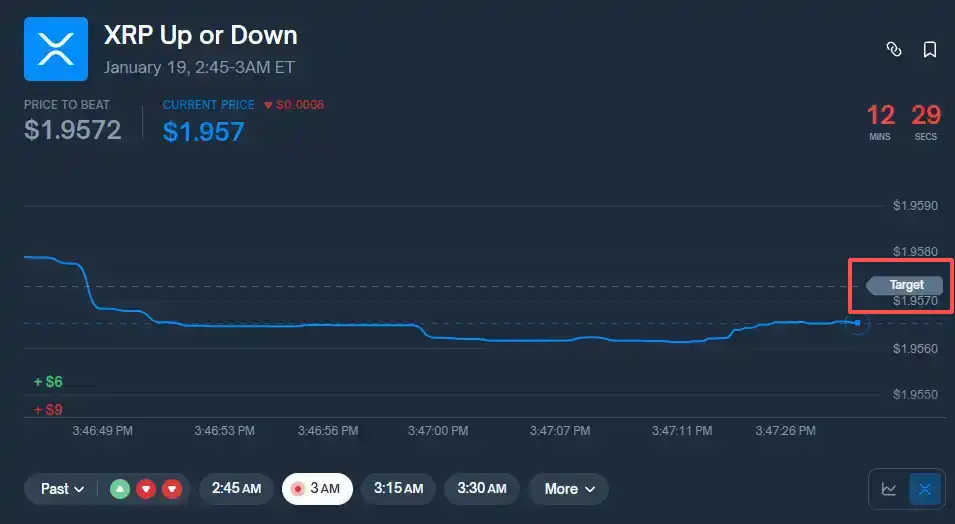
As shown in the figure, "Price To Beat" corresponds to the starting price, and "Current Price" corresponds to the real-time price. The red "12:29" in the upper right corner indicates the remaining time until settlement. If the price line is above the "target" shown in the figure at the time of settlement, a bet on "up" will be profitable; conversely, a bet on "down" will be profitable.
This real-time mechanism makes the betting market a paradise for quantitative robots: algorithms use sophisticated statistical models to detect pricing deviations caused by retail investors due to emotions, information delays, remaining time, and many other factors, and then steadily erode profits through automated trading.
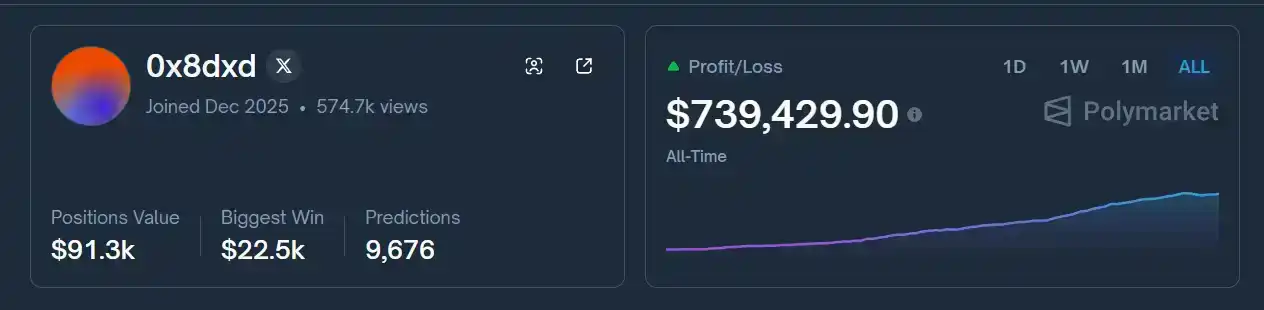
0x8dxd is a perfect example of a quantitative trading bot: since its launch on December 5, 2025, it has generated cumulative profits of $740,000 over the past 44 days, participating in an average of 219 different markets per day, with a very smooth profit curve.
XRP soars exactly at settlement time, "lucky big fool" doubles their funds.
On the afternoon of January 17, 2026, a4385 bet "up" in "XRP will rise or fall in 15 minutes."
The XRP price at this market's opening was $2.0784, and until 17:58:54 (66 seconds remaining until settlement), the XRP price was still hovering around $2.0737, with an upward probability of only 36%—the market consensus believes that XRP is unlikely to rise above the opening price within the remaining one minute.
And just within the next minute, XRP suddenly began to rise steadily, and the price settled at $2.0817 at market close—just above the opening price.
This means that position a4385 achieved substantial profits from entry to settlement, while others, such as the quantitative bots shown in the example below, lost all their historical profits due to this single market movement, and even incurred additional losses.
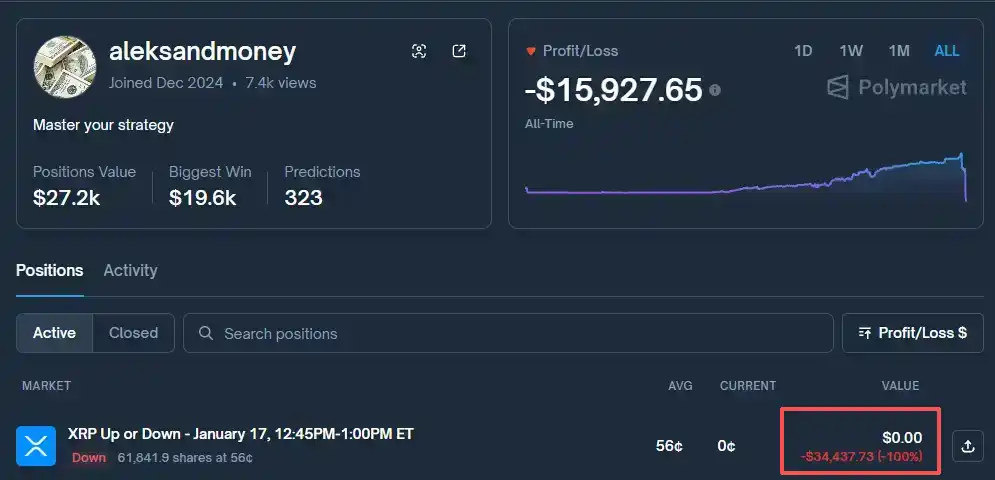
This quantitative trading bot made more than $40,000 in profit over the past 7 months, while the loss at this trading position was $34,000.
Careful manipulation behind repeated good luck
After the market settled, people found that a4385 repeated similar "lucky" operations several times: just one minute before the settlement of multiple markets, the price of XRP suddenly surged, then quickly dropped back to its original level the moment after settlement.
This has led people to begin doubting that his "luck" might not be a coincidence, but rather a precise ambush aimed at the quantitative trading robots.
In theory, a4385 could first bet "up" when the real-time XRP price is below the starting price, and then, one minute before settlement, place a large market buy order for XRP to artificially drive up the price, ensuring that the settlement price is higher than the starting price and thereby locking in a profit.
At this point, all previously trivial details began to take on significance: the 17th was a weekend, indicating that market makers provided insufficient order-book depth for XRP to absorb large short-term trades.
Choosing XRP, a less popular asset distinct from Bitcoin, further ensures a shallower order book depth, allowing manipulators to move the price within a short time at a lower cost.
This gives A4385 a perfect short-term trading window:
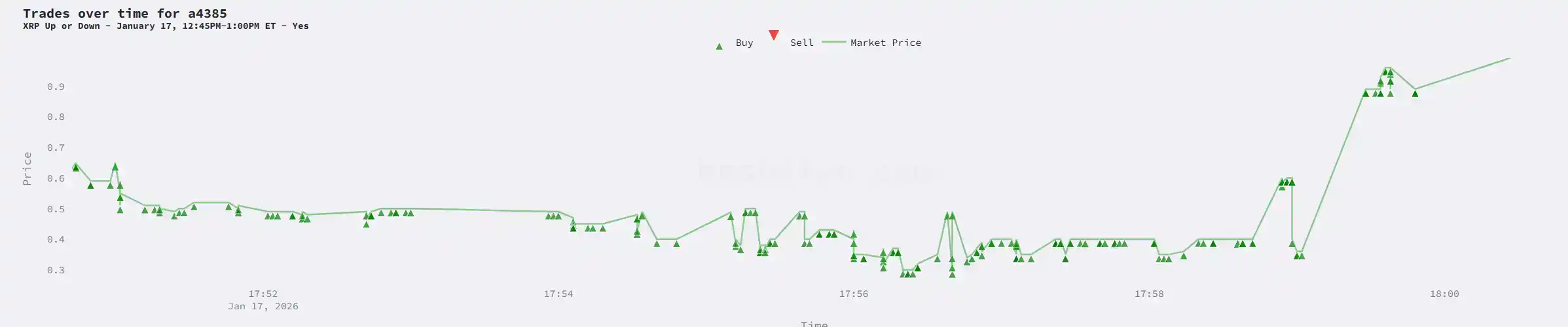
First, in the prediction market, place multiple large bets on "up" within 10 minutes before the market settles. During this period, the real-time prices are all lower than the starting price, resulting in higher odds for bets placed at this time.
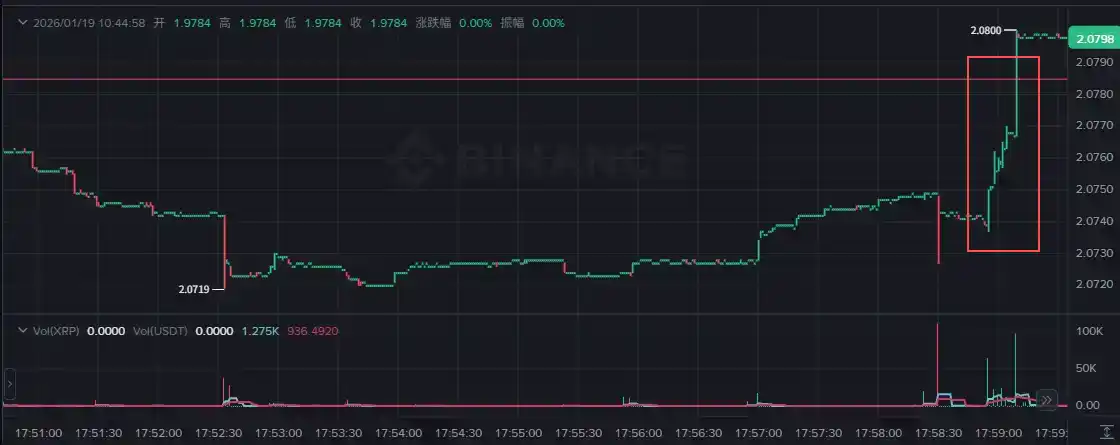
On the corresponding XRP price chart, the price hovered around 2.074 until 17:59. In the final minute, multiple abnormal large-volume trades surged in, causing the price to instantly break through the initial price level (red horizontal line).
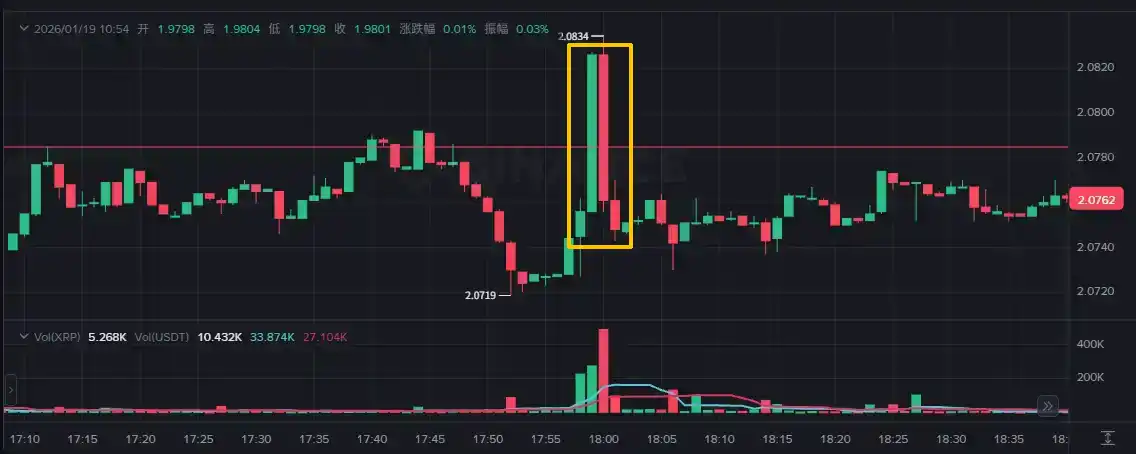
After the order book was successfully settled, the recently purchased XRP was immediately dumped, causing the price to drop instantly.
If we assume that all market buy orders at 17:59 came from a4385, then based on the trading volume of $569,000 for that minute's candlestick and an exchange fee of 0.32%, the total cost for buying and selling would be approximately $6,200.
And his profit from betting "up" on this market was $40,218. By continuously replicating this strategy, he has already earned nearly $300,000 within 48 hours.
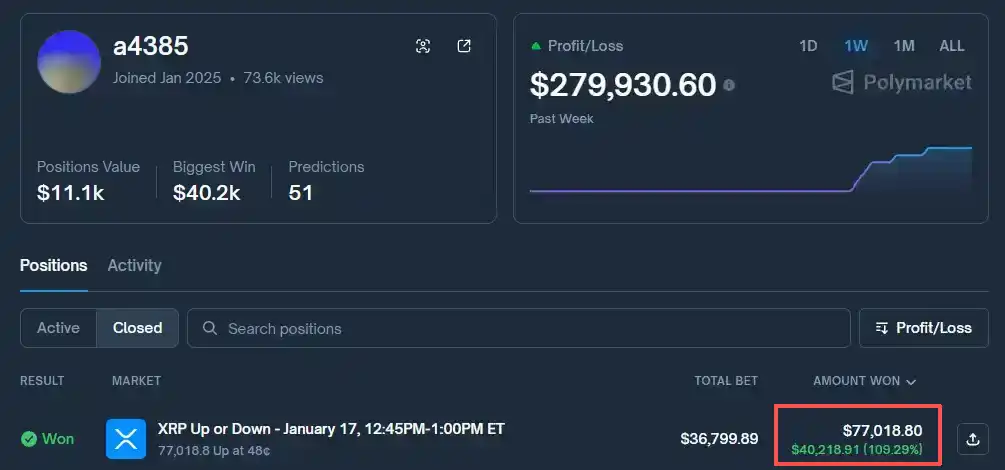
While we may be amazed by A4385's money-printing-like operations, we also need to consider the costs behind this seemingly "retail investor comeback" story.
In addition to incurring thousands of dollars in transaction fee losses, buying and pulling the price up (buying to pump the price) will also result in significant losses when selling after settlement, due to the cryptocurrency's price drop.
Therefore, while shorting, he also needs to hold an equivalent 1x short position. Only in this way can the total value of his assets remain unchanged regardless of how drastically the price of the XRP spot in his possession fluctuates.
In other words, in addition to bearing the transaction fee erosion, he also needs over a million dollars in liquid capital to ensure the feasibility of this strategy.
Therefore, this is not a game of luck for gamblers, nor is it a celebration for ordinary retail investors.
Behind each legendary tale of casino profits, perhaps the ultimate winners are never luck itself, but rather the inevitable outcomes resulting from precise calculations of capital, structure, and rules.
Click to learn about BlockBeats' job openings.
Welcome to join the official Lulin BlockBeats community:
Telegram Subscription Group:https://t.me/theblockbeats
Telegram discussion group:https://t.me/BlockBeats_App
Official Twitter account:https://twitter.com/BlockBeatsAsia