





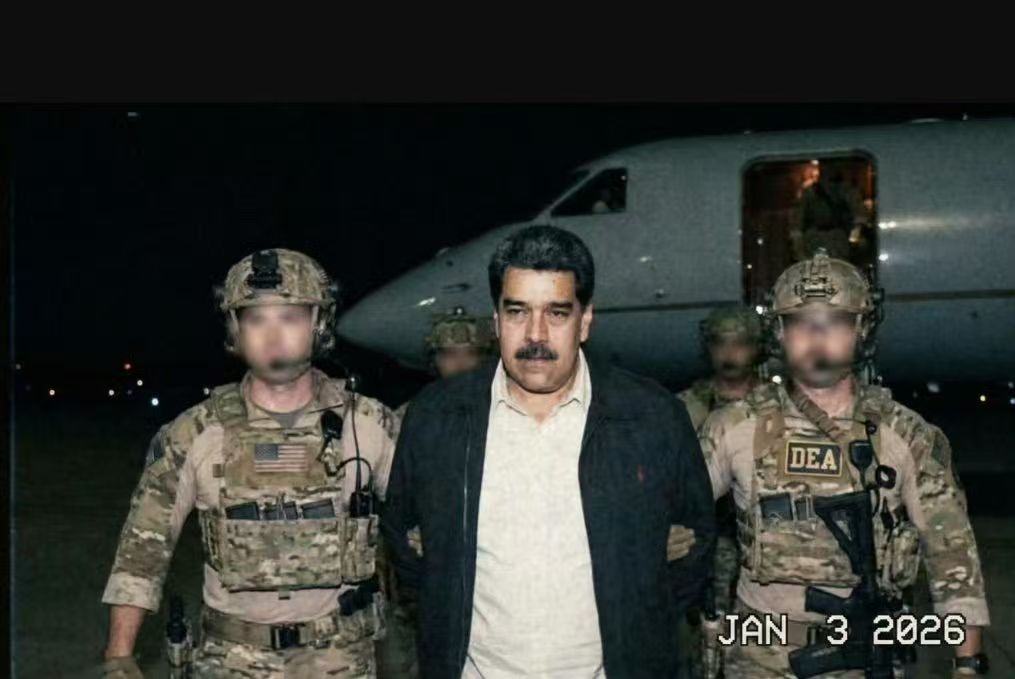
Yeh Hui-Wen,Wall Street Journal Insights
Hours before the Trump administration announced a raid on Venezuela and the arrest of its president, Nicolás Maduro, a series of nearly perfectly accurate bets appeared on the prediction market Polymarket.
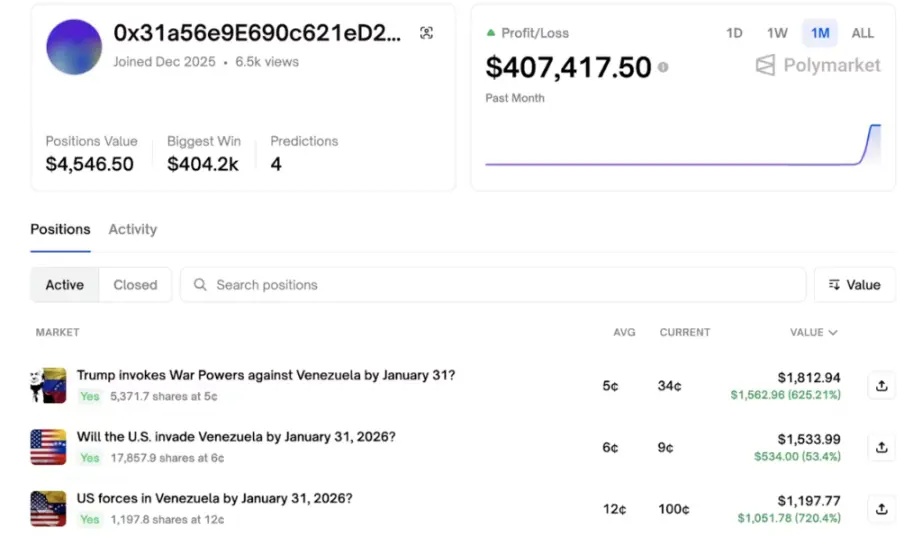
A mysterious account created last Saturday achieved a return of over 1,200% in less than a day by betting on Maduro's downfall, raising strong market suspicions of insider trading related to geopolitical events.
According toCCTV NewsIt was reported that Trump officially announced a military strike against Venezuela early Saturday morning and confirmed that Maduro and his wife had already been taken out of the country.
Although this action appeared sudden to the public, it seemed to have been foreshadowed in prediction markets. According to reports from Axios and The Information, on Polymarket, the price of prediction contracts regarding whether Maduro would lose power before the end of January experienced significant fluctuations late Friday night, before Trump's official public announcement. This suggests that some market participants may have had early access to highly sensitive information about the military operation.
This incident quickly sparked widespread discussions about market regulation for predictions and the leakage of political intelligence. The timing of the mysterious account's trades closely aligned with the timeline of U.S. military decisions, generating over $400,000 in returns from an initial investment of just a few tens of thousands of dollars. Meanwhile, the geopolitical ripples from this military operation are spreading. In a subsequent interview, Trump pointed the finger at Mexico, hinting that similar actions might be taken in the future against the country's cartel organizations.
This incident not only highlights the sensitivity of unregulated prediction markets in major geopolitical events, but also serves as a warning to investors about the boundaries of compliance. According to reports, U.S. Representative Ritchie Torres plans to propose new legislation aimed at restricting federal elected officials and political figures from participating in such prediction markets, in order to safeguard the public integrity of financial markets.
Accurate betting yields over $400,000 in profits
According to data cited by The Information from Bloomberg and the Wall Street Journal, a new account created on December 27, 2025, on Polymarket has shown remarkable foresight. This account has invested a total of approximately $32,537 over the past four days, specifically betting that Maduro will step down before January 31.
The trading records show that the account heavily built positions on Friday night, several hours before the announcement of the military operation became public. At that time, the market estimated the probability of U.S. intervention in Venezuela to be around 6%. As President Trump confirmed on Saturday morning that the U.S. had captured Maduro, the value of the account's position surged, ultimately generating a profit of $404,222, with a return rate of 1,242%.
According to Axios' analysis, trading activity on Polymarket began to rise around 10 p.m. Eastern Time on Friday and peaked around 4:20 a.m. on Saturday—approximately when Trump made his announcement. In contrast, at that time, the price of contracts on another prediction platform, Kalshi, regarding Maduro's departure was only about 13 cents, highlighting the clear lead in specific capital flows on Polymarket. According to The New Republic, in addition to betting on Maduro's removal, the account also placed bets on a U.S. invasion of Venezuela.
Regulatory Gaps and Legislative Responses
This unusual trading activity once again brings the regulatory issues surrounding prediction markets into the spotlight. The Commodity Futures Trading Commission (CFTC) typically prohibits contracts related to war, terrorism, and assassinations that go against the public interest. However, Polymarket, as a global platform, is theoretically not available to U.S. users, placing it in a regulatory gray area under U.S. oversight.
According to Axios, in response to the potential risk of insider information abuse revealed by this incident, Representative Ritchie Torres plans to propose the "Public Integrity in Financial Prediction Markets Act of 2026." The bill aims to restrict federal officials from participating in such markets to prevent profiting from non-public political or military information.
The New Republic's report further notes that the timing of this operation indeed raises suspicions. According to the report, U.S. military officials initially discussed conducting the strike during Christmas, but postponed it due to weather conditions. Although the Trump administration was relatively successful in preventing leaks to the media, abnormal fluctuations in market data suggest that details of the operation may have been known in advance by certain market participants.