





Have you ever thought about becoming a shareholder in SpaceX before it lands on the moon, or in ByteDance before it goes public?
In traditional finance, this opportunity is known as "Pre-IPO" private equity investment, typically occurring in the final stage before unicorns like SpaceX and ByteDance go public. At this stage, the business model is highly mature, carrying significantly lower risk than early-stage venture capital, yet the returns after the company’s IPO remain astonishing—ranging from double to several or even tens of times the initial investment.
However, for a long time, this lucrative opportunity has been exclusively enjoyed by private equity (PE) and venture capital (VC) firms, with ordinary retail investors locked out behind highly restricted walls, forced to wait until companies go public before entering the secondary market—ultimately, Pre-IPO opportunities have long been out of reach for the majority.
Today, Maotong MSX has decided to break through this high wall by combining tokenization with a Wall Street-compliant platform.
I. The Trillion-Dollar Cake Inside the Fence: Visible, But Unattainable
Data shows that the Pre-IPO market has long surpassed expectations.
The 2025 Global Unicorn Enterprise 500 Report shows that the total valuation of the 2025 Global Unicorn Enterprise 500 reached RMB 39.14 trillion, a 30.71% year-over-year increase, far exceeding the GDP of Germany, the world’s third-largest economy. The average valuation also rose from RMB 59.883 billion to RMB 78.276 billion, up 30.71% year-over-year.
Dawson Managing Partner Yann Robard also noted in the article "Why Private Equity Wins: Reflecting on a Quarter-Century of Outperformance" that private markets generated approximately three times the value created by public markets over the past 25 years, meaning that the periods delivering superior returns typically occur before companies go public.
Taking SpaceX, currently the world’s number one unicorn, as an example, after exclusive analysis by MaiTong MSX, it was found that its private market valuation in 2024 was only $180 billion. It then surged sharply, reaching a non-public valuation of $1.25 trillion by early 2026 following its share swap integration with xAI—an increase of sixfold in just two years.
The private share transfer price for SpaceX, outside the public market, surged from approximately $56 per share in October 2021 to about $527 per share in February 2026, nearly a ninefold increase.
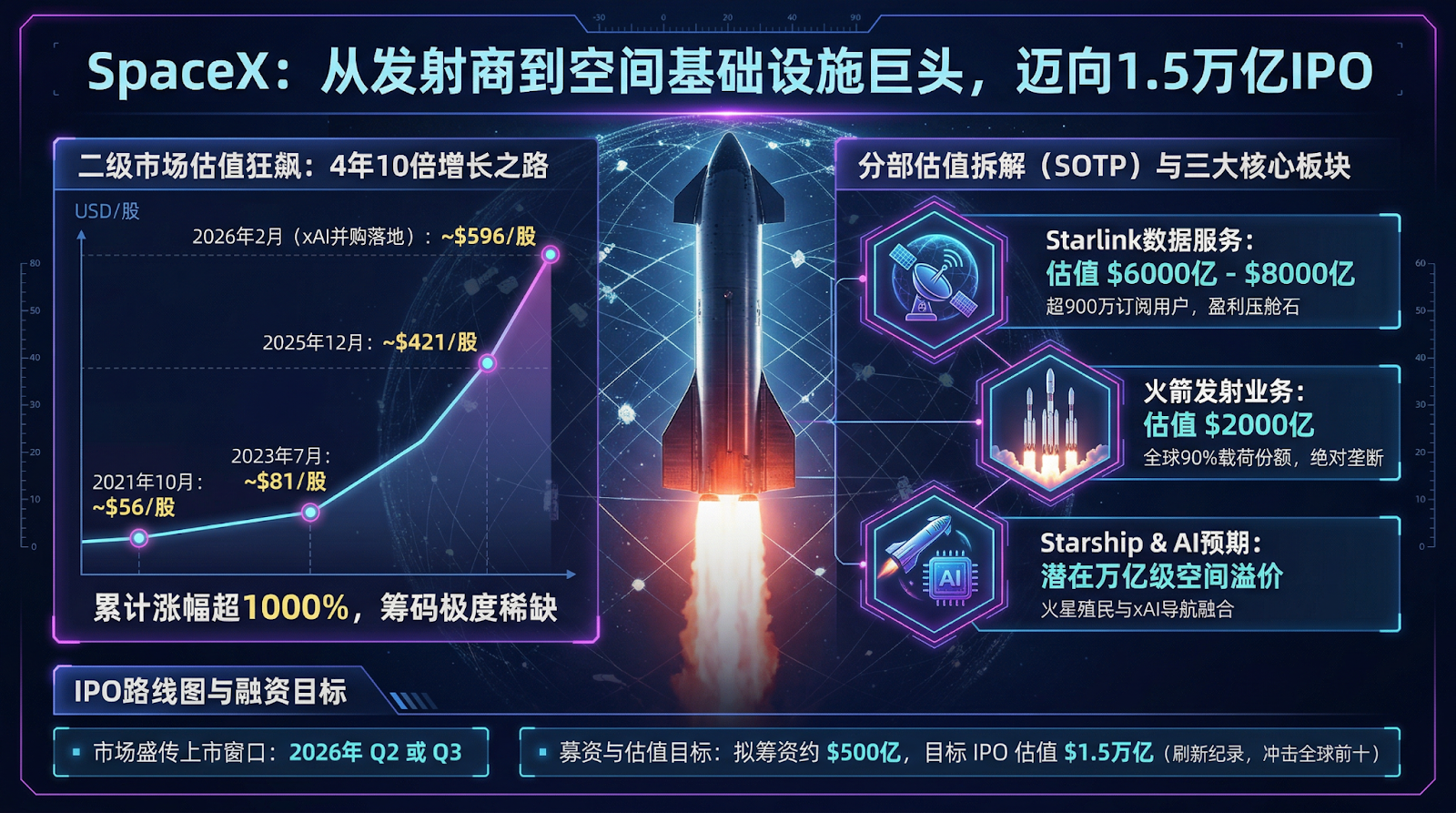
Equity in unlisted unicorns has long been a super alpha in global asset allocation—everyone knows it, but the barrier to entry in this trillion-dollar sector with rapid valuation growth remains high:
- Minimum investment thresholds often start at “millions”: entry fees ranging from hundreds of thousands to millions of dollars directly deter 99.9% of individual investors;
- The "opportunity cost" of liquidity: Once invested, funds are often locked up for extended periods—up to 5 to 10 years—and are difficult to liquidate;
- Highly unequal allocation: Highly sought-after companies like OpenAI, SpaceX, and ByteDance, which are oversubscribed by buyers, only have their shares ever circulated within a small circle of top-tier PE and VC firms;
In other words, it is a trillion-dollar market with potentially high returns that has long been accessible only to institutional investors and ultra-high-net-worth individuals.
This is why the market paid close attention in June 2025 when online brokerage giant Robinhood offered "stock tokens" of OpenAI and SpaceX to European users, marking the first large-scale trial of traditional online brokerages entering the tokenization of private assets.
Because it sends a significant signal: by tokenizing RWA, we can break down the walls of the primary market, mapping real equity as on-chain, divisible tokens—potentially redefining limitations around access thresholds, liquidity constraints, and exit efficiency.
II. Partnering with Republic: How MSX Breaks Down the Pre-IPO Barrier
Today, Maitong MSX has entered into a strategic partnership with Republic, a U.S.-compliant asset tokenization platform, to launch a Pre-IPO section that will offer tokenized private equity access to global top-tier unicorns such as SpaceX and ByteDance for eligible platform users. The initial offering exceeds $10 million and includes more than ten leading global unicorns; the full list of assets and available allocations will be disclosed upon official launch.
However, when faced with this kind of equity tokenization prior to an IPO, your first reaction might be to ask: Is it secure? Is it legal? Or is it just a "virtual mapping"?
Before proceeding, it’s important to provide some background on Republic. As a compliant private securities platform operating under the oversight of the U.S. Securities and Exchange Commission (SEC), Republic has long provided global investors with access to private equity financing. It is dedicated to enabling individual and institutional investors to participate in private markets and alternative assets—asset classes that were traditionally accessible only to a select group of professional investors. All of Republic’s private assets are held by regulated third-party custodians, such as licensed institutions like BitGo Trust Company.
Notably, Republic is the core service provider behind Robinhood’s project to launch tokenized shares of unlisted unicorns in Europe.
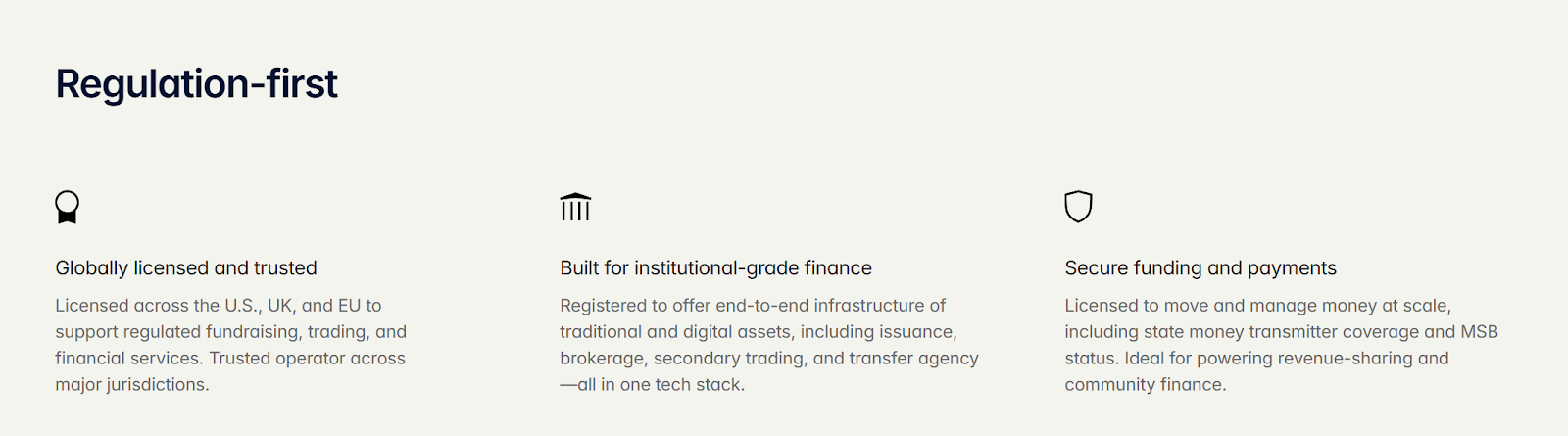
Source: Republic
This means that MSX’s Pre-IPO section introduces structural innovation atop a mature, compliant framework, enabling users to access services on par with the world’s leading brokerages: all unicorn equity assets are connected through compliance channels equivalent to those of Robinhood, ensuring that the underlying tokens represent genuine existing shares, held in custody by regulated third parties, and backed by legal and asset foundations.
Ultimately, when tokenization technology meets a compliant private placement platform regulated by the U.S. SEC, equity in unlisted giants will no longer be the exclusive domain of top-tier venture capitalists.
III. What does this mean for regular users?
The newly launched Pre-IPO product brings structural changes for ordinary users in three key dimensions.
First, there's the "democratization" of entry barriers—say goodbye to million-dollar entry tickets.
As mentioned above, the entry threshold for traditional private markets is typically hundreds of thousands to millions of dollars. Tokenization, however, fragments previously inaccessible pre-IPO shares of unicorns, enabling eligible ordinary users on the MaiTong MSX platform to participate on equal footing with top-tier venture capital firms and share in the future growth premium of companies like SpaceX or ByteDance across both primary and secondary markets—at a remarkably low entry barrier.
Second, it’s the "source-level" valuation advantage, avoiding the emotional premium of the secondary market.
It is well known that the sharp price surge on or near an IPO’s first day is often fueled by excessive emotional speculation, leaving retail investors to enter at inflated prices. Participating in the Pre-IPO stage means you’re accessing a valuation range that is far closer to reality. In short, ordinary users can now position themselves at lower valuations before a company goes public, rather than becoming the last buyers in the post-IPO frenzy.
Finally, there is the "restructuring" of the liquidity structure, breaking the illusion of N-year lock-ups.
The most frustrating aspect of traditional private equity investments has been the 5- to 10-year lock-up period for exits. To address this pain point, Maitong MSX plans to率先 launch high-quality Pre-IPO assets with a short-term redemption mechanism, and will continue exploring additional technological pathways to enhance asset liquidity, potentially reshaping the exit logic of the primary market.
In conclusion
The launch of the "Pre-IPO" section also marks the expansion of Maitong MSX's U.S. stock tokenization footprint from secondary market asset trading to primary market share distribution.
Amid the global trend of tokenizing assets, Pre-IPO tokenization has become a widely discussed next frontier, and as one of the world’s earliest platforms dedicated to tokenizing U.S. stocks, MSX has consistently focused on one goal: from breaking down barriers to trading U.S. stocks to now dismantling the walls surrounding private equity.
Give ordinary people the opportunity to share in the growth benefits of the most scarce high-quality assets of this era.
Just as five years ago, the average person couldn't imagine buying and selling U.S. stocks instantly through a blockchain wallet; until today, you might have found it equally hard to imagine becoming a "shareholder" in SpaceX or ByteDance with an extremely low barrier to entry.