





Core Trade Summary (TL;DR)
This quarter’s MicroStrategy (MSTR) earnings report completely changed the game: previously, it was simply “print shares and buy BTC,” but now the company has officially revealed a clear metric—the 1.22x mNAV (market-to-net asset value premium). This figure determines whether MSTR will buy or sell BTC going forward.
● For MSTR:
○ Premium > 1.22x: Stick to the old approach—issue new shares at a premium and use the proceeds to buy BTC.
○ Premium < 1.22x (core reversal): It would no longer be advantageous for the company to issue additional shares. Management has explicitly stated that if the premium falls below this level, they will sell BTC to use the proceeds for debt repayment or share buybacks.
● How to arbitrage: If the premium on MSTR falls below 1.22x, it will trigger an arbitrage opportunity to go long on MSTR and short on BTC. At this point, the company will directly intervene by selling BTC and buying its own stock; the company’s selling activity will eliminate the price discrepancy. Management’s recent statement provides the core confidence for this arbitrage trade.
● For STRC (preferred shares): Previously, investors feared that MicroStrategy’s potential bankruptcy could render these 11.5% dividend-paying preferred shares worthless. Now, with official statements indicating that “Bitcoin will be sold if necessary to repay debts,” STRC has gained a tangible safety net, no longer resembling a Ponzi scheme.
● For the BTC market: The myth of MicroStrategy holding onto its BTC indefinitely has been shattered, leading to short-term bearish sentiment; however, the benefit is that the company has proactively sold coins to reduce leverage, completely eliminating the risk of forced liquidations in a prolonged bear market.
Diamond hands are gone: 1.22x mNAV is the line between life and death, and the dividing line for Bitcoin bulls and bears.
Over the past two years, there has been significant FUD in the market regarding MSTR, particularly concerning how it manages its leverage and interest expenses. As Bitcoin is an asset with no cash flow, questions arose about where MSTR would obtain the funds to pay substantial interest on its financing. During this Q1 earnings call, management explicitly stated: they will sell Bitcoin if the mNAV falls below 1.22x.
This is equivalent to revealing the company’s “hidden cards” and “automated procedures”:
● Above Water Level (Bloodsucking Expansion Phase): The company is a die-hard bull on BTC. As long as retail investors are willing to pay a premium of more than 1.22 times, MicroStrategy can achieve "arbitrage-free expansion." Issuing shares to extract capital → aggressively buying BTC → increasing book assets → boosting stock price—this positive feedback loop will continue to spin.
● Below Water Level (Balance Sheet Defense Period): Sudden Brake on the Flywheel. If MSTR trades at a significant discount to the BTC it holds, continuing to issue shares would amount to selling company assets at a deep discount. The management, acting with extreme rationality, states that at this time, selling BTC for cash to pay dividends, manage debt, or directly repurchase MSTR common shares at depressed prices delivers the greatest value enhancement for existing shareholders.
This means MSTR now has a definitive "value floor," and it is no longer a runaway train without brakes.
Arbitrage opportunity: Long MSTR / Short BTC when below 1.22 mNAV
What arbitrage fears most is discovering an excellent price discrepancy, only for the market to remain irrational for an extended period (such as MSTR consistently trading at a discount), ultimately causing your hedged position to be worn down by funding rates or interest costs.
However, MSTR's threshold of 1.22 times provides a clearly defined arbitrage opportunity.
Deep practical logic:
● Strict trigger condition: Only when MSTR's mNAV declines by a certain amount below 1.22 times.
● Position opening: At this point, MSTR's price is "significantly undervalued" relative to its underlying BTC assets. Traders go long on MSTR while simultaneously opening a short position in an equivalent market value of BTC.
● The underlying logic of guaranteed success: Even if market participants don’t close the spread, MicroStrategy’s management will force it to close. Once the threshold is breached, management—driven by their stated goal of maximizing Bitcoin per share—will activate their committed self-rescue mechanism: “sell BTC to repurchase undervalued MSTR shares.” Do you understand? Your long/short position will perfectly align with the direction of MicroStrategy’s multi-billion-dollar official market support. You don’t need to predict whether BTC will rise or fall tomorrow—you simply need to confidently capture the risk-free profit from spread convergence.
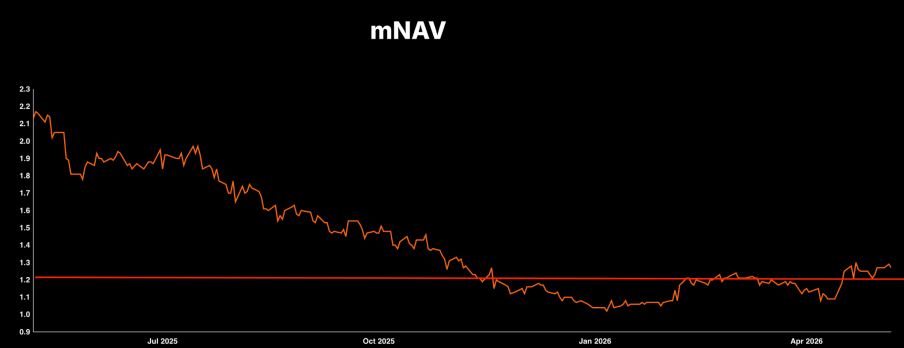
Monitoring Alert: MSTR’s premium is currently oscillating around 1.28x and has not triggered an arbitrage condition—opening a position prematurely would be chasing the move. However, it has now entered an excellent sniper radar zone; set a price alert and act only after a breakdown.
3. The safety cushion for STRC (preferred shares) has significantly improved.
STRC offers a dividend yield of up to 11.5%. In previous bearish scenarios, MicroStrategy was seen as a gambler with extremely high leverage; if Bitcoin experienced a crash of more than 50%, MicroStrategy’s cash flow would collapse, rendering STRC preferred shares instantly worthless.
However, the Q1 earnings report fully exposed the company's true financials, not only refuting the short sellers but also providing reassurance to fixed-income investors:
● Remarkable asset depth: The company has $13.5 billion in preferred shares and $8.2 billion in convertible bonds on its liability side, but its asset side is backed by a massive $64 billion BTC reserve. The net leverage ratio is only a negligible 9%, representing an exceptionally conservative balance sheet by traditional financial standards.
● Extreme Depth Stress Test: Even if the crypto market experiences another crash, with BTC dropping 90% from its current price (falling all the way to $7,300), selling your holdings would still be sufficient to repay all net debts.
● Cash Moat: Even in the worst-case scenario where Bitcoin becomes temporarily illiquid and unsellable, the company still holds $2.25 billion in pure cash on its balance sheet. Simply earning interest on this cash reserve is sufficient to cover debt interest and preferred dividends for the next 1.5 years (at $1.5 billion per year). Overall, as long as BTC rises by just 2.3% annually, STRC’s interest obligations can be fully covered.
The most fundamental expectation reversal is that management has broken the dogma of "never selling Bitcoin." This means they will proactively and gradually sell BTC before an extreme crisis occurs, in order to preserve the company’s credit rating and interest payment capacity. STRC has completely shed the label of "crypto Ponzi high-yield debt," and its risk pricing logic is now aligning with that of high-quality corporate bonds, making it highly likely to attract institutional buying allocations in the future.
4. Impact on the BTC market: Loss of die-hard buyers and removal of the chain reaction of liquidations
The impact of this phone call on market sentiment for BTC spot is dual-sided, and traders should view it by switching timeframes:
● Short-term pain (sentimental bearishness): Retail investors previously viewed MicroStrategy as a mythical "buy-only, never-sell, always supportive" bixie. Now, with management openly acknowledging that they will sell Bitcoin if valuation is off, this directly shatters the bulls' sacred symbol, delivering a significant blow to market bullish sentiment and speculative hype in the short term.
● Long-term bullish catalyst (infrastructure upgrade): Traders with even a basic understanding of market cycles know why the last bear market (2022) was so severe—because giants like LUNA, Three Arrows Capital, and Celsius held on rigidly until their liquidity vanished and they were forcibly liquidated, triggering a cascading wave of fire sales. MicroStrategy is no longer a fervent believer swept up by hype; it has become a seasoned Wall Street player who understands accounting. It has established clear sell-off warning thresholds and knows how to proactively rebalance and reduce leverage at the first signs of crisis. This effectively disarms the largest systemic liquidation bomb hanging over the crypto market.
Summary: MicroStrategy remains the largest "BTC bull commander" in the entire U.S. stock market, but it has evolved from a reckless charge-and-attack warrior into a calculated strategist who knows when to advance or retreat—and even exploits market sentiment in reverse.