





Author: Nikka / WolfDAO (X: @10xWolfdao)
Against the backdrop of the ongoing market correction in the cryptocurrency sector in early 2026 (with BTC hovering around $89,000–90,000 and ETH at approximately $3,200), enterprise-level crypto accumulation strategies have become one of the most significant narratives in the market. This article will analyze the accumulation behaviors of two representative companies, Strategy (formerly MicroStrategy) and Bitmine Immersion Technologies, revealing their strategic differences, financial models, and multidimensional impacts on the market.
Part I: In-depth Analysis of Coin Hoarding Behavior
1.1 Strategy (MSTR): Leveraged Belief Injection
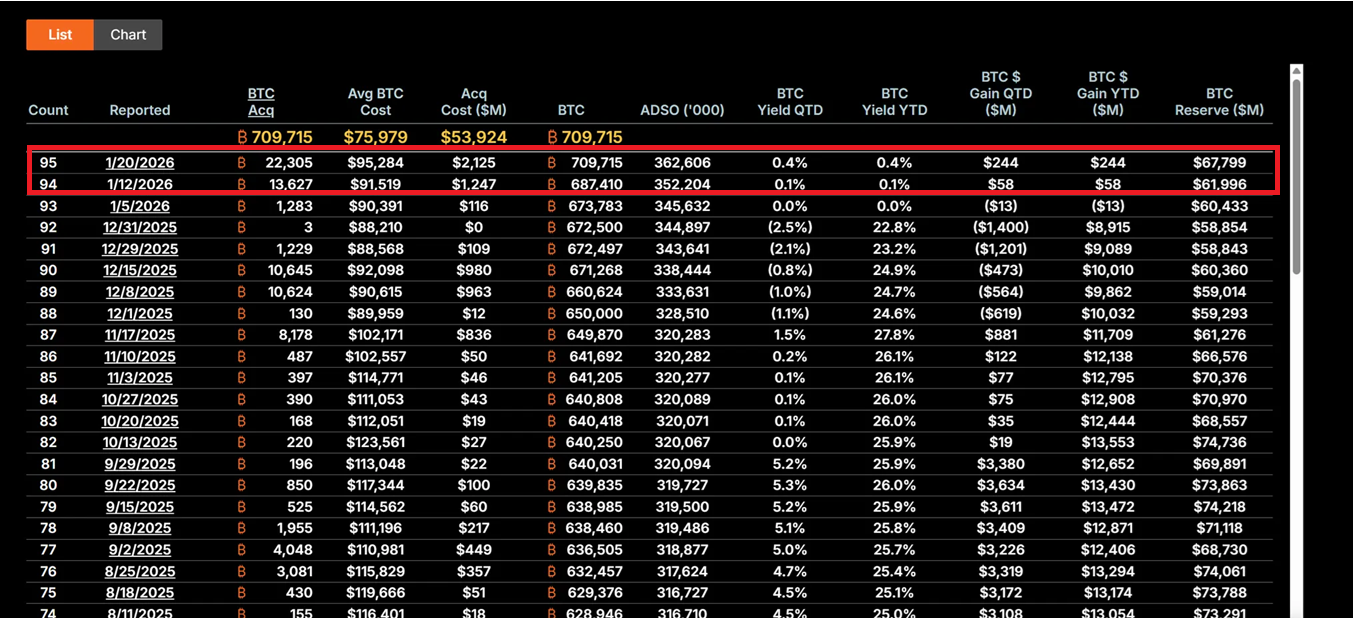
Under CEO Michael Saylor's leadership, MicroStrategy has fully transformed the company into a Bitcoin holding vehicle. From January 12 to 19, 2026, the company purchased 22,305 BTC at an average price of approximately $95,500, totaling $2.13 billion, marking the largest single purchase in the past nine months. To date, MSTR's total Bitcoin holdings amount to 709,715 BTC, with an average cost of $75,979 and a total investment of nearly $53.92 billion.
Its core strategy is built upon the "21/21 Plan," which aims to raise $2.1 billion each through equity financing and fixed-income instruments to continuously purchase Bitcoin. This model does not rely on operating cash flow, but instead leverages the "leverage effect" of capital markets—by issuing stocks, convertible bonds, and ATM (At-The-Market) instruments, it converts fiat currency debt into deflationary digital assets. This strategy makes the MSTR stock price volatility typically 2 to 3 times that of Bitcoin's price fluctuations, positioning it as the most aggressive "BTC proxy" tool in the market.
Saylor's investment philosophy is deeply rooted in an extreme confidence in Bitcoin's scarcity. He views BTC as "digital gold" and a hedge against inflation, and in the current macroeconomic environment of uncertainty—including the Fed's fluctuating interest rate policies, tariff trade wars, and geopolitical risks—this contrarian move to increase positions demonstrates institutional-level long-termism. Even though the company's stock price has pulled back 62% from its peak, MSTR is still considered by value investors as an "extremely discounted" buying opportunity.
If the price of Bitcoin rebounds to $150,000, MicroStrategy's (MSTR) Bitcoin holdings would exceed $106.4 billion, and the stock price could experience 5-10 times leverage-driven elasticity. However, the reverse risk is equally significant: if Bitcoin falls below $80,000, the debt cost (annualized interest rate of 5-7%) could trigger liquidity pressures, forcing the company to adjust its strategy or even face liquidation risks.
1.2 Bitmine Immersion Technologies (BMNR): Staking-Driven Productivity Model
Under Tom Lee's leadership, BMNR has taken a completely different path. The company has positioned itself as the "world's largest Ethereum Treasury company," holding 4.203 million ETH as of January 19, valued at approximately $13.45 billion. More importantly, 1,838,003 ETH is staked, generating roughly $59 million in annual cash flow income at the current 4-5% annualized yield.
This "stake-first" strategy provides BMNR with an inherent value buffer. Unlike MSTR's pure price exposure, BMNR generates ongoing revenue through network participation, similar to holding high-yield bonds but with the added benefit of Ethereum ecosystem growth. The company added staking of 581,920 ETH during Q4 2025 to Q1 2026, demonstrating its continued commitment to the long-term value of the network.
BMNR's ecological expansion strategy is also worth noting. The company plans to launch the MAVAN staking solution in Q1 2026, offering ETH management services to institutional investors and building an "ETH per share" growth model. Additionally, the $200 million investment in Beast Industries on January 15, along with the shareholder-approved share repurchase program, pave the way for potential mergers and acquisitions (such as acquiring small ETH holding companies). The company also holds 193 BTC and a $22 million equity stake in Eightco Holdings, with a total of $14.5 billion in crypto and cash assets.
From a risk management perspective, BMNR's staking yield provides downside protection. Even if the ETH price fluctuates around the $3,000 level, the staking yield can still partially offset the opportunity cost. However, if network activity on the ETH network remains persistently weak, leading to a decline in staking APY, or if the price breaks below key support levels, the company's NAV discount may widen further (the current stock price is approximately $28.85, down more than 50% from its peak).
1.3 Strategy Comparison and Evolution
The two companies represent two typical paradigms of corporate Bitcoin accumulation. MSTR follows an aggressive, high-risk, high-reward leveraged model, entirely relying on Bitcoin's price appreciation to deliver shareholder value. Its success is built on the belief in BTC's long-term supply scarcity and the macroeconomic trend of currency depreciation. In contrast, BMNR adopts a defensive, yield-oriented ecosystem model, generating diversified income through staking and services, thereby reducing reliance on price volatility.
Notably, both have drawn lessons from 2025 and shifted toward more sustainable financing models. MSTR avoids excessive equity dilution, while BMNR reduces reliance on external financing through staking income. This evolution reflects the transition of corporate crypto holdings from "experimental allocations" to "core financial strategies," marking the arrival of a 2026 era defined by "institutional leadership rather than retail FOMO."
II: Multi-dimensional Impact on the Market
2.1 Short-Term Impact: Bottom Signals and Sentiment Recovery
Massive purchases of MSTR are often interpreted by the market as a confirmation signal of a Bitcoin bottom. The $2.13 billion purchase in mid-January drove a single-day inflow of $844 million into Bitcoin ETFs, indicating that institutional capital is flowing back in line with the company's accumulation of Bitcoin. This "corporate anchoring" effect is particularly important during periods of fragile retail confidence—when the Fear & Greed Index indicates "extreme fear," MSTR's continuous buying provides psychological support to the market.
BMNR's Ethereum accumulation also plays a catalytic role. The company's strategy aligns with the optimism of traditional financial giants like BlackRock regarding Ethereum's leading position in the tokenization of RWA (Real-World Assets). This could trigger a "Second Wave of ETH Treasury," as companies like SharpLink Gaming and Bit Digital have already started to follow suit, accelerating staking adoption and the trend of ecosystem mergers and acquisitions.
Investor sentiment is shifting from panic toward cautious optimism. This emotional recovery has self-reinforcing characteristics in the cryptocurrency market and could sow the seeds for the next upward cycle.
2.2 Mid-term Impacts: Amplified Volatility and Narrative Diversification
However, the leveraged nature of corporate Bitcoin holdings also amplifies market risks. MicroStrategy's (MSTR) highly leveraged model could potentially trigger a chain reaction if Bitcoin experiences further pullbacks. Since its stock beta is more than twice that of Bitcoin, any price decline would be magnified, potentially leading to passive selling or a liquidity crisis. This "leverage transmission" effect previously triggered a similar wave of liquidations in 2025, when multiple leveraged holders were forced to close positions rapidly amid a sharp price drop.
Although BMNR has the buffer of staking rewards, it also faces challenges. Low activity on the Ethereum network could lead to a decline in staking APY, weakening its advantage as a "productive asset." Additionally, if the ETH/BTC ratio remains weak, it may exacerbate BMNR's NAV discount, creating a negative feedback loop.
A deeper impact lies in narrative differentiation. MicroStrategy (MSTR) has reinforced Bitcoin's positioning as a "scarce safe-haven asset," attracting conservative investors seeking macroeconomic hedging. Meanwhile, the Bank of the Brave (BMNR) promotes Ethereum's narrative as a "productivity platform," emphasizing its application value in DeFi, staking, and tokenization. This differentiation could lead to BTC and ETH exhibiting divergent performances in different macroeconomic scenarios—for example, in a liquidity-tightening environment, BTC might outperform due to its "digital gold" characteristics; whereas in a technology innovation cycle, ETH could gain a premium due to its ecosystem expansion.
2.3 Long-term Impact: Restructuring of Financial Paradigms and Regulatory Adaptation
From a long-term perspective, the actions of MSTR and BMNR may reshape corporate financial management paradigms. If the U.S. CLARITY Act is successfully implemented, clearly defining the accounting treatment and regulatory classification of digital assets, it could significantly reduce compliance costs for companies allocating cryptocurrency assets. This legislation might drive Fortune 500 companies to hold over $1 trillion in digital assets, shifting corporate balance sheets from the traditional "cash + bonds" portfolio toward "digital productivity assets."
MSTR has become a textbook case of a "BTC proxy," where its market capitalization trades at a premium to its net asset value (NAV). This premium mechanism is known as a "reflector flywheel"—issuing new shares at a premium to buy more Bitcoin, increasing BTC holdings per share, which in turn drives up the stock price, creating a positive feedback loop. BMNR, on the other hand, provides a replicable blueprint for an ETH Treasury, demonstrating how staking rewards can generate continuous value for shareholders.
This could also trigger a wave of industry consolidation. BMNR has received shareholder approval to expand its share repurchase program for potential mergers and acquisitions, possibly acquiring small ETH-holding companies to form "treasury giants." Weaker coin-holding firms may be forced to sell or merge under macroeconomic pressures, leading the market toward a "survival of the fittest" dynamic. This marks a structural shift in the crypto market from "retail-driven" to "institutional-driven."
However, this process is not without risks. If the regulatory environment deteriorates (e.g., the SEC takes a hardline stance on the classification of digital assets) or if macroeconomic conditions unexpectedly worsen (e.g., the Fed raises interest rates due to a resurgence in inflation), corporate coin holdings could shift from being a "paradigm shift" to a "leverage trap." Historically, similar financial innovations have often led to systemic crises when faced with regulatory crackdowns or market reversals.
Three: Core Issue Discussion
3.1 Corporate Coin Hoarding: A New Golden Age or a Leverage Bubble?
The answer to this question depends on the perspective and the time horizon. From the perspective of institutional investors, corporate coin hoarding represents a rational evolution of capital allocation. Against the backdrop of global debt expansion and increasing concerns about currency depreciation, allocating a portion of assets into scarce digital assets holds strategic rationale. MicroStrategy's "smart leverage" is not gambling, but rather utilizing capital market instruments to convert equity premiums into digital asset accumulation. This approach is sustainable when equity markets fully recognize and support the strategy.
BMNR's staking model further demonstrates the "productive" nature of digital assets. The annualized staking rewards of $59 million not only provide a cash flow but also enable the company to maintain financial stability amid price fluctuations. This is similar to holding high-yield bonds, but with the added benefit of network growth dividends, showcasing the potential of crypto assets to go beyond being mere speculative tools.
However, critics' concerns are not entirely unfounded. The current leverage ratio of corporate Bitcoin holdings is indeed at a historically high level. The scale of $9.48 billion in debt and $3.35 billion in preferred equity financing could become a burden under macroeconomic headwinds. The lessons from the retail Bitcoin bubble in 2021 are still fresh in our memory—many highly leveraged participants were severely impacted during the rapid deleveraging at that time. If the current wave of corporate Bitcoin accumulation merely shifts leverage from retail investors to the corporate level without fundamentally altering the risk structure, the eventual outcome could be equally severe.
A more balanced perspective is that corporate accumulation of cryptocurrency is in an "institutional transition phase." This is neither a simple bubble (as it has fundamental support and long-term logic) nor an immediate golden age (as regulatory, macroeconomic, and technological risks still exist). The key lies in execution—can sufficient market acceptance be established before regulatory clarity emerges? Can financial discipline be maintained under macroeconomic pressures? Can technological and ecosystem innovation demonstrate the long-term value of digital assets?
Conclusion and Outlook
MSTR and BMNR's coin accumulation behaviors signify the crypto market entering a new phase. This is no longer a retail-driven speculative frenzy, but a rational allocation based on long-term strategies by institutional players. Although the two companies have taken distinctly different approaches—MSTR's leveraged belief injection and BMNR's staking-driven productivity model—they both demonstrate a commitment to the long-term value of digital assets.
Corporate coin hoarding is essentially a high-stakes gamble about "time."It is betting that regulatory clarity will arrive faster than liquidity dries up, that price increases will precede debt maturities, and that market faith will outweigh macroeconomic headwinds. This game allows no middle ground—it must either prove that digital asset allocation is a paradigm revolution in 21st-century corporate finance or become yet another cautionary tale of excessive financialization.
The market now stands at a crossroads. To the left lies a mature market dominated by institutions, and to the right lies the abyss of leveraged collapse. The answer will reveal itself within the next 12 to 24 months, and we are all witnesses to this experiment.