





On April 3, multiple foreign media outlets, including the Financial Times, cited informed sources claiming that Amazon's data center in Bahrain was hit by a missile.
The day before the attack, entities and related assets in the Middle East operated by Silicon Valley giants—including 18 U.S. companies such as Microsoft, Apple, Google, and Meta—were warned of the risk.
In early March, two other Amazon data centers in Bahrain and the UAE were also attacked.
A hyper-scale data center targeted in armed conflict becomes a highly attractive strategic target—according to publicly available data, the total investment for a 1 GW data center exceeds $50 billion.
It is important to note that the destruction of a data center involves not only physical damage and the loss of hundreds of billions of dollars in assets, but, as critical infrastructure, such an attack could also impact the internet and artificial intelligence development trajectory of a nation or region.
Your order has gone offline.
The data center was destroyed, resulting in an immediate interruption of related services.
In early March, two of Amazon UAE's three AWS data center "availability zones" went offline simultaneously during the first attack, causing widespread disruption to local internet services.
Online services of Abu Dhabi Commercial Bank and Emirates National Bank were disrupted, the payment platform Hubpay became unavailable, and the food delivery app Careem went offline. Millions of users who rely on these digital services found their wallets, ride-hailing apps, and business operations inaccessible due to the data center outage.
Although AWS has always emphasized that its data centers are designed with redundancy—so that if one facility fails, a backup automatically takes over—this time, multiple facilities were hit simultaneously, and the redundancy mechanism largely failed to function.
It is worth noting that physical damage includes building structural collapse, power outages, fires, and secondary water damage caused by fire suppression systems. Amazon explains on its service health page that the reconstruction and recovery process for data centers will be "very lengthy," with some services taking weeks to restore.
For operators and owners of data center assets, physical damage directly correlates with financial loss.
Building a traditional data center costs an estimated $70 million to $120 million per MW. In contrast, an AI data center equipped with the latest Blackwell and Rubin chips, along with advanced power and cooling systems, can reach a cost of $50 billion per GW, as previously mentioned.
According to data disclosed by ConstructConnect, a U.S. construction industry analysis firm, in February, the average cost of data centers breaking ground in 2025 is $633 million.
Including the recently attacked data center in Bahrain, the combined direct physical damage, equipment replacement costs, and lost revenue across AWS’s four facilities are conservatively estimated at billions of dollars.
Additionally, Amazon stated in emails to affected users that it would waive their usage fees for March, a move that may also temporarily reduce the company's profits.
Critical infrastructure within range
The loss from a single data center being attacked is negligible compared to the capital expenditures of tech giants.
Public data shows that Amazon, Alphabet, Meta, and Microsoft plan to spend a total of $630 billion in 2026, a 62% increase from $388 billion in 2025, with Amazon alone allocating $200 billion. Approximately 75% of the combined spending—about $450 billion—will be directly dedicated to AI infrastructure.
A significant portion of these funds was originally intended for the Middle East.
From 2021 to 2024, the Middle East has been a popular region for cloud providers' expansion. In early 2025, Saudi Arabia alone secured over $21 billion in committed data center investments.
Among these, Microsoft plans to invest $15.2 billion in the UAE between 2023 and 2029, with $7.3 billion already spent on collaboration with G42 and infrastructure development; Google, in partnership with Saudi Arabia’s Public Investment Fund, has committed $10 billion to establish a global AI hub; Amazon plans to invest an additional $5.3 billion in Saudi Arabia to build a new region featuring an “AI Zone”; and Oracle has invested $1.5 billion to expand its cloud presence in Saudi Arabia, while forming a deep partnership with NVIDIA to support sovereign AI initiatives.
U.S. tech giants are expanding their infrastructure presence in the Middle East, both to align with the region’s AI development plans and to court Middle Eastern capital, such as Gulf sovereign wealth funds.
Trump is also actively promoting the expansion of U.S. data centers in the Middle East.
In May 2025, Trump, accompanied by Amazon CEO Andy Jassy, OpenAI CEO Sam Altman, and other tech industry leaders, traveled to the Middle East in an effort to secure over $2 trillion in data center investment commitments through a vision of “turning chaos into commerce.”
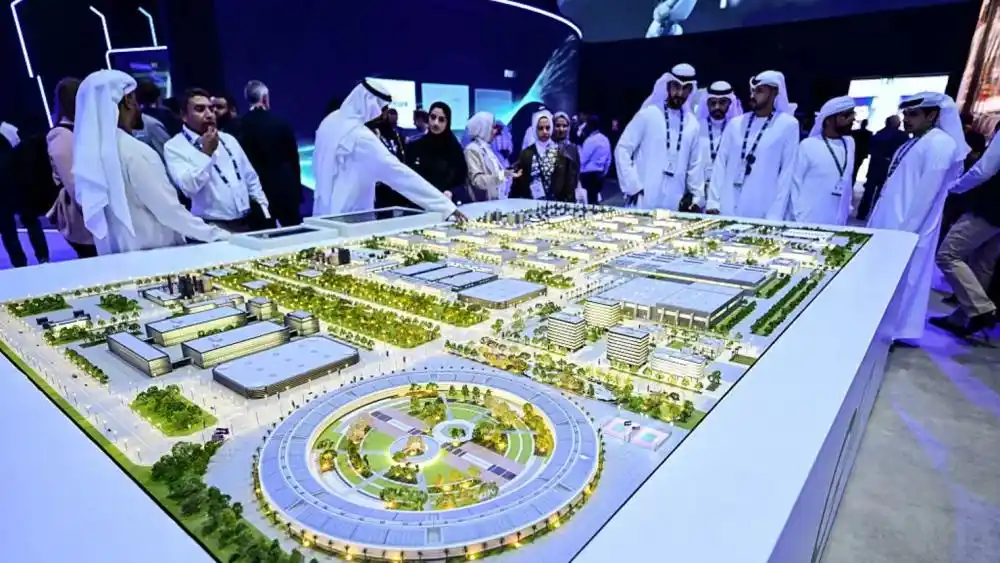
The largest under-construction data center model in the UAE is part of the Middle East's version of the "Stargate Project."
The most notable among these is the "Stargate" ultra-large-scale AI data center project in Abu Dhabi, which aims to leverage the Middle East’s low-cost energy and land to build the largest AI infrastructure outside the United States.
When data centers are assigned such high strategic value, they inevitably become targets for attack.
Ioannis Kalpouzos, a visiting professor at Harvard Law School, believes whether a data center should be a target of attack depends on the facts at the time of the incident, not its past use.
Karpuzos explained: "If this facility is currently used to train large language models with strategic value—such as through fine-tuning to optimize specific functions—it could potentially become a target."
This "dual-use" characteristic has transformed data centers from quiet electricity consumers into strategic chokepoints. This means that future data centers will need more than just security personnel and fencing—they will require specialized defense systems and counter-drone technologies.
As Professor Vili Lehdonvirta of Aalto University stated, as state power increasingly incorporates commercial cloud and AI into strategic operations, adversaries will view them as critical infrastructure. This renders data centers legally “transparent” and vulnerable, making the entire physical entity potentially a legitimate target under international law once it is deemed to have effectively enhanced an adversary’s strategic capabilities.
03 Middle East computing power faces uncertainty
After the attack on Amazon's data centers, will computing power prices rise? The short-term impact is limited.
According to Knight Frank's previously released "Global Data Center Report 2024-2025," despite the Middle East—particularly the Gulf nations—possessing substantial capital and energy advantages, it currently accounts for only about 1% of the global share of commissioned third-party data center capacity.
In other words, the current losses are not sufficient to cause a fundamental impact on global hash rate supply.
Meanwhile, on its Amazon Services Health page, the company encouraged users to migrate part of their load to servers in Europe, North America, and the Asia-Pacific region to help alleviate some of the pressure caused by the regional outage.
However, in the medium to long term, hash rate prices do face upward pressure, primarily from three sources.
The top item is physical defense costs, which we won't elaborate on here.
The second is multi-region backup. In the context of armed conflict, redundancy within a single geographic region is no longer sufficient to mitigate risk. If businesses are forced to adopt disaster recovery solutions that span regions or even continents, the cost of using cloud services will rise significantly.
The third is energy and insurance costs. Energy accounts for approximately 60% of data center operating expenses. Conflicts in the Middle East can drive up oil and natural gas prices, and fluctuations in liquefied natural gas prices are directly reflected in electricity bills. Meanwhile, insurance premiums for data centers in high-risk regions may also increase.
Alok Mehta, Director of the Center for Strategic and International Studies, said: This attack has changed how companies think about security. To maintain business continuity, enterprises have had to adopt more expensive backup solutions—this investment in "digital resilience" is essentially an implicit cost increase in computing power.
Notably, Knight Frank also forecasts in the report that by 2030, the data center capacity in the Middle East is expected to triple to 3.3 GW or higher, and the greater the capacity, the more significantly the potential losses from an attack will increase.
Although market participants remain optimistic about future growth, the risk of conflict may alter the investment models of data center investors, leading to more stringent cost-benefit evaluations for future incremental investments.
According to Patrick J. Murphy, Executive Director of the Geopolitical Division at Hilco Global, and others, the next wave of computing power construction may shift toward regions with more predictable security conditions.
04 Final Thoughts
Data centers in the UAE to Bahrain, targeted multiple times within a month as civilian facilities, are linked to their critical infrastructure status.
Across various data centers, nearly everything—from personal daily applications to business systems—is hosted; when these facilities are attacked, the economy, daily life, and all industries, groups, and services that rely on them are directly affected.
To some extent, the complex geopolitical environment has taught tech companies a lesson—while investing hundreds of billions of dollars to expand computing infrastructure, they must also reassess the underlying physical security costs, which may soon surpass the value of the chips themselves.
On this topic, I thought of Musk’s previously promoted space-based data centers and Microsoft’s underwater data centers—ignoring feasibility and construction timelines, are these unconventional approaches the optimal solution to security concerns?
The answer could also be no.
This article is from the WeChat public account "Tencent Technology," authored by: Worth Noting