





Micron Stock vs. SanDisk Stock: One Is a Much Better Buy, According to a Wall Street Analyst
Original author: Trevor Jennewine, The Motley Fool
Peggy, BlockBeats
Editor’s Note: The U.S. stock storage sector is becoming the latest star in AI trading.
This week, stock prices of memory chip companies such as Micron and SanDisk continued to surge. Micron rose approximately 11% in a single day, with its market capitalization surpassing $700 billion for the first time; SanDisk gained about 12%, and since its spin-off from Western Digital in 2025, its market cap has also exceeded $200 billion. Over the past year, market pricing focus on AI has further expanded from GPUs, cloud providers, and large model companies to the underlying storage supply chain.
Behind this rally is not just the spillover effect of the "AI concept," but a fundamental transformation in data center architecture. AI training and inference require storage systems with higher speed, greater capacity, and lower latency: HBM delivers data and models to GPUs at extremely high speeds, while NAND SSDs provide the storage support needed for training data, model files, and inference operations. As the competition for computing power enters the stage of system-level engineering, storage is no longer merely a cyclical supporting component in the semiconductor supply chain—it has become a critical factor influencing the efficiency, cost, and scalability of AI infrastructure.
Micron and SanDisk, the focus of this article, occupy two critical positions in this storage chain. Micron’s key focus lies in DRAM and HBM, particularly in their role of enabling high-bandwidth data transfer in AI servers. SanDisk’s strength is concentrated in NAND flash and enterprise-grade SSDs, and it gains cost competitiveness through its collaboration with Kioxia. SanDisk’s development of High-Bandwidth Flash (HBF) also reflects storage manufacturers’ efforts to address the mismatch between GPU speed and storage bandwidth.
But what’s more noteworthy is not how much these two companies’ stock prices have risen, but how capital markets are reevaluating the value of “storage.” In the past, the memory chip industry was highly cyclical, with price increases often signaling future supply expansion and subsequent price declines. However, amid sustained growth in AI demand, investors are now betting that this cycle may be extended—or even fundamentally alter the traditional dynamics of supply and demand. IDC’s latest report also suggests that AI demand could propel the memory chip market into a phase unlike any seen before.
The risks are equally clear. Historical patterns in the storage industry have never disappeared: today’s shortages can easily become tomorrow’s surpluses after capacity expansion. Once DRAM and NAND prices decline, Micron and SanDisk’s earnings elasticity will amplify in reverse. Therefore, what this article truly discusses is not “how much higher AI storage stocks can rise,” but rather how investors can distinguish between growth driven by genuine demand and growth that has already been priced into stock valuations amid the reevaluation of AI infrastructure and the semiconductor cycle.
This is also the core contradiction in the current storage sector. AI is positioning memory chips as strategic assets, yet this business still cannot fully escape cyclical fluctuations. The rise in Micron and SanDisk’s stock prices is both a result of expanding AI infrastructure and a concentrated market bet on a “memory supercycle.”
The following is the original text:
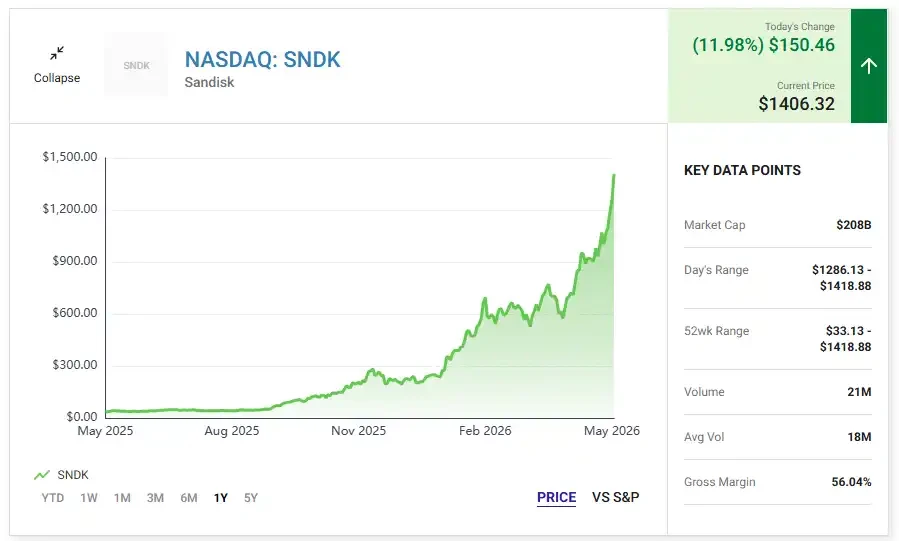
The rapid adoption of artificial intelligence (AI) has significantly driven growth for memory chip manufacturers Micron Technology (MU, +10.95%) and SanDisk (SNDK, +11.98%). Over the past year, the stock prices of these two companies have risen by 571% and 3,350%, respectively.
Despite the significant rise in stock prices, Cantor Fitzgerald analyst CJ Muse still believes both stocks are currently undervalued. However, based on his target prices, SanDisk appears to be the more attractive investment at this time.
Muse set Micron’s price target at $700 per share, implying a 29% upside from the current stock price of $542.
Muse set a price target of $1,800 per share for SanDisk, implying a 52% upside from the current stock price of $1,187.
Here are the two semiconductor stocks that investors need to know about.
Micron Technology: 29% implied upside
Micron Technology primarily produces memory chips and storage products for smartphones, personal computers, automotive systems, and data centers. According to Counterpoint Research, Micron is the world's third-largest DRAM memory supplier, with products including High Bandwidth Memory (HBM) and NAND flash memory.
Data centers optimized for artificial intelligence have far higher storage demands than traditional data centers. This surging demand, nearly outstripping supply, has caused an unprecedented shortage across the industry. According to The Wall Street Journal, contract prices for DRAM and NAND have risen approximately sevenfold over the past year.
Micron delivered an outstanding performance in its second-quarter earnings. The company's revenue increased by 196% to $23.8 billion; non-GAAP (adjusted) net profit surged by 682%, with diluted earnings per share reaching $12.20. CEO Sanjay Mehrotra stated, "AI is not only driving increased demand for memory, but is fundamentally reshaping the role of memory, making it a decisive strategic asset in the AI era."
Investors have reason to remain optimistic. HBM is critical for AI workloads because it can transmit data and models to GPUs at extremely high speeds. Over the past year, Micron’s market share in the HBM sector increased by 12 percentage points, and the company is likely to continue gaining share, as its HBM3E is currently the fastest and highest-capacity HBM product on the market.
However, it’s important to note that sales of memory chips have historically been highly cyclical. The industry is currently in an upswing, but historical patterns show that supply shortages often eventually give way to oversupply. At that point, memory prices and Micron’s profitability are likely to decline. Wall Street expects this trend to reverse around fiscal year 2029, but in reality, no one can accurately predict when the current cycle will peak.
According to Wall Street consensus estimates, Micron’s adjusted earnings per share are expected to grow at an annual rate of 13% over the next several years through fiscal year 2029. Given this outlook, the current valuation of 25 times earnings appears somewhat rich. I believe investors would be wise to wait for a better entry point before buying Micron stock—or at the very least, limit new positions to a relatively small size.
SanDisk: Implies a 52% upside potential
SanDisk primarily develops storage devices based on NAND flash memory. Its product portfolio includes external and embedded flash drives for mobile devices, gaming consoles, and automotive systems, as well as enterprise-grade solid-state drives (SSDs) for data centers.
NAND-based SSDs are a critical component in the storage hierarchy required to support AI workloads, responsible for storing training data and models until they are loaded into HBM. SanDisk is increasing its market share in the NAND storage market, partly due to its joint venture with Japanese manufacturer Kioxia. This partnership enables SanDisk to access low-cost wafers, maintaining price competitiveness.
SanDisk announced impressive financial results for the third quarter of fiscal year 2026 (ended in March). Driven by particularly strong demand for data center storage solutions, the company's revenue increased 251% to $5.9 billion; non-GAAP net profit rose to $23.41 per diluted share, compared to a diluted loss of $0.30 per share in the same period last year.
CEO David Goeckeler said: "NAND flash is increasingly becoming the only economically viable solution capable of delivering the capacity, performance, and efficiency required for large-scale real-time inference, keeping models accessible. The market’s renewed recognition of the critical importance of our technology coincides precisely with the stage where our product’s differentiated advantages are strongest."
SanDisk is designing a new type of NAND called High Bandwidth Flash (HBF) to bridge the performance gap between GPU speed and storage bandwidth. HBF will enable faster loading of data and models into HBM. SanDisk announced this technology last year and plans to begin providing HBF storage samples in the second half of this year.
Wall Street expects SanDisk's adjusted earnings to grow rapidly through fiscal year 2028, followed by a significant decline in fiscal year 2029. Even so, consensus estimates still show the company's earnings growing at an annual rate of 25% over this period. Given this, the current valuation of 38 times adjusted P/E remains reasonable. I believe CJ Muse's assessment that SanDisk is a better buy at current prices is well-founded.
Is Micron Technology an opportunity to build generational wealth?
Before buying Micron Technology stock, consider this: The Motley Fool Stock Advisor team has just identified the 10 stocks they believe are the most worthwhile buys for investors right now—and Micron Technology is not among them. Generational wealth is rarely built on bets about a single hot stock, but rather on a resilient, well-diversified portfolio that can compound growth over decades. If your goal is to truly build generational wealth, you’ll want to see the 10 stocks our analysts believe are the best buys right now.
Historically, Netflix joined this list on December 17, 2004. If you had invested $1,000 based on our recommendation at that time, it would now be worth $490,864. Similarly, NVIDIA joined this list on April 15, 2005—investing $1,000 then would now be worth $1,216,789. This is the power of identifying a select few winners with long-term potential and letting compounding work over time.
To date, Stock Advisor has delivered an average total return of 963%, significantly outperforming the S&P 500’s 201% return over the same period. If your goal is to begin building lasting intergenerational wealth, don’t miss Stock Advisor’s newly released list of the top ten stocks and take the next step toward creating an investment portfolio that can benefit you and your family for years to come.