





13.5 billion dollars, this is Meta (META.M) the amount of money planned to be spent in 2026.
The double beat on the Q4 2025 performance and the Q1 2026 guidance brought relief to many shareholders who had been struggling with doubts about "falling behind." However, at the same time, the full-year 2026 capital expenditure (CapEx) is surging toward $135 billion, nearly double that of last year, which makes it hard not to worry—could this be another aggressive gamble?
However, surprisingly,The market appears to have bought the story, as Meta's stock surged more than 10% after hours, and continued to rise in the overnight session.
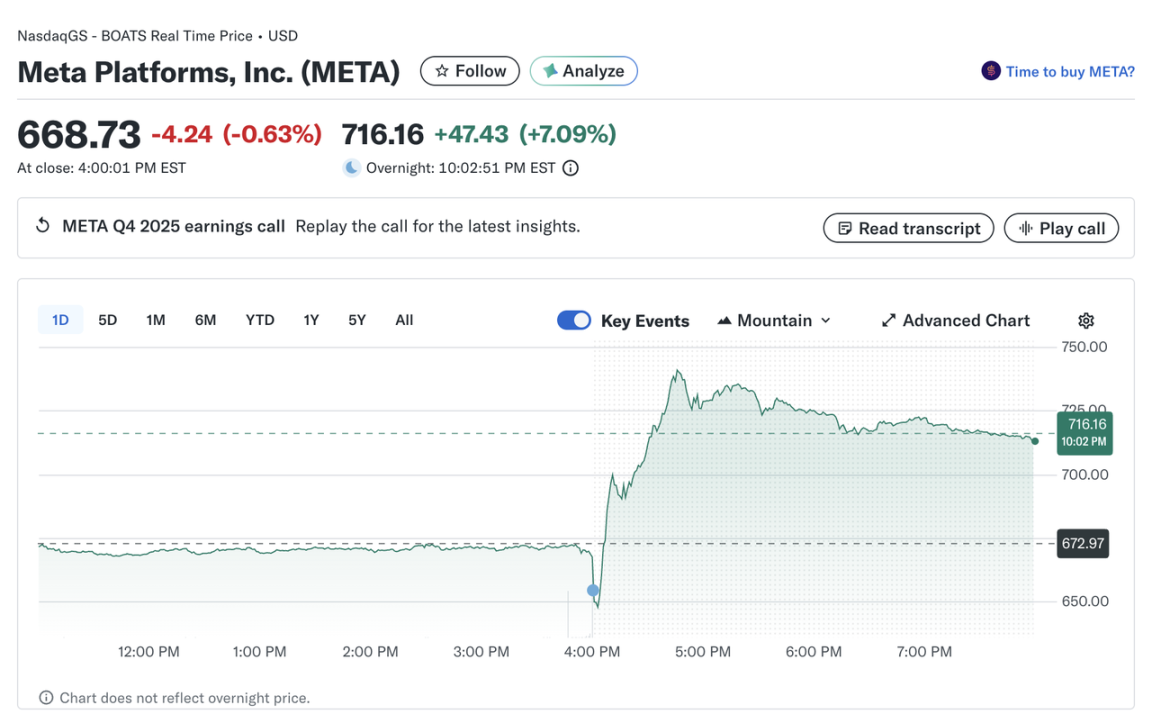
Meta Stock Price Data Source: Yahoo Finance
And the answer is hidden in this earnings report: at least for now, it has shown the market that AI investments are not just future visions but have already concretely improved Meta's most core cash cow—its advertising business. As a result, Wall Street has started betting on a narrative reversal for Meta and is willing to pay for this ambitious investment plan.
At the end of the day, "being bold in spending money and going all-in" has always been the core characteristic of Meta and Mark Zuckerberg.This also means that winning could represent a major narrative reversal; losing, at the very least under the current financial structure, would find it difficult to escalate into an uncontrollable disaster.
1. Quick Read of Earnings Report: Performance and Guidance Both Exceed Expectations
From the results, this is an earnings report capable of changing market sentiment.
The core financial metrics for Q4 2025 were almost universally better than expected: revenue reached $59.893 billion, representing a 24% year-over-year increase and exceeding the market's expectation of $58.6 billion; net profit was $22.768 billion, up 9% year-over-year; diluted earnings per share (EPS) stood at $8.88, an 11% year-over-year increase and higher than the market's expectation of $8.23.
It can be said that whether in terms of growth resilience on the revenue side or the pace of profit realization, Meta has delivered a solid and stable Q4 performance.
Extending the perspective to the entire year, the growth logic still holds true: In 2025, the annual revenue reached $200.966 billion, representing a 22% year-over-year increase; operating profit amounted to $83.276 billion, up 20% year-over-year. Key metrics continue to expand at a double-digit rate.
The only figure that appears to be "reversing" is the annual net profit, which amounted to $60.458 billion, a 3% decline compared to the previous year. However, this change does not reflect a deterioration in core operations, but rather stems primarily from one-time tax factors. Specifically, due to the impact of the "Big and Beautiful Act," the company recognized approximately $16 billion in one-time, non-cash income tax expenses.
Excluding this factor, net profit and EPS for the full year would still achieve significant growth, thus explaining the apparent contradiction between the annual figures and the strong quarterly performance.
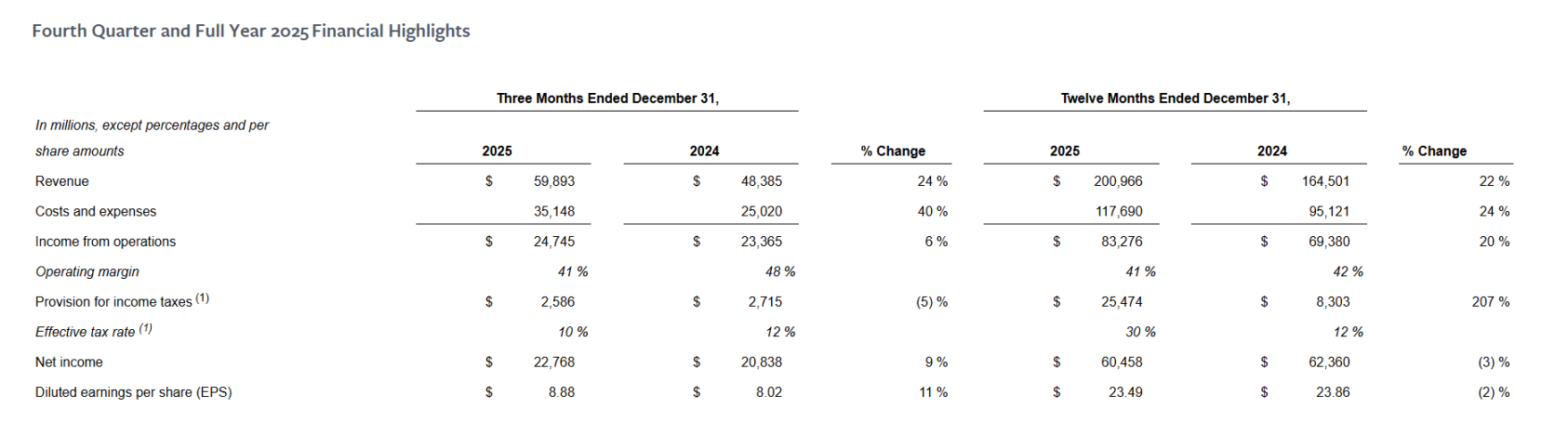
Source: Meta
At the same time, operational metrics also show a typical "increase in both volume and price" trend:
- The family applications' daily active users (DAP) reached 3.58 billion, representing a 7% year-over-year growth, in line with market expectations;
- The number of ad impressions increased by 18% year-over-year; the average price per ad increased by 6% year-over-year;
- The average revenue per user (ARPU) was $16.73, representing a 16% year-over-year growth;
This set of data collectively points to a conclusion, which is that Meta's ad engine is not only not slowing down, but it continues to evolve in terms of efficiency and monetization capabilities.
Moreover, what further stimulated a shift in market sentiment was not only the already delivered, better-than-expected performance, but also the management's optimistic guidance for the future: According to Meta's forecast, first-quarter 2026 revenue is expected to reach $53.5–56.5 billion, representing a year-over-year growth of 26%–34%, significantly higher than the market's previous expectation of around 21% growth. This pricing implies that the management believes the high momentum of Reels will continue, and that the monetization progress of Threads is better than the market's previously cautious expectations.
Against the backdrop of a stable advertising foundation, this guidance has also directly strengthened the market's confidence in the sustained efficiency improvements driven by AI in advertising.
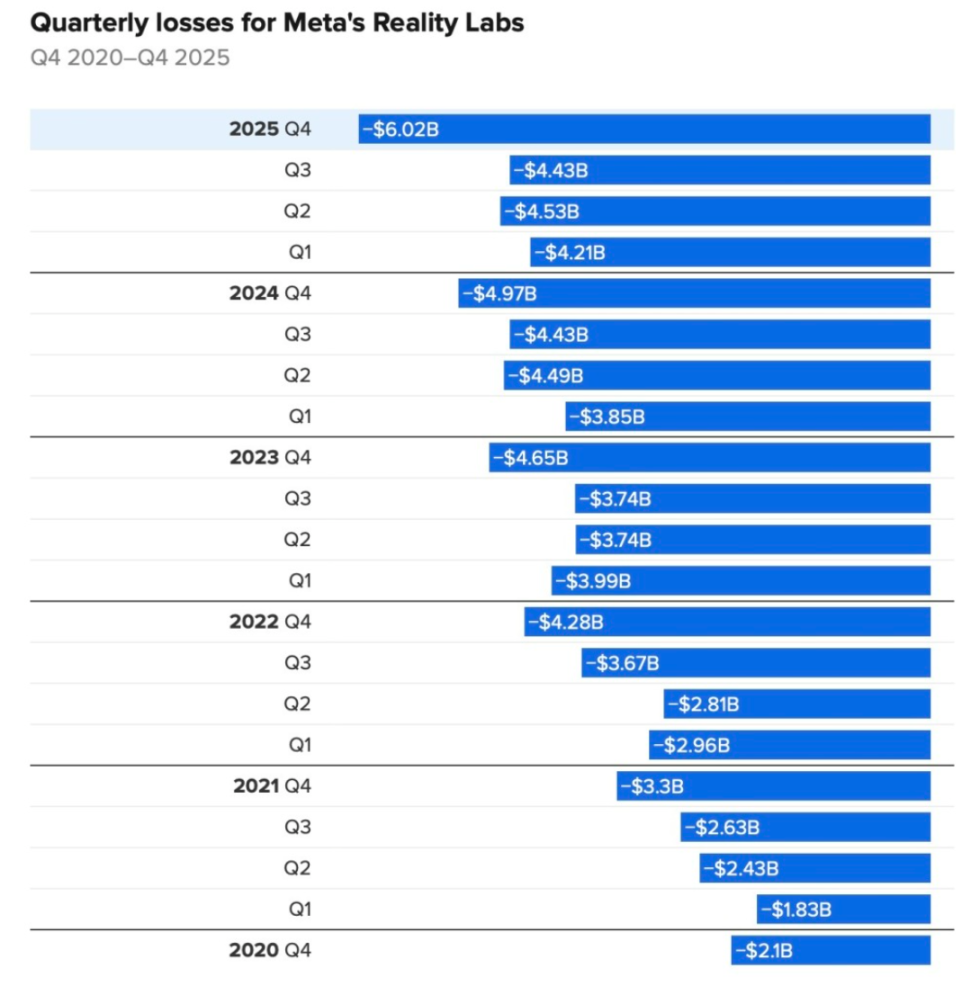
Details of Reality Labs' Five-Year Losses
Of course, it's worth noting that "the Metaverse" remains a cash drain for Meta. Its Metaverse division, Reality Labs, recorded an operating loss of $6.02 billion in Q4, a 21% increase year-over-year, with revenue reaching $955 million, a 13% increase from the same period. Since the end of 2020, the division's cumulative operating losses have approached $80 billion.
However, unlike in the past, the role of Reality Labs in the current earnings report is no longer a core factor shaping the overall company narrative and is gradually being marginalized.
II. Solid Social Foundations, AI Deepens the "Moat"
At least in terms of its core business, AI has indeed already started to drive Meta.META.MCommercialization truly creates value with real money.
It could be said that, to some extent, compared to Google (GOOGL.M is the stock ticker symbol for Alphabet Inc. Class A shares on the NASDAQ) or Microsoft (MSFT.MUnlike others, Meta is currently the most direct player whose "AI investment directly contributes to main operating cash flow" has been verified by financial reports.
First, it is reflected in a systematic improvement in advertising efficiency, which is made possible by AI directly integrated into recommendation systems and ad delivery systems enabled Meta to achieve a 6% year-over-year increase in average price per ad in Q4, along with an 18% surge in impressions.The management has also repeatedly emphasized that the upgrade of the AI recommendation algorithm and the ad delivery system has significantly improved the ad conversion rate and delivery efficiency.
Instagram Reels has seen a year-over-year growth of more than 30% in watch time in the U.S. market, becoming a core engine for driving ad inventory and monetization capabilities.
Secondly, the accelerated commercialization of WhatsApp,Meta plans to fully introduce ads into WhatsApp Stories this year, which is seen as the company's next potential billion-dollar revenue growth opportunity.It is also a key step for AI recommendation and advertising systems to expand into more traffic scenarios.
Overall, despite ongoing external competition from platforms like TikTok, Meta's core social media business has not weakened. Instead, by deeply integrating AI into its recommendation and advertising systems, Meta has further deepened its moat.
Source: Meta
Looking back at the past year, Meta's moves in the AI direction have been nothing short of aggressive—ranging from spending over $10 billion to acquire equity in Scale AI and bringing in Alexandr Wang to lead the "Meta Super AI Lab (MSL)," to continuously offering high salaries to recruit top talent and restructuring its AI organization. Additionally, Meta has invested hundreds of millions to acquire Manus, launched Meta Compute, and plans to build tens of GW-level computing and power infrastructure within this decade.
This series of moves has led many to recall a familiar storyline: aggressive investment, grand narratives, and long return cycles. In other words, it seems we are once again seeing a "Zuckerberg of the metaverse era."
But unlike the metaverse era, this time the management has provided a clear floor expectation, stating thatEven with a significant increase in infrastructure investment, the operating profit in 2026 will still be higher than that in 2025.Moreover, the cost growth path for the significant investment in 2026 is highly transparent, primarily focusing on computing power, depreciation, third-party cloud services, and high-end technical talent.
In short, within Meta's strategic framework, AI is not merely a narrative for betting on the future, but a practical tool that is continuously improving its core cash flow. The logic is not complicated: once AI is deeply integrated into recommendation systems and ad delivery systems, even a very slight marginal improvement can have significant impacts, such asIf it can make 3.6 billion users spend just a few more seconds each day or increase ad conversion rates by 1%, this would be quickly amplified into significant and repeatable incremental cash flows, given Meta's current traffic scale and existing base of advertisements.
It is precisely under this high-leverage structure that the efficiency gains brought by AI are genuinely offsetting, and even surpassing, Meta's annual capital expenditures of up to $135 billion. In other words, Wall Street is no longer afraid of Meta's spending, partly because it has already seen the tangible financial benefits generated by AI.
Interestingly, from a broader perspective, in this AI arms race in Silicon Valley,In addition to the mainstream approach of exporting computing power, models, and tools to the world and "selling shovels and tools" to others, there is another approach: the Meta model.— Integrate AI as the core of your business system, directly amplifying your existing traffic and monetization engines.
It is precisely this model—relying not on selling new products externally, but instead achieving returns by improving its own monetization efficiency—that makes Meta's path of AI investment clearly distinct from the monetization logic of other major tech companies, which centers around large models or cloud services. As a result, the market has begun to reassess Meta's valuation fundamentals:
AI here is not a long-term story waiting to be realized, but rather a tangible variable that is already continuously and quantifiably contributing to the main operating cash flow through the advertising system.
This might also be the fundamental reason why the market is willing to revalue Meta.
III. All-in Gambling, A War That Cannot Be Lost?
"Superintelligence" has become one of the most frequently mentioned keywords by Mark Zuckerberg and the Meta leadership.
During this earnings call, Zuckerberg showed no hesitation in expressing his ambitions: "I look forward to advancing a personal super intelligence for users around the globe," which has become a long-term strategy for Meta encompassing talent, computing power, and infrastructure.
First, in terms of capital expenditures, as mentioned above, Meta has launched an all-out aggressive investment. Its total operating expenses for the entire year of 2026 will reach $162 billion to $169 billion, representing a year-over-year increase of 37% to 44%. This is significantly higher than the previous market buy-side's expected range of approximately $150 billion to $160 billion.
At the same time, Meta is sending a "trade-off signal" to the market through its actions. This month, the media revealed that the company plans to cut another 10% of its Reality Labs workforce, affecting approximately 1,500 employees. This indicates that its metaverse-related business is being further scaled back to reallocate resources toward AI and core business areas.
More strategically significant is Meta's reclassification of computing power and infrastructure. On January 12, Mark Zuckerberg personally posted, stating that he had "launched a new top-tier strategic initiative called Meta Compute." According to the disclosed information,Meta plans to invest at least $60 billion cumulatively in data centers and related infrastructure in the United States by 2028.
However, Meta's Chief Financial Officer, Susan Li, later clarified this figure, stating that the investment was not solely for purchasing AI servers, but also covered the construction of domestic U.S. data centers, computational and power infrastructure, as well as the additional staff and related costs required to support business operations in the United States.

Objectively speaking, in terms of talent density, computing power scale, or infrastructure intensity, Meta's investment in AI is already on par with, and in some aspects even exceeds, that of its main competitors.
Of course, this path is also naturally a double-edged sword.Once revenue growth, advertising efficiency, or progress on new models can no longer outpace cost expansion, market tolerance will quickly decline, and both valuation and profit expectations may face backlash.
In other words, this is not an experiment that allows for repeated trial and error, but rather a strategic battle where once the arrow is drawn, it is difficult to turn back.
Final Words
As early as a blog episode in September 2025, Mark Zuckerberg openly stated that it would certainly be unfortunate if tens of billions of dollars ultimately turned out to be wasted. However, on the other hand, the risk to Meta of falling behind in the AI wave could be even greater.
"For Meta, the real risk is not whether the investment is too aggressive, but whether it will hesitate at critical moments."These words, placed in today's context, can almost be seen as a commentary on Meta's strategic moves over the past year.
Of course, history is not easily forgotten. In the previous metaverse narrative, Zuckerberg made the same choice to bet early and push forward with full force, but the final outcome did not meet the market's initial expectations.
The difference is that,This time, Meta holds the world's densest and most commercially viable user traffic entry point. Meanwhile, AI is reshaping, in unprecedented ways, the efficiency of connections between people and content, as well as between people and commerce.
As for the 13.5 billion dollars, whether it represents a historically significant strategic move or another costly lesson, the answer will still require time to reveal.