



Author | Azuma (@azuma_eth)

Reuters reported exclusively on April 18 that, according to three knowledgeable sources, Zuckerberg's Meta plans to launch its first round of major layoffs on May 20, with further layoffs to follow.
A person familiar with the matter said Meta will cut approximately 10% of its global workforce—around 8,000 people out of a total of about 79,000 employees—in its first round of layoffs. Another person familiar with the situation said Meta also plans to conduct additional layoffs in the second half of this year, though the timing and scale have not yet been finalized; Meta’s leadership may adjust the plan as it continues to monitor advancements in AI capabilities.
In another report by Reuters last month, insiders also revealed that Meta was considering layoffs of 20% or more.
As of publication, Meta has declined to comment on the timing and scale of the layoffs.
10 days ago, Meta just caught up with the AI mainstream.
Just 10 days ago, Meta’s AI development team, Superintelligence Labs (MSL), led by the highly recruited Chinese prodigy Alexandr Wang, launched its first self-developed AI model, Muse Spark.
Alexandr Wang disclosed that over the past nine months, MSL has rebuilt its entire AI technology stack from scratch. Muse Spark is a native multimodal reasoning model that supports tool calling, visual chain of thought, and multi-agent orchestration. It is the most powerful model Meta has ever released. During training, MSL observed predictable scaling improvements across pre-training, reinforcement learning, and inference during testing.
Muse Spark also supports Contemplating Mode, which orchestrates multiple parallel reasoning agents specifically designed to handle complex scientific problems and reasoning tasks. In testing, MSL found its performance competitive with state-of-the-art reasoning models such as Gemini Deep Think and GPT Pro.
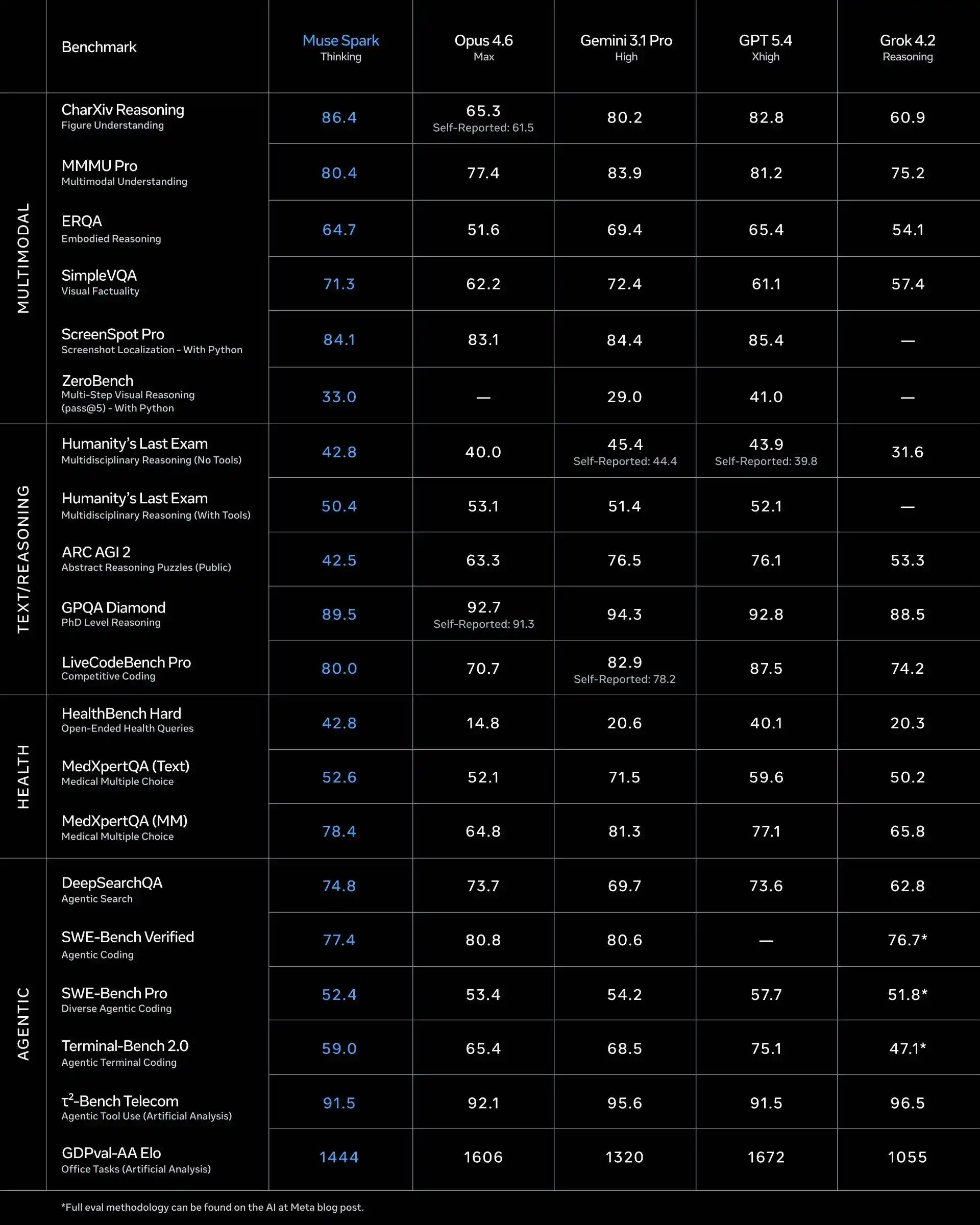
As Meta’s first tangible product launched after heavily betting on AI and shifting to a closed-source model, Muse Spark is widely regarded by the market as the beginning of Meta’s pursuit of the top tier of AI companies such as Anthropic, OpenAI, and Google. Although Meta acknowledges that this model still lags behind the flagship models of the top three companies in certain capabilities, for Zuckerberg, who long fell behind in the AI race due to the setbacks of the Llama strategy, Muse Spark and its upcoming series of models are sufficient to reestablish his position at the AI table.
The market has also responded positively to Muse Spark; on that day, Meta closed at $612.42, up 6.5%, and continued to rise over the following 10 days (also influenced by the overall market uptrend), with yesterday’s closing price reaching $688.55.
The AI blade fell first on the employees
From the end of 2022 to the beginning of 2023, Meta launched the controversial "Year of Efficiency" initiative, carrying out its largest workforce reduction in company history, eliminating approximately 21,000 positions. This round is likely to become Meta’s largest layoff since the "Year of Efficiency."
Compared to the "Year of Efficiency," Meta previously faced significant stock price declines and adjustment pressures following overgrowth during the pandemic. Today, Meta is clearly in a stronger financial position, but its executives envision a future organization with fewer management layers and AI-augmented employees driving greater efficiency.
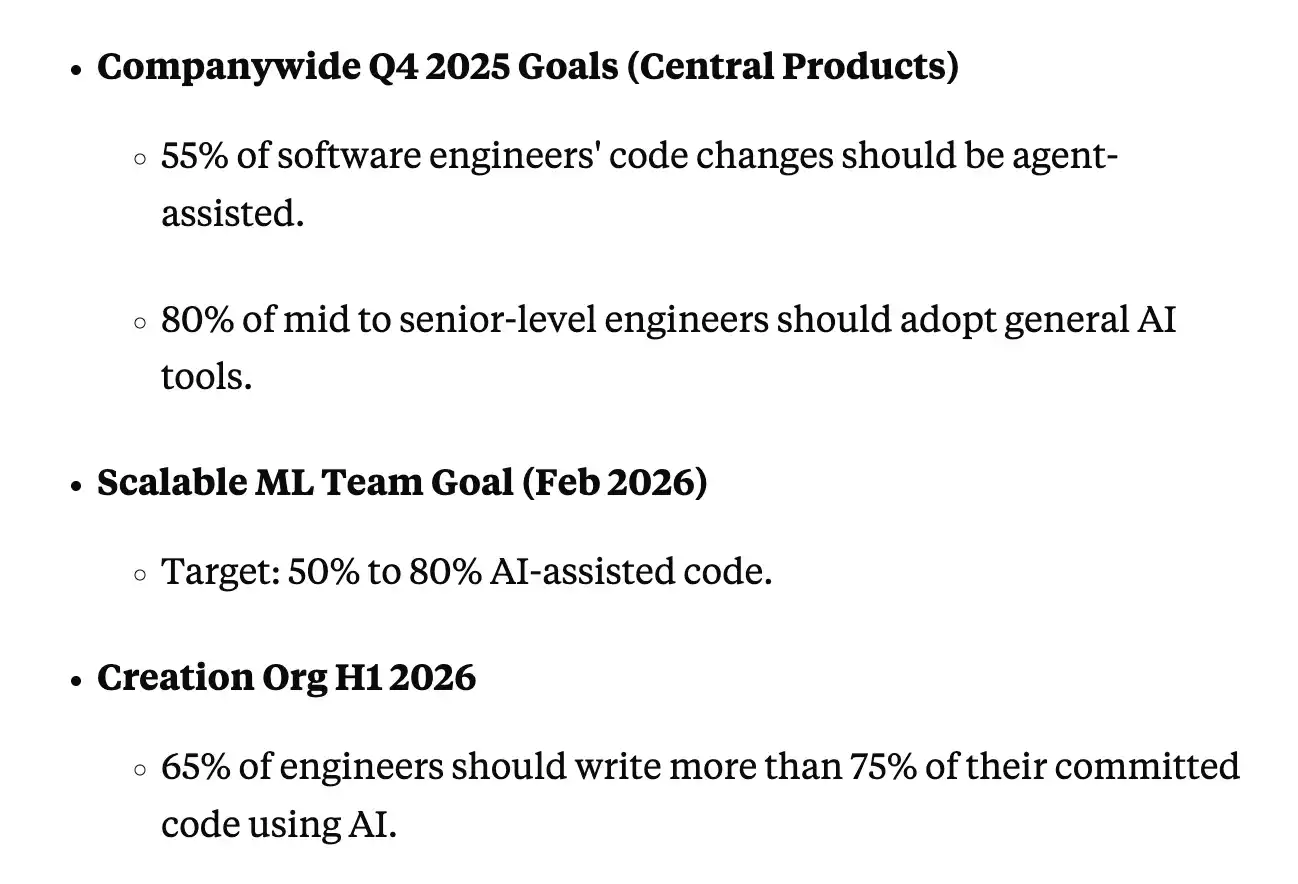
Business Insider reported last month that, based on internally leaked documents from Meta, the company is pushing employees to use AI tools more actively, with a target of having 65% of engineers generate over 75% of their code with AI assistance by mid-2026.
According to the Weibo account Official Layoff (@LayoffAI), which focuses on layoff news from major companies (no source provided, not verified): “Since the beginning of this year, Meta has incorporated ‘AI-driven impact’ into the performance evaluations of all employees, making it a core metric. Promotion is no longer possible without using AI. Meta has become the first major tech company to formally tie AI usage to promotions.”
AI iterating white-collar jobs is no longer an isolated case
Layoffs justified by "AI iterating productivity" are no longer an isolated case.
In October last year, Amazon cut up to 30,000 jobs across its logistics, payments, gaming, and cloud computing divisions. CEO Andy Jassy had previously foreseen this round of layoffs: “As the company increasingly uses AI to perform tasks previously done by humans, Amazon’s workforce size may shrink.”
At the end of February this year, Block, the fintech company founded by Jack Dorsey (also the founder of Twitter), announced the elimination of 4,000 positions, reducing its workforce from over 10,000 to fewer than 6,000 employees, to drive a leaner, flatter, and AI-centric organizational structure. Amrita Ahuja, Block’s Chief Financial Officer and Chief Operating Officer, revealed that after the announcement, numerous corporate executives reached out to Block seeking to replicate this “playbook.”
- Odaily Note: See “Jack Dorsey’s Company, 4,000 White-Collar Workers Are Being Replaced by AI.”
Earlier this week, Snap, a direct competitor to Meta’s core product Instagram, also cut approximately 1,000 jobs, with CEO Evan Spiegel stating, “AI will enable our team to reduce repetitive tasks, increase efficiency, and better support our community, partners, and advertisers.”
Now, the same wind has reached Menlo Park, California, and Zuckerberg has raised his sword.
Oh, and there’s another point worth mentioning. Although Jack Dorsey loudly proclaimed during the layoffs that “the rapid advancement of AI is transforming traditional productivity growth paradigms,” many of the laid-off employees at Block soon received invitations to return to their roles (see “The First Wave of AI-Laid-Off Workers from Major Companies Are Already Returning”)…
AI-driven workforce iteration may one day become reality, but rushing to cut 40% of staff all at once, as Block did, risks overreaching and causing harm.