




By Xu Tan
Edited by Su Yang
Achieving lifelong wealth and career success with a single investment, the story of Liu Yueting (Lucy Liu), dubbed "the luckiest Gen Z entrepreneur," may be one of vision, courage, opportunity, and rewriting the rules.

Lucy Liu, Co-founder and President of Airwallex
Liu Yueting's first investment in life, putting everything into one sector, yielded a thousandfold return.
In 2015, at age 25, she met Jack Zhang (co-founder and CEO of Airwallex) and Max Li (co-founder of Airwallex), both alumni of the University of Melbourne, at a café in Melbourne. Jack Zhang complained about the high costs of cross-border procurement and currency exchange for the café, and suggested it would be better to start a business and create a superior payment solution.
Liu Yueting keenly identified the pain points in traditional cross-border payment channels, and a disruptive business revolution may begin with a deep understanding of these pain points.
During a conversation with Jack Zhang in 2025, he recounted this experience: when he first conceived the idea of building a cross-border payment system, he had no company, no product—just an idea. Yet Liu Yueting immediately decided to invest $1 million for a 20% stake in the company, and she transferred the money to his account the very next day—it was the money she had planned to use to buy a house. Jack Zhang had never encountered such decisive investment behavior before.
Related reading:Airwallex Founder Jack Zhang: Tackling the Toughest Challenges in the Top Tier of the European and American Markets
Therefore, Airwallex was founded in 2015 by four Chinese entrepreneurs, with Liu Yueting as the only woman. Liu Yueting joined the company as a co-founder because she believes that investing in a company must be a venture where you stake your own future.
By 2026, Airwallex had completed its Series G funding round, led by investors including Addition, T. Rowe Price, and Activant, achieving an $8 billion valuation. Liu Yueting’s initial $1 million investment yielded over a thousandfold return. Based on this investment, in June 2025, the 34-year-old Liu Yueting ranked among the top women on New Zealand’s Wealth List published by the New Zealand Business Review, with an estimated net worth of NZ$700 million (approximately RMB 3 billion), earning her the nickname “New Zealand’s Richest Woman.”
In a male-dominated fintech industry, Liu Yueting stands out as a unique presence. When she first met with clients, the client’s boss, after listening to her presentation, said, “You did a decent job explaining, but I didn’t quite understand—next time, could your boss come instead?”
She is young and beautiful, making it easy for people to overlook her capabilities. But within the company, she’s more like a “general manager”—she has rotated through finance, HR, marketing, branding, and more. “Even now, when I see something unsatisfactory, I still feel the urge to jump in and get it done myself,” says Liu Yueting.
Although Airwallex’s growth trajectory is seen as part of a grand narrative reshaping the global financial system, their original vision was to build a more efficient, multi-currency, and lower-cost cross-border payment platform to address the pain points of businesses in need. This is because, under the traditional banking system and USD-clearing SWIFT network, international wire transfers require intermediation through five to six banks, taking several days and incurring high fees.
Airwallex has obtained financial licenses in 80 countries and regions, further expanding its multi-currency offerings. In its first two years of operation, Airwallex generated almost no revenue, but the founding team chose to build infrastructure rather than pursue short-term monetization, causing the company’s business model to evolve from cross-border payments into a “global financial operating system.” The results reflected this strategy: it took nine years for the company’s revenue to grow from $0 to $500 million, and just one year to go from $500 million to $1 billion. Liu Yueting believes that every decision you made previously led to the outcome you have today.
Now, Airwallex can help businesses open accounts in over 70 countries and regions in just two minutes. More than 200,000 companies, including Minimax, Kimi, Zhipu, SHEIN, TikTok, Jingdong, have become Airwallex customers.
Liu Yueting is uncomfortable with the label of "female executive" imposed by outsiders, but she founded the "Women Going Global" alliance at Airwallex to identify commonalities among women-led companies.
She also established a "three-minute quick veto" mechanism within the company to avoid the trap of excessive compromise by female entrepreneurs.
Young, beautiful, and wealthy. Jack Zhang sometimes curiously asks her, “What motivates you to work?” She believes it’s curiosity and passion that drive a person to never be satisfied with the status quo.
Below is the transcript of a recent conversation between the author and Lucy Liu, Co-founder and President of Airwallex:
01A life-defining investment
Question: Many people are curious about you—why, at such a young age, were you able to make such a pivotal investment? Where does your investment and financial acumen come from? Could you start by introducing yourself?
Liu Yueting: I’ve indeed seen some different speculation, but my personal background isn’t complicated. I was born in Northeast China, and my father was among the early professionals in China’s financial securities industry. In 1999, when I was eight years old and in third grade, I moved to Shanghai with my parents. After completing elementary school, my entire family immigrated to New Zealand, where I attended middle and high school. I skipped a grade in high school and, at age 17 in 2008, enrolled at the University of Melbourne, where I completed both my undergraduate and graduate studies in business and finance. After graduation, I worked in the finance industry.
I’ve been interested in stocks since I was a child; I’d often play around with my dad’s trading system. From a young age, I knew that stocks starting with 600 were listed on the Shanghai exchange, and those starting with 000 were listed on the Shenzhen exchange.
Regardless of whether one enters a securities firm or a bank, the career path in finance is very clear. I joined a joint venture, starting as a regular investment advisor, then progressing to Director, Executive Director, and Managing Director. Later, I resigned and traveled extensively, as I was more interested in investing—specifically in venture capital or private equity. In 2015, while in Melbourne, I met some old friends and university classmates; Max Li (one of Airwallex’s co-founders) was running a coffee shop with Jack Zhang (another Airwallex co-founder). We all loved coffee, and I visited their shop every day. What followed is exactly as Jack described—we began discussing Airwallex’s original idea: a tool similar to cross-border payment.
At that time, the entire cross-border industry was also developing rapidly. We certainly didn’t envision such complexity when we first started the company, but based on customer feedback, we made many adjustments to our products and strategies over time, and we’ve been doing this for about ten years.
Question: In May 2025, during my conversation with Jack, he shared how you invested in them as an angel investor. My biggest question is: at the time, Airwallex hadn’t been founded yet—there was only an idea. What convinced you to invest that money?
Liu Yueting: I previously worked mostly with pre-IPO and post-IPO companies, for which one million U.S. dollars isn’t a particularly large sum. But for a startup, it’s a significant investment.
Besides me, the other partners have also contributed some of their savings, though the amounts are smaller compared to mine. My own thinking is to invest in what I and my partners can do together; if I simply invest money directly, I don’t have much control over it and can’t predict how things will develop next. By investing in myself and my partners, I still maintain a degree of control—I might just be someone with a strong need for control.
I think back then I was impulsive and young, just thinking I was willing to bet both my money and myself on something like this—the worst-case scenario was that it might not work out, and I’d just go home and return to what I was doing before.
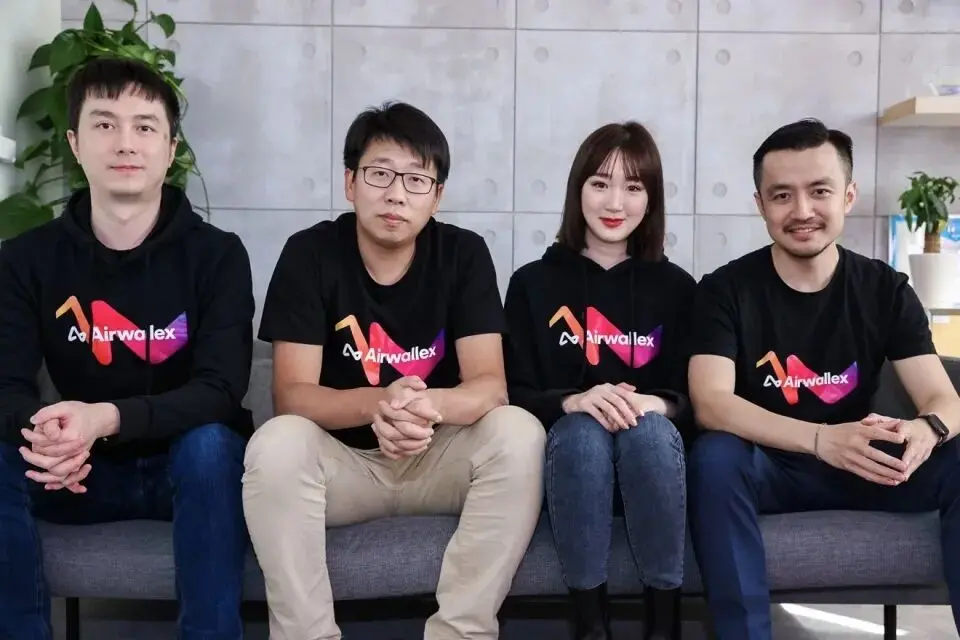
Airwallex co-founders, from left to right: Xijing Dai, Jack Zhang, Lucy Liu, and Max Li.
Question: It is rumored on the market that 1 million U.S. dollars ten years ago yielded a return of 1.2 billion U.S. dollars. Is this figure accurate?
Liu Yueting: That’s probably not accurate. We’ve raised 12 rounds of funding, so there has certainly been some dilution, and the company’s market cap is also a dynamic figure.
Question: Is it true that you became New Zealand’s wealthiest woman due to the returns from this $1 million investment in Airwallex?
Liu Yueting: Thank you very much for your interest in our company. This matter originated from a list published by New Zealand media, and the figures on the list were merely estimates. I feel that in the internet age, there’s been an overemphasis on sensational headlines. If you look closely at that list, I wasn’t even ranked particularly high—I believe I was around 30th to 40th. I’ve always thought that wealth rankings contain a certain amount of inflation, and I personally am not fond of such things.
Question: If we break down this investment logic and the thinking behind the key decision, what are the key points to summarize?
Liu Yueting: My basic logic consists of three levels: people, industry, and moat. I view this startup as a marathon, and first and foremost, the person running it is crucial—can this athlete truly endure the full distance of a marathon?
Second, the赛道 must be large enough and challenging enough so that you continuously have new things to work on, rather than solving a small problem and then having nothing left to do.
Finally, our payment license moat is deep and wide enough. When we first introduced the concept of financial infrastructure, many people didn’t understand it—they thought infrastructure was like building roads. But with the advancement of AI, people now better understand what underlies it and why building infrastructure itself is more barrier-rich and more valuable than creating a small tool. For us, building a feature or tool is easy, but laying the foundational layer underneath is extremely difficult. We’ve spent ten years building relationships with regulators and earning their trust and confidence. Today, we hold 80 licenses and have established partnerships with over 50 global financial institutions. By the end of this year, we plan to apply for an additional 13 core licenses. This does not include licenses for expanding our business scope, such as extending foreign exchange trading to new countries.
From the perspective of market scale, this also validates my vision from back then. Going global has become an inevitable choice for today’s enterprises. We are no longer just a cross-border payment company, but have integrated the entire financial lifecycle of businesses, covering all aspects of multi-currency, multi-entity receipt collection, fund management, and payments, establishing a new global financial services model that operates in sync with the rapid development of the modern economy.
Question: As an investor, what is your thought process? Which company milestones since becoming a co-founder of Airwallex have validated your approach?
Liu Yueting: I never saw myself as an investor; I’ve always thought of myself as a co-founder—someone who brought capital into the team, in a way. To be honest, after making that investment, I never thought about returns again. I fully stepped into the role of a co-founder, growing alongside the company. At different stages of the company’s development, my role evolved: in the early days, I did everything; later, I focused more on long-term strategic initiatives. When there were gaps in team leadership, I would step in temporarily to manage a team and help it grow better.
To be honest, 99.9% of the time I feel like I’m just a co-founder—only 0.1% of the time, like during board meetings or when fundraising is needed, do I feel like I’m also an investor in the company.
Question: Over the past ten years of founding Airwallex, what was the most difficult trade-off you made?
Liu Yueting: As Jack mentioned, we nearly got acquired by Stripe in 2018 (we ultimately declined). For us, during the first three to four years, the company grew very rapidly; once we started generating revenue and entered a phase of more structured growth, our planning and forecasting for the future became more accurate.
It’s not really about trade-offs, but about choices. We’re a bit greedy and always feel like we can do everything. At critical junctures, our choices and direction have been right; if you frame it as a trade-off, we’ve never sacrificed long-term planning for short-term goals. Or perhaps we’ve given up some very short-term gains to fuel our long-term growth. Looking back, over the first nine years we built $500 million in ARR (annual recurring revenue), and it took just one year to go from $500 million to $1 billion. If the company hadn’t made it to its tenth year, we never would have reached that second billion. For a very long time, without seeing results, we had to persist in doing what was right for the long term.
Question: What did you do right to achieve breakthrough revenue growth in the tenth year?
Liu Yueting: Everything we did previously led to the outcomes we have today. Over the past decade, we chose to build network infrastructure rather than directly developing applications. The company was founded in December 2015 and began generating revenue in January 2018—during which there was a full two-plus years with no income at all. For a VC-backed company, that pressure was significant. We had partners and customers, and investors needed to see results. But by choosing to build financial infrastructure, we signaled our intent to avoid over-reliance on banks or any third-party channels, instead relying on our own local licenses and clearing network.
Second, we connected our products together. We started with foreign exchange and payments, and in 2019, we launched global business accounts and an end-to-end financial infrastructure, including card issuance and payment processing. We unified cross-border payments across more than 90 currencies and 200 countries and regions using a single FX engine and intelligent routing, significantly reducing time and costs.
Next, we are transforming ourselves into a financial operating system by integrating and centralizing billing, expense control, finance, ERP, and more onto our platform. The proportion of customers using three or more of our products is steadily increasing, and they no longer view us merely as a payment tool.
Currently, we are focusing on AI. When AI agents make decisions, funds can be transferred globally in real time with coordinated planning. From liquidity management to cross-border payment orchestration, these agents can perform actual financial operations such as reconciliation, transaction routing, optimization, and execution.
Question: You set a "North Star" metric of serving 1 million customers and achieving $10 billion in ARR (annual recurring revenue). But currently, you’re at $1 billion in ARR—how long do you estimate it will take, and what path will you follow, to reach $10 billion in ARR?
Liu Yueting: It took us nine years to go from $0 to $500 million in annual revenue, but only one year to go from $500 million to $1 billion. This has given us a clearer understanding of the path to $10 billion—not through a single breakout product, but through the compounding effect of our systemic capabilities.
First, we continued our global expansion. In 2025, we extended our licensed operations into 12 new markets, enhanced our local service capabilities, and obtained new licenses and launched new products in countries and regions including France, the Netherlands, Israel, Canada, South Korea, Japan, New Zealand, Malaysia, Vietnam, Brazil, Mexico, and the UAE.
In 2026, we will enter more than 10 new markets; between 2026 and 2029, we will invest $1 billion to expand in the U.S. market, and over $500 million will be invested in the UK market over the next five years.
In the past, we spent very little on marketing because we believed that for B2B companies, sales and product leadership should come before market exposure. However, as we expanded to serve more small B-end customers and increased C-end visibility, building global brand trust became essential. Starting in 2025, we began significantly increasing our offline marketing efforts, including sports platform sponsorships. Our partnerships with McLaren and Arsenal are not merely sponsorships—they position us as their financial partner, helping enhance operational efficiency beyond the field. In March, we also announced collaborations with the San Francisco Giants and the New Zealand Blues.
Another point is providing a full ecosystem of services. Many customers initially choose us to solve specific challenges, such as receiving payments, managing fees, or global expansion. However, when businesses migrate their entire financial systems to Airwallex, their overall costs are significantly reduced. Currently, more than half of our customers use multiple products, which confirms that our PMF (product-market fit) is improving.
02 Business Expansion: How to Grow Quickly While Maintaining Core Competitiveness?
Question: In recent years, more and more Chinese companies have been expanding overseas. If you had to summarize the evolution of Chinese companies’ financial needs when going global using three keywords, what would they be?
Liu Yueting: I would summarize the evolution of Chinese enterprises' financial needs when going global in three words: compliance, efficiency, intelligence.
Initially, people were primarily concerned with whether they could safely receive and send funds. Now, the focus has shifted to sophisticated settlement, tax, and regulatory compliance across multiple entities and currencies amid complex geopolitical landscapes. In the past, overseas expansion was largely centered on goods trade, with products shipped abroad while all operations remained domestic. This model is becoming increasingly difficult, as exporting goods now often requires relocating part of your operations locally to comply with regional regulations. From the perspective of supporting enterprises going global, helping them manage local financial operations overseas can significantly reduce their burdens.
The second stage is efficiency—aiming to reduce costs, speed up settlement times, and serve low-value, high-frequency needs.
In the past two years, an increasing number of clients have been asking about automation and intelligence: Can repetitive tasks like reconciliation, expense control, and billing be handed over to the system—or even to AI? Our strategy follows this same trajectory: from a global account and payment network, to expense control and billing (invoice issuance, fee settlement, etc.), and onward to agent-based finance and agent-based commerce, enabling enterprises to complete global payments, fund management, and intelligent decision-making all on a single platform.
Question: What were the biggest financial issues you observed in those failed overseas expansion cases?
Liu Yueting: I believe that over-reliance on a particular sector or trend means you’re too dependent on external factors affecting your business, which could expose your company to significant risk.
However, some companies stand out by responding quickly to the market. Similar to our company, having core capabilities while being less affected by external market fluctuations is a key factor in our success.
Question: What do you think is your company’s biggest challenge right now?
Liu Yueting: The biggest challenge for the company, I think, is that as it has grown to this scale, the scope of operations has become quite broad. First, the market capacity is enormous—whether competing with banks or other industry players, this competition is inevitable, and it indicates that the market itself is a very large pie. But how do you secure a larger share of that pie? This puts great pressure on us to directly compete with our rivals and traditional systems, as they are also making massive investments.
Moreover, returning to the point I made about choices, you are making different decisions every single day. You must uphold our foundational core clearing network and our core competitive advantages, while simultaneously integrating new technologies—such as AI—into our entire workflow as quickly and precisely as possible. The truth is, it all starts from the ground up; by the time customers perceive the improvement, an entire development cycle—or even longer—has already passed. So how can we complete this as fast as possible? It feels like a race against time. Because if you miss the window, you risk becoming a lagging company. Therefore, the challenge lies in how to move at the fastest possible pace while staying true to our original core competencies.
Also, can the growth of our people keep pace with the growth of our business? Even today, people remain as important as they were on day one.
Question: How do you personally keep growing and keep up with the pace of the company’s business development?
Liu Yueting: Everyone talks about maintaining the ability to learn continuously. But I think it’s not just about learning ability—it’s about business acumen. When something new happens, can you quickly break it down into something that benefits the company? My partner Jack is extremely strong in this area—he has an incredibly steep learning curve.
I believe my value lies in being the person who understands the company best, and showing up where I’m needed most in this complex situation. I always say that the founders and I are like firefighters—where there’s a fire, there we are.
I think it’s important to maintain enthusiasm and curiosity about something—it may sound cliché, but I truly believe that curiosity and passion are the core drivers that help you stick with something.
Question: In working alongside three male co-founders, where does your uniqueness lie?
Liu Yueting: Even if the sky falls, I’ll still have a cup of coffee first. I believe founders need to provide emotional value to their company. As a founder, having stable emotions is crucial—the larger the company grows, the greater the impact your emotional fluctuations have on the organization. Emotional stability is the core factor in keeping your team grounded.
Question: What causes significant emotional fluctuations in you?
Liu Yueting: I feel that even up to now, I still have an impulse to take over tasks from others. When I think I can do something better, I always want to take it on myself. This isn’t particularly good for leadership—I should be helping others do their jobs better. But even now, I’m still very impulsive. This is my own reflection.
03 AI Development: Who does the work, and where does the funding come from?
Question: At the beginning of 2026, AI companies entered a "model war" scenario, where faster technological iteration meant higher efficiency and greater value capture. Does this logic hold true in the fintech industry? Since your competitor Stripe is also investing in AI, will this spur Airwallex to increase its own AI investments?
Liu Yueting: Fintech will not become a race where the one with the stronger model wins. Ultimately, the key battleground will be whether you can correctly anticipate customer behavior—what the customer is likely to do next. I’ve always believed that the best salespeople aren’t those who tell customers what features their product has, but those who guide them on how to proceed—more like a consultant.
Airwallex has been a cloud-native financial infrastructure since day one, with sufficiently mature data and scenarios, making it relatively easier for us to develop AI applications or AI-powered products.
Returning to competition, I believe this market is truly large enough, and the real competition is more between modern tech companies and traditional finance. Traditional finance still accounts for over 90% of global business. Therefore, for us, disrupting traditional finance itself is a much larger scale endeavor than competing with other tech companies, and it continues to grow.
Question: I don’t understand—what specific aspects of the company is AI building supposed to transform? I see that Airwallex is launching three AI strategies in 2025: Agentic Finance, Agentic Commerce, and AI Protocols for Developers. What is the core logic connecting these three strategies?
Liu Yueting: These three strategies address the three layers of who does the work, where the funding comes from, and how the system is built.
Agentic Finance involves AI first taking over internal corporate finance. Traditional financial systems only handle bookkeeping, reporting, and reconciliation—humans must log in, review reports, and make decisions themselves. We aim to transform this into a system where a team of AI agents assists the CFO in automatically monitoring cash flow, making forecasts, verifying expenses, and initiating payments, with decisions escalated only when necessary.
Extend the same intelligence to the revenue side and commercial scenarios through Agentic Commerce. Businesses shouldn’t just manage money—they need to earn it. Agentic Commerce enables AI to guide businesses and consumers through the entire journey: discovering products, comparing prices, placing orders, and making payments. This way, AI not only optimizes internal financial efficiency but also generates new revenue streams at the front-end transaction level.
Then, by building an AI protocol, transform the first two into open capabilities. To truly deploy hundreds or thousands of agents, one company alone is not enough—you need an open protocol and a developer ecosystem. The AI protocol enables different models, agents, and applications to uniformly access Airwallex’s payment, foreign exchange, card issuance, billing, and data capabilities, achieving seamless cross-platform interoperability.
Viewed together, Agent Finance addresses “How can AI help businesses manage their money?”, Agent Commerce addresses “How can AI help businesses generate revenue?”, and the AI Protocol abstracts both into an open infrastructure that enables developers and partners worldwide to build applications on top. Together, these three layers form what we call the “AI-native financial operating system”—the direction we will continue to invest in over the next decade.
04 Wealth Creation: Industry Tailwinds or Compound Capabilities
Question: It seems you’re somewhat opposed to being labeled as a woman, yet in 2026 you co-founded the “Women Going Global Alliance” initiated by Airwallex. What was the original intention behind establishing this alliance?
Liu Yueting: I’ve met many founders associated with so-called female labels while abroad, and there are actually many women in leadership positions. So I’m quite resistant to being constantly asked questions about gender. Once, I said, “If you wouldn’t ask Jack that question, then don’t ask me either.”
The original intention behind launching the Women Going Global Alliance can be summed up in one sentence: Let each other’s experiences become beacons for one another.
Within Airwallex, we’ve observed that when female executives encounter compliance challenges, talent shortages, or cultural clashes while expanding overseas, they often have to figure things out on their own. For example, our Jeanette (Chief Legal and Compliance Officer) has navigated regulatory entry in dozens of countries, and Dinghua (Head of Operations) has built operational systems spanning three continents. It would be a shame if these valuable experiences remained confined to just one person’s mind. That’s why we want to do something: connect these islands into an archipelago.
International Women’s Day is a symbol, but its true meaning lies in this: starting from this day, alliance members can initiate 1:1 requests anytime—you have compliance questions, schedule a coffee with Jeanette; you’re building an overseas team, chat for two hours with Dinghua. We also have partners from AI, legal, branding, marketing, and other fields joining this Women’s Circle.
This is not a “ceremonial” alliance, but a “practical” one. As more people are willing to share their experiences, this alliance will grow stronger, and women venturing abroad won’t have to face those “hardest nights” alone.
Question: The fintech industry is largely male-dominated. As a female founder, have you encountered any obstacles?
Liu Yueting: I feel fortunate to have three co-founders who have been very supportive and accommodating toward me. Age was a greater challenge for me in the early stages of entrepreneurship—being a woman and young made it even more challenging.
In the early stages of starting a business, you definitely encounter situations like this—once, an investor introduced me to a client in a relatively traditional industry. At the end of the meeting, he said, “I think you did okay, but I didn’t really understand what you were saying. Next time, could you have your boss come instead?” It was definitely awkward—you do run into situations like this.
At 35, I’m no longer young, and相对来说, I encounter such issues less often. In the end, whether it’s the market, clients, or investors, they only care about two things: ability and results. Bias will always exist; you must persist over the long term to prove your capabilities.
Question: You're a member of the 90s generation and accumulated significant wealth by age 35. Do you believe your wealth accumulation was due to industry tailwinds or the compounding of your capabilities?
Liu Yueting: The era and the industry are crucial, because we truly came of age during the rise of globalization and the digital economy, so there are certainly industry-wide benefits. I am also cautious about not mistaking industry红利 for personal ability. I believe that being in the right place at the right time is a matter of luck and ability, but the prerequisite is certainly that the venture itself is sound and that structural opportunities exist. I remember a founder saying that everyone works hard—hard work is a necessary condition, but it’s not that hard work alone leads to success; rather, all successful people are hardworking.
So, this is by no means an easy path—it’s a combination of complex factors, not an either-or situation. Everything Airwallex has accomplished to date confirms that this is a real, structural issue. We’ve built our current scale over ten years through our own efforts and a bit of luck, which has led to some personal wealth accumulation for me. So, this is a multifaceted issue, and every era has its own opportunities.
Question: You achieved financial freedom so early—you entered a state where you lacked nothing too soon. What now keeps you passionately engaged?
Liu Yueting: Jack also asked me this question—he said, “What motivates you in your work?” I truly love what I do, whether it’s the entrepreneurial journey itself or the business our company is building. As the company grows larger and more complex, I’m constantly forced to deepen my understanding of this field—it’s a state of continuous growth. I believe that this process itself is a powerful driver. As the company grows, so do I.
You never run out of things to do at work every day—there’s always something new to tackle. Why do I say curiosity is so important? Because it’s what continuously drives you forward. In the past, it was about doing as much as possible in the shortest time. Now, it’s more about making harder, longer-term, right decisions—and that’s my current motivation.