



Key Insights:
- Kraken added Pi network under its Chains roadmap, but gave no listing date.
- KYC and mainnet delays continue to weigh on Pi Network sentiment.
- PI coin price is still under pressure even after the renewed exchange attention.
Kraken added Pi (PI) to its public listings roadmap. The asset appears under the exchange’s “Chains” category. This category tracks new blockchain integrations. The move signals Kraken’s interest in expanding its supported networks.
The update comes as Pi Network continues to receive criticism around delays related to KYC verification and mainnet migration.
Kraken Roadmap Update Puts Pi under Chain Integrations
Kraken included Pi in the “Chains” section of its listings roadmap. It’s a category used for blockchains that need technical integration before native token trading is supported.
The listing saw Piplaced alongside other networks like Conflux, MegaETH, Pepecoin, and Quai. Kraken uses this section to indicate evaluation and integration work rather than true listings.
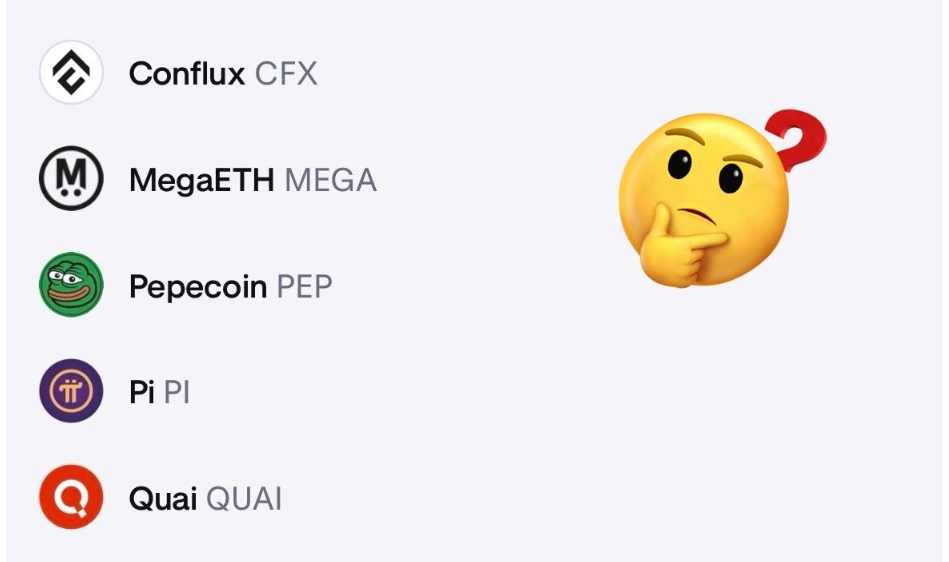
The exchange added a disclaimer to the roadmap, warning that assets shown are not guaranteed to list. Kraken also told users not to deposit tokens until an official announcement is made.
No timeline was given for when PI deposits, withdrawals, or spot trading could start. The Pi network community widely discussed the update as progress. They viewed it as a step toward broader exchange recognition.
Kraken also expanded its “Tokens” roadmap. This covers assets launching on blockchains that the exchange already supports.

Newly added tokens were Amnis Finance, Boost, Ika, Light, Map Protocol, My Shell, and Navi Protocol. It also involves Nexo, Pepecoin, Sui Name Service, Suilend, Minotari, PACT, Rails, Rain, and Velo.
KYC and Migration Delays Continue to Weigh on Pi Network
However, the roadmap update comes as Pi Network continues to address criticism around its KYC process and mainnet migration.
Since the Open Network mainnet launched nearly a year ago, many users have struggled with verification. Others reported issues transferring balances to the mainnet. Complaints have centered around lengthy checks, repeated submission failures, and account blocks.
Pi’s Core Team recognized the problems with recent updates. The team said some accounts were blocked deliberately and promised technical changes to broaden access for eligible users.
Pi announced earlier this week that nearly 2.5 million users in certain regions would be unblocked. The rollout marks a significant step toward broader accessibility for the network.
The Core Team made clear that KYC eligibility is based on active mining status and completion of the mainnet checklist. Based on the update, an additional 700,000 accounts are expected to gain access to KYC submission in the forthcoming phases.
This expansion will further open verification opportunities for Pi users. These changes are designed to minimize friction, which has slowed migration and restricted the usability of the balance.
PI Coin Price Under Pressure Amid Market Weakness
Technically, PI’s performance in the market has been weak over the same period. The token is down approximately 83% year-on-year, reflecting both internal problems and overall pressure on the crypto market.
Analysts have cited a lack of liquidity and delay in migration as contributing factors. CoinGecko data revealed that PI trading peaked in the mid-teens of a cent in early February.
The token was trading in a range of around $0.14 to $0.17 in a span of seven days after hitting recent lows. CoinMarketCap data from the same period pegged PI at around $0.14 with a decline of almost 30% within a month.
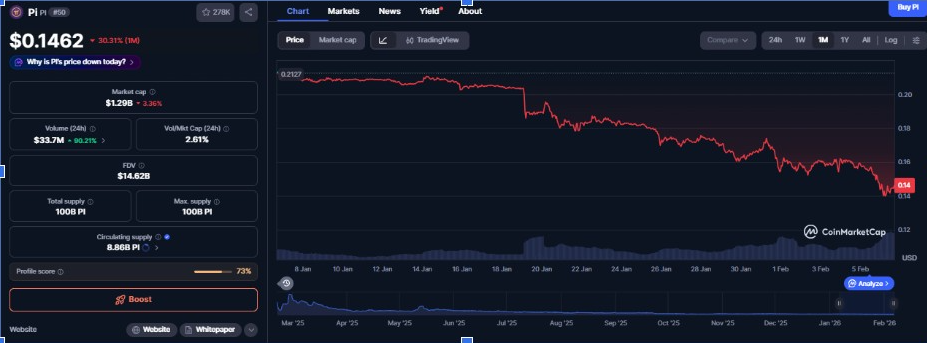
Within the Pi community, some users have attributed the recent drop to the bottlenecks of KYC and migration.
These constraints can slow down the movement of balances into the mainnet, affecting liquidity and price discovery. The price weakness has continued in the crypto markets amid a broader sell-off.
Pi Introduces Palm Print Authentication as a Security Trial
Alongside exchange developments, the Pi Network Core Team revealed plans to test palm print authentication. This feature will strengthen its security framework and enhance user verification.
The feature will be rolled out as a beta as part of Pi KYC to a few users. The option would be a privacy-focused alternative and might not need facial recognition, the team described.
According to the announcement, palm print authentication could be used for some other security workflow support. These include account recovery, password resets, two-factor authentication, and other identity protection use cases.
The team said the beta would be launched before Pi’s decentralized applications were fully deployed.
The post Kraken Adds Pi Network to Listings Roadmap as KYC Issues Persist appeared first on The Market Periodical.