





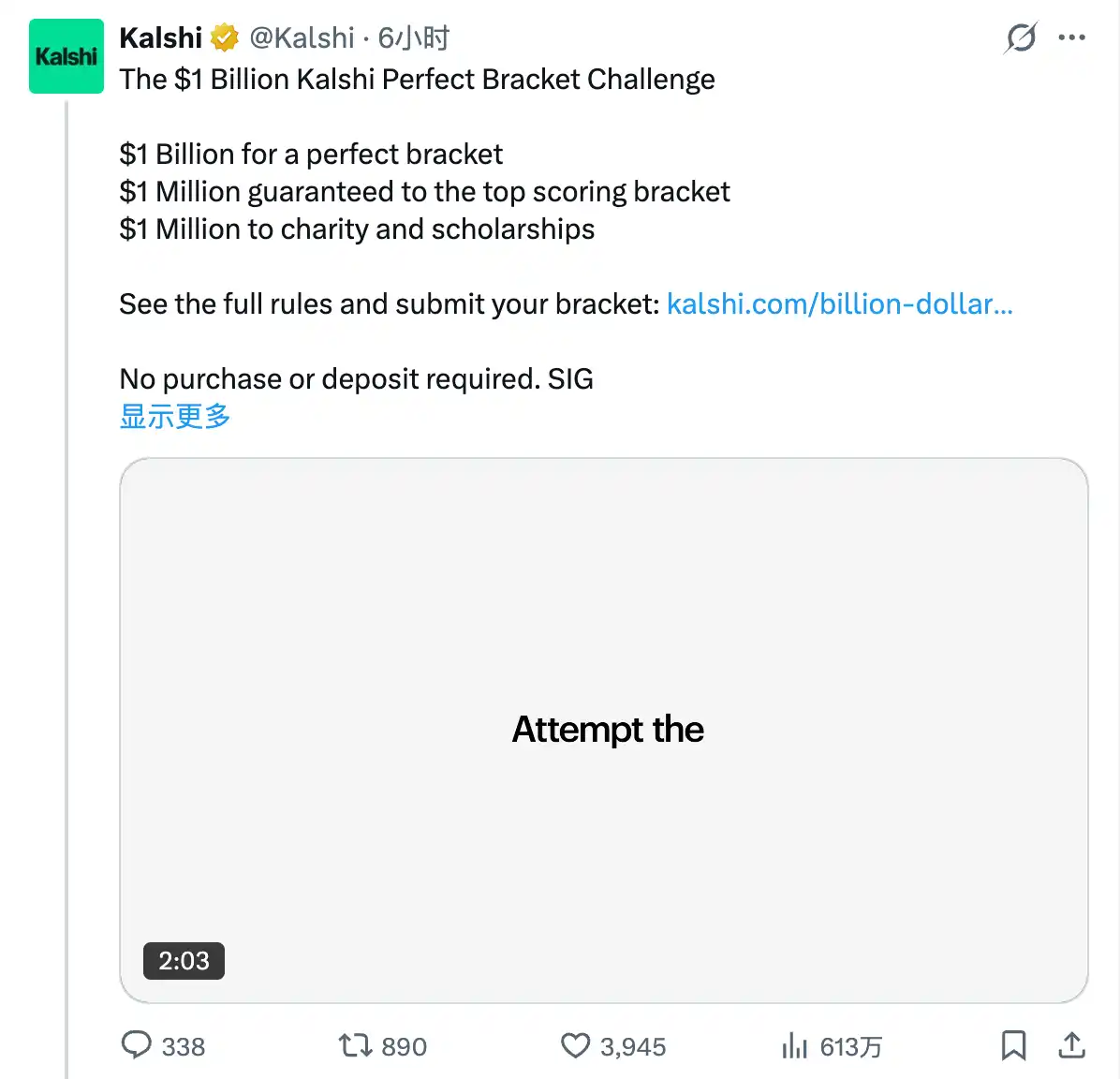
On the early morning of March 17, the prediction market Kalshi announced on X that it would follow the example of Warren Buffett by launching a "Perfect Bracket Challenge" for the upcoming NCAA "March Madness" tournament—users who perfectly predict all game outcomes will win a $1 billion grand prize.
March Madness: The Nation's Hottest Basketball Spectacle
Known as "March Madness," the NCAA Men's Division I Basketball Tournament is an annual event held in March by the National Collegiate Athletic Association (NCAA). It earned its nickname due to its typical March start, single-elimination format, packed schedule, and intense competition.
Based on the schedule confirmed by yesterday's drawing, the 2026 "March Madness" will officially begin on March 18 Beijing Time (tomorrow).
Sixty-eight college teams, having earned their spot in "March Madness" through months of regular-season competition, will now compete for the championship. The tournament begins with the First Four, where eight teams play in preliminary games, eliminating four and leaving 64 teams. These 64 teams will then compete in five rounds of single-elimination games (64 → 32 → Sweet 16 → Elite Eight → Final Four → Championship Game) to determine the national champion.
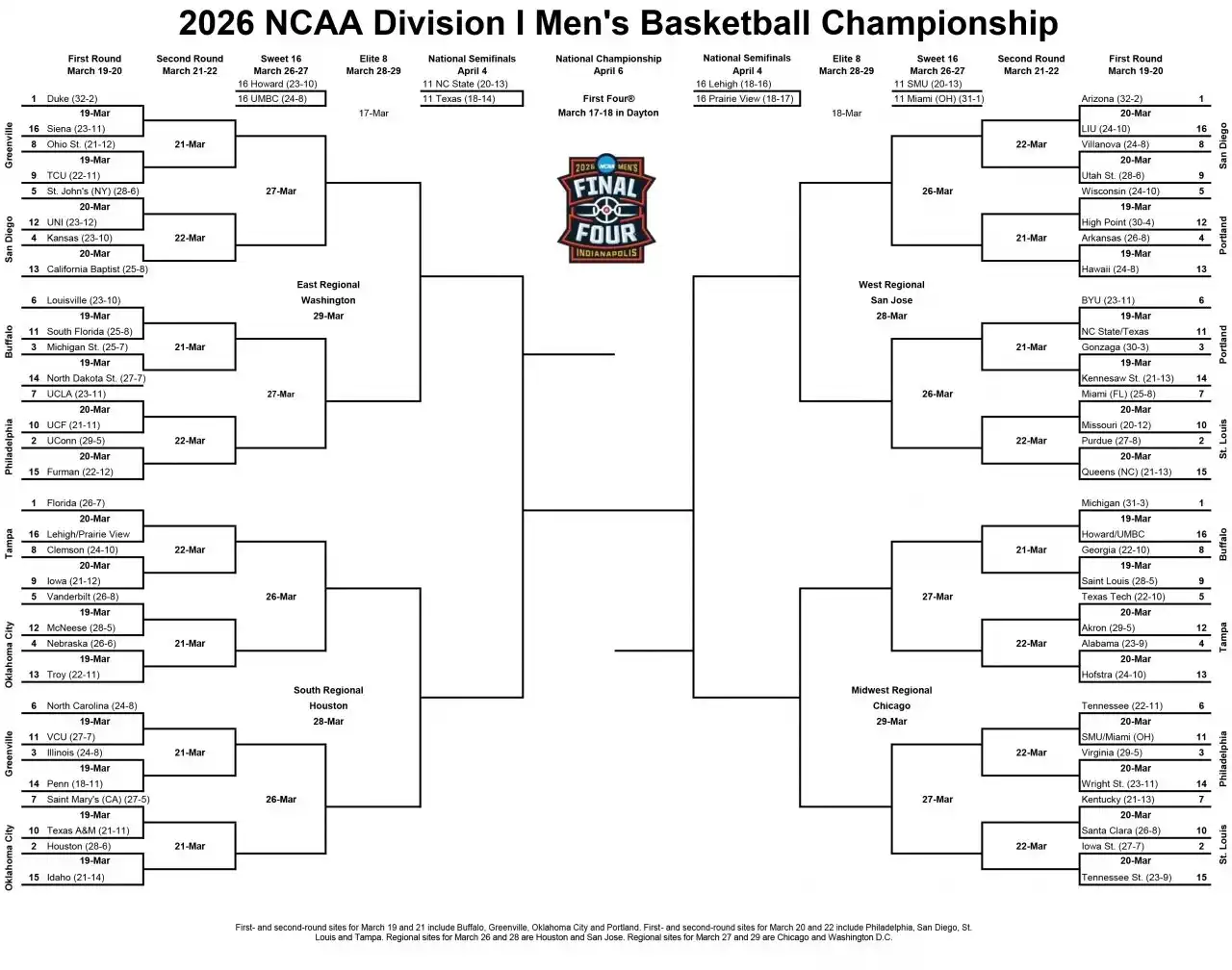
As the most widely followed college basketball tournament in the United States, NCAA, which features universities as competing entities, often fosters stronger "home team loyalty" among the general public compared to the NBA, which is composed of professional clubs. During "March Madness," current students, alumni, and even local communities spontaneously rally behind their alma maters. For this reason, the tournament’s atmosphere of widespread public participation can, in some ways, surpass the热度 of the NBA Finals.
From a competitive standpoint, although college players still lag behind professionals in overall skill, what makes "March Madness" unique is that most participants have an extremely limited window to shine—typically just one to four years—with the most elite talents often entering the NBA after their freshman season. This fleeting opportunity gives every possession a heightened sense of urgency—once they step on the court, nearly everyone gives it their all.
Meanwhile, 2026 is widely regarded as a landmark NBA draft year, further amplifying interest in this year’s tournament. Players such as Darrin Peterson from the University of Kansas, A.J. DiBanza from Brigham Young University, and Cameron Buzel—son of Carlos Buzel, former rival of Yao Ming—are considered once-in-a-generation talents expected to compete for next year’s NBA No. 1 overall pick. The direct matchups among these “future stars” add a layer of foresight about the future NBA landscape, enhancing the tournament’s appeal beyond mere entertainment.
Massive traffic—how could the prediction market afford to miss it?
During "March Madness," filling out brackets to predict game outcomes through sports betting services has long been a popular tradition in the United States. How could a specialized prediction market miss this opportunity?
Currently, prediction markets such as Polymarket and Kalshi have launched prediction markets related to the "March Madness" tournament. Polymarket has even included it among its first试点收费 sports events, indicating its intent to capitalize on the upcoming tournament surge.
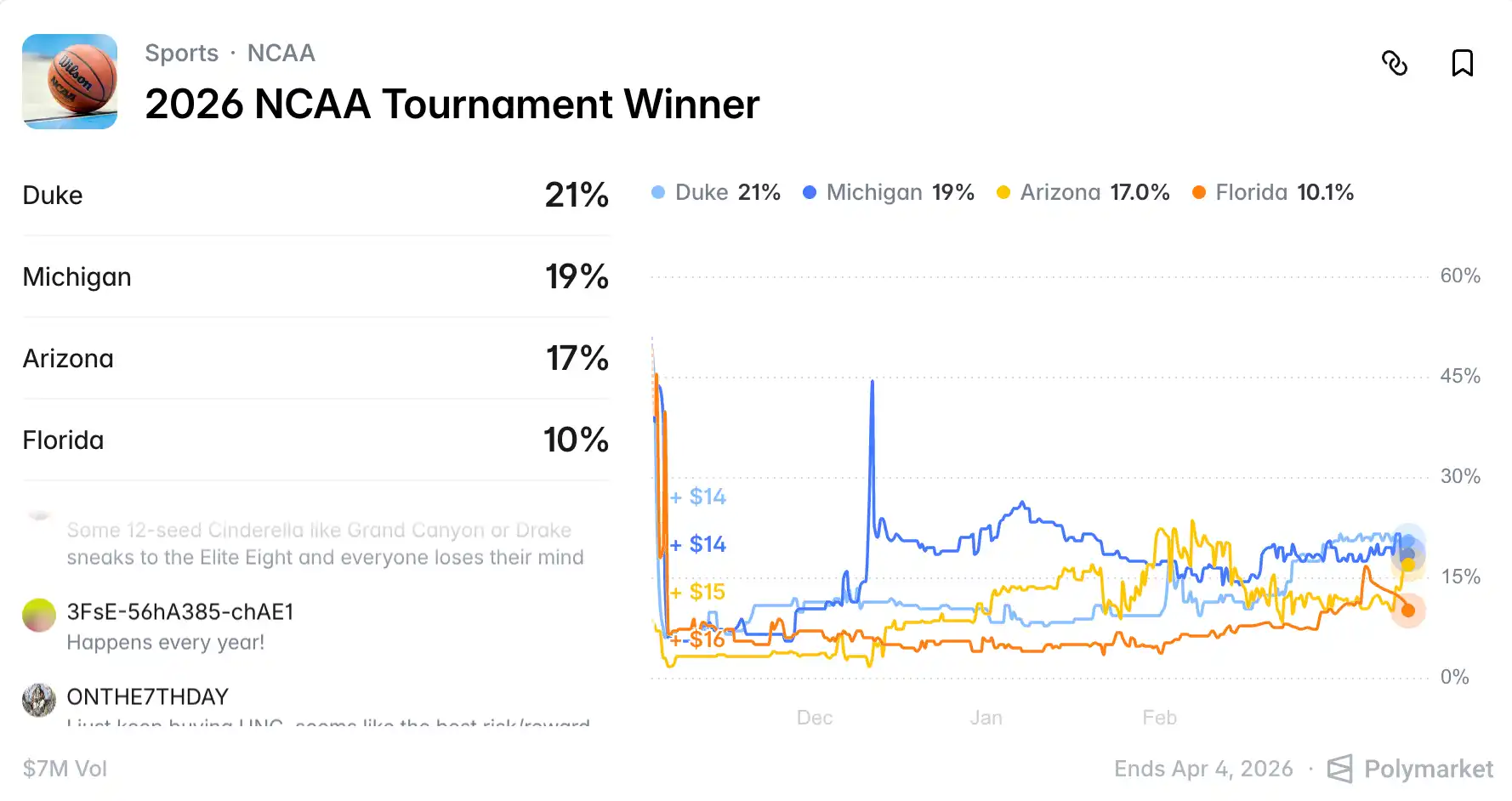
Polymarket's real-time probabilities show that the top four favorites to win "March Madness" are the No. 1 seeds from each of the four major regions:
Duke University, featuring Cameron Buzel, a top prospect for next season's NBA draft, leads with a provisional 21%.
· The University of Michigan is ranked second with a provisional rate of 19%; the University of Arizona is ranked third with a provisional rate of 17%;
Defending champion the University of Florida is ranked fourth, currently at 11%.
On the other side, Kalshi launched a blockbuster “$1 billion prize” campaign this morning, emulating Buffett. All users can submit a prediction for free on Kalshi; anyone who perfectly predicts all match outcomes will win $1 billion. If no one succeeds, Kalshi will award $1 million to the user with the best prediction accuracy, plus an additional $1 million allocated to charitable organizations.
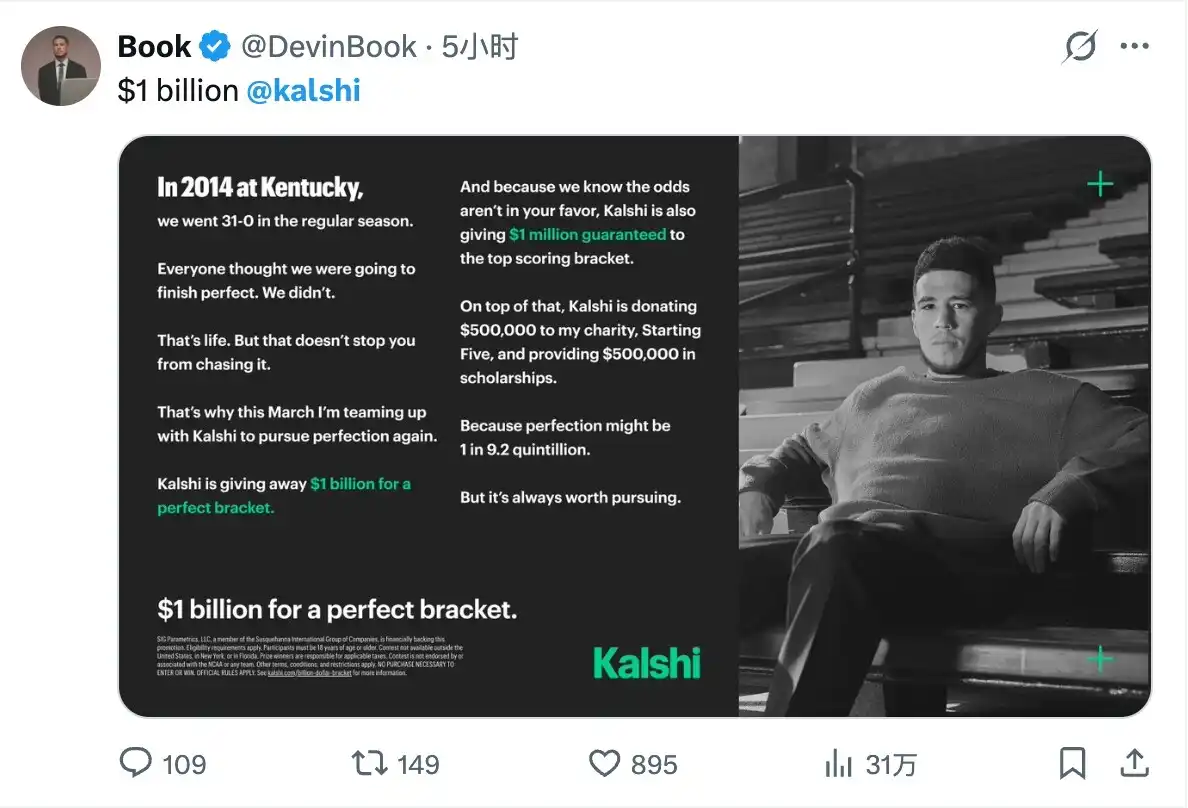
Notably, Kalshi has enlisted NBA star Devin Booker to help promote the event. In 2014, Booker’s team, the University of Kentucky, went undefeated at 31-0 during the regular season and was widely favored to win the national championship that year—but lost 64-71 to the University of Wisconsin in the semifinals. Booker entered the NBA the following year, leaving him unable to redeem that遗憾.
Buffett has offered a $1 billion prize for 12 years, but no one has claimed it.
The reason Kalshi’s grand prize is mentioned as emulating Buffett is that Buffett established the same prize back in 2014: any employee of Berkshire Hathaway who correctly predicts the outcome of all games will receive a $1 billion grand prize, paid out over 40 years (or a one-time lump sum of $500 million).
However, due to the extreme difficulty of perfectly predicting the outcomes, the prize remained unclaimed for years. Subsequently, Buffett lowered the difficulty of the contest several times (with corresponding reductions in the prize amount), until last year, when an anonymous employee of FlightSafety International, a subsidiary of Berkshire Hathaway, won the reduced $1 million prize by correctly predicting 31 out of the first 32 games.
How difficult is perfect prediction? The most famous figure circulating in the industry is “1 in 9.2 quintillion,” or “one in 9.2 billion billion.” This probability stems from the following mathematical calculation: assuming each game is a 50% vs. 50% chance (completely random), without considering seed strength, odds, or historical trends, the “March Madness” tournament consists of 63 games (excluding the first-round play-in games), resulting in 2^63 possible combinations—written as a number, that’s 9,223,372,036,854,775,808. If you were to write out every possible outcome on paper, the total weight of the paper would reach 180 trillion tons—equivalent to the weight of 500 million Empire State Buildings.
Feeling like it’s impossible? Don’t worry—I’ll help you significantly increase your chances!
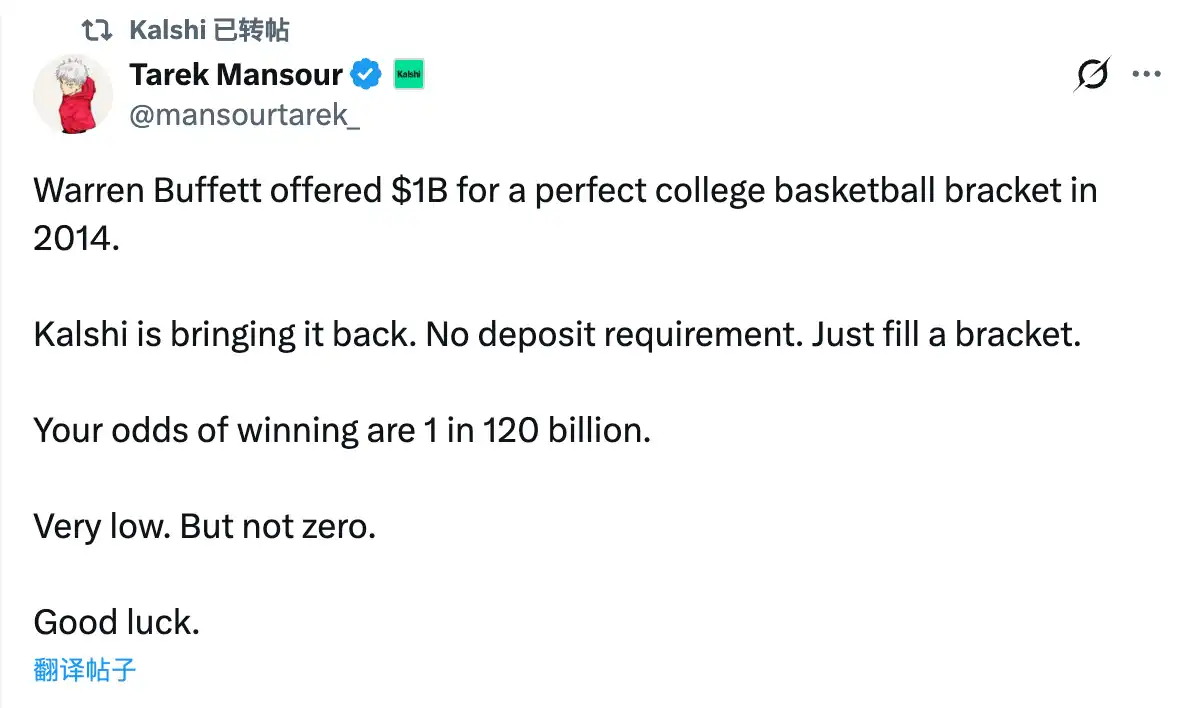
Kalshi CEO Tarek Mansour said this morning that the probability of perfectly predicting the outcome is approximately "1 in 120 billion," or "one in 120 billion."
The reason the two probabilities differ so greatly is that this probability is calculated using a more realistic model—sports games are not evenly matched, and stronger teams often win more easily. After weighting historical win rates and associated odds, academics and statisticians typically estimate the probability of perfectly predicting "March Madness" to be between 1 in 10¹¹ and 1 in 10¹³, and "1 in 120 billion" falls within this range.
Even a "1 in 120 billion" chance means the probability is virtually zero. Clearly, Kalshi is playing the same probability game as Buffett, betting that no one will claim the $1 billion.
The community is eager to act—AI may be the key to breaking through.
After Kalshi announced its grand prize event, it immediately sparked widespread discussion on social media—after all, predicting costs nothing, and what if you win?
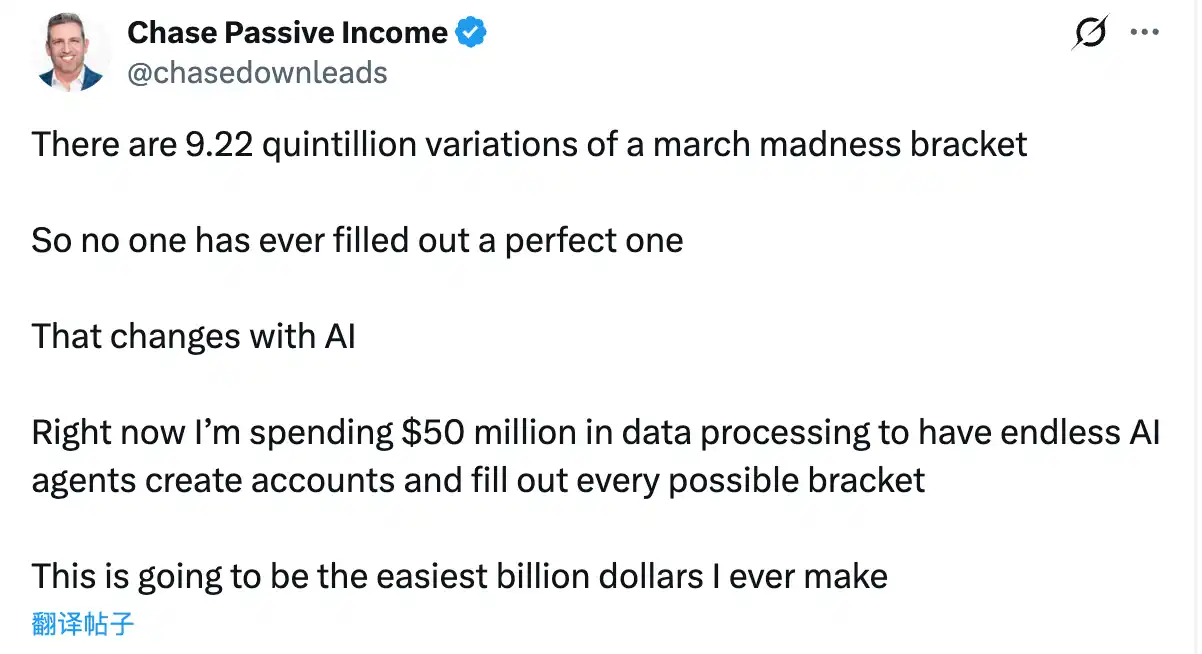
This time, many users are pinning their hopes for breakthrough success on AI—a transformative revolution. Overseas KOL Chase Passive Income posted on X, stating that he plans to spend $50 million on data processing to enable countless AI agents to create accounts and fill out every possible grouping, calling it “the easiest $1 billion to make.”
Will the unsolvable probability puzzle continue? Can AI work a miracle? No one knows the answer until the national champion of March Madness is crowned.
As a spectator, while you're waiting to watch the game and enjoy the drama, don’t forget to place a dream bet on Kalshi.