





Original Title: What If: I Were the Founder of Kaito?
Original Author: RYAN YOON, TIGER RESEARCH
Translated by: Peggy, BlockBeats
Editor's Note: A single API policy adjustment by X caused InfoFi to collectively "shut down" within three days. This collapse not only exposed Web3's deep reliance on centralized platforms, but also revealed another side of incentive mechanisms: the more rewards there are, the faster the data can be gamed, and the harder it becomes to maintain content quality.
This article takes Kaito as a starting point, outlines five possible paths for the InfoFi project, and suggests that InfoFi 2.0 is likely to evolve into a more controlled model with a smaller scale, stronger curation, and a greater emphasis on quality. Beyond this, a more critical question remains: when airdrops and narratives fade, what will ultimately support the token value of InfoFi?
The following is the original text:
Key Takeaways
X's policy changes caused the InfoFi ecosystem to collapse within three days, exposing the structural limitations of over-reliance on centralized platforms.
The InfoFi project is currently facing five options: shutdown; transformation into a bounty-based task platform; adoption of South Korea's brand-sponsored writing model; expansion to multi-platform operations; or transformation into an MCN-style KOL management model.
InfoFi 2.0 is likely to evolve into a smaller-scale, more controllable model, shifting from "permissionless large-scale expansion" to "collaboration between carefully selected KOLs (Key Opinion Leaders) and project teams."
There are still two fundamental challenges to be resolved: how to establish a fair compensation system, and how to provide reasonable support for the token's value.
InfoFi Collapsed Within Three Days
Source: X (@nikitabier)
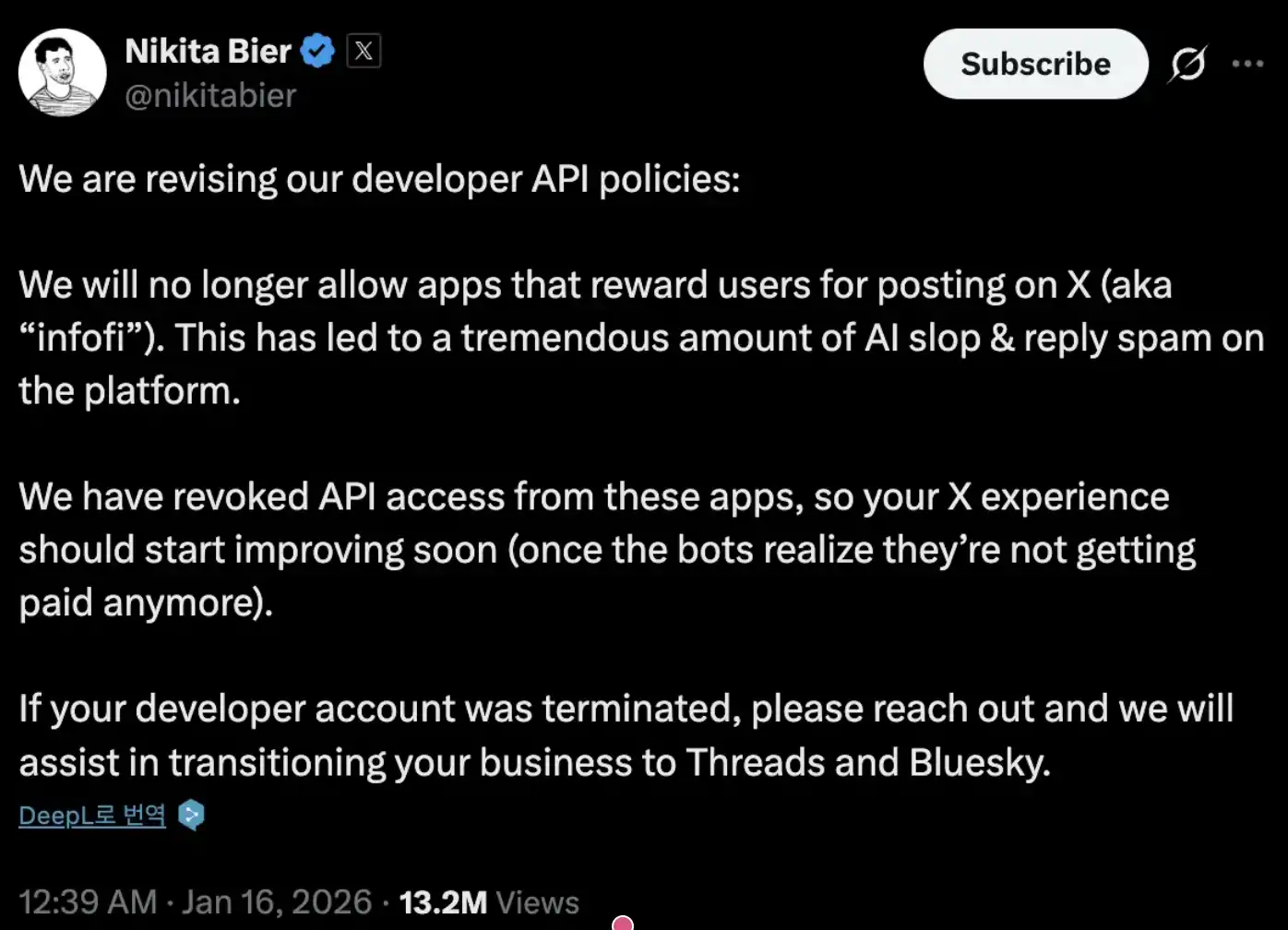
On January 15, X's product lead, Nikita Bier, posted a brief update clearly stating that the platform would no longer allow apps that "bribe users for posts" to operate. For the InfoFi project, this was effectively a death sentence.
According to Kaito's founder Yu Hu's recollection, the events unfolded roughly as follows:
January 13: Kaito received an email from X indicating that it might enter the review process. The team immediately sent a letter requesting further clarification from the other party.
January 14: X issued a formal legal notice, and Kaito submitted a legal response on the same day.
January 15: Public post by Nikita Bier. Kaito found out about the final decision almost at the same time as everyone else.
The market's reaction was merciless.
KAITO's price quickly dropped, and the community began to accuse the team of "claiming they had a contingency plan in place, yet failing to warn users in advance about the risks." That night, Kaito issued an emergency statement explaining that they had previously received legal notices from X but had resolved them by signing new agreements, so this time, the team chose to wait and engage in further communication and negotiations first.
But regardless of the explanations, the reality is already clear: A decision by X directly ended the entire InfoFi ecosystem. In just three days, an entire sector collapsed altogether, simply because the platform determined that it was harming user experience and content quality.
If I were an InfoFi project founder today,
Does this mean that InfoFi has come to an end? In fact, projects like Kaito are already preparing for the next step. However, what is truly needed now is not simply continuing the old model, but finding a new form of InfoFi 2.0.
If I were a founder of an InfoFi project like Kaito, what viable options remain in the real world today? By mapping out these "feasible paths," we may be able to outline what the next phase of InfoFi could look like.
shut down
This is the most direct and simplest choice: to shrink operations and cease business as quickly as possible before the funds run out. In reality, many small and medium-sized projects may fall into a "zombie state," where they basically stop updating their products, only occasionally post on social media, and then gradually disappear.
Since the product-market fit (PMF) of the product was built upon X, and this foundation has now been removed, it is actually more commercially rational to cut losses and exit proactively, rather than continuing to spend money in search of new directions.
If a project still holds reusable data assets, it may also consider selling them to other companies to recover some of their value. For this reason, most mid-sized or smaller InfoFi projects are likely to choose this path.
A Task Platform Based on a Bounty Mechanism
When X's API can no longer be used, a viable alternative is to revert to a more "traditional" incentive model: having KOLs directly apply to participate in activities, with their content reviewed manually after submission, and rewards issued after approval.
This mechanism is essentially more similar to early "task platforms" or "bounty campaigns": KOLs (Key Opinion Leaders) actively apply; project teams manually screen and assign tasks; creators submit content; and after the platform approves the content, rewards are settled.
It sacrifices the original automation and scalability, but in return, it offers a more controllable execution process. Under tightened platform regulations, this "inefficient yet compliant" approach paradoxically makes survival easier.
Source: Scribble
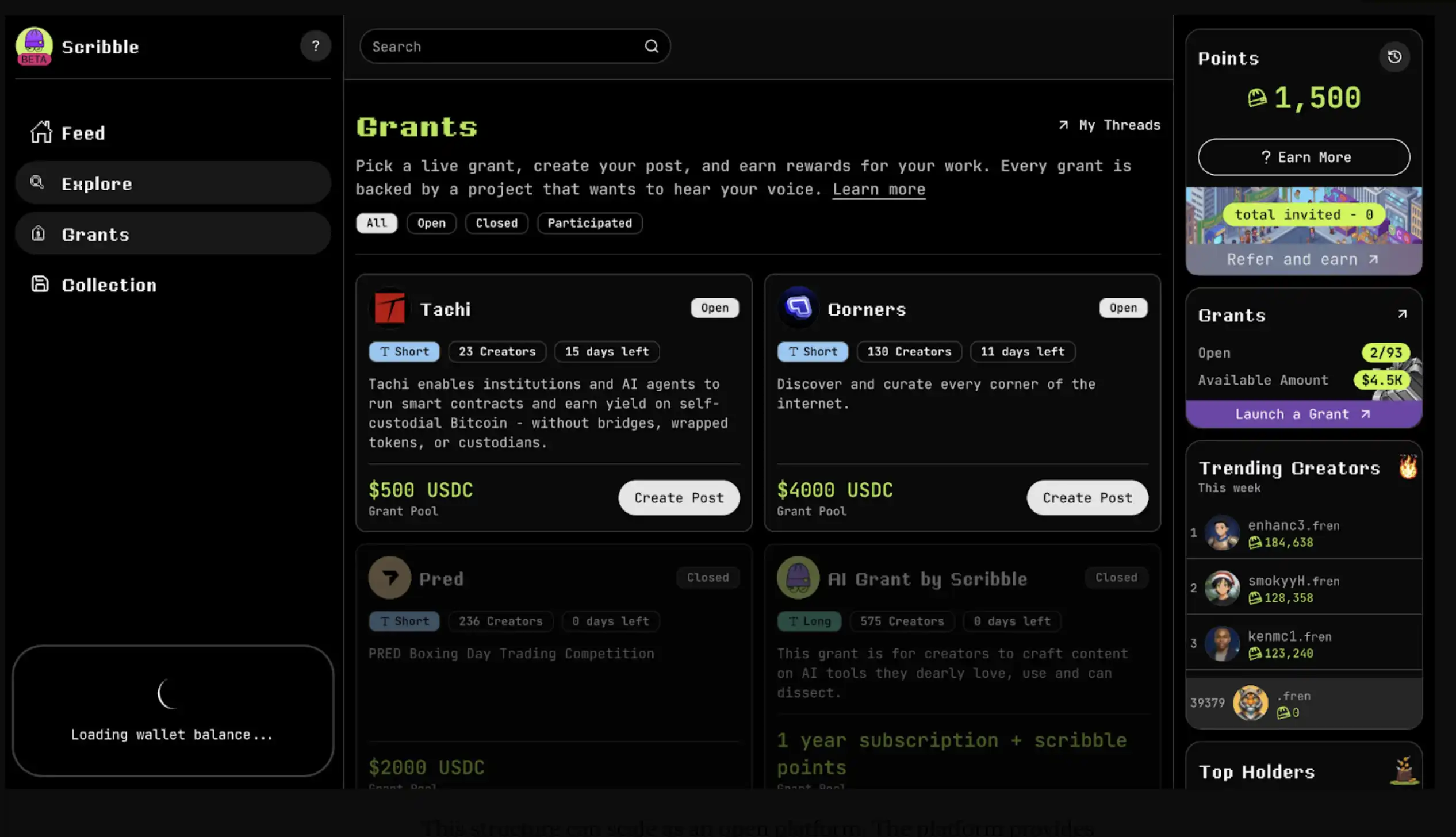
Scribble is a typical example. The project team issues grants in the form of "bounty tasks," while KOLs (Key Opinion Leaders) create content and submit it for review. Rewards can only be claimed after approval. This mechanism is not real-time tracking with instant settlement, but rather follows a "submission-review" process model.
This structure has the potential to become an open platform: the platform provides matching services and infrastructure support, while specific event operations and content management remain the responsibility of individual projects. As more projects join, the KOL (Key Opinion Leader) pool will expand accordingly. With the growth of the creator community, project teams will also have more potential partners to choose from for collaboration.
However, its drawbacks are equally evident: the uncertainty is very high for KOLs (Key Opinion Leaders). If their content is rejected, the time they've invested becomes a total sunk cost. After experiencing multiple failures, KOLs are likely to leave the platform altogether.
The Korean-style "Brand Blog" Model
Source: Revu
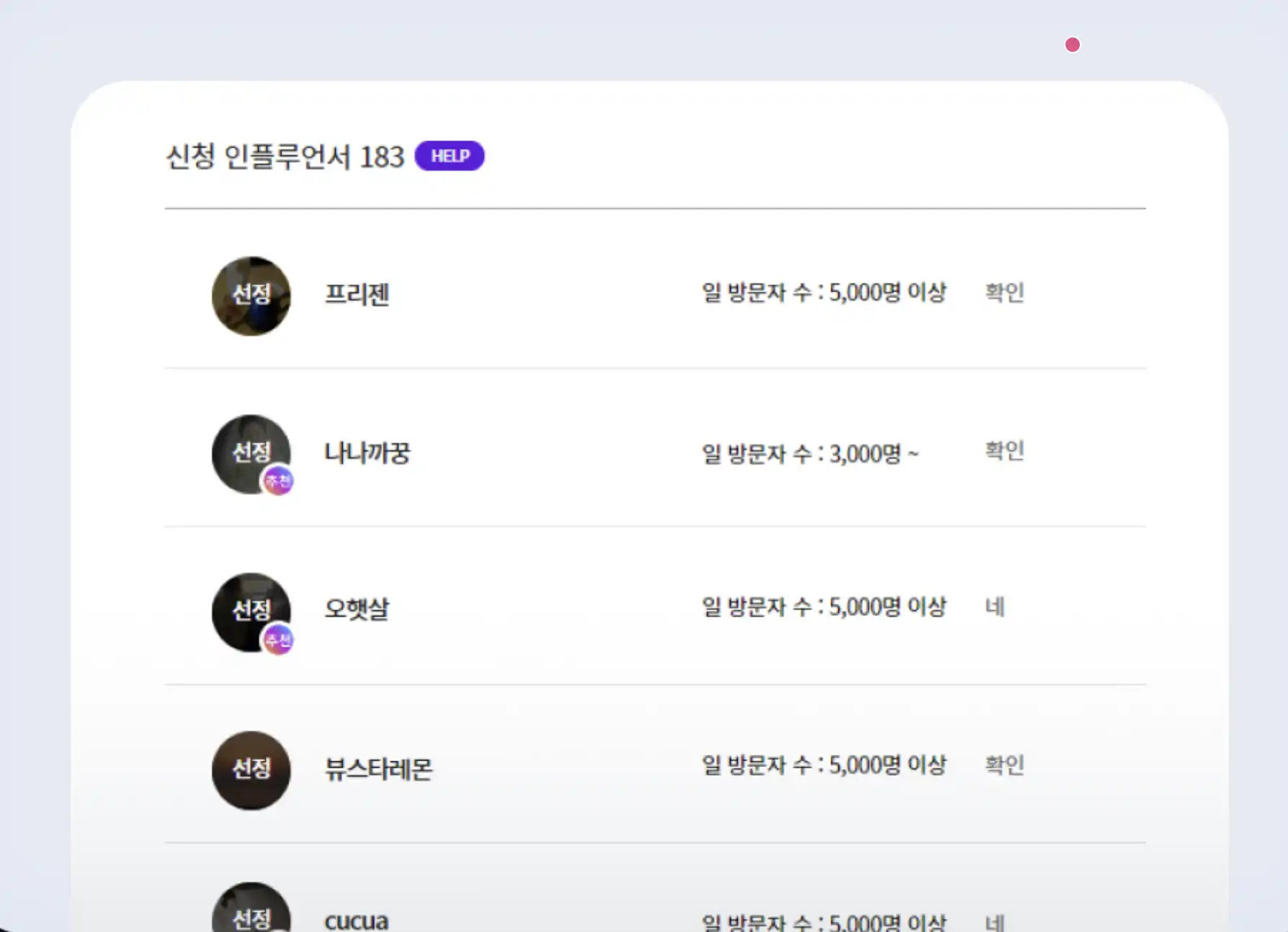
South Korea's "brand blog" model follows a path of "screening first, then managing," rather than the "create content first, review later" approach used by bounty platforms. Organizations like Revu have been operating under this model for over a decade.
The process is also clear: the project team first sets the target number of participants and launches the campaign. After creators submit their applications, the project team selects the collaborating KOLs based on data such as their follower count and past performance. Selected KOLs will receive clear content guidelines and writing requirements. After the content is published, it will be reviewed by the operations team. If it does not meet the standards, revisions will be required. If the content is not submitted on time, the KOL may face penalties or fines.
The biggest advantage of this model is that creators are almost never "working in vain." As long as they pass the screening and follow the guidelines, their payment is essentially guaranteed, avoiding the risk of "completing the work only to be rejected, with all labor costs lost," which can happen with bounty systems. For project initiators, since collaborators are pre-screened, quality control becomes easier, and the overall execution is more manageable.
Multi-platform Expansion
If X becomes unavailable, the next practical option is to shift our presence to platforms like YouTube, TikTok, and Instagram. In fact, within the Web3 community, "moving away from X" has already become a consensus: if one truly wants to achieve meaningful growth, it is necessary to transition from a community primarily composed of crypto-native users to channels with broader audiences.
The biggest advantage of this approach is that its potential user base is significantly larger than that of X. Particularly in emerging markets such as Southeast Asia and Latin America, the influence of TikTok and Instagram may even be stronger. At the same time, different platforms have distinct content distribution mechanisms. Even if one platform faces restrictions, exposure and operations can still be maintained through other channels.
However, the cost is a sharp increase in operational complexity. On X, only text and interactions need to be reviewed; on YouTube, the upload duration and production quality directly determine performance; on TikTok, the first three seconds almost determine success or failure; and on Instagram, the team must evaluate Stories, layout, and format completeness. This requires the team to have platform-specific operational capabilities or to build new tools and processes. At the same time, each platform's API policies and data scraping methods are inconsistent, which is equivalent to "building the system from scratch again."
Policy-related risks still exist, and any platform may suddenly change its rules, just like X did. However, a multi-platform strategy can at least reduce the risk of relying on a single platform. For larger projects, this is also the only direction that still offers "scalability potential."
KOL Management Model of MCN
In the Web2 MCN model, a KOL's brand value itself determines their commercial value; however, in Web3, this effect is even more extreme. Narratives drive capital flows, and the influence of opinion leaders is amplified to the point where they can directly impact cryptocurrency prices—just a single comment can trigger market fluctuations.
Some successful InfoFi projects have already cultivated a group of active and highly aligned KOLs (Key Opinion Leaders). These KOLs are not externally recruited on a temporary basis, but have gradually grown within the platform through months of participation. Compared to Web2 MCNs that rely on continuously "discovering new talent," InfoFi is more likely to retain these existing KOLs and shift the platform's advantages toward data-driven management and content distribution.
The so-called "MCN-ization" implies that collaborative relationships will shift from loose, voluntary participation to more formal contracts and binding agreements. Leveraging long-term accumulated data and relationship networks, platforms will gain stronger bargaining power within the Web3 ecosystem, making it easier to secure more favorable cooperation terms and prime resource placements.
However, this path imposes higher requirements on the InfoFi project: it must have a sufficiently robust management system, and "data" will become a core asset. If the platform can use data to guide KOLs' content production pace, content direction, and conversion effectiveness, and provide project teams with more professional, data-driven GTM (go-to-market) strategies, this model could potentially form a more long-term competitive barrier.
InfoFi 2.0
The collapse of InfoFi has left two important lessons for the entire Web3 ecosystem.
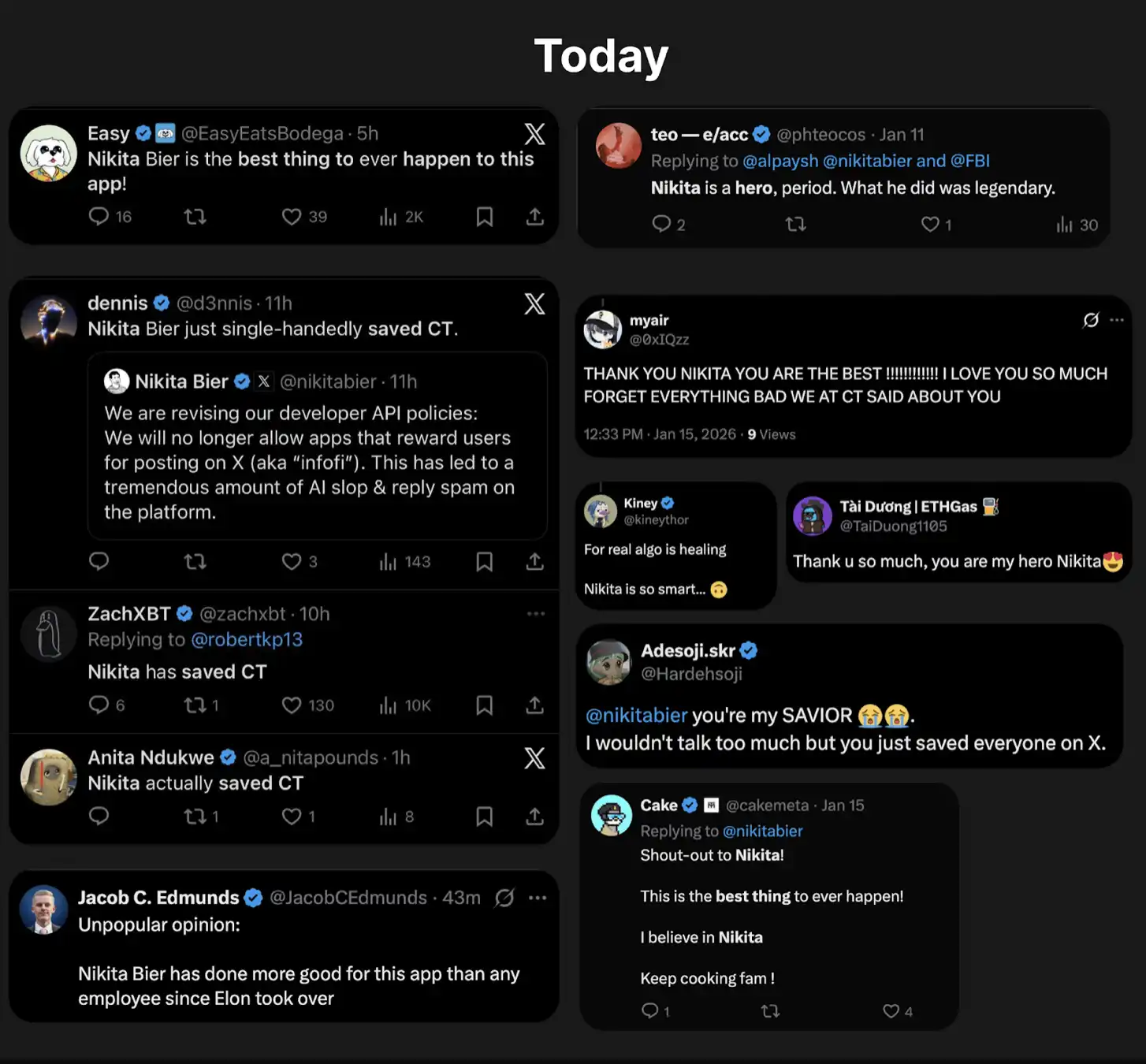
First, there is the irony of decentralization: many Web3 projects actually heavily rely on the centralized platform X, and a single decision by X can be enough to bring down the entire system.
Second, there is the boundary of incentive design: while the reward mechanism successfully attracted a large number of participants, the platform lacked effective quality control measures. As a result, low-quality content and traffic manipulation rapidly proliferated, providing X with sufficient grounds to intervene and block the platform.
Source: X (@nikitabier)
Does this mean that InfoFi has ended?
Not entirely. A few projects that have truly achieved product-market fit (PMF) may still continue to survive by changing their forms, such as expanding to multiple platforms, conducting more selective marketing campaigns, or upgrading to an MCN-style KOL management model.
However, InfoFi 2.0 is likely to become smaller, more controllable, and place greater emphasis on content quality. It will shift from the previous open, permissionless, and scale-focused "platform model" toward a curated network of partners. It will function more like an integrated marketing platform, combining localized GTM strategies with components such as offline advertising to form a more complete and closed-loop execution system.
However, the fundamental issues remain.
Joel Mun from Tiger Research House pointed out that once a reward mechanism is introduced, participants inevitably seek ways to "milk the system," making it nearly impossible to design a fair incentive structure. Such behavior continuously lowers content quality, creating a negative feedback loop that ultimately harms the platform itself—this is a critical challenge that InfoFi projects must directly address.
David raised a more fundamental question. He argued that the value of the InfoFi token is less based on the platform's actual performance and more built upon "staking airdrops" and "narrative belief." However, both of these factors have now lost their practical relevance, bringing the issue directly to the forefront: why should investors still buy InfoFi's tokens?
If InfoFi 2.0 wants to survive, it must provide clear answers to these questions. A project that is disconnected from its token holders will ultimately struggle to achieve true sustainability.
Click to learn about BlockBeats' job openings.
Welcome to join the official Lulin BlockBeats community:
Telegram Subscription Group:https://t.me/theblockbeats
Telegram discussion group:https://t.me/BlockBeats_App
Official Twitter account:https://twitter.com/BlockBeatsAsia