





Key Insights
- Japan’s 5-year government bond yield reaches highest level since 2007.
- BOJ Governor Ueda signals continued rate hikes if economy holds.
- Policy rate stands at 0.75%, the highest level in 30 years.
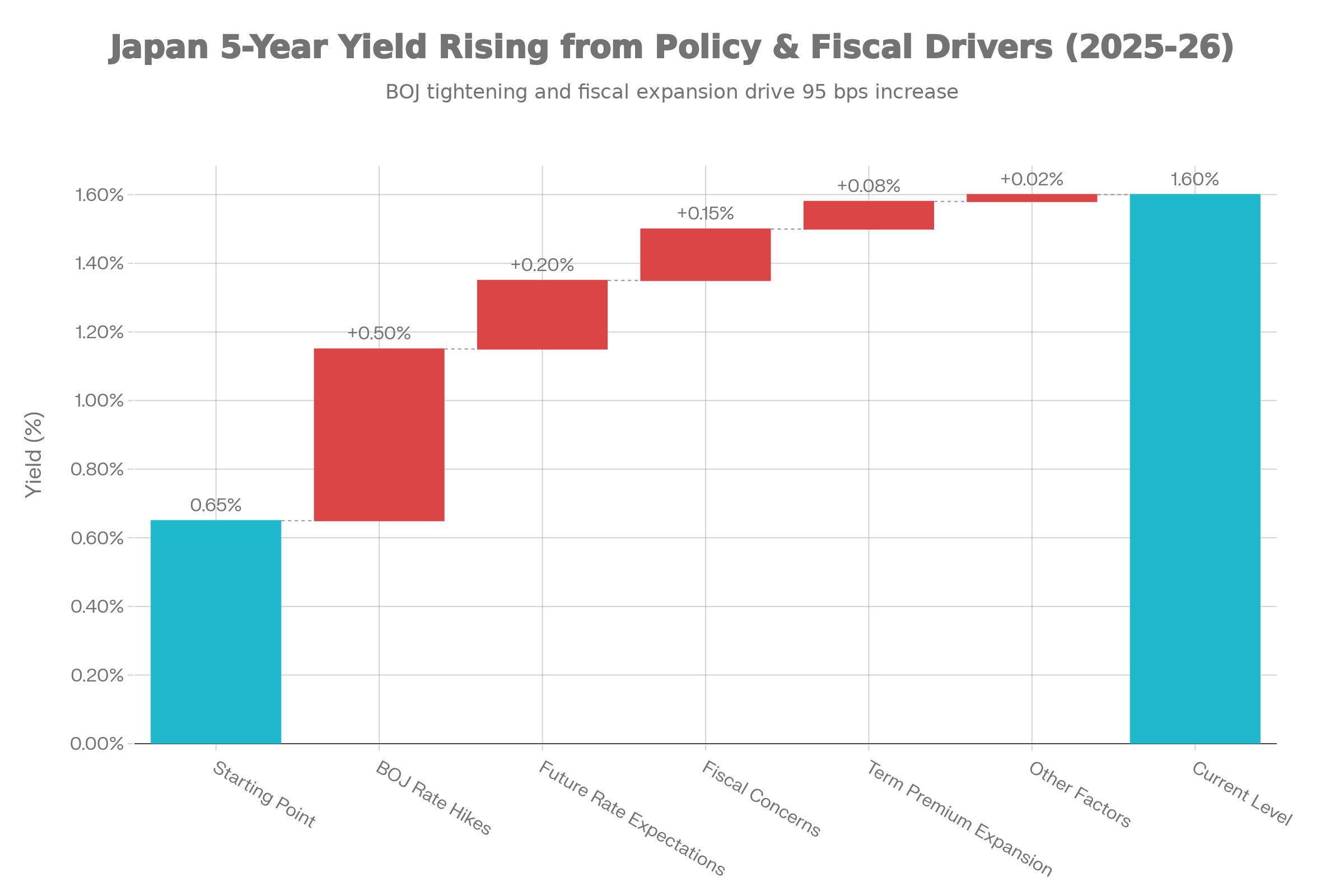
Japan’s 5-year government bond yield reached 1.60% on January 5, matching its highest level since June 2007.
The milestone came as Bank of Japan Governor Kazuo Ueda signaled the central bank will continue raising interest rates if economic and price developments move in line with forecasts.
The BOJ raised its policy rate to 0.75% from 0.5% last month, marking a 30-year high and taking another step in ending decades of monetary support.
BOJ Governor Signals Continued Monetary Tightening
Bank of Japan Governor Kazuo Ueda stated on Monday that the central bank will continue to raise interest rates if conditions warrant.
Japan’s economy sustained a moderate recovery last year despite pressure from higher U.S. tariffs on corporate profits. Ueda delivered his remarks in a speech to the country’s banking sector lobby.
The BOJ governor said wages and prices are highly likely to rise together moderately. He stated that adjusting the degree of monetary support will help the economy achieve sustained growth.
Markets are focusing on the BOJ’s quarterly outlook report scheduled for its policy meeting on January 22-23. The report will provide insight into how the board views the inflationary impact of recent yen falls.
Consumer inflation has exceeded the BOJ’s 2% target for nearly four years. Real borrowing costs remain deeply negative even after recent rate increases.
The policy rate of 0.75% is the third interest rate increase since the BOJ initiated its historic exit from negative rates in March 2024.
Government Bond Yields Reach Multi-Decade Highs
Japan’s 10-year government bond yield briefly hit 2.125% on Monday, reaching a 27-year high not seen since February 1999.
The 5-year yield climbed to 1.60%, matching levels last observed in June 2007. Market expectations of further BOJ rate hikes have pushed yields higher across the curve.
The bond market repricing entered 2026 with major movements that have not occurred in nearly two decades. The yield increase is a wholesale transformation in market expectations regarding Japan’s monetary policy trajectory.
The dollar rose 0.2% to 157.08 yen on Monday after reaching 157.255 for the first time since December 22. Currency movements have created additional complications for the BOJ’s policy decisions.
Inflation and Currency Dynamics Force Policy Shift
Japan has experienced inflation above the BOJ’s 2% target for approximately four years. The yen’s weakness has increased import costs, creating broader inflationary pressures across the economy.
Finance Minister Satsuki Katayama stated that Japan is at a critical stage of shifting to a growth-driven economy from one mired in deflation.
She delivered her remarks before the same banking lobby as Governor Ueda. The government’s messaging aligns with the BOJ’s policy direction toward normalization.
The BOJ projects that Japan’s economy will sustain moderate growth with inflation anchored around its 2% target.
Real interest rates remain negative even with the policy rate at 0.75%. The gap between nominal rates and inflation suggests the BOJ has substantial room for additional increases.
Finance Minister Endorses Crypto Exchange Integration
Finance Minister Katayama declared 2026 the “Digital Year Zero” and pledged support for traditional exchanges to distribute digital assets. Her remarks at the Tokyo Stock Exchange’s New Year opening ceremony represent a shift in Japan’s stance toward cryptocurrency.
The government is moving beyond experimentation toward institutionalization of digital asset trading.
Katayama stated that exchanges are crucial for public access to digital assets. She emphasized that adoption should be driven by exchange infrastructure rather than alternative trading venues.
The Financial Services Agency proposed reclassifying 105 cryptocurrencies, including Bitcoin and Ethereum, as financial products under the Financial Instruments and Exchange Act.
The reclassification addresses years of investor complaints about inconsistent treatment and high taxation. The reform creates a unified regulatory framework for approved cryptocurrencies.
The post Japan 5-Year Yield Hits 2007 High as BOJ Signals More Hikes appeared first on The Market Periodical.