





Original author: Eddie Xin, Chief Analyst at OSL Group
They were scamming us the whole time.
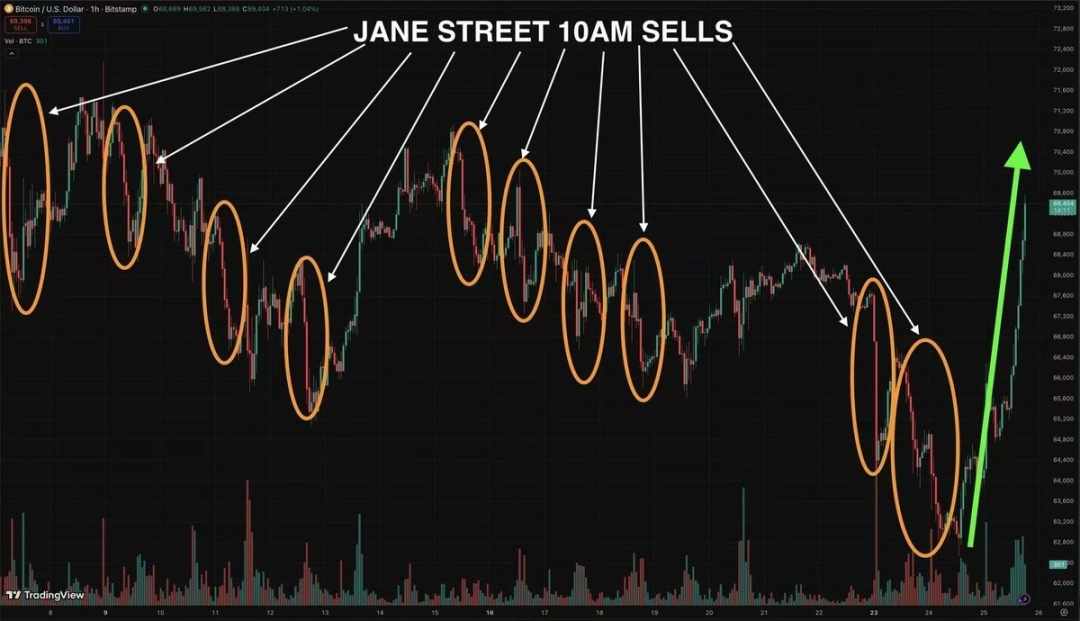
This profanity, which spread across Reddit and Crypto Twitter after the lawsuit, alongside a historic short squeeze with over $240 billion in liquidations, directed the market’s fury toward a single target: Jane Street Capital.
At 10 AM, this long-standing liquidity low point in the Asian market has finally begun to reveal its surface, following the U.S. Department of Justice’s complaint. The entire affair stems from Jane Street Capital, a top-tier Wall Street market maker founded in 2000, which is accused of executing a months-long “smokescreen” by exploiting the creation and redemption mechanism of spot ETFs to arbitrage between spot and derivatives markets through targeted ETF arbitrage.
Until a lawsuit brought this dispute into the public eye, discussions around the ETF arbitrage mechanism and price discovery structure rapidly intensified, triggering a massive market rebound and an epic short squeeze with over $240 billion in liquidations.
But is Jane Street really the culprit that pressed the suppression button? That’s a question worth at least $1 billion.
I. Did Jane Street really suppress the BTC price?
This question deserves an accurate answer, and the most important thing to understand first is that this is not just about Jane Street.
This is a question regarding the structural characteristics of a Bitcoin ETF, which applies equally to every authorized participant (AP) in the ecosystem. For BlackRock’s IBIT alone, this list includes Jane Street, JPMorgan, Macquarie, Virtu Americas, Goldman Sachs, Citadel Securities, Citigroup, UBS, and ABN AMRO.
The roles of these institutions have indeed been deeply misunderstood, even among seasoned industry veterans, and this misunderstanding deserves to be corrected before any conclusions are drawn.
Regarding APs, it’s important to understand that they occupy a niche exception within the regulatory framework of Regulation SHO (the SEC’s short-selling rule). For instance, Regulation SHO requires short sellers to locate shares before shorting, but APs are exempt due to their contractual rights to participate in creations and redemptions.
Although this may sound procedural, the practical implications are significant: any AP can arbitrarily create shares—without borrowing costs, without the capital commitment traditionally associated with short selling, and without a hard deadline for closing the position beyond commercial reasonableness.
This is the gray area: a regulatory exemption designed for orderly ETF market-making that is structurally indistinguishable from regulatory arbitrage with unparalleled duration. This exemption is not exclusive to any single company—it is a prerequisite for membership in the AP Club.
II. What does this AP exemption mean?
Typically, if IBIT trades below its net asset value (NAV), you would expect arbitrage buyers to step in, redeem shares for bitcoin, and eliminate the spread. However, any AP is itself that arbitrage buyer—they control the pipeline—meaning their incentive to close this spread differs from that of a third-party trading desk without redemption rights.
It may sound complicated, but it becomes much easier to understand with a simple analogy:
Layer 1: What is a normal "spread flattening"?
Suppose there is a blind box on the market (this is the IBIT ETF), and everyone knows that inside the blind box is a genuine Bitcoin voucher worth $100 (this is the net asset value, or NAV). But today, due to market panic, the blind box is trading at $95.
Logically, a savvy merchant (arbitrage buyer) would eagerly spend $95 to buy a blind box, then go to the official platform to open it and exchange it for $100 worth of Bitcoin, pocketing a risk-free $5 profit.
Because everyone is rushing to buy blind boxes for arbitrage, the demand will quickly push the price back up to 100 yuan. This is called "closing the price gap."
Layer 2: AP of the "Monopoly Channel"
But in the real world of Bitcoin ETFs, ordinary trading firms and retail investors are not eligible to go to the official channel to “open the mystery box” (i.e., they lack creation/redemption rights). Only a handful of privileged Wall Street investment banks (Authorized Participants) have this ability—meaning APs monopolize the sole pathway for converting ETF shares into actual Bitcoin (they control the pipeline).
Layer 3: Why isn't AP playing by the rules of arbitrage?
If a regular third-party merchant saw this $5 risk-free arbitrage opportunity, they would act immediately—but APs are different. They run a smarter calculation: “Since only I can open these blind boxes, why rush? If I deliberately don’t bring the price back to $100, but instead exploit the current false impression of a $95 low price to go long or short on another market—like Bitcoin futures—I could make $20!”
In short, the market originally had an automatic correction mechanism (where buying arbitrage would push prices up after sharp declines), but since the sole trigger for this mechanism is controlled by APs, and APs found they could earn more elsewhere by maintaining the price spread, they had no incentive to restore prices to normal levels.
Retail investors are waiting anxiously for arbitrageurs to rescue the price, unaware that the only arbitrage大军 (AP) is right beside them profiting from this spread in other markets.
Three: The issue is not with Jianjie, but with AP's architecture.
The short exposure to IBIT can, in principle, be hedged by going long on spot Bitcoin, but this is not mandatory—as long as the chosen instrument maintains a high degree of correlation.
The obvious alternative is BTC futures, especially given their capital efficiency. This essentially means that if the hedging instrument is futures rather than spot, the spot is never purchased, and due to natural arbitrageurs choosing not to buy spot, this spread cannot be closed by natural arbitrage mechanisms.
It is worth noting that the spot/futures basis itself is the central focus of the entire group of basis traders, who strive to maintain the tightness of this relationship. However, each divergence between the hedging instrument and the underlying asset introduces dirty basis risk, which accumulates throughout the structure—and under stressed conditions, basis risk is precisely where market dislocations occur.
The final piece involves the SEC’s recent approval of in-kind creation and redemption. Under the previous cash-only system, APs were required to deliver cash to the fund, after which the custodian used that cash to purchase spot Bitcoin—this purchasing action served as a structural regulator, mechanically mandating spot purchases as a direct consequence of creations.
Physical redemption completely eliminates this issue, allowing any AP to directly deliver Bitcoin, with full control over the timing and counterparty of acquisition—whether through OTC desks, negotiated pricing, or minimizing market impact.
The broadest interpretation of this flexibility is that an AP can maintain derivative positions designed to capture funding rate or volatility profits during the time window between short position establishment and physical delivery, while ensuring that each individual step still complies with the definition of legitimate AP activity.
And this is precisely where the problem lies: the beginning appears to be normal market-making behavior, the end appears to be normal market-making behavior, but the middle process is difficult to clearly categorize. This is not an accusation against any single company. Every AP on the IBIT list—and by extension, every AP for every Bitcoin ETF—operates within the same structural framework, enjoys the same exemptions, and therefore possesses the same theoretical capabilities. Whether any of them have exercised these capabilities in a manner bordering on coordinated activity falls entirely within the scope of the “monitoring sharing agreements” required by the SEC when approving the ETF.
Whether these protocols are sufficient to capture behaviors that span spot, futures, and ETF markets—even across offshore trading venues—remains a genuinely open question.
In short, Jan Street has merely been thrown into the spotlight; the real issue lies buried in the underlying architecture of the Bitcoin ETF, meticulously designed by Wall Street veterans. No AP is deliberately suppressing Bitcoin’s price—what the AP structure can suppress is the very integrity of the price discovery mechanism, which may have far more profound consequences.
So, the real question to ask isn't whether a specific company is the villain, but whether a regulatory framework built for 20th-century traditional finance is suitable for safeguarding a 21st-century asset whose value lies in being beyond the control of regulators?
This may be the tuition fee required for the crypto market to enter the "era of institutional players," as while we welcome the liquidity injection from Wall Street, we do not wish to passively accept the black-box games they construct using regulatory exemptions.
This is not just about the answer to Jane Street, but the ultimate question of the Bitcoin ETF era.