





The U.S. Treasury and the Internal Revenue Service (IRS), the tax watchdog, have proposed that crypto brokers use default electronic delivery for crypto tax forms for customers.
In a bid to overhaul its crypto tax reporting regime, the IRS seems ready to reduce the compliance burden for brokers (exchanges and other crypto platforms).
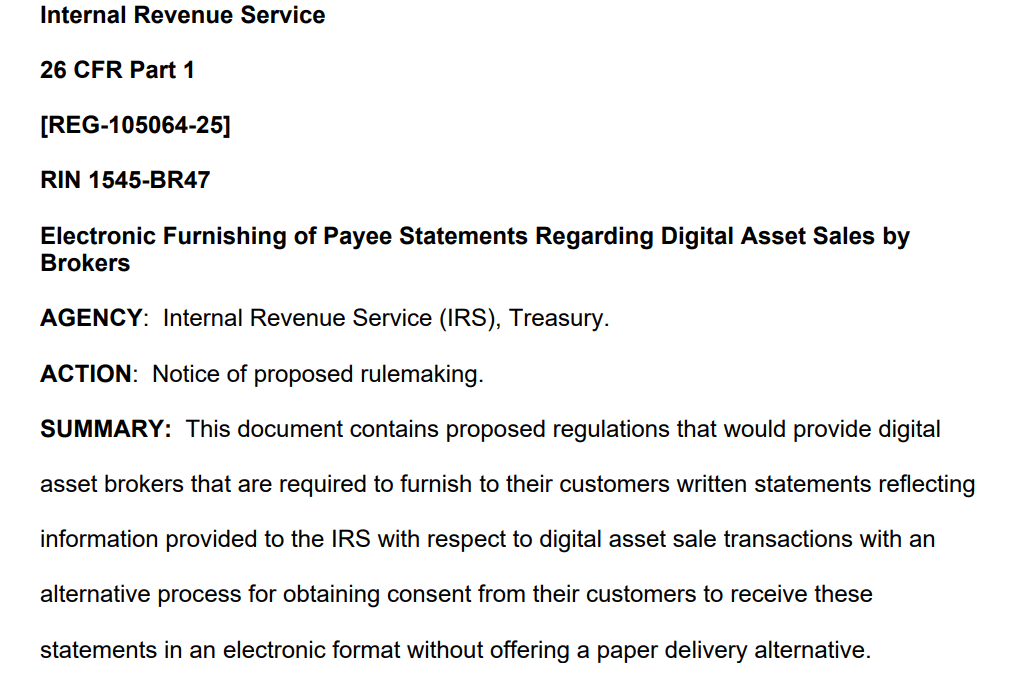
Source: Federal Register
Currently, the IRS requires brokers to submit two crypto tax forms, one to the regulator and another to the customer.
For customers who haven’t signed up for email, their paper tax forms are physically mailed. If an exchange handles over a million users, they have to send +1 million paper crypto tax forms via physical mail per year for the same – An overwhelming cost and compliance burden.
Under the latest proposal, the IRS seeks to stop offering paper copies entirely and have crypto tax forms delivered by email by default. Stakeholders have 60 days to provide feedback on the proposal before the IRS issues formal guidance.
Will crypto staking tax be resolved?
While the push for a crypto tax reporting regime may be positively welcomed by brokers, there are other unresolved issues too. For example, U.S investors still face double taxation for crypto staking rewards.
Currently, the IRS treats crypto staking rewards as income tax guidelines. As such, if an investor receives 1 Ethereum [ETH] as a staking reward, the value (currently at $2000) will trigger an income tax immediately when you receive it.
At the same time, if you hold it and offload it later, say, when ETH surges to $4k, capital gains tax will also apply.
U.S lawmaker Mike Carey has been pushing the U.S Treasury and the IRS to clarify and offer relief on crypto staking taxes. In a recent House committee hearing, Carey sought a similar direction from IRS officials.
“America needs to be the crypto capital of the world. Our tax code needs to reflect that priority, especially for crypto stakers and miners.”
In response, Frank Bisignano, the IRS’s CEO, said he will soon brief the legislator on the ongoing reviews and the way forward for treating crypto staking rewards for tax purposes.
It remains to be seen whether the said IRS review will offer miners and stakers tax relief. However, critics have argued that double taxation will likely push more investors to offshore jurisdictions with more lenient crypto staking tax regimes.
Final Summary
- The IRS has proposed an overhaul of the crypto tax reporting regime that seeks to scrap out mailing of paper-based crypto tax forms and opt for e-mail by default.
- Congressman Mike Carey is pushing the IRS to table crypto tax reviews to resolve the current double taxation of mining and staking rewards.