



Authors: Brayden Lindrea, Felix Ng
Compiled by DeepChain TechFlow
DeepChain Summary: This report uses on-chain data to quantify the real scale of cryptocurrencies as a capital escape route during geopolitical crises—nearly $3 million was withdrawn within a single hour after the airstrike. But the other half of the story is equally noteworthy: the Iranian government immediately cut off internet access, blocking this escape route as well. Elliptic and TRM Labs reach conflicting conclusions; readers can judge for themselves.
The full text is as follows:
Within minutes of the U.S. and Israel launching airstrikes on Tehran on Saturday, Iran’s largest cryptocurrency exchange experienced a massive wave of withdrawals. However, widespread internet outages subsequently curbed further outflows of funds.
Blockchain analysis firm Elliptic said on Monday that cryptocurrency withdrawals from the Nobitex exchange surged more than 700% within minutes after the initial airstrike, exceeding $500,000. Charts showed that withdrawal volumes in a single hour later that day approached $3 million.
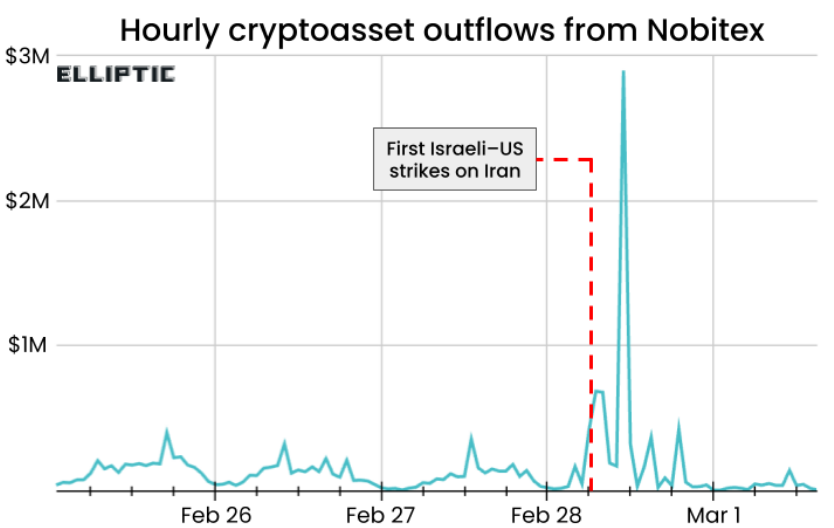
Elliptic stated that the sharp increase in withdrawal volumes "may indicate capital flight from Iran," with its initial tracking showing that substantial funds were transferred to offshore crypto exchanges.
“This allows funds to be transferred out of Iran while circumventing part of the global banking system’s scrutiny,” said Elliptic.
However, Nobitex's withdrawal volumes dropped sharply after Saturday. Another cryptocurrency forensic platform, TRM Labs, attributed this to Iranian authorities implementing strict internet shutdowns.
TRM noted that shortly after the conflict erupted, Iran's internet connectivity dropped by approximately 99%.
TRM also disputes Elliptic’s conclusion that “funds are fleeing Iran”:
Currently, the country’s crypto ecosystem shows no signs of acceleration or capital flight; on the contrary, transaction counts and volumes are declining as authorities enforce strict internet restrictions.
This outflow of crypto funds occurred against the backdrop of the United States and Israel seeking to overthrow Iran’s current regime and dismantle its nuclear weapons and missile programs. In response, Iran launched retaliatory airstrikes on neighboring countries, further escalating regional instability.
Nobitex is Iran's largest cryptocurrency exchange, handling approximately 87% of the country's crypto trading volume. In 2025, its trading volume reached about $7.2 billion, with over 11 million users.
Tens of millions of people in Iran have been affected by the recent banking collapse.
Due to the fragility of Iran’s banking system and widespread international sanctions, Iranians have long relied on cryptocurrencies to store and transfer funds.
In October last year, Ayandeh Bank, one of Iran's largest private banks, declared bankruptcy after accumulating losses of $5.1 billion and liabilities of nearly $3 billion, affecting over 42 million customers.
Last year, Iran's central bank warned that eight additional local banks faced the risk of dissolution if they did not implement reforms.
Iran's cryptocurrency exchanges have also faced numerous issues—Nobitex suffered an $81 million hack in June.