





Author: Zen, PANews
The world’s spotlight is on Iran and the Persian Gulf. External discussions about Iran often revolve around two narratives: military and regime risks, and impacts on energy and shipping. Mainstream media coverage immediately focuses on military actions, oil and gas facilities, the Strait of Hormuz, and sharp fluctuations in financial markets.
But beneath these grand narratives, when you zoom in on ordinary individuals in cities like Tehran, Mashhad, and Ahvaz, you’ll find that during times of heightened tension, safeguarding life and assets is the top priority.
Following the U.S.-Israel strike, asset outflows from Nobitex, Iran’s largest cryptocurrency exchange, surged by approximately 700% within minutes. A Chainalysis report also confirmed that within hours of the strike, hourly transaction volumes of crypto assets within Iran rose sharply.
Over the four days ending March 2, more than $10 million worth of crypto assets have accelerated out of Iran. Iranian citizens are using cryptocurrency to channel their funds through a safer pathway.
Iran's economy under the dominance of the U.S. dollar
For Iran, any escalation in the Middle East situation rapidly transmits through the fragile nerves of exchange rates and the financial system, while cryptocurrency has unexpectedly become an important channel.
Over the past several years, Iran's economy has become increasingly entrenched in a cycle of external sanctions, internal imbalances, and currency depreciation. The persistent weakening of the fiat rial has long ceased to be merely a price fluctuation—it has become a widespread societal panic.
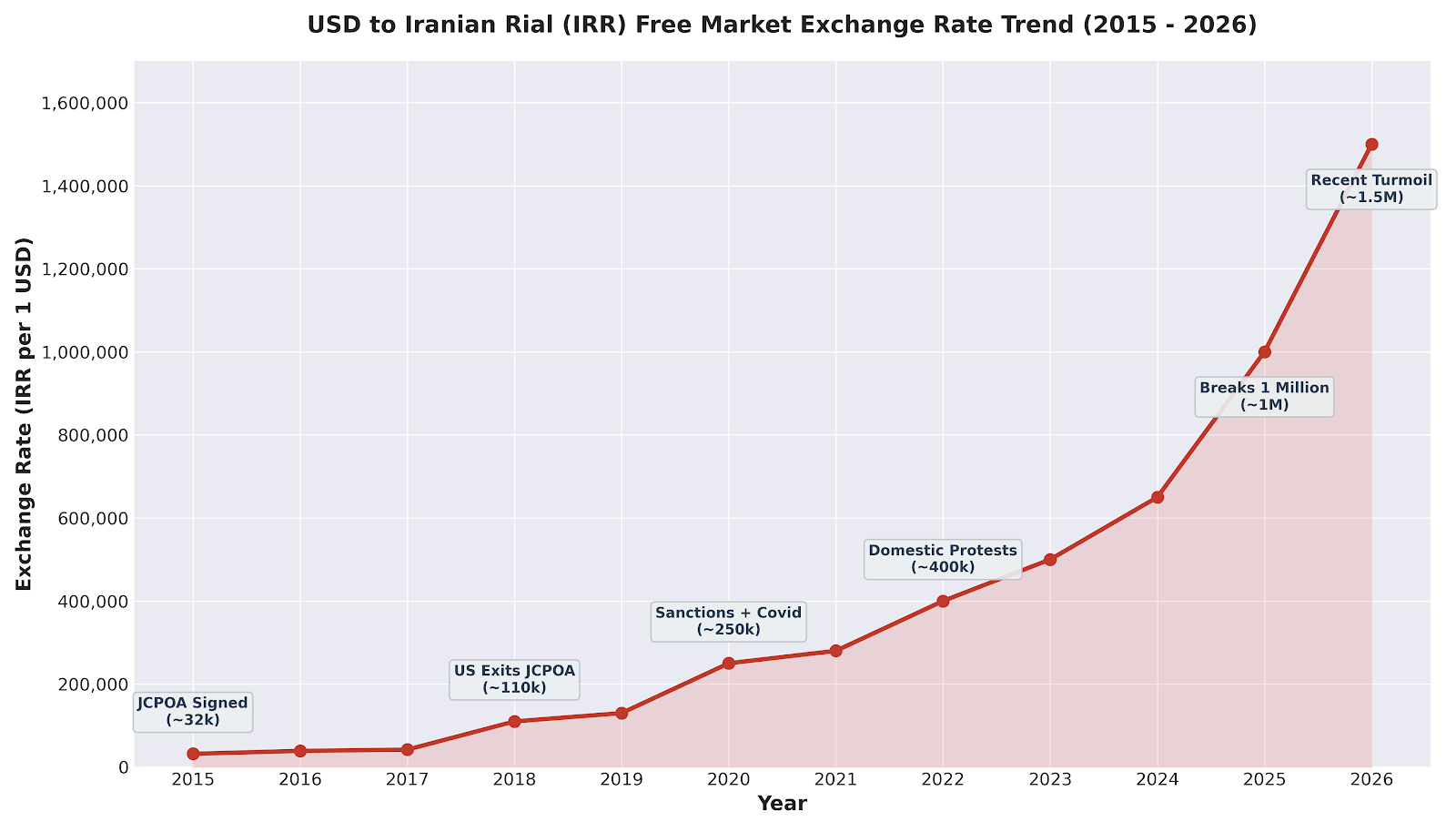
After the JCPOA nuclear deal was reached in 2015, the market anticipated sanctions relief; at the time, the free market exchange rate was approximately 32,000 rials per U.S. dollar. Since the United States withdrew from the JCPOA in 2018 and announced a phased reinstatement of sanctions, the rial quickly moved from tens of thousands to the "hundred thousand rial" era. Subsequent prolonged sanctions, combined with inflation, tight foreign exchange supply, and geopolitical tensions, caused the exchange rate to fall below one million rials in the first half of last year. During the wave of protests at the beginning of this year, it plunged to a historic low of 1.5 million rials.
In a global financial system centered on the U.S. dollar, Iran, subjected to sanctions that cut off its access, is forced to confront a situation dominated by the dollar and the ongoing depreciation of the rial.
The U.S. dollar, as the global hub currency in foreign exchange trading, enables stable and low-friction completion of cross-border transactions such as imports, debt payments, insurance, shipping, and procurement of critical components. Even if Iran’s printing presses run at full capacity and issue vast amounts of rials, they cannot replace this essential capability.
In many commodity and supply chain pricing systems, the U.S. dollar remains the natural pricing anchor; under sanctions, Iran finds it even harder to access U.S. dollar clearing services through normal banking channels, making entry points for hard currency scarce and expensive.
Therefore, many people expect to quickly exchange their rials for more reliable assets—such as U.S. dollar cash, gold, and cryptocurrencies like Bitcoin and stablecoins including USDT.
As an Islamic nation, financial activities must also comply with Sharia law. Islamic teachings strictly prohibit all forms of interest (Riba) and gambling (Gharar), and cryptocurrency trading, due to its high volatility and speculative nature, raises concerns in this regard.
However, Iran’s former Supreme Leader Khamenei has taken a relatively open stance toward cryptocurrencies and has called for Islamic law to evolve with the times. His remarks, in essence, reflect a pragmatic compromise driven by economic desperation.
From the government to the public, Iran needs cryptocurrency.
Due to long-standing sanctions and high inflation, both the Iranian government and its citizens are seeking alternatives to hard currencies in their own ways. This is why crypto assets, such as Bitcoin and USD-stablecoins, have gradually evolved in Iran from speculative items into nearly essential value tools—serving as a financial safety valve for citizens and a cyber bank for the state to circumvent sanctions.
The Iranian government's attitude toward cryptocurrency can be described as ambivalent—simultaneously leveraging and suppressing it.
At the national level, regulators may tolerate or even incorporate cryptocurrency activities when they provide alternative channels for import settlement, foreign exchange acquisition, or fund transfers—such as the early domestic legalization of Bitcoin mining. Cryptocurrencies also serve as a key component of Iran’s government and military’s “shadow financial network,” used to move funds and evade regulation.
According to TRM Labs, the company identified over 5,000 addresses associated with the Islamic Revolutionary Guard Corps (IRGC) and estimated that the organization has transferred $3 billion in cryptocurrency since 2023. The UK blockchain research firm Elliptic stated that Iran’s Central Bank received at least $507 million in the stablecoin USDT in 2025.
However, when cryptocurrencies are seen as accelerating the rial's depreciation, reinforcing expectations of capital flight, or creating an难以监管的民间金融网络, the Iranian government quickly shifts toward tightening restrictions.
In early 2025, Iran’s Central Bank (CBI) abruptly shut down all rial payment channels for cryptocurrency exchanges, leaving over 10 million crypto users unable to purchase Bitcoin and other digital assets using rials. Reports indicated that one of its primary goals was to prevent further depreciation of the rial and stop the rapid conversion of the local currency into foreign currencies or stablecoins through exchanges.
This cutoff of fiat currency access essentially uses administrative means to sever the most convenient channel for the public to convert rials into value. However, it does not mean that Iranian society no longer needs cryptocurrency; instead, it pushes demand toward more opaque and decentralized pathways, such as over-the-counter trading, alternative payment and receipt accounts, or more隐蔽 on-chain transfers.
When governments repeatedly resort to this governance approach during currency crises, the public's preference for "assets outside the system" is further reinforced, as each sudden restriction reminds them that financial rules can change at any time and that assets are not entirely under personal control.
At the individual level, demand for cryptocurrency is primarily driven by three factors: store of value, transferability, and speculation. According to TRM Labs, 95% of funds flows related to Iran originate from retail investors. Iran’s largest cryptocurrency exchange, Nobitex, reports having 11 million customers, with the majority of trading activity coming from retail and small-scale investors. The exchange states: “For many users, cryptocurrency primarily serves as a store of value to hedge against the ongoing depreciation of the local currency.”
Even more magically, in mid-2024, Telegram-based “tap-to-earn” crypto mini-games such as Hamster Kombat and Notcoin sparked a nationwide frenzy in Iran. Across Tehran’s subways and streets, countless Iranians frantically tapped their phone screens, hoping to combat soaring inflation through free crypto airdrops. Reports indicate that nearly a quarter of Iran’s population participated in these games. As the national currency lost credibility, even the faint hope of earning tiny virtual coins through tapping became a glimmer of light in the darkness.
Thus, in Iran, we see a paradox: on one hand, authorities, concerned that cryptocurrencies accelerate the rial’s depreciation and undermine capital controls, cut off rial payment channels at critical moments; on the other hand, under the long-term structural pressures of sanctions and foreign exchange shortages, cryptocurrencies have consistently proven their practicality. For ordinary Iranians, this practicality is especially vital, serving as an emergency lifeline amid crisis.
The covert battle over electricity and the growing number of "black miners"
Unlike direct confrontations on the frontlines with conventional weapons, Iran has for years been engaged in a silent struggle over its power resources.
In Iran, a country with scarce social resources, electricity is no longer merely a basic necessity but has been redefined as a strategic asset for arbitrage. However, the cost of this arbitrage is ultimately borne by ordinary residents, leading to severe electricity shortages.
Although Iran is a typical energy-rich country, it has long been caught in a cycle of power shortages and rolling blackouts. The main reasons are insufficient infrastructure investment, aging power generation and transmission systems, and price subsidies that have led to rapid demand growth.
In public statements during the summer of 2025, Iran’s power company Tavanir stated that cryptocurrency mining consumes nearly 2,000 MW of electricity—approximately equivalent to the output of two Bushehr nuclear power plants. More critically, mining accounts for about 5% of total electricity consumption but may represent 15%–20% of the current power shortfall.
Tavanir stated that during an internet outage related to the conflict with Israel, national electricity consumption dropped by approximately 2,400 MW; Tavanir attributed part of this decline to the shutdown of a large number of illegal mining rigs, claiming that the cessation of 900,000 illegal devices indirectly confirms the scale of underground mining operations.
The CEO of Tehran Province Electricity Distribution Company also stated that Iran has become the world's fourth-largest cryptocurrency mining hub, with over 95% of active mining machines operating without licenses, making it a "paradise for illegal miners" with an extremely high level of illegality. This claim shifts responsibility from the government onto ordinary Iranian citizens.
In recent years, Iranian authorities have publicly cracked down on illegal mining, yet the problem has only grown worse. This indicates that so-called illegal mining has evolved from a marginal phenomenon into a structural industry, driven not only by electricity price arbitrage but also by gray-area protection, law enforcement rent-seeking, and complex local interest networks—deeply entrenched with privileges.
Mosques and military-controlled industrial zones even enjoy the benefit of free mining.
Ordinary individuals and even private companies cannot obtain the electricity required to operate and cool such a large number of mining rigs. Professionals in the cryptocurrency mining industry believe that only industrial-scale operations can consume such vast amounts of electricity.
According to multiple media outlets and investigative agencies, Iran’s privileged class has taken absolute control of this electricity bonanza. In Iran, religious sites such as mosques are legally entitled to extremely cheap or even free electricity, leading many mosques to become noisy underground mining operations.
Meanwhile, massive mining operations are often hidden within military-controlled industrial parks and certain classified facilities exempt from power rationing limits. While the privileged class exploits free “state electricity” to aggressively mine Bitcoin, ordinary residents burdened by high inflation can’t even afford the basic luxury of electricity to run a fan on a summer night.
Ultimately, Iran’s electricity crisis and illegal mining are not merely public order issues, but a battle over subsidized resources, currency depreciation, and survival pressures. The pain of blackouts will linger in ordinary households’ summer nights.
Currently, under endless geopolitical conflicts and political uncertainty, Iran's economic future has once again been cast into shadow.