





Hold, waiting for a better entry point and an upward move in BTC.
Author: Benji @ IOSG
Source: IOSG

Key insight: STRC is an elegantly designed financing tool that converts fixed-income demand into buying pressure for Bitcoin. In a bull market, it offers a floating yield of 11.5% with low price volatility, but its risk structure is essentially equivalent to "selling a put option" on Bitcoin asset coverage—meaning it cannot substitute for genuine fixed-income products when BTC declines.
The true vulnerability of STRC is not the price of BTC, but its mNAV. If MSTR’s mNAV falls below 1.0x for more than four consecutive weeks, the flywheel will enter a downward spiral into passive mode within three months. We estimate a 70% probability that this trigger will occur in the second half of 2026, creating a buyable entry point for STRC at $85–$90. If the trigger does not activate, it means Saylor has successfully created an entirely new category of BTC-native credit instruments.
Part One Background
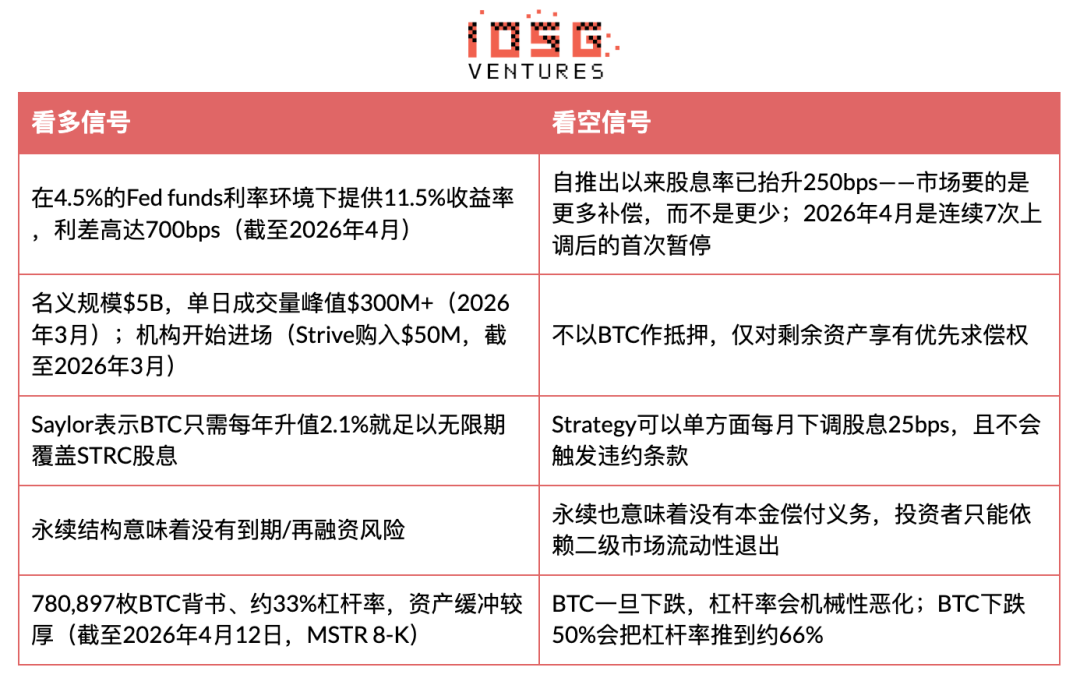
Strategy (formerly MicroStrategy) launched STRC ("Stretch"), a perpetual preferred stock with a target par value of $100, designed to maintain price stability through monthly floating dividends. As of March 31, 2026, STRC had a nominal outstanding size of $5 billion, with a single-day trading volume peak exceeding $300 million (as of March 2026 data). Since its launch, STRC has provided Strategy with over $3.5 billion in funding for BTC purchases and remains its most critical financing vehicle. As of April 12, 2026, Strategy held 780,897 BTC on its balance sheet with a leverage ratio of 33%, and approximately $21.6 billion in remaining issuance capacity under its STRC ATM program.
- This tool belongs to a novel category: it appears like a money market fund (with stable pricing and high yields), but its credit risk is entirely derived from a single company’s BTC holdings.
Before presenting the argument, clearly outline where we might be wrong.
If our analysis is wrong, it will be because traditional fixed-income allocators are genuinely willing to accept reflexive risk for a 700 bps spread; STRC grows to $50 billion within three years, becoming the de facto BTC yield curve; and Saylor successfully securitizes BTC into an interest-bearing collateral asset acceptable to institutional portfolios. This outcome would represent the largest-ever integration of crypto into traditional finance—a new asset class of over $50 billion that did not exist before 2025.
- Under this optimistic scenario, the dividend suspension in April 2026 is not a warning sign, but rather a feature: a mature instrument beginning to stabilize its returns after early price discovery, similar to the gradual downward repricing of early high-yield bond ETFs as institutional adoption progresses.
Part Two: Argument Breakdown
The core innovation of STRC: it transforms yield-seeking capital into buying pressure for BTC. When STRC trades near $100, Saylor issues new shares via ATM (accounting for approximately 40% of daily volume), uses the proceeds to purchase BTC, and then leverages the issuance of MSTR common stock at a price above NAV (mNAV > 1x) to deleverage. The end result: $100 million in daily STRC trading volume can mobilize approximately $120 million in BTC purchases.
The weakness in this mechanism lies in its underlying circularity: STRC remains stable at $100 because investors believe it will stay stable; and Saylor maintains this belief by continuously increasing dividends. This peg is not backed by collateral but by confidence, sustained by a continuous dividend auction with no formal upper limit. Once this confidence breaks, the auction becomes increasingly expensive.
Evidence and Comparison: STRC vs. Other Bitcoin Exposure Tools
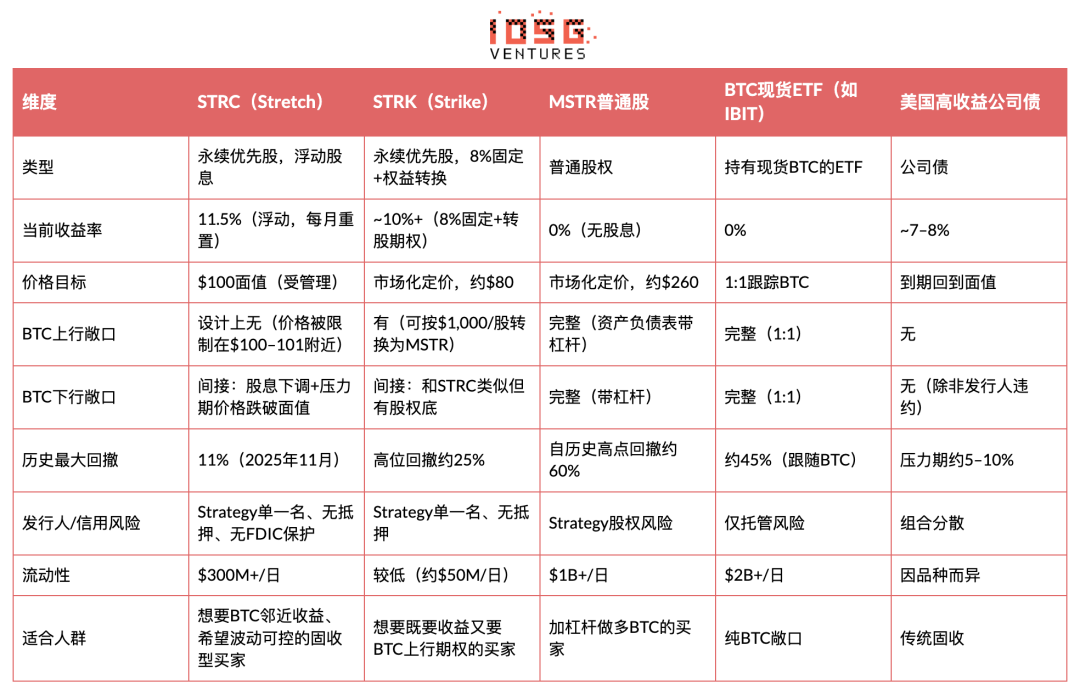
Key insight: For Strategy, STRC converts fixed-income demand into fuel for BTC accumulation. For investors, it delivers Sharpe-optimized returns in favorable conditions but implicitly carries a BTC "short put." NYDIG’s description is precise: “It’s akin to selling a put option on Bitcoin asset coverage—earning yield by assuming the downside risk of BTC price declines eroding the asset buffer.”
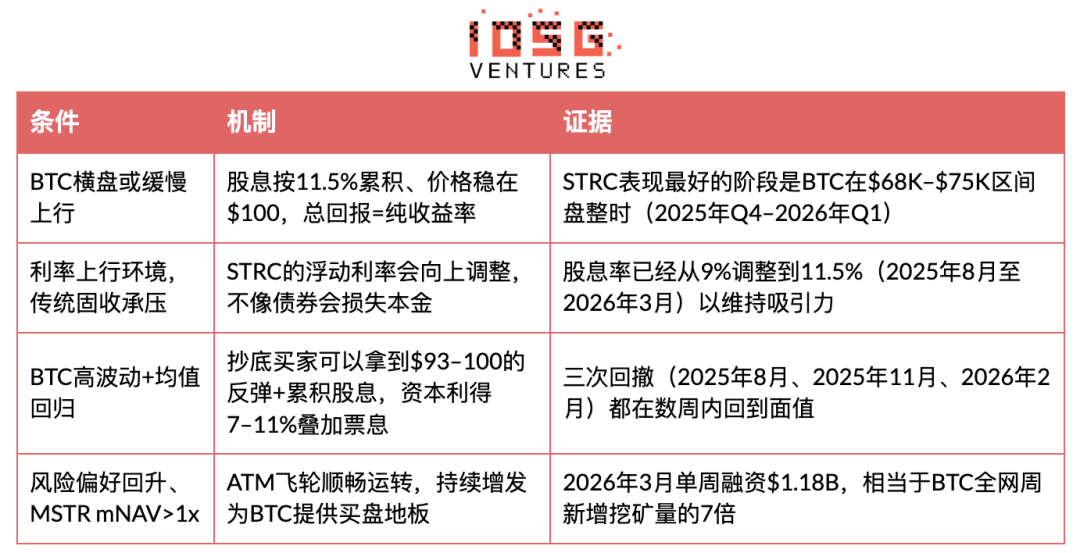
When does STRC perform well?
When does STRC perform poorly?
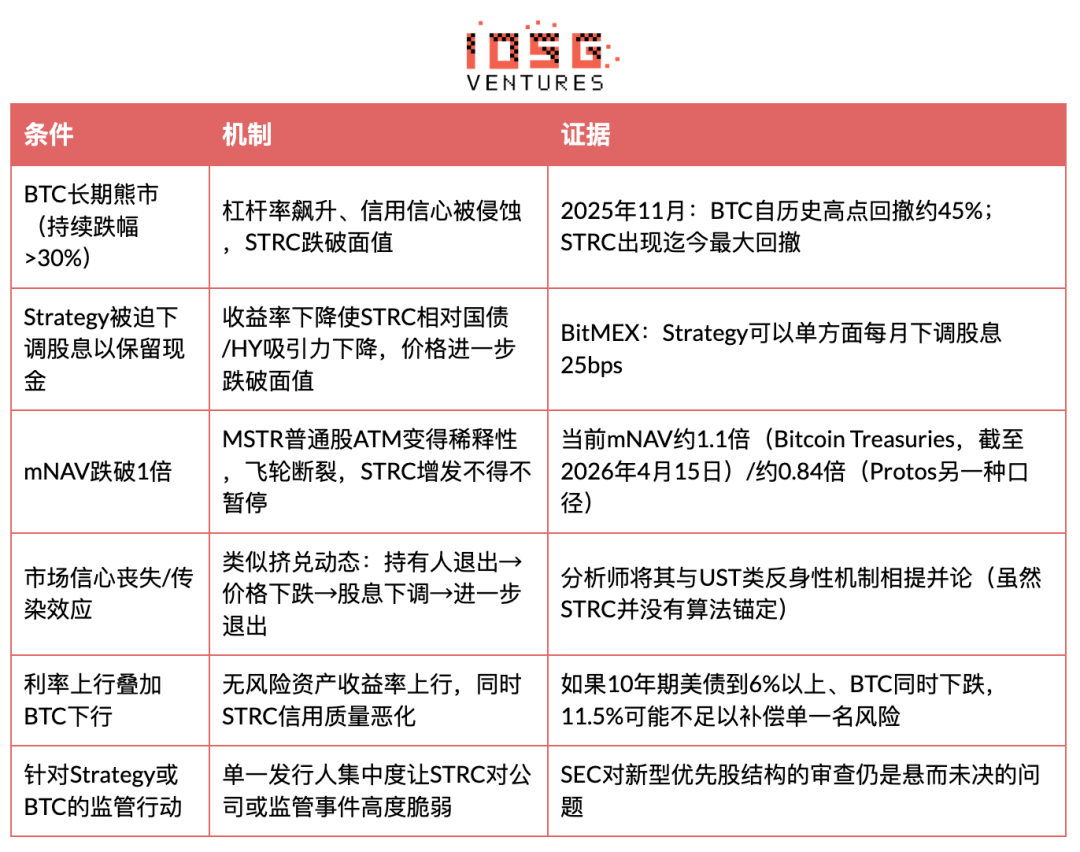
When will STRC crash: a death spiral scenario
The key question is: Will STRC enter a self-reinforcing downward cycle? The answer is yes, but only under specific conditions. This mechanism has three interconnected failure pathways.
Phase One: BTC Decline Breaks the $100 Anchor
When BTC experiences a sharp decline (e.g., a ~45% pullback from its all-time high at the end of 2025), the strategy’s leverage ratio mechanically increases. Based on 780,897 BTC and a 33% leverage ratio (as of April 12, 2026, per MSTR’s 8-K), if BTC were to fall another 50%, the leverage ratio would rise to approximately 66%. At this point, STRC’s credit quality deteriorates, as its priority claim on remaining assets becomes diluted. The price falls below $100. This scenario has occurred three times previously (August 2025: ~$92, November 2025: intraday low, February 2026: ~$93), but each time BTC quickly rebounded, pulling the anchor back up.
Phase Two: The Dividend Increase Trap
According to Strategy’s guidance submitted to the SEC: if the monthly VWAP is between $95 and $99, the dividend rate increases by 25 bps monthly; if it falls below $95, the rate increases by 50 bps monthly. From 9% to 11.5%, the dividend rate has risen by a cumulative 250 bps over approximately eight months (August 2025 to April 2026), averaging about 31 bps per month—faster than any comparable preferred stock has repriced under stable market conditions. April 2026 marks the first pause after seven consecutive increases. Two interpretations: (a) demand has stabilized—bullish; (b) Strategy has reached the traditional fixed-income buyer’s sensitivity ceiling for yield—bearish. This is the single most important signal to monitor over the next one to two months.
If BTC remains sluggish, dividends must continue to rise to attract buyers back near par value. At a $5B scale, each 100bps increase implies approximately $50M in additional annual cash outflows; if STRC expands to $20B (the authorized ATM limit), the cost per 100bps rises to $200M annually. A bear market lasting more than six months at the current pace of increases would push STRC’s yield to 13–15%; at this level, annual dividend payouts on a $20B scale would exceed $2.6–3.0 billion, consuming a significant portion of Strategy BTC’s potential returns and forcing a choice between “continuing to raise” or “abandoning the stable narrative.”
There is no formal cap on dividend increases, and this "unlimited" upward dynamic is precisely what bears are closely watching.
Phase Three: The Flywheel Breaks After mNAV Drops Below 1x
This is the true breaking point. The Strategy purchases BTC and deleverages by issuing MSTR common shares at a price above NAV (mNAV > 1x). If BTC falls sufficiently deep and mNAV drops below 1x, issuing common shares would dilute existing shareholders’ value, making it impossible for Saylor to deleverage through equity issuance. At that point, the Strategy faces a trilemma: (a) continue issuing STRC at a higher dividend yield and accept increased leverage; (b) unilaterally reduce the dividend (by 25 bps monthly) as per SEC filing terms, allowing STRC’s price to decline; or (c) sell BTC to cash in a falling market.
Saylor repeatedly claims he will never sell BTC. BitMEX Research concludes that (b) is the most likely scenario: "The strategy will not sell Bitcoin; it will instead abandon STRC in favor of a stable narrative." The pressure will fall entirely on STRC holders.
An early warning signal has lit up: During the week of April 6–12, 2026, MSTR’s ATM mechanism issued $0 in new shares—all funding was completed via STRC ($1.00B, 10.028 million shares; MSTR 8-K). The mNAV has tightened to the point where Saylor is unwilling to risk diluting common shares. The preconditions for Phase Three have been partially triggered—the flywheel is now spinning on one leg.
Quantitative collapse scenario
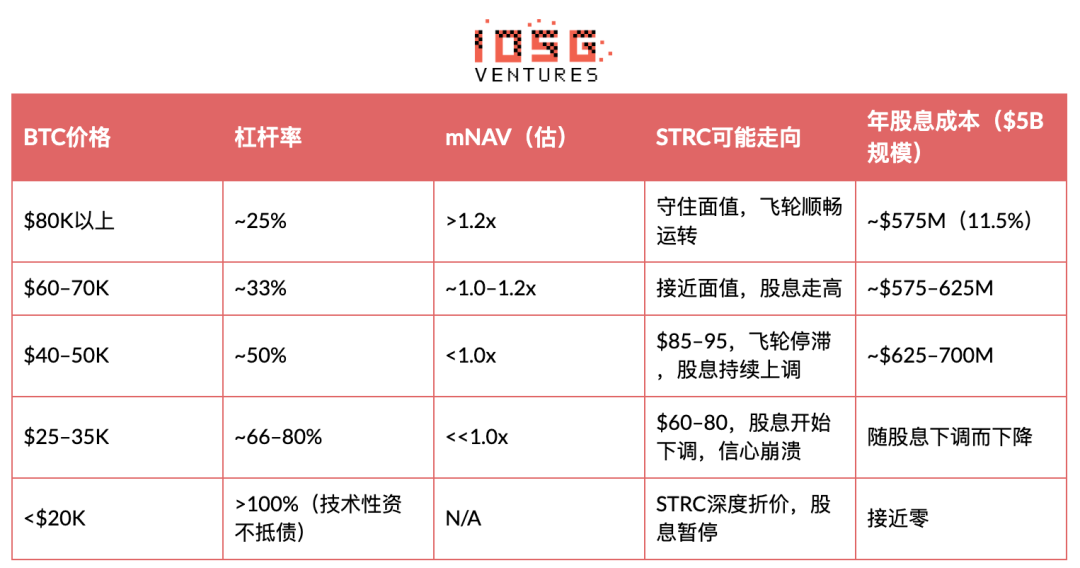
Why this is different from UST/Terra: UST relied on an algorithmic minting and burning mechanism, with its only backing being the native token (LUNA). STRC is backed by actual BTC, and the Strategy has discretion to reduce dividends rather than face forced liquidation. STRC’s floor is not zero—it represents a priority claim on remaining assets in the event of bankruptcy liquidation. However, if BTC falls more than 60% and remains at that level, this floor could be significantly below $100.
The key variable is time. Previously, every STRC pullback was corrected within weeks, as BTC rebounded. A true collapse would require a prolonged bear market (lasting more than three months below $50K), allowing the dividend adjustment mechanism to run long enough to erode confidence. The longer STRC remains below par with continuously rising dividends, the more it resembles a company rolling over increasingly fragile debt at ever-higher interest rates—and this pattern has a very clear outcome in credit markets.
Capital structure priority: In the event of liquidation, the order is: convertible bonds (~$8.2B) → STRF → STRC → STRK → STRD → MSTR common stock. STRC ranks after the $8.2B unsecured debt and STRF preferred shares.
Industry perspective
The risk of STRC is significantly higher than that of short-duration U.S. Treasuries... When the music stops, investors may feel somewhat offended.” — BitMEX Research, “A Bit of a Stretch” (November 2025)
A suitable approach to evaluating STRC risk is to consider governance and subordination order, rather than focusing solely on payment risk.—Greg Cipolaro, Global Head of Research, NYDIG (March 2026)
It is similar to selling a put option on Bitcoin asset coverage—earning income by assuming the downside risk of BTC price declines eroding the asset buffer. — NYDIG Research Report (March 2026)
The core disagreement among analysts here is this: Bulls view STRC as the safest way to earn 11.5% in today’s market; bears see it as a mispriced credit risk disguised as a money market product. The bears’ primary concern directly aligns with the dividend adjustment mechanism described above: STRC won’t default suddenly, but will gradually repriced—the longer BTC remains depressed, the more STRC will shift from a quasi-money market instrument to a distressed yield product. This gradual erosion is the real risk, not a sudden collapse overnight.
Part Three Inference and Prediction
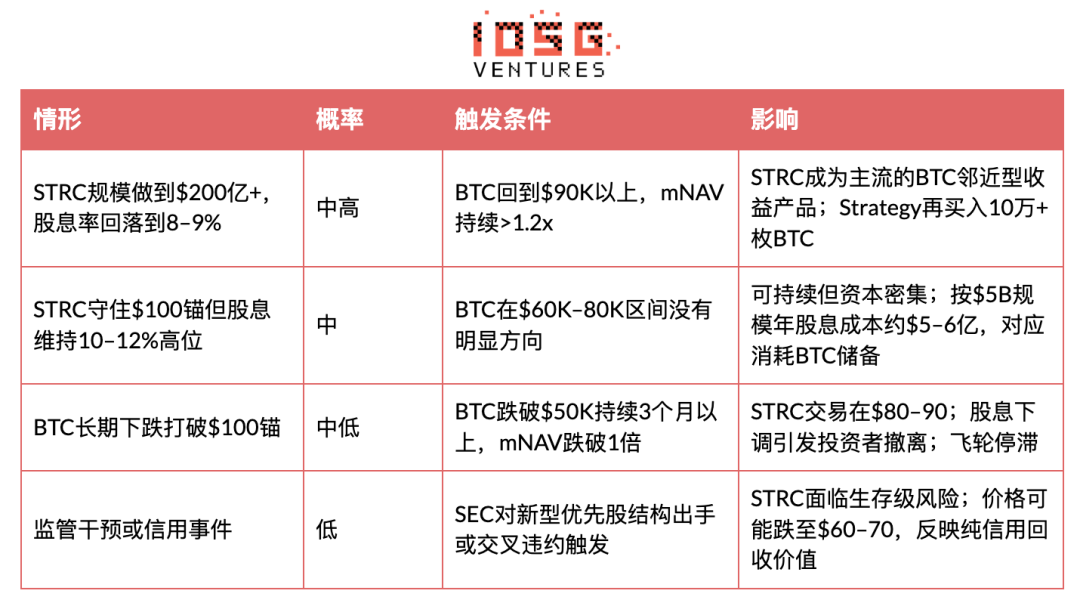
Bottom line: STRC is a genuinely novel financial instrument that performs exceptionally well in the environment for which it was designed—where BTC is steadily rising, capital markets are open, and mNAV > 1x. In this state, it offers an attractive 11.5% yield with manageable volatility. However, its downside structure is asymmetric: you earn coupon payments in good times but bear concentrated, single-asset BTC credit risk in bad times. It is not a substitute for Treasuries or diversified high-yield bonds, but rather a leveraged bet on the continued operation of the Strategy BTC accumulation flywheel—just packaged as fixed income.
Three new signals (as of April 2026)
Signal One: First suspension of dividend increase in April (as of April 1, 2026, CoinDesk).
After seven consecutive increases between August 2025 and March 2026 (raising the dividend rate from 9% to 11.5%), Saylor held the rate steady in April. Two interpretations: (a) demand has stabilized at this yield level—bullish; (b) the strategy has hit the yield sensitivity ceiling of traditional fixed-income buyers—bearish. This is the single most important signal to monitor in May–June and the turning point around which the mNAV trigger framework above is built.
Signal Two: For the week of April 6–12, MSTR’s ATM offering was $0, with all financing completed through STRC ($1.00B; MSTR 8-K, April 2026).
At the current BTC price level, mNAV has tightened to the point where Saylor is unwilling to risk diluting common shares by issuing more MSTR. The preconditions for phase three of the death spiral have been partially triggered—the flywheel is now running on one leg.
Signal Three: Last week's average BTC purchase price was $71,902 per coin, below Strategy's historical cost of $75,577 per coin (as of April 12, 2026, MSTR 8-K).
The strategy is DCAing into a weak market. The flywheel is still spinning, but each marginal purchase is thinning the asset buffer rather than thickening it—exactly the opposite of the accumulation dynamics seen in 2024–2025.
Investment advice
Hold, waiting for a better entry point and an upward move in BTC.
Current Status: Hold existing position; do not add to position until a stronger signal emerges. MSTR’s mNAV has compressed to around 1.0x. STRC remains at its $100 par value and continues to pay an 11.5% dividend, indicating the dividend mechanism is functioning as designed. However, the margin of safety is very narrow.
Rebuild position condition: BTC rises above $70–75K, and MSTR’s mNAV remains above 1.1x for two consecutive weeks. At that point, STRC will re-enter the conditional buy zone near its $100 face value. Historical data shows that buying below $95 followed by a BTC rebound has previously generated cumulative capital gains of 7–11% plus accrued coupons—but this only occurred when BTC rebounded within several weeks (August 2025, November 2025, February 2026). Whether the current pullback continues this pattern or signals a more prolonged bear market remains truly uncertain.
Exit Signal: Initiate a sell evaluation if any of the following occurs: (a) MSTR mNAV falls below 1.0x and remains below for more than two weeks; (b) STRC VWAP remains below $95 for four consecutive weeks; (c) BTC breaks below $55K on increased volume.
Sources
- Strategy.com — STRC Product Page https://www.strategy.com/stretch
- CoinDesk — "The Genius and the Danger of STRC" https://www.coindesk.com/business/2026/03/22/the-genius-and-the-danger-of-strc-how-strategy-s-new-funding-model-bends-so-it-doesn-t-break
- Crypto Narratives — "Understanding STRC: How Strategy Turns Yield Demand into BTC Buying" https://cryptonarratives.substack.com/p/understanding-strc-how-strategy-turns
- BitMEX Research — "A Bit of a Stretch" STRC Analysis https://www.bitmex.com/blog/a-bit-of-a-stretch
- AInvest — "STRC's Sharpe Ratio of 3.08: Real Alpha or Structural Illusion?" https://www.ainvest.com/news/strc-bitcoin-backed-preferred-equity-promises-11-5-yield-sharpe-ratio-3-08-real-alpha-structural-illusion-2603/
- Investopedia — "Meet Stretch: Michael Saylor’s New Tool" https://www.investopedia.com/meet-stretch-michael-saylor-s-new-tool-for-using-bitcoin-to-pay-a-big-dividend-here-s-what-to-know-11921210
- Blockonomi — "STRC Raises $1.18B in One Week" https://blockonomi.com/strategys-strc-raises-1-18b-in-one-week-buying-seven-times-bitcoins-weekly-mined-supply/
- Seeking Alpha — "STRK: The Most Undervalued Bitcoin Security" https://seekingalpha.com/article/4885379-strk-the-most-undervalued-and-versatile-bitcoin-security-today
- CryptoTimes — "Strategy's Bitcoin Empire: How Preferred Perpetuals Are Redefining Corporate Finance" https://www.cryptotimes.io/2026/03/21/strategy-inc-s-bitcoin-empire-how-preferred-perpetuals-strc-strk-strf-strd-are-redefining-corporate-finance/
- Benzinga — "Saylor: STRC Achieved Better Risk-Adjusted Returns Than NVDA, TSLA" https://cdn2.benzinga.com/crypto/cryptocurrency/26/03/51195736/michael-saylor-strc-stock-achieved-better-risk-adjusted-returns-than-nvidia-tesla
Part Four Appendix
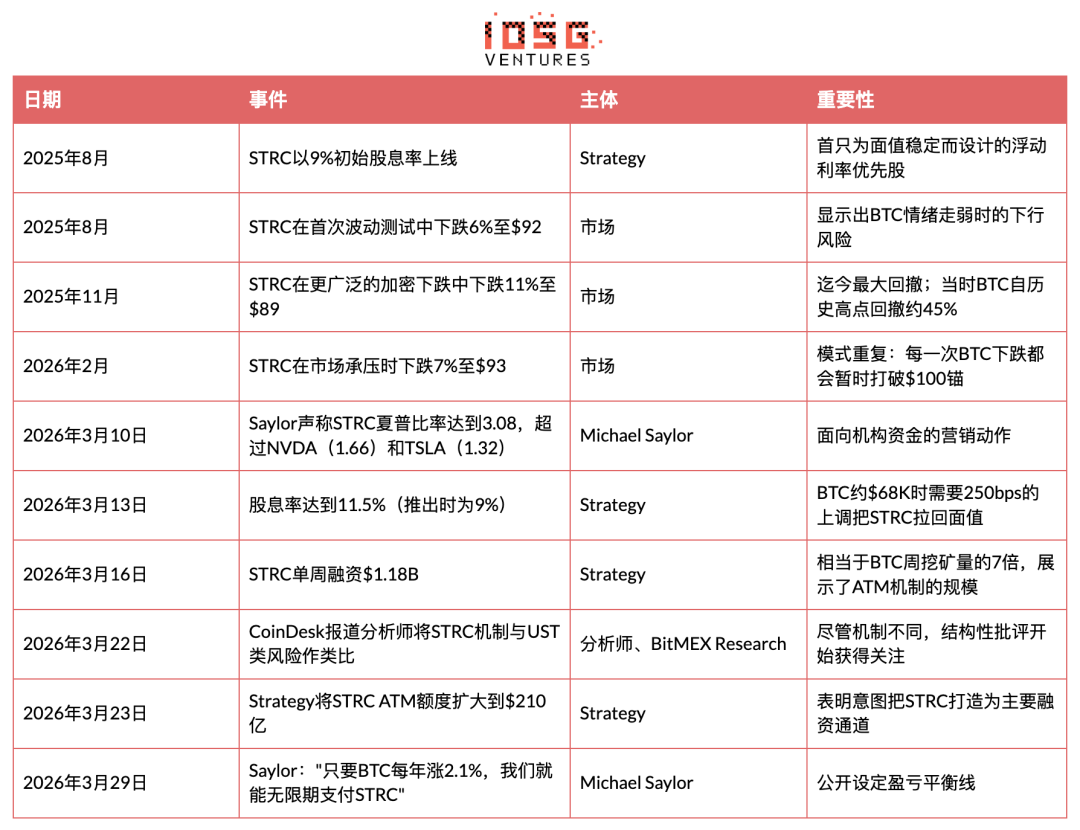
Timeline
Concentration of holdings—who can forcibly break the price?
Strive’s $50M purchase was mentioned, but there was no discussion of whether STRC has a few large institutional holders—who, if they all exited simultaneously, could overwhelm the daily average volume of $258M and drive STRC below par through a self-fulfilling collapse. This is the “bank run” risk.