





Author: Alex Xu
BTC was my largest asset allocation for most of the past few years (it is no longer).
During this BTC bull market cycle:
At 70,000, I removed the small leverage I added during the deep bear market (approximately 1.1x to 1.2x, achieved through BTC collateralized borrowing);
Between 100,000 and 120,000, I reduced my BTC position from full exposure to around 30%.
There were also some minor adjustments, such as slightly increasing positions when BTC retraced to above $50,000 in 2024 and again when BTC dipped to $60,000 in February this year—these moves were all based on a long-term bullish outlook for BTC.
According to historical cyclical patterns, now is a good time to accumulate more BTC and wait for the next bull market cycle. However, during BTC’s recent rebound, I further reduced my already low 30% BTC position at the 78,000–79,000 range.
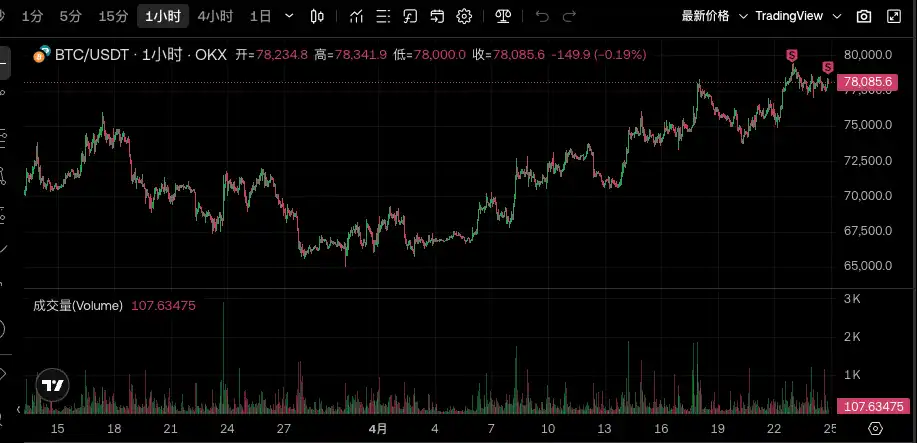
It is essential to continuously monitor your held assets and regularly conduct fundamental check-ups. Reducing my BTC position was an action taken after ongoing evaluation and careful consideration, leading me to lower my expectations for BTC’s market cap peak in the next bull cycle.
Review the reasons:
First, the potential energy driving the next surge in BTC is not as strong as in previous cycles.
In previous cycles, BTC was expected to experience exponential growth in its investor base, evolving from a niche geeky financial experiment to a mainstream and institutional asset allocation. This narrative has gradually been realized in each prior cycle.
In this cycle, from 2023 to 2025, it entered the portfolios of mainstream financial institutions through the listing of compliant ETF products and received strong support from Trafi financial institutions led by BlackRock, along with vigorous endorsement from the president of the world’s largest country. To elevate the narrative to the next level, its next phase will need to at least enter the balance sheets of leading sovereign nations, such as:
More sovereign funds (currently primarily Abu Dhabi)
Central bank reserves
The government's fiscal reserves alone (such as state treasuries in the U.S.) may be insufficient, as the purchasing power they can provide is relatively small compared to traditional financial institutions.
But in my view, achieving this leap within the next 2-3 years is still quite difficult. Originally, during this bull market, many expected Bitcoin to be adopted by the U.S. Federal Reserve, but that hope was largely disproven last year.
Currently, very few U.S. states have even passed Bitcoin reserve bills. At the peak in early 2025, more than twenty states were advancing Bitcoin reserve legislation, but now only a small number have ultimately passed such bills, and some of these are only “partial” reserve bills requiring separate proposals and approvals for their purchasing budgets.
Central banks in major countries still show no clear interest in BTC, as its short consensus history, high volatility, and the presence of gold as a competitor make it difficult for BTC to enter central bank balance sheets.
Second, it is the increase in my personal opportunity cost.
Over the past several months, I've gradually identified several strong companies whose current prices are quite attractive—they will be the main focus of my portfolio rebalancing (with another part dedicated to increasing cash reserves).
Third, the overall downturn in the crypto industry has had a negative impact on demand and consensus for Bitcoin.
Currently, there are very few viable business models in the crypto industry; most Web3 models (socialfi, gamefi, depin, decentralized storage/computing, etc.) have been gradually disproven over time. In fact, the only model that consistently generates positive cash flow and creates profit is DeFi. However, DeFi as a whole has also grown modestly in the latter half of this cycle, largely due to the contraction of native high-quality assets in the industry, which has led to a decline in DeFi activities (still primarily centered around lending and DEX trading).
The shrinking base of the entire crypto industry, along with a decline in practitioners and investors, will also lead to a slowdown or even a loss in the base of BTC holders.
Hyperliquid stands out as an on-chain exchange experiencing growth against the market trend. However, much of its success stems from capturing a share of CEX users' existing market share and later expanding into round-the-clock trading of asset classes beyond crypto—such as commodities, U.S. stocks, and pre-IPO assets—while contributing relatively little to BTC's value flow. Hyperliquid, reliant on regulatory arbitrage and operating as a lone outlier, struggles to hedge against industry-wide structural decline (a similar dynamic applies to prediction markets).
Fourth, the financing cost for Strategy, the largest buyer of BTC, continues to rise.
Its primary financing method currently involves issuing perpetual preferred shares (STRC), with the financing rate having risen to 11.5%, and it is about to switch from monthly to biweekly interest payments to prevent the STRC market price from collapsing. This gives me a negative impression, even though Strategy’s current financial condition is still very far from any kind of default.
In addition, we can see that among the once highly active BTC DAT stocks, all except Strategy have essentially died out, leaving it alone. Strategy does not need to experience an actual scandal to exert downward pressure on BTC prices; as the largest listed holder and net buyer of BTC, a slowdown in its buying pace and the depletion of its funding capacity alone can trigger significant marginal selling pressure.
Fifth, gold, Bitcoin’s primary competitor in the non-sovereign asset space (value proposition: hedge against fiat inflation), has narrowed the product gap with Bitcoin.
We previously said that Bitcoin, as "electronic gold," is superior to gold because it offers better divisibility, portability, and verifiability, plus decentralization.
But this cycle has introduced the product of tokenized gold, which is identical to Bitcoin in verifiability, portability, and divisibility, and its scale is growing rapidly.
(Reference: rwa.xyz's statistics on tokenized commodity assets, most of which are tokenized gold)
Of course, many people say that tokenized gold relies on centralized credit, but in my view, whether or not something relies on centralized credit is not a necessary condition in the crypto industry, since one of the core infrastructures of the entire crypto industry—stablecoins—is largely based on fully centralized credit.
Sixth, as Bitcoin undergoes halving, the issue of insufficient security budget is becoming increasingly severe.
(The exploration of new fee sources such as inscriptions and BTC L2 has largely failed.) This is a well-worn topic, but it remains an issue. In contrast, I don’t consider quantum computing to be a major threat, as the community already has solutions in place.
Summary and Self-Questioning
Of course, I still believe in BTC after reducing my position; otherwise, I would have closed it entirely. It remains one of my largest holdings, and I hope it continues to rise.
Other questions may include:
Why now?
Since it has rebounded significantly recently, let's reduce it.
What if it goes up after I sold?
If the aforementioned reasons for concern become less valid or no longer hold due to changes in external and internal conditions, or if new positive factors emerge that I hadn’t previously considered, and the price at that time is not expensive, I will repurchase.
If the price had already risen to a level where buying back was no longer reasonable, it means my understanding wasn’t aligned with the asset—accept the outcome.
This is just one person's opinion, for reference only.