





Author: Claude, Shenchao TechFlow
Deep潮 Summary: Intel's Q1 earnings significantly surpassed expectations, with revenue of $13.6 billion and an adjusted EPS of $0.29 (expected $0.01). The stock surged 24% in a single day to $82.57, marking its largest one-day gain since 1987 and surpassing its historical peak during the 2000 dot-com bubble.
Yet behind this frenzy, only 6 out of 34 Wall Street analysts have issued buy ratings, with the median consensus target price at approximately $55—over 30% below the current stock price. Is Intel’s 250% surge in one year a genuine turnaround in the AI era, or merely a faith-based trade priced far above its fundamentals?
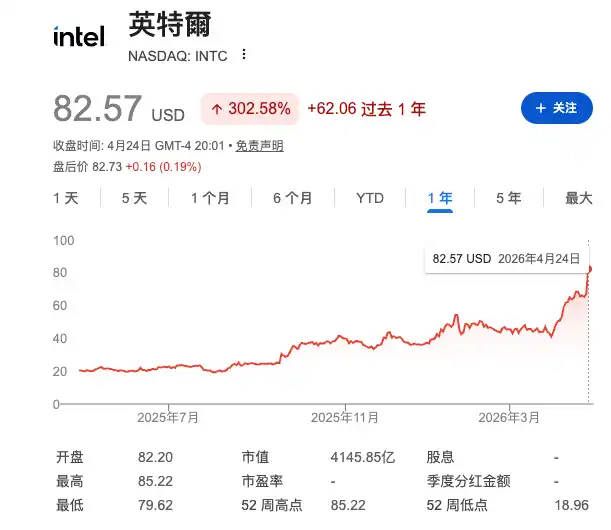
Intel delivered the most dramatic earnings report in the U.S. stock market since the start of 2026.
On Friday, April 24, Intel rose approximately 24% to $82.57, marking its largest single-day gain since 1987 and officially surpassing its historical high from the 2000 dot-com bubble. This represents a cumulative gain of over 250% since its 52-week low of $18.25 in September 2024. On the same day, the Philadelphia Semiconductor Index recorded its 18th consecutive daily gain, AMD surged about 14%, and NVIDIA closed up 4.3%, with its market capitalization reclaiming the $5 trillion mark.
However, the gap between the extreme market enthusiasm and Wall Street's consensus is also worth noting.
Of the 34 analysts covering Intel, only 6 have issued a buy rating, 24 maintain a hold, and 4 still recommend selling. The median consensus target price is approximately $55, suggesting that most analysts believe the stock should be more than 30% lower than its current price.
Q1 Dominant Performance: Revenue beat by nearly 10%, EPS guidance was $0.01, actual came in at $0.29
According to CNBC, Intel's Q1 revenue was $13.58 billion, surpassing Wall Street's expectation of $12.42 billion by approximately 9.4%. Adjusted earnings per share came in at $0.29, far exceeding the consensus estimate of just $0.01 (some sources report $0.02), a difference of nearly 30 times. This marks Intel’s sixth consecutive quarter of beating expectations.
By business segment, the data center and AI divisions were the largest growth drivers, generating $5.1 billion in revenue, a 22% year-over-year increase, surpassing the expected $4.41 billion. Client computing revenue (PC chips) reached $7.7 billion, above the expected $7.1 billion. Non-GAAP gross margin expanded to 41% from 39.2% in the same period last year.
Q2 guidance also significantly exceeded expectations: revenue guidance of $13.8 billion to $14.8 billion (midpoint of $14.3 billion), compared to Wall Street expectations of $13.07 billion; adjusted EPS guidance of $0.20, compared to expectations of $0.09 to $0.10.
Intel CEO Lip-Bu Tan stated during the earnings call: "CPU is reasserting its role as an indispensable foundation in the AI era." His core argument is that AI is shifting from the stage of foundational model training toward inference and agentic applications, a transition that significantly increases demand for CPUs and semiconductor manufacturing, rather than relying solely on GPUs.
Benchmark/StoneX semiconductor senior analyst Cody Acree posed a sharp question in an interview with Sherwood News: If this upside potential is possible, why did the guidance for Q4 remain so conservative? He noted that Intel had explicitly stated during its Q4 earnings call that wafer supply was "tight," a comment that triggered a 17% single-day stock plunge.
Three major customer verifications implemented simultaneously: Terafab, Google, and Irish wafer fab repurchase.
Beyond Q1's financial figures, what truly ignited market sentiment was the nearly simultaneous execution of three strategic deals.
On April 7, Intel announced its participation in Musk’s Terafab project as a primary foundry partner in the chip manufacturing joint venture involving SpaceX, xAI, and Tesla. According to TechCrunch, Intel posted on X that its capabilities in designing, manufacturing, and packaging ultra-high-performance chips will help Terafab achieve its goal of 1 terawatt of computational capacity per year. Musk confirmed on Tesla’s Q1 earnings call that Tesla plans to use Intel’s next-generation 14A process for chip manufacturing, adding, “By the time Terafab scales up, 14A should be quite mature.”
This is Intel’s first major external client after years of waiting for its foundry business. Previously, Intel had been the sole major customer for its own 18A process; despite this technology being on par with TSMC’s 2-nanometer node, external customers have remained cautious.
Meanwhile, Intel and Google announced a multi-year partnership, with Google committing to deploy Intel’s latest Xeon 6 processors in its cloud infrastructure for AI inference and other workloads. Additionally, Intel repurchased a 49% stake in its Fab 34 wafer fabrication facility in Ireland from Apollo for $14.2 billion (having sold it for $11.2 billion in 2024), regaining full ownership. According to SEC filings, the repurchase was funded by cash reserves and a $6.5 billion bridge loan.
Analysts are divided: Roth targets $100, BofA maintains "Sell"
The rating changes following the earnings release showed a rare polarization.
Among the bullish camp, Roth Capital upgraded Intel from Neutral to Buy, doubling its price target from $50 to $100, citing strong confidence in CEO Pat Gelsinger’s execution in improving manufacturing efficiency and CPU products. HSBC analyst Frank Lee upgraded to Buy ahead of earnings (April 21), raising the price target significantly from $50 to $95, making it the highest target on Wall Street at the time. Lee’s core thesis was not centered on contract manufacturing, but rather on the underappreciated growth potential in server CPUs: he expects Intel’s server CPU shipments to grow approximately 20% year-over-year in both 2026 and 2027, with average selling prices rising by around 20% over the same period. Citi and Evercore ISI also raised their ratings to buy-equivalent following the earnings report.
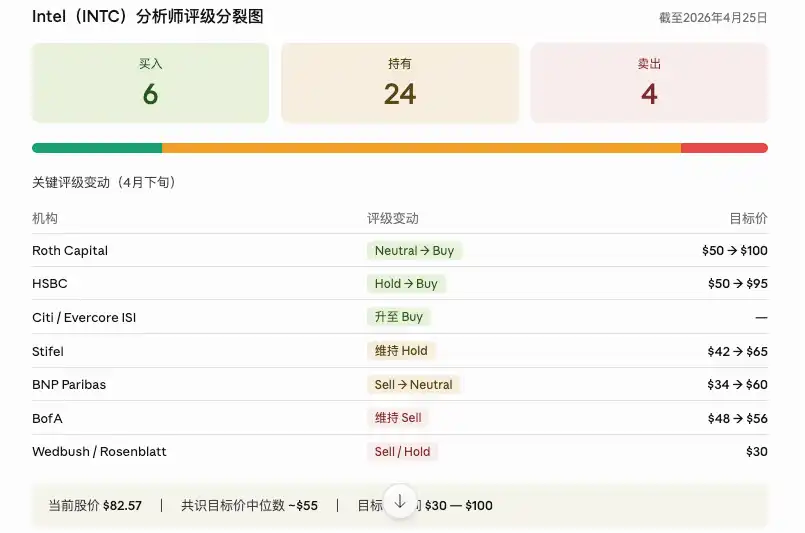
The bearish camp remains equally resolute. According to TheStreet, Bank of America analyst Vivek Arya maintained an Underperform (Sell) rating, despite raising the target price from $48 to $56, as he believes Intel’s recovery is already fully priced in. He noted that Intel’s gross margins remain below industry peers, the company continues to burn cash, yields for its 18A product are still low, and Intel Foundry still needs to prove itself to external customers. Bank of America forecasts Intel’s sales CAGR from 2025 to 2028 at 10%-15%, significantly lower than the industry’s 30%-40%. Wedbush and Rosenblatt have even lower target prices of $30, implying over 60% downside from current levels.
Overall, according to Benzinga data, among 34 covering analysts, only 6 have a Buy rating, 24 have a Hold rating, and 4 have a Sell rating. The median consensus target price is approximately $55, with a range from $30 to $100. The current stock price of $82.57 significantly exceeds the majority of target price ceilings.
117x Forward P/E: The Valuation Cost of a Turnaround Story
The core of this split lies in valuation.
Intel’s current forward P/E ratio is approximately 117 to 150 (varying by data source), while its five-year median P/E is only 12. On a GAAP basis, Intel has remained unprofitable over the past 12 months (TTM EPS of -$0.06), and its market cap of approximately $35.5 billion is already 6.4 times its revenue. GuruFocus’s GF Value estimates Intel’s fair value at just $27, suggesting the current stock price is overvalued by more than 200%.
From another perspective, Intel has risen over 105% year-to-date and approximately 284% over the past 12 months. On April 24, its single-day trading volume reached 264 million shares, about 1.5 times the three-month average. Market enthusiasm for this stock has far exceeded what its current fundamentals can justify.
The bearish counterargument is equally compelling: Intel’s 18A process has yet to resolve its yield issues, and the 14A process remains “not fully ready” (in Elon Musk’s own words); the foundry business has yet to generate meaningful revenue from external customers, and the company’s free cash flow remains negative.
The semiconductor industry is inherently highly cyclical, and it remains uncertain how long the current surge in AI demand will last. Paying a forward P/E ratio of nearly 150 for a company that is still burning cash leaves almost no margin for error.
This may be the fundamental reason why only 6 out of 34 analysts dare to go long: Intel’s turnaround story is compelling enough, but the price paid for this narrative is already alarming.