





Author | Asher (@Asher_0210)

On May 2, Hyperliquid launched HIP-4 Outcome Markets on mainnet, officially introducing outcome markets to its on-chain trading system. The initial offerings are intraday binary outcome contracts for BTC, allowing users to trade on whether BTC’s price will be above a specified level at a given time. Contract prices fluctuate between 0.001 and 0.999, reflecting the market’s pricing of the event’s probability; upon settlement, the contract pays out 1 if the event occurs and 0 if it does not. Contracts are fully collateralized in USDH, with no fees to open positions.
This is not a simple product expansion. In the past, Polymarket functioned more like an information market centered around events, where users entered specific markets—driven by elections, sports, geopolitical conflicts, or crypto trends—to express their judgment of outcomes through pricing; Kalshi, on the other hand, has sought to place event contracts within a clearer regulatory framework.
Hyperliquid takes a different approach. Instead of first building a standalone prediction market and then attracting users to migrate funds, it starts directly from its most familiar trading context—integrating outcome contracts alongside perpetual and spot trading in the same environment. For Hyperliquid, prediction markets are not just about betting on outcomes, but serve as a new tool for traders to express directional views, manage risk, and build strategies.
BTC won its first intraday market battle, with first-day data exceeding expectations
The first market for HIP-4 is a daily settlement market for BTC price performance. This choice is inherently “Hyperliquid”—rather than focusing on political, sports, or entertainment events, it begins with the BTC price volatility most familiar to crypto traders.
On its first day of launch, HIP-4 delivered strong numbers. According to Predictefy, on the first day of the Hyperliquid launch event, trading volume for BTC price-related event contracts reached $6.15 million, far surpassing similar markets on Kalshi, Polymarket, and other prediction markets. In other words, in this specific segment of BTC price-related event contracts, Hyperliquid ranked among the absolute leaders on its first day.
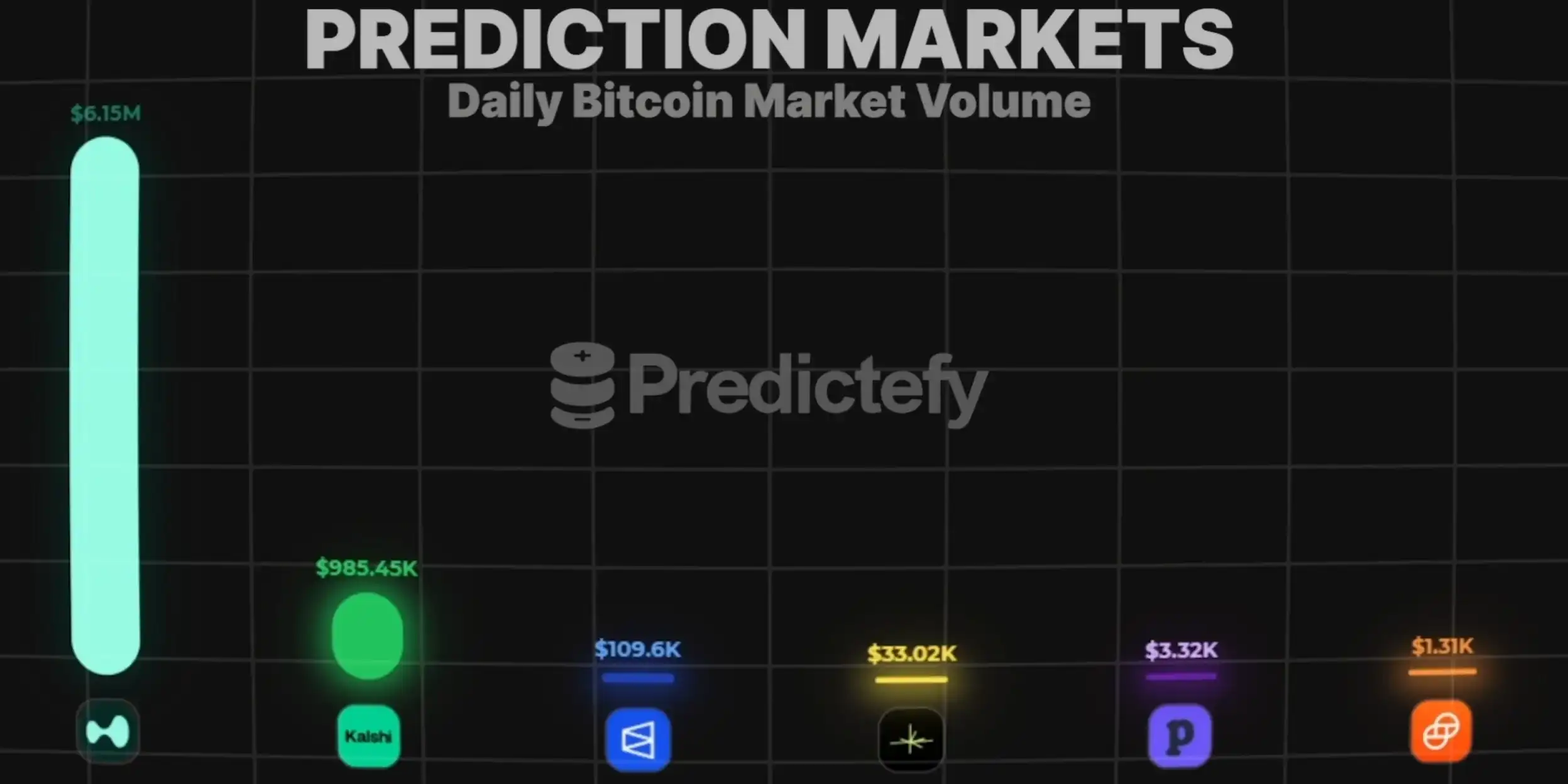
Data source: Predictefy
Additionally, on its first day of launch, HIP-4 generated over $12,000 in total trading fees, more than 54,000 trades, and involved over 3,000 participants. For a newly launched HIP-4 event related to a prediction market, these figures are already impressive—achieved not by launching a wide variety of event types, but by successfully bootstrapping within a single BTC intraday market, making HIP-4’s first step all the more meaningful.
Why isn't HIP-4 simply derived from HIP-3?
Hyperliquid previously supported builders deploying perpetual markets through HIP-3. So the question arises: if perpetual markets can already be deployed, why was HIP-4 specifically designed? The answer lies in the fundamentally different settlement logic of result contracts.
Perpetual contracts require continuous pricing, and oracle prices can be adjusted incrementally; however, binary outcome contracts can only settle to either 0 or 1. If an oracle mechanism unsuitable for binary contracts is used, it may leave a prolonged mispricing window even after the event outcome has been determined, creating nearly risk-free arbitrage opportunities.
Therefore, HIP-4 is designed as a standalone result market primitive. It is not a rebranded perpetual contract, but rather a contract type specifically built for expiration, settlement, dispute resolution, and Oracle result confirmation. For ordinary users, prediction markets may simply appear as buying Yes or No; however, for the underlying trading system, the real challenges lie in how events are defined, who confirms them, when settlement occurs, how disputes are handled, and how incorrect results are corrected and penalized. The core of prediction markets is not just the frontend interface and trading entry points, but the settlement mechanism itself.
Hyperliquid, Polymarket, and Kalshi each have their own battlegrounds.
When viewed together, HIP-4 on Hyperliquid, Polymarket, and Kalshi represent three distinct directions in prediction markets:
- Polymarket’s core strengths are event richness and user mindset: it excels at transforming complex events into tradable questions, combining public interest, media coverage, and market probabilities. Political elections, geopolitical conflicts, celebrity incidents, sporting events, and cryptocurrency project milestones can all be rapidly turned into markets.
- Kalshi’s advantage lies in its compliance pathway: it positions itself closer to event contract platforms within the traditional financial context, targeting users and regulatory frameworks that differ from those of Polymarket and Hyperliquid. Recent debates in the U.S. over regulatory authority for prediction markets, including conflicts between the CFTC and state regulators, demonstrate that event contracts are no longer niche products but have entered the core of financial regulatory discussions.
- Hyperliquid’s advantages lie in trading experience and capital efficiency: Hyperliquid has its own L1, HyperCore matching engine, on-chain order book, and spot and perpetual infrastructure. According to official documentation, HyperCore features fully on-chain perpetual and spot order books, with orders, cancellations, trades, and liquidations executed transparently and capable of handling 200k orders per second.
Therefore, Hyperliquid may not necessarily attract all of Polymarket’s users in the short term. A casual user interested in the U.S. election, sports events, or entertainment gossip is unlikely to enter Hyperliquid’s trading interface just to buy an event contract. However, a trader already active on Hyperliquid trading BTC, ETH, gold, oil, or stock perpetuals may naturally incorporate BTC intraday outcome contracts into their portfolio.
HYPE could become the value capturer in this competition
HIP-4 is significant for Hyperliquid not just because it introduces a new trading scenario, but because it further integrates prediction markets with HYPE staking, fee structures, and buyback mechanisms. Under HIP-4’s design, the first phase will involve validators deploying standardized markets, while the second phase will open up permissionless deployment. In the future, market creators wishing to launch their own prediction markets will need to stake 1 million HYPE. Each staking slot can support both rolling and periodic markets and can be reused after settlement; however, staked assets may be slashed in cases of oracle manipulation, abnormal market conditions, or prolonged downtime.
This threshold is significantly higher than HIP-3’s 500,000 HYPE. The reason is straightforward: outcome markets rely more heavily on event definitions and Oracle settlements than perpetual markets. While perpetual market prices can be continuously adjusted, outcome markets ultimately only have two possible results: 0 and 1. An incorrect settlement doesn’t just affect the trading experience of a single market—it undermines the credibility of the entire prediction market system.
For HYPE, HIP-4 introduces two layers of incremental demand. First, staking demand. More Builders seeking to deploy outcome markets will need to lock up additional HYPE, especially as categories such as sports, macroeconomics, politics, crypto events, and entertainment gradually open up—making access to high-quality market creation a potentially high-barrier privilege. Second, fee and buyback mechanics. Hyperliquid already possesses strong trading volume and fee capture capabilities, with the majority of protocol fees used to repurchase HYPE. If HIP-4 drives new trading volume, outcome markets will not merely be an added feature, but become part of a growth flywheel for fees and HYPE buybacks.
This is also a key difference between Hyperliquid and Polymarket and Kalshi. The growth of Polymarket and Kalshi is primarily reflected in increased platform trading volume, market share, and brand influence; whereas Hyperliquid’s growth more directly translates into demand for and value capture by HYPE.
The market is optimistic, but HIP-4 still needs to prove itself.
Market feedback on HIP-4 has been optimistic, and the reasons are straightforward. Hyperliquid already has a mature trading infrastructure, an active user base, and a clear HYPE value capture mechanism. Entering the prediction market, it does not need to rebuild its matching system or start from scratch to find its first traders.
However, HIP-4 is still in a very early stage. The current market remains focused on BTC price outcomes; whether it can expand to additional categories such as sports, politics, macroeconomic events, crypto events, and entertainment will depend on the successful progression of the second-phase permissionless deployment. Meanwhile, outcome markets demand higher standards from oracles and settlement mechanisms—event definitions, data source selection, dispute resolution, and incorrect settlements all directly impact market trust.
Therefore, the significance of HIP-4 is not that Hyperliquid has already won the prediction market, but that it offers a new competitive direction for this space. Polymarket has demonstrated that events can become information markets, Kalshi represents the path of compliant event contracts, and Hyperliquid aims to prove that event contracts can also become part of an on-chain trading system.
If past competition in prediction markets was about who could capture more trending events and attract more users to place bets, then after HIP-4, competition has added another dimension: who can truly integrate event outcomes into traders' funds, positions, and strategies.
This also means that Polymarket’s competitors are no longer just Kalshi. With Hyperliquid entering the space, the next phase of prediction markets may not just be competition between event markets, but rather competition in trading systems, liquidity, and asset pricing capabilities.